

Last Updated: June 2026
A home health agency is worth between 4x and 8x EBITDA. The spread is the widest in healthcare M&A. It is driven by Medicare dependency, geographic coverage, and regulatory risk. A well-run agency with diversified payer mix and clean survey history can command 7x–8x. A Medicare-heavy operation with accreditation gaps may struggle to clear 4x–5x.
Private equity has been the dominant acquirer in home health for the past decade. Strategic buyers, regional home health systems, hospice operators, and hospital networks, remain active too. PE interest has kept multiples elevated. But the spread between the best and worst transactions has never been wider. The Patient-Driven Groupings Model (PDGM) compressed margins for poorly managed agencies. Sellers who expected pre-PDGM multiples are facing a valuation gap. Sofer Advisors helps owners and their advisors work through exactly these questions and turn the analysis into a defensible business valuation they can act on.
The following takeaways summarize the key valuation and transaction factors covered in this guide.
Key Takeaways
- Home Health EBITDA Multiples – Home health EBITDA multiples range from 4x to 8x, with Medicare-heavy agencies clustering at the lower end.
- PDGM Reimbursement Risk Now – PDGM reimbursement risk is now a standard valuation haircut – buyers model it explicitly in their financial diligence.
- CON States Restrict New – CON states restrict new market entry and can add 1x–2x to multiples in competitive markets.
- Joint Commission CHAP Accreditation – Joint Commission or CHAP accreditation protects Medicare billing privileges – and transferability.
- Staffing Concentration Small Number – Staffing concentration in a small number of aides is the most common reason agencies trade at a discount.
- Home Health Agency 500K – A home health agency with $500K in revenue and 15%+ EBITDA margin is worth roughly $300K–$600K on a normalized earnings basis.
Each of these factors is examined in depth in the sections that follow.
What EBITDA Multiples Do Home Health Agencies Trade At?
The short answer is 4x–8x EBITDA. Most middle-market agencies ($3M–$20M in revenue) clear 5x–7x when the fundamentals are clean.
| Agency Profile | EBITDA Multiple Range | Key Driver |
|---|---|---|
| Medicare-only, single-county | 4.0x – 5.0x | Concentration risk, PDGM exposure |
| Medicare/Medicaid mix, multi-county | 5.0x – 6.5x | Geographic spread, lower per-episode risk |
| Diversified (Medicare + private pay + VA) | 6.0x – 7.5x | Payer diversification, margin stability |
| CON-state agency with exclusive territory | 6.5x – 8.0x | Regulatory moat, barrier to entry |
| High-acuity specialty (wound care, IV therapy) | 7.0x – 8.5x | Clinical differentiation, physician referral base |
These multiples apply to normalized EBITDA. Buyers adjust for above-market owner pay, one-time expenses, and COVID-era cost distortions before applying their multiple. An agency showing $400K in EBITDA may yield a different normalized figure after a quality of earnings review.
Revenue multiples are less common but do appear in smaller transactions. Agencies trading on revenue land at 0.4x–1.2x. The upper end is reserved for high-margin, accredited agencies in CON states. For a $500K revenue agency, that is roughly $200K–$600K, consistent with earnings-based analysis.
PE firms active in this space have become more disciplined about PDGM-adjusted cash flow. They no longer buy on pre-PDGM EBITDA without a haircut. Sellers who haven’t recalibrated their expectations will face a gap in negotiations.
A market multiple is a starting point, not a conclusion of value. A defensible fair market value still rests on the factors the IRS sets out for valuing closely held businesses under Revenue Ruling 59-60.
How Does Medicare vs. Private Pay Mix Affect Value?
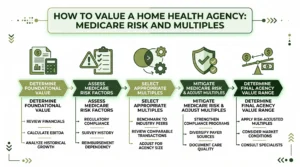
Payer mix is the most scrutinized variable in home health valuation. Medicare reimburses on a 30-day episodic basis under PDGM. Private pay and Medicaid waiver programs typically reimburse per visit. The distinction matters because per-episode billing creates revenue predictability. But it also creates concentration risk if Medicare makes up 70%+ of total revenue.
Buyers apply a risk premium to agencies where Medicare represents more than 65%–70% of total revenue. Medicare reimbursement is subject to regulatory change at the federal level, OIG scrutiny, and utilization review. A single MAC audit finding can result in repayment demands, prepayment review, or program exclusion. Buyers price that tail risk into the multiple.
Private pay is the most valued payer in home health. Margins are typically 25%–35% on private pay versus 12%–18% on Medicare after clinical costs. An agency with 40% private pay, 40% Medicare, and 20% Medicaid waiver will consistently trade at a premium to a pure-play Medicare agency of the same size.
VA Community Care Network contracts have become valuable as an alternative to Medicare. These contracts are competitively awarded and not easily replicated. That makes them a quality indicator for buyers.
Georgia’s NOW/COMP Medicaid waiver programs reimburse for home-based support services for individuals with developmental disabilities. Buyers familiar with Georgia’s waiver landscape treat this revenue as relatively stable but lower-margin than Medicare skilled care.
What Is PDGM and Why Does It Affect Valuation?
The Patient-Driven Groupings Model (PDGM) took effect in January 2020. It changed Medicare home health reimbursement from 60-day episodes to 30-day periods. Payment for each period depends on clinical grouping, functional impairment level, comorbidity adjustment, and admission source. High-utilization agencies that previously generated revenue through therapy visit volume saw significant margin compression.
From a valuation standpoint, PDGM introduced two permanent changes buyers now model.
First, agencies that haven’t optimized PDGM documentation are leaving money on the table. Buyers who identify documentation gaps in diligence will haircut the EBITDA. They assume they’ll need to invest in clinical compliance infrastructure post-close.
Second, PDGM behavioral assumptions created permanent payment reductions for some agency profiles. Buyers now benchmark an agency’s PDGM performance against peer group data from NAHC. Agencies performing below peer benchmarks on PDGM capture rate face a valuation discount.
The practical implication: sellers should document their PDGM optimization history before going to market. That includes coding accuracy rates, OASIS accuracy, and LUPA (Low Utilization Payment Adjustment) rates. LUPA rates above 10% are a yellow flag. Above 15% is a red flag in diligence.
How Do CON States Affect Home Health Agency Value?
Certificate of Need laws restrict new healthcare services, including home health agencies, in roughly 35 states. Georgia is a CON state for home health. A competitor cannot open a new Medicare-certified home health agency in your service territory without obtaining a CON from the Georgia Department of Community Health.
For sellers, CON status creates a valuation floor. A buyer isn’t just acquiring cash flow, they’re acquiring a regulatory moat. The CON itself has market value independent of the operating business. This is especially true in high-density markets like metro Atlanta, Savannah, or Augusta.
In competitive CON markets, acquirers routinely pay 1x–2x more on EBITDA than they would for a comparable non-CON state agency. The premium reflects the cost and uncertainty of obtaining a new CON, which can take 12–24 months and face competitor challenges, versus acquiring an existing license.
CON transferability is a separate issue. Most state programs allow CON transfer with the business. But the process involves regulatory notification and, in some states, approval. Georgia’s CON transfer process is straightforward but requires advance planning. Buyers will conduct CON transfer diligence as part of regulatory review.
David Hern CPA ABV ASA, founder of Sofer Advisors, brings a Heart of a Teacher to every engagement – translating complex valuation methodology into clear, actionable guidance that clients can act on before and after the report is delivered. With 15+ years of valuation experience, 11+ expert witness cases across multiple jurisdictions, and 180+ five-star Google reviews, David built Sofer Advisors into an Inc. 5000-recognized firm. The Sofer Difference is a four-phase process of Discovery, Diligence, Analysis, and Delivery that ensures every conclusion is defensible, documented, and tied to the specific facts of the business.
While national firms like Stout and Kroll serve large enterprise clients, Sofer Advisors specializes in middle-market businesses that require personalized attention, direct access to credentialed professionals, and a next business day response policy.
What Do Buyers Look for in Home Health Agency Diligence?
Sophisticated buyers conduct detailed clinical and operational diligence beyond financial statement review. The categories that most often drive value adjustments include the following.
- Accreditation status. Joint Commission and CHAP accreditation allow agencies to skip the standard state survey process. Loss of accreditation can result in loss of Medicare billing privileges. Buyers confirm accreditation status, review the most recent survey report, and assess any open Plans of Correction.
- Staffing concentration. An agency where one or two high-volume aides generate 30%+ of billable visits has key-person risk. Post-close aide defection is a real risk. Buyers either require employment agreements for key clinical staff or haircut the multiple to reflect turnover probability.
- Geographic coverage and referral relationships. Buyers map referral concentration the same way they map customer concentration in non-healthcare businesses. If 40% of admissions come from a single hospital, that risk needs to be addressed in deal structure, earnout, escrow, or transition support.
- HHA license transferability. The home health agency license must transfer with the business or the buyer must obtain a new license. Buyers confirm license transferability early and structure deals contingent on regulatory approval.
How Much Is a $500,000 Revenue Home Health Agency Worth?
A home health agency generating $500,000 in annual revenue is a small operation. It’s likely serving 15–30 active patients, probably Medicare-certified, and operating with thin administrative infrastructure.
At a 15% EBITDA margin ($75,000), a 4x–6x multiple yields $300,000–$450,000 in enterprise value. At a 20% EBITDA margin ($100,000), a 5x–7x multiple yields $500,000–$700,000. The challenge at this size: many agencies have owner pay that’s well above market. The owner is also clinical director, billing manager, and scheduler. So normalized EBITDA after replacing owner functions is often lower than the income statement suggests.
Buyers at this size are typically individual operators, regional agency groups, or larger agencies adding patient census in a specific geography. Multiples at the sub-$1M revenue level are typically 4x–6x normalized EBITDA. Deals often include seller financing, earnouts, or employment transition agreements.
Sellers at this size should prepare normalized financials, clean OASIS and billing records for at least 24 months, and documentation of accreditation and CON status. A certified business valuation is the right starting point before any negotiation.
The questions below address the most common issues business owners raise before engaging a qualified appraiser for a home health agency valuation engagement.
Frequently Asked Questions
How much is a home health agency worth?
A home health agency is typically worth 4x–8x EBITDA. That depends on payer mix, accreditation, CON status, and staffing stability. Revenue multiples of 0.4x–1.2x apply in smaller transactions. A certified valuation is required to determine fair market value for any specific agency.
Is a home health agency a profitable business?
Yes, when managed well. Medicare-certified agencies typically generate 12%–18% EBITDA margins. Private-pay agencies can reach 25%–35%. Profitability depends heavily on aide utilization rates, PDGM billing accuracy, and overhead structure.
How does PDGM affect home health agency value?
PDGM changed Medicare reimbursement from 60-day episodes to 30-day periods. It also eliminated therapy visit-based payments. Agencies that haven’t optimized PDGM coding often have suppressed revenue. Buyers identify this in diligence and use it to negotiate price reductions.
What is the difference between CON and non-CON states for home health?
In CON states like Georgia, new Medicare-certified agencies require state approval before entering the market. This creates a barrier to entry that supports higher multiples, typically 1x–2x more than comparable non-CON state agencies. Buyers are also acquiring geographic exclusivity.
What accreditation does a home health agency need?
Medicare-certified agencies must pass a state survey or obtain accreditation from a CMS-approved body such as Joint Commission or CHAP. Accreditation grants deemed status, which is preferred by buyers because it reduces ongoing regulatory exposure.
What kills a home health agency deal?
Common deal killers include active Medicare audits or repayment demands, CON transfer complications, loss of accreditation, high LUPA rates, staffing concentration in one or two aides, and referral concentration in a single hospital or physician group.
How long does it take to sell a home health agency?
Marketing, due diligence, and regulatory approvals typically take 6–18 months. CON transfer and Medicare enrollment change-of-ownership (CHOW) filings can extend timelines in some states.
What is a typical EBITDA margin for a home health agency?
Medicare-certified agencies average 12%–18% EBITDA margins. Well-run agencies with strong payer mix and optimized PDGM coding can reach 20%–25%. Margins below 10% typically reflect underbilling or above-market owner pay.
Do PE firms buy small home health agencies?
Most PE firms target agencies with at least $2M–$3M in EBITDA for platform acquisitions. Smaller agencies are more often acquired by regional consolidators or as add-ons to PE-backed platforms. Valuation method is the same; deal structure differs.
How does staffing affect home health agency value?
Staffing is a major risk factor. High aide turnover or dependence on a few high-volume aides reduces value. Buyers typically require key employee agreements for critical clinical staff as a closing condition.
Related Case Studies
- Medical Practice Valuation Atlanta Healthcare Sale Transition Guide
- Healthcare Business Valuation Methods Guide Sofer Advisors
- Dental Practice Valuation Atlanta Owners Guide 2026
Executive Summary
- Home health EBITDA multiples range from 4x to 8x. The widest spread is driven by payer mix, CON status, and Medicare regulatory risk.
- PDGM has permanently changed the reimbursement calculus. Buyers conduct PDGM-specific diligence and will haircut agencies with poor documentation.
- CON states like Georgia create regulatory moats that support premium multiples – a meaningful advantage for sellers in protected markets.
- A $500K revenue agency with 15%–20% EBITDA margins is realistically worth $300K–$700K depending on normalized earnings and deal structure.
What Should You Do Next?
If you own or are considering acquiring a home health agency, start with a certified business valuation. It should account for PDGM-adjusted revenue, payer mix risk, and CON regulatory value. David Hern CPA ABV ASA, founder of Sofer Advisors, holds dual ASA and ABV credentials recognized by the IRS, SEC, and FINRA, with 15+ years of valuation experience and 180+ five-star Google reviews. Schedule a consultation to discuss your business valuation needs.
People Also Read
- Why You Must Start Planning Your Business Exit Now With The Right Valuation Expert
- What To Expect During A Business Valuation Step By Step Process
About the Author
This guide was prepared by David Hern CPA ABV ASA, founder of Sofer Advisors – a business valuation firm headquartered in Atlanta, GA serving clients across the United States. David holds dual accreditations as an Accredited Senior Appraiser (ASA) and is Accredited in Business Valuation (ABV), credentials recognized by the IRS, SEC, and FINRA. He also holds the Certified Exit Planning Advisor (CEPA) designation. With 15+ years of valuation experience, David has served as an expert witness in 11+ cases across multiple jurisdictions and built Sofer Advisors into an Inc. 5000-recognized firm with 180+ five-star Google reviews. The firm’s full W2 employee team maintains subscriptions to all major valuation databases and operates under a next business day response policy.
For professional business valuation services, visit soferadvisors.com/about-us/ or schedule a consultation at soferadvisors.com/contact-us/.
This content is for informational purposes only and does not constitute professional valuation advice. Business valuation conclusions depend on specific facts and circumstances. Contact Sofer Advisors for guidance regarding your specific situation.