


Last Updated: August 2026
A business with $5 million in sales is usually worth about $2.5 million to $10 million. The exact figure rests on profit, not revenue. At this size, buyers price the firm on a multiple of adjusted EBITDA. Per lower middle market deal data, firms with $10 million to $25 million in enterprise value sold near 6.4 times EBITDA in late 2025. Sofer Advisors values each company on its own numbers, not a rule of thumb.
Owners ask this before a sale, a partner buyout, or an estate filing. The honest answer starts with earnings, not the top line. A firm with wide margins and steady, repeat customers earns a higher multiple. One that leans on the owner or a few clients earns less. So the real price hinges on what sits beneath the sales.
Key Takeaways
- EBITDA drives value: At $5 million in sales, buyers price the firm on adjusted EBITDA, not revenue.
- A realistic range: Most firms this size sell for a few times earnings, often $2.5 million to $10 million.
- Add-backs matter: Normalized earnings remove owner perks and one-time costs. That lifts the base for value.
- Margin sets the spread: Two firms with $5 million in sales can be worth very different amounts.
- A wider buyer pool: A firm this size draws private equity and strategic buyers, not just individuals.
These points share one theme: value follows earning power, not the top line. The sections below show how appraisers turn $5 million in sales into a defensible number you can stand behind.
Why Is Revenue a Weak Value Anchor?
Revenue is a weak anchor because a buyer pays for profit, not sales. Two firms can both post $5 million in revenue. One keeps $400,000 in profit. The other keeps $1 million. The second is worth far more. Revenue shows how much money comes in. It says nothing about what stays after costs. Appraisers look past the top line to the cash the business truly produces.
That cash figure carries most of the weight in a valuation. A high sales number can hide thin margins, heavy debt, or bloated overhead. When an appraiser studies your books, the first job is to find real earnings. From there, the fair market value follows. What lies under the revenue decides the price, and the top line tells you little about it.
What Is a Realistic Value Range at $5M?
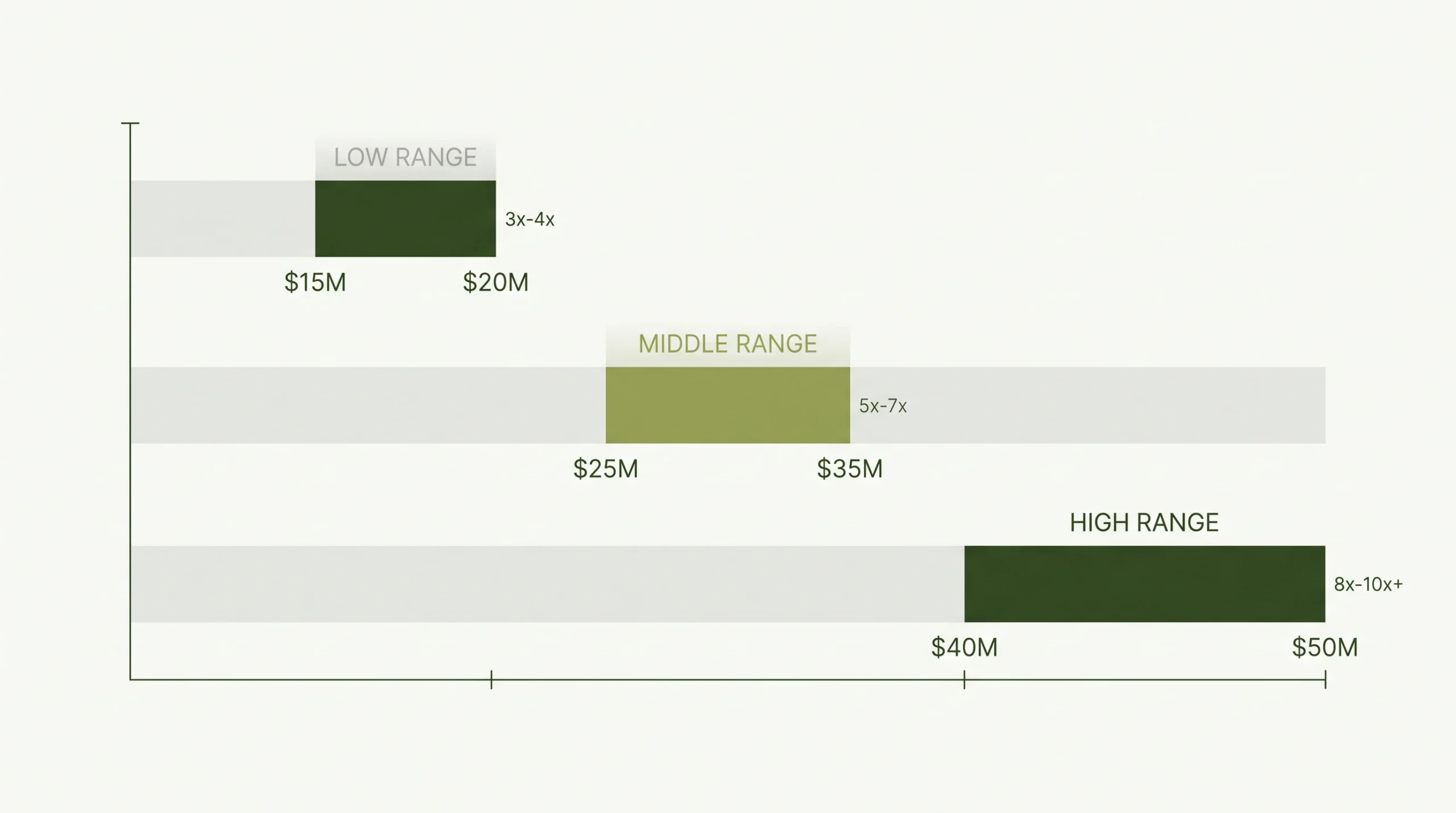
A realistic value range for a $5 million business is roughly $2.5 million to $10 million. The number rests on margin and risk. Say a service firm earns 12 percent, or $600,000 in EBITDA. A four times multiple puts its worth near $2.4 million. A high-margin firm earning $1.2 million may reach seven times. That lifts the figure toward $8 million or more. These are just examples, not a promise.
Wide as that spread sounds, it reflects real deal evidence. Margin, growth, and stability all pull the figure up or down. A firm with recurring revenue and low customer concentration sits near the top. One that leans on a single owner or a few accounts sits lower. This is why revenue alone is a poor guide. The same $5 million in sales can support a very different price, based on the earnings and risk behind it.
Why Does EBITDA Beat SDE Here?
At $5 million in sales, EBITDA usually beats SDE as the basis for value. A firm this size often runs with a management layer, not a single owner doing every job. EBITDA measures core operating profit without owner pay mixed in. That makes it the cleaner read once a company can run on its own. Seller’s Discretionary Earnings still fits the smallest, owner-run shops, but most $5 million firms have grown past that point.
| Basis | What it measures | Best suited to | Common range |
|---|---|---|---|
| EBITDA | Core operating profit | Manager-run firms at this size | 4x to 7x |
| SDE | Owner’s total yearly benefit | Small, owner-run shops | 2x to 4x |
| Revenue | Gross sales | Quick screen only | 0.5x to 3x |
Notice how far the revenue multiple can swing. That range is so wide because it ignores cost and risk. A profit multiple gives a tighter, more honest read. For a firm at this size, EBITDA is usually the right anchor, since the owner no longer touches every task. The adjusted EBITDA vs EBITDA split matters once a company grows large enough to draw bigger buyers.
How Do Owner Add-Backs Change Earnings?
Owner add-backs change earnings by restoring costs that are personal, not part of the business. This step is called normalization. Appraisers recast your profit to show what the firm really earns for any owner. The goal is a clean number a buyer can trust. Common add-backs include an above-market salary, a family member on payroll, and one-time legal fees. Each one raises the earnings base that the multiple is applied to.
Here are typical items that get added back:
- Owner pay above a fair market wage for the role
- Personal costs run through the business, such as a car or travel
- One-time expenses that will not repeat, like a lawsuit or a move
These adjustments often raise reported profit by a wide margin. A firm showing $700,000 in net income might reveal $1 million in true EBITDA once this step is done. At a five times multiple, that change can lift value by well over $1 million. Careful, well-documented add-backs are one of the biggest levers in any deal. This is the Heart of a Teacher approach the firm brings to every job: show the owner the math, not just the answer.
Who Buys a Business at This Size?
A $5 million business sits in the lower middle market, so its buyer pool is wide. Private equity firms, search funds, and strategic buyers all shop in this range. These buyers bring capital and deal skills that individual buyers lack. They also study earnings closely, since they price on profit and future cash flow. So a defensible EBITDA figure matters a great deal at this size.
This buyer pool also pays more for scale and stability. Per GF Data deal reports, average purchase price multiples in the middle market rose to 7.5 times adjusted EBITDA in the third quarter of 2025. Larger, steadier firms sit at the high end of that range. Smaller or owner-dependent firms sit lower. A well-run $5 million company that can operate without its founder is exactly what these buyers seek. So preparing the business to run on its own often lifts the final price.
How Do You Get a Defensible Number?
A defensible number comes from a certified appraiser who weighs three methods. The market approach compares your firm to similar businesses that recently sold. The income approach converts steady profit into value, often through the capitalization of earnings method. The asset approach totals what the business owns, less what it owes. A sound valuation weighs all three, then blends them into one figure that holds up for its purpose.
The work must follow recognized standards to survive review. IRS Revenue Ruling 59-60 directs appraisers to weigh eight factors, from earning capacity to industry outlook. AICPA SSVS and USPAP set the rules for how the report is built and documented. This is where The Sofer Difference shows: a four-phase process of Discovery, Diligence, Analysis, and Delivery that yields an audit-ready report. Large firms such as Alvarez and Marsal, Kroll, or Stout aim at enterprise clients. Sofer Advisors brings that same senior-level rigor to middle-market owners, and unlike a solo practitioner, backs each conclusion with a full W2 team of 14. The EBITDA multiple for business valuation by industry then anchors the market approach in current data.
Frequently Asked Questions
How much is a business worth that makes $5 million a year?
A business with $5 million in annual sales is usually worth about $2.5 million to $10 million. The figure rests on profit, not revenue. A high-margin firm with recurring income sits near the top of that range. A thin-margin or owner-dependent firm sits lower. Sofer Advisors weighs your true earnings, industry risk, and balance sheet to reach a defensible value for your company.
What EBITDA multiple applies to a $5 million business?
Most firms at this size trade near four to seven times adjusted EBITDA, though the exact multiple depends on your facts. Recurring revenue, strong margins, and low customer concentration push it higher. Owner reliance and volatile earnings push it lower. Sofer Advisors checks your business against current market data, so the multiple reflects real deals rather than a generic average that may not fit your sector.
Does revenue or profit determine business value?
Profit is the primary driver of value, because it shows the cash a buyer can actually keep. Revenue tracks the scale of operations, but a firm with high sales and thin margins often sells for less than a smaller, high-margin one. Buyers pay for future earnings, not past sales. Sofer Advisors focuses on normalized earnings, so your valuation reflects the genuine economic power of your specific company.
Is $5 million in sales good?
Reaching $5 million in sales signals an established firm, but its quality depends on margins and stability. Strong net margins and steady, repeat customers point to a healthy operation. Thin margins or a reliance on one or two clients raise the risk a buyer sees. Sofer Advisors compares your metrics against peers of similar size, so you can judge how your revenue really stacks up.
How much profit does a $5 million business make?
There is no fixed rule, though firms with $5 million in sales often net 8 to 20 percent, based on sector. A high margin points to a scalable, efficient model. A thin margin points to heavy overhead or a lot of equipment. What counts for value is the normalized profit, not the reported figure. David Hern CPA ABV ASA and his team check your margin against peers of similar size and risk.
What is Seller’s Discretionary Earnings?
Seller’s Discretionary Earnings measures the total yearly benefit an owner draws from a business. It starts with net income, then adds back the owner’s salary, non-cash costs, and one-time or personal expenses. The result shows the full economic benefit to a single owner-operator. SDE fits the smallest firms best. At $5 million in sales, most companies have grown past that point, so EBITDA becomes the cleaner basis for value.
Who buys a business with $5 million in revenue?
A firm this size draws private equity groups, search funds, and strategic buyers in the same industry. These buyers bring capital and deal skills that individual buyers often lack. They price on profit and future cash flow, so they study your earnings closely. A business that can run without its founder is what they want most. Sofer Advisors helps owners bring clean, solid numbers to this buyer pool.
Can I value my business on revenue alone?
Valuing a business on revenue alone is rarely accurate. Top-line sales ignore the costs, debt, and risk that decide real worth. A revenue multiple can swing widely, since it says nothing about profit. For a sale, a tax filing, or a dispute, that gap becomes a real problem. A profit-based analysis, weighed against market data, produces a number that survives review by a buyer, the IRS, or a court.
How much does a business valuation from Sofer Advisors cost?
A business valuation from Sofer Advisors usually runs $7,500 to $25,000. The price depends on how complex your books are and the scope of the report. Simpler planning or tax work may fall toward the lower end. Deals and litigation support need deeper analysis, so they fall higher. Contact Sofer Advisors for a fee quote matched to your situation and goals.
Related Case Studies
- Mid-Market M&A Due Diligence Checklist: 14 Categories Buyers Review
- EBITDA Add-Backs: What Buyers Accept and What They Reject
- Precedent Transaction Analysis: Deal Comps
Executive Summary
A business with $5 million in sales is usually worth $2.5 million to $10 million, driven by profit rather than revenue. At this size, EBITDA is the main basis, and most firms sell for four to seven times adjusted earnings. A service firm earning $600,000 may sell near four times, while a high-margin firm earning $1.2 million may reach seven times. These figures are illustrative. Add-backs can lift reported profit by six figures. The firm sits in the lower middle market, where private equity and strategic buyers price on cash flow. A sound valuation weighs the market, income, and asset approaches under IRS Revenue Ruling 59-60, USPAP, and AICPA SSVS.
What Should You Do Next?
Start by gathering three to five years of tax returns, plus a current profit and loss statement. Next, normalize your earnings so owner perks and one-time costs do not distort the picture. Then confirm the purpose of the work, since a number for planning may not survive IRS or court review.
For a value you can defend, work with David Hern CPA ABV ASA. His team has given expert witness testimony in 11+ cases across Georgia, Florida, California, and New Mexico. Schedule a consultation to discuss what your $5 million business is really worth.
People Also Read
- Guideline Public Company Method: Comp Sets
- Owner Compensation Normalization: Why Salary Affects Sale Value
About the Author
This guide was prepared by David Hern CPA ABV ASA, founder of Sofer Advisors, a business valuation firm headquartered in Atlanta, GA serving clients across the United States. David holds dual accreditations as an Accredited Senior Appraiser (ASA) and is Accredited in Business Valuation (ABV), credentials recognized by the IRS, SEC, and FINRA. He also holds the Certified Exit Planning Advisor (CEPA) designation. With 15+ years of valuation experience, David has served as an expert witness in 11+ cases across multiple jurisdictions and built Sofer Advisors into an Inc. 5000-recognized firm with 180+ five-star Google reviews. Its full W2 employee team maintains subscriptions to all major valuation databases and operates under a next business day response policy. For professional business valuation services, visit soferadvisors.com/about-us/ or contact Sofer Advisors at soferadvisors.com/contact-us/.
Disclaimer: This content is for informational purposes only and does not constitute professional valuation advice. Business valuation conclusions depend on specific facts and circumstances. Contact Sofer Advisors for guidance regarding your specific situation.









