


Last Updated: July 2026
The Guideline Public Company Method (GPCM) finds the worth of a private business by comparing it to similar public companies, using live market data to set valuation multiples. A multiple is a ratio that links price to a financial result, such as EV/EBITDA or EV/Revenue. Analysts apply these market multiples to the private firm’s numbers to estimate fair market value, then adjust for gaps in size, risk, and growth. The result is a market-based view of value that tax, reporting, and deal work often calls for. Sofer Advisors gives independent valuation help for the choices in this article.
With seven years of experience, Sofer Advisors serves owners, lawyers, and tax pros. The team has handled more than 11 expert witness cases, including court work in Georgia, Florida, California, and New Mexico, and that record helps our methods meet strict IRS and court rules. Because market prices shift each day, this data gives a fresh snapshot of industry pricing, so we search for firms with shared models, revenue, and risk.
Key Takeaways
- Market-Based Comparison: The Guideline Public Company Method (GPCM) values a private firm against similar public ones.
- Diligence in Selection: Picking a good peer group by industry, size, and growth takes real work.
- Metric Application: Common multiples like EV/EBITDA or EV/Revenue set value based on profit and sector.
- Valuation Adjustments: Analysts add control premiums and marketability discounts to align private and public data.
- Reliable Industry Tool: This method fits mature firms, serving reporting, tax filings, and deal advice.
Using this market logic for your case takes care, since it means a close look at current results and peer groups. David Hern CPA ABV ASA founded Sofer Advisors and has the deep skill to weigh these factors against current rules.
What is the Guideline Public Company Method (GPCM)?
The Guideline Public Company Method values a private firm. It uses multiples from public peers and forms a core part of the Market Approach. This asks what a willing buyer would likely pay based on real deals in the wider market.
This method rests on the idea of substitution, since a smart buyer will pay no more than a fair substitute costs. So experts find similar firms that trade on major exchanges, and these firms form a baseline for comparison. Peer data come from public filings such as 10-K and 10-Q reports, so the numbers can be checked and stay open to review.
Analysts must follow standards like USPAP, a set of rules that keeps appraisal work fair and asks experts to explain each key choice. The rules are set by The Appraisal Foundation, and Sofer Advisors uses them so each report holds up well.
How do analysts select comparable companies?
Analysts build a comp set by screening firms. A comp set is a group of peer firms used for comparison, and analysts look for firms that share industry, size, and growth traits. The first pass uses industry filters that rely on SIC and NAICS codes. This groups firms by the work they do.
This first list is only a rough start, and it casts a wide net on purpose. Because the screen may pull in firms that just look alike, the next step must sort the true matches from the weak ones, since a code alone does not prove a real fit.
The work then turns to quality checks that confirm the peers really act like true matches. Analysts review business models, end markets, and sites to show how well each firm lines up with the subject. A close look here keeps weak matches out, since the goal is a set that mirrors the private firm’s traits.
What valuation multiples are used in GPCM?
The most common multiples in the GPCM are three. They are Enterprise Value to EBITDA, EV/Revenue, and Price to Earnings (P/E). These ratios let an advisor compare a private firm to public peers by putting results on the same scale, and analysts pick multiples based on industry and growth stage.
An EV/EBITDA multiple fits capital-heavy fields, where depreciation and amortization charges run high. Because this multiple shows operating cash flow before tax or debt effects, it gives a clean view of core results. Enterprise value itself blends debt and equity, so it helps to understand enterprise value versus equity value before applying any ratio. The EV/Revenue multiple suits high-growth firms that lack profit, such as many SaaS firms, since this ratio looks at top-line sales, not margins.
The P/E ratio compares share price to net income and works well for mature firms with steady earnings. The right multiple keeps the result true to the business, while the wrong one can skew the whole answer. The best choice depends on your deal type, industry, and value standard, so a Sofer Advisors specialist can match the right approach to your profile.
What are the key adjustments in a GPCM analysis?
Key adjustments in a GPCM analysis fall into three types. They are the control premium, the discount for lack of marketability (DLOM), and normalizing adjustments. A control premium reflects the added worth of running a firm. Meanwhile, a DLOM lowers value because private shares are hard to sell. Normalizing adjustments remove one-time costs, and together the three close the gap between public data and private facts.
A control premium is added when a buyer gains full command and can direct operations and strategy. A DLOM reflects the private nature of the shares, which do not trade on an open exchange, so a seller may wait a long time to cash out and that extra risk lowers what a buyer will pay.
Normalizing adjustments strip out one-time expenses. Say the firm paid a large legal fee last year that may not repeat; an analyst removes it so public multiples reflect real, ongoing results. Each of these changes needs clear support in the record.
When is the GPCM method most appropriate to use?
The GPCM fits mature, stable firms with enough public peers. This approach uses market prices to estimate value, which makes it a common standard for tax and estate work. It also serves financial reporting under ASC 820, a rule for fair value that applies when active market evidence exists.
The method fits less well for small, niche, or early-stage firms, which often have no true public matches because they lack the size or liquidity of public firms, so the data may miss their real risk. In these cases, experts turn to tools such as a Discounted Cash Flow analysis or the Guideline Transaction Method to weigh growth risk and short market history.
What are GPCM advantages and disadvantages?
The GPCM uses live market data from public filings. This gives an objective base for analysis, since the method finds public firms that share the subject’s traits and uses them to set valuation multiples. Because value rests on observed market prices, it carries high trust with the IRS and often holds up well in court too. Sofer Advisors uses this method in Litigation & Dispute Valuation work to anchor arguments in public evidence.
The main drawback is finding true matches. Public firms often have larger scale and lower risk, so pros must apply subjective adjustments that bridge gaps between the subject and its peers. Firms like Stout and Kroll face these same issues and use judgment to close size and liquidity gaps.
Analysts must document each choice clearly to meet USPAP guidelines and the professional standards set by the AICPA. A reader should be able to trace how each number was set, so the final report holds up under review.
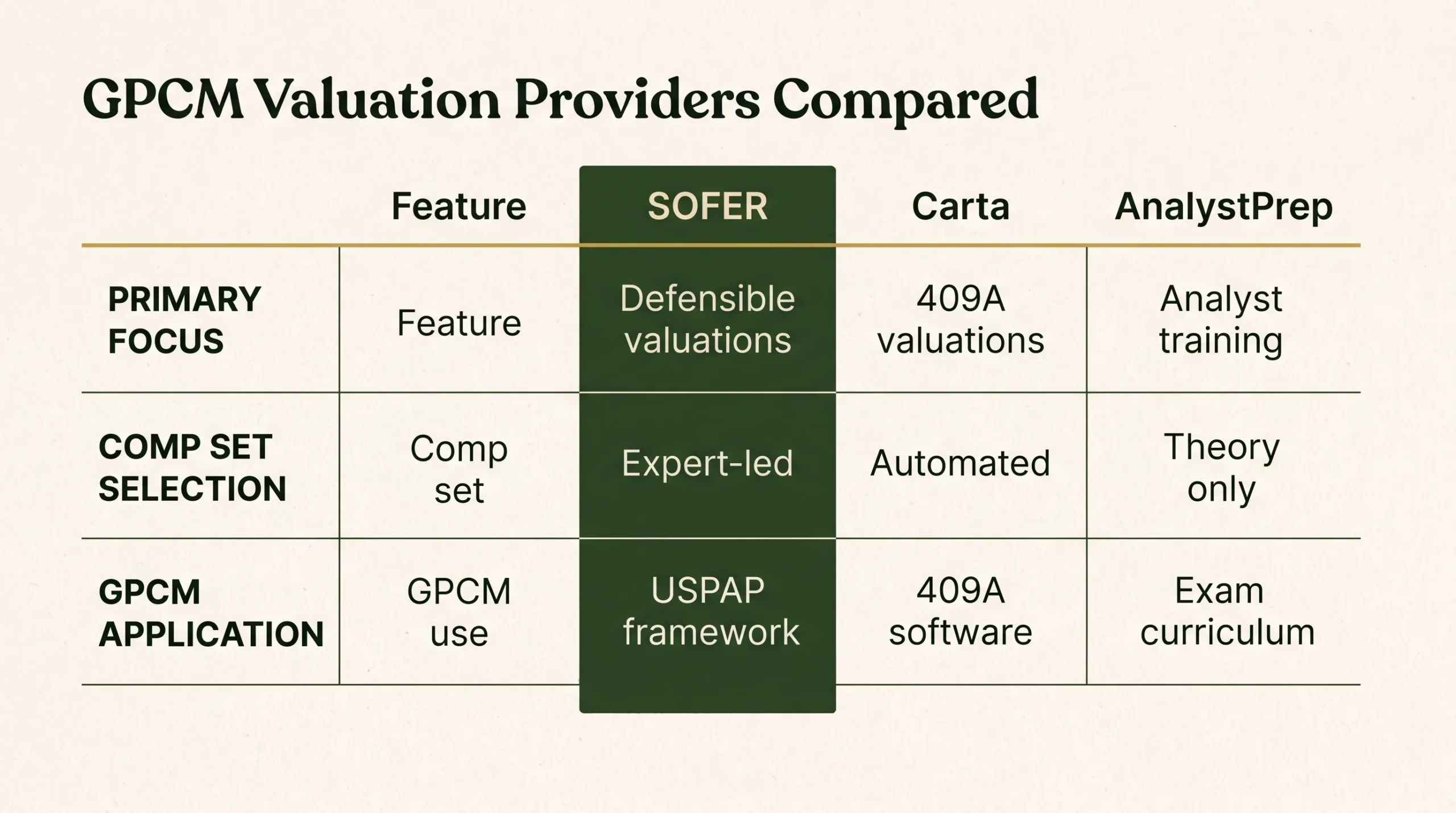
| Feature | Sofer Advisors | Carta | AnalystPrep |
|---|---|---|---|
| Primary Focus | Bespoke, defensible valuations for tax, transactions, and litigation. | Primarily 409A valuations and cap table management for VC-backed companies. | Training materials and courses for financial analyst certifications (e.g., CFA). |
| Comp Set Selection | Expert-led process using multiple databases and qualitative analysis. | Often automated or semi-automated based on platform data and algorithms. | Teaches the theory of comp selection but does not perform valuations. |
| Application of GPCM | Applied as one of several methods within a USPAP-compliant framework. | Used within their 409A valuation software, often alongside an OPM/PWERM model. | Included in curriculum as a core valuation technique to learn for exams. |
These providers differ in a clear way: one side offers professional advice, while the other offers software or teaching tools. Platform tools give speed for basic internal reports, but complex work needs a credentialed appraiser for litigation support and IRS tax reporting. When close regulatory review raises the stakes, a human analyst’s records matter most because that work must survive an audit.
Frequently Asked Questions
What is the difference between GTM and GPCM?
The Guideline Transaction Method (GTM) uses pricing data from real sales of similar companies to estimate value. The Guideline Public Company Method (GPCM) is different, since it uses market prices from traded stocks of peers. GTM focuses on whole-company sale prices, while GPCM relies on public market multiples.
What are the 4 methods of inventory valuation?
Inventory has four common valuation methods: First-In, First-Out; Last-In, First-Out; weighted-average cost; and specific identification. These set the cost of goods sold and the ending balance sheet figure. Under AICPA standards, the choice must fit past practice and meet regulatory rules.
What is the difference between guideline transaction method and guideline public company method?
The guideline transaction method looks at recent private and public merger or purchase events to derive pricing multiples. The guideline public company method uses public data from minority interests traded on exchanges. GTM often includes a control premium because it reflects prices paid for whole companies.
What are the 5 methods of valuation?
Standard frameworks include five methods: the discounted cash flow method, the guideline public company method, the guideline transaction method, the relief from royalty method, and the cost approach. These techniques trace back to Revenue Ruling 59-60, which guides how to find the fair market value of business interests.
How many comparable companies are needed for a GPCM analysis?
Analysts usually seek five to ten strong public matches to form a reliable comp set, since a larger group smooths the data and cuts the impact of outliers. Per professional standards, quality beats quantity, so Sofer Advisors filters comps by industry, size, and risk to build a set we can defend.
What financial reports supply the data for a GPCM analysis?
Peer data come from public filings such as 10-K and 10-Q reports, so the numbers can be checked and stay open to review. Analysts also follow USPAP standards, which keep appraisal work fair and ask experts to explain each key choice.
Which valuation multiple fits a SaaS company best?
For many SaaS firms, the EV/Revenue multiple often fits best, since it looks at top-line sales rather than margins. By contrast, EV/EBITDA fits capital-heavy fields where depreciation runs high, and P/E works well for mature firms with steady earnings.
Why do analysts apply a discount for lack of marketability?
A discount for lack of marketability (DLOM) lowers value because private shares are hard to sell. They do not trade on an open exchange, so a seller may wait a long time to cash out, and that extra risk lowers what a buyer will pay.
When should analysts use a DCF instead of the GPCM?
The GPCM fits less well for small, niche, or early-stage firms, since they often lack true public matches. Without peers of similar size or liquidity, experts turn to a Discounted Cash Flow analysis or the Guideline Transaction Method to weigh growth risk and short market history.
Related Case Studies
- What is a DCF Valuation? Complete Guide to DCF Method
- Revenue Ruling 59-60: The IRS Foundation of Business Valuation
- Minority Interest and Marketability Discounts Guide
Executive Summary
The Guideline Public Company Method values a private business by applying multiples drawn from comparable public companies within the Market Approach. Analysts build a comp set by screening for peers that share industry codes, size, and growth, then confirm true matches through qualitative review. They apply EV/EBITDA, EV/Revenue, or P/E based on the sector and growth stage, drawing data from public 10-K and 10-Q filings.
To bridge public and private facts, they add a control premium, a discount for lack of marketability, and normalizing adjustments for one-time items. The method fits mature firms with strong public peers and supports tax, estate, and ASC 820 reporting work. Because value rests on observed market prices, GPCM carries high trust with the IRS and holds up well under court and audit review.
What Should You Do Next?
Gather your last three years of financial statements, tax returns, and any partnership or buy-sell agreements so an analyst can see the full picture. List your major assets, debts, and any recent ownership triggers that could affect a comp-based conclusion. Then schedule time with a credentialed appraiser to confirm the right multiples and adjustments for your industry and intended use.
David Hern CPA ABV ASA, founder of Sofer Advisors provides neutral, defensible valuations for private companies. Schedule a free consultation to discuss your situation.
People Also Read
- SaaS Valuation: Complete Guide to Software Company Value
- How Do You Determine What a Business is Worth? Complete Guide
About the Author
This guide was prepared by David Hern CPA ABV ASAc, founder of Sofer Advisors, a business valuation firm headquartered in Atlanta, GA serving clients across the United States. David holds dual accreditations as an Accredited Senior Appraiser (ASA) and is Accredited in Business Valuation (ABV), credentials recognized by the IRS, SEC, and FINRA. He also holds the Certified Exit Planning Advisor (CEPA) designation. With 15+ years of valuation experience, David has served as an expert witness in 11+ cases across multiple jurisdictions and built Sofer Advisors into an Inc. 5000-recognized firm with 180+ five-star Google reviews. Its full W2 employee team maintains subscriptions to all major valuation databases and operates under a next business day response policy.
For professional business valuation services, visit soferadvisors.com/about-us/ or contact Sofer Advisors at soferadvisors.com/contact-us/.
Disclaimer: This content is for informational purposes only and does not constitute professional valuation advice. Business valuation conclusions depend on specific facts and circumstances. Contact Sofer Advisors for guidance regarding your specific situation.









