


Last Updated: August 2026
A SAFE (simple agreement for future equity) is a contract that turns an early investor’s cash into stock during a later priced round. It is not a loan. It carries no interest and no maturity date. Y Combinator created the SAFE in 2013, and nearly every startup it funds now uses one. A safe note valuation sets what that promise is worth today. Sofer Advisors builds these numbers for founders and their advisors, work backed by 180+ five-star Google reviews.
Founders like the SAFE because it raises cash fast, without pinning down a firm price. Yet each SAFE still claims equity later. A clear value now shows how much ownership that promise will take. It also keeps the next 409A report clean, since a SAFE sits ahead of common stock. Get the value wrong, and the option price for employees can be off too.
Key Takeaways
- Definition: A safe note valuation sets what a SAFE is worth before it converts to stock.
- Not debt: A SAFE has no interest and no maturity date, so its math is simpler than a convertible note’s.
- Cap and discount: The valuation cap and the discount decide how many shares the SAFE earns.
- Post-money clarity: A post-money SAFE fixes the investor’s ownership right after the new money comes in.
- 409A link: A SAFE pulls value from common stock, so it shapes the 409A price under IRC Section 409A.
Each point ties the SAFE’s terms to real dollars of ownership. The sections below walk through the cap, the discount, and the conversion math. They also show how a SAFE feeds a 409A report that an auditor will accept.
What is a SAFE and how is it valued?
A SAFE is a promise to hand an investor stock in a future priced round. It is not debt, so it pays no interest and never comes due. The investor gives cash now for equity later. A safe note valuation estimates what that future stake is worth today. The value rests on the Y Combinator SAFE terms: the valuation cap, the discount, and the odds the round happens.
The work starts with the signed document. An analyst reads the cap, the discount, and the type of SAFE. Then the team models how it will convert under a likely round. This gives owners a clear view of future dilution before it lands. David Hern CPA ABV ASA leads this work so the number holds up in a tax or audit review. Clean terms in, clean value out.
How is a SAFE different from a convertible note?
A SAFE and a convertible note both convert into future equity. But a SAFE is not debt. It carries no interest and no maturity date. A note accrues interest and must be repaid or converted by a set date. That deadline gives a note of real weight today, since it can come due before any round. A SAFE waits quietly for the next round instead. The table below lines up the terms that change the math.
| Feature | SAFE | Convertible note |
|---|---|---|
| Legal form | Not debt | Debt |
| Interest | None | Accrues over time |
| Maturity date | None | Yes |
| Valuation cap | Common | Common |
| Discount | Optional | Common |
| Converts at | Priced round | Qualified round |
The missing maturity date matters most for value. A note can force repayment or a tense talk with the holder. A SAFE carries no such threat, so its present value is easier to model. Both instruments still claim equity, and both shape the cap table. Sofer Advisors weighs each one by its real legal terms, not by the label on the page. The goal is a value that matches the contract, not a rough guess.
How do the valuation cap and discount work?
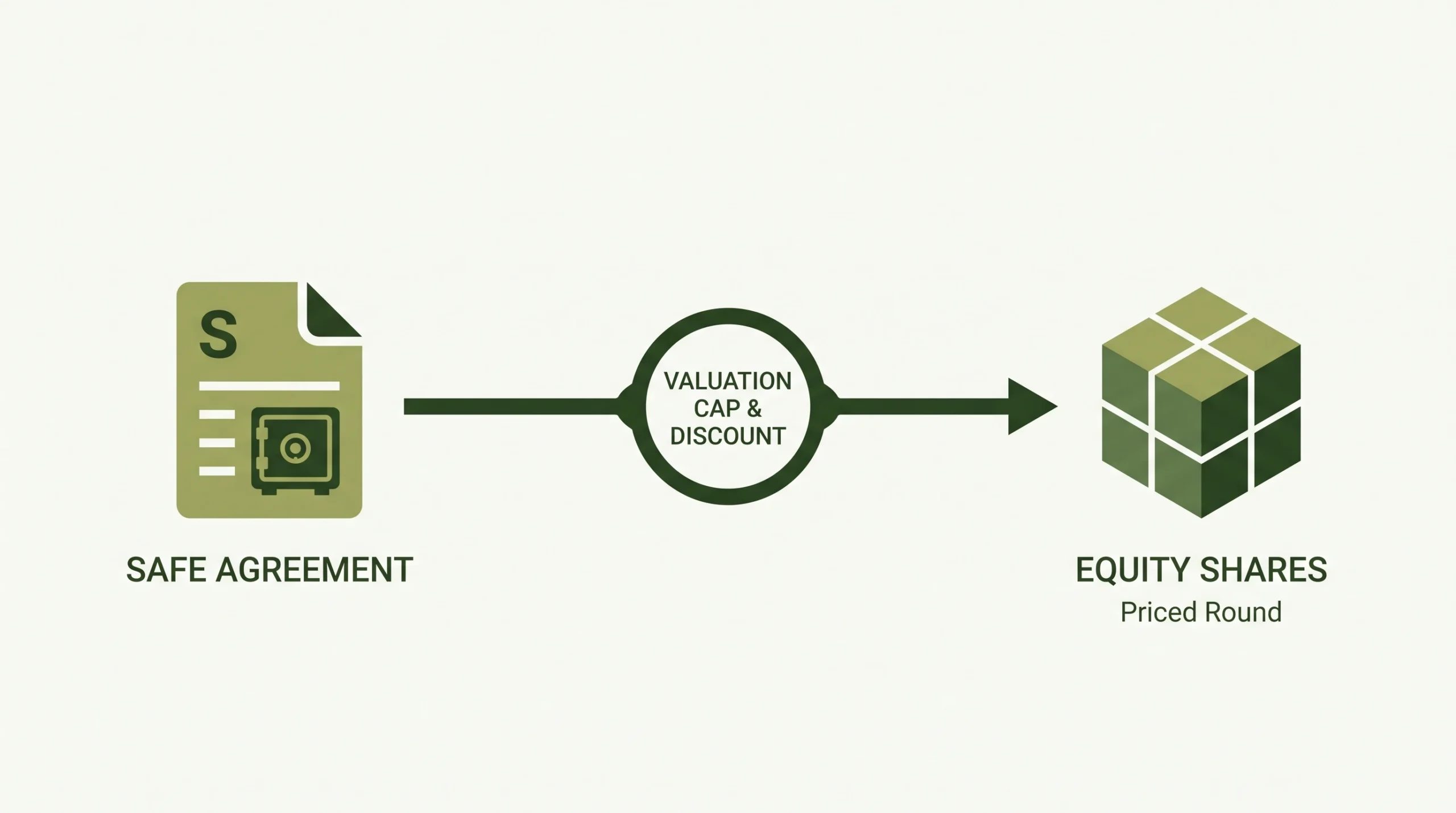
A valuation cap is the highest company value at which a SAFE can convert. It protects early backers. If the next round prices the company above the cap, the SAFE still converts at the lower capped value. That hands the holder more shares for the same money. A discount works beside the cap. It cuts a set percent off the round price, often 10 to 20 percent. The holder takes whichever term gives the better deal.
Say a SAFE has a 5 million dollar cap and a 20 percent discount. The next round prices the company at 10 million dollars. The cap wins here, so the SAFE converts as if the company were worth 5 million. The holder gets close to twice the shares a new investor would. Sofer Advisors runs both terms side by side. This is the Heart of a Teacher approach: show the owner the math, not just the answer.
Pre-money vs post-money SAFE: what changes?
The big split is pre-money versus post-money. A pre-money SAFE sets the investor’s stake based on the value before the new money comes in. A post-money SAFE fixes the stake based on the value right after it. Y Combinator moved to the post-money SAFE in 2018 to make dilution clearer. With it, an investor knows the exact percent owned, before the priced round even opens.
That clarity helps the investor but shifts more dilution onto the founder. Each new post-money SAFE stacks on top of the last. So several SAFEs together can take a bigger slice than a founder expects. The order of the math matters as well. Sofer Advisors models every SAFE on the cap table at once. Owners then see their true fully diluted position before they sign the next one.
How and when does a SAFE convert?
A SAFE converts when the company closes a priced equity round, such as a Series A. At that point the promise turns into real shares. The conversion price is the lower of the cap price or the discounted round price. The result is the SAFE’s as-converted value: the stake the holder now owns. Founders feel this as dilution. Modeling it early keeps the cap table honest before the round closes.
The math looks small until the numbers grow. A single 250,000 dollar SAFE at a low cap can convert into a large slice of a young company. Multiply that across several SAFEs, and founders can lose more ownership than they planned. Sofer Advisors builds a conversion schedule for every outstanding SAFE. It shows each holder’s shares under the round’s actual terms. Owners can then plan the raise around the real picture, as our fair market value guide explains in depth.
How does a SAFE affect a 409A value?
A 409A valuation sets the fair market value of a company’s common stock. Startups need it to price stock options. SAFEs change that value. They sit ahead of common stock in line for proceeds. So they pull value away from the common shares. A valuation that ignores the SAFEs will set the option price too high or too low. Both errors carry tax risk under IRC Section 409A.
An analyst uses a waterfall, or allocation model, to split value across the cap table. Often that means an option pricing model, which treats each layer of equity as a call option on the whole company. The method follows the AICPA cheap stock guide and supports ASC 718 reporting. Large firms such as Alvarez and Marsal or the Big 4 run this work for public filers. Sofer Advisors brings that same senior-level rigor to founders and middle-market owners. Unlike a solo practitioner, it backs every number through The Sofer Difference: a four-phase path of Discovery, Diligence, Analysis, and Delivery.
Frequently Asked Questions
Does a SAFE have a valuation?
A SAFE has no fixed price at the time you sign it. The valuation is put off until a future priced round. Instead of a set price, the contract uses a valuation cap or a discount to decide the terms later. Sofer Advisors reviews these features to show owners how their ownership might shift during the next funding event. The number still matters today for planning and reporting.
How is a SAFE different from a convertible note?
A SAFE is not debt, so it has no interest and no maturity date. A convertible note is debt. It accrues interest and must be repaid or converted by a set date. Both often carry a cap and a discount, and both convert into equity at a round. The absence of a deadline makes a SAFE simpler to model. Sofer Advisors values each one by its real terms, not the label.
What is the difference between a pre-money and post-money SAFE?
A pre-money SAFE sets the investor’s stake on the value before the new money is added. A post-money SAFE fixes the stake on the value right after it comes in. The post-money version, which Y Combinator adopted in 2018, gives the investor a clearer ownership percent. It also shifts more dilution onto the founder. Sofer Advisors models both so owners can see the full effect.
How does a SAFE convert to equity?
A SAFE converts when the company closes a priced round, such as a Series A. The promise turns into shares at that moment. The price used is the lower of the cap value or the discounted round price. This decides how many shares the holder receives. Sofer Advisors maps the conversion for every SAFE, so the new cap table is right and free of ownership disputes later.
Does a SAFE show up on the cap table?
Yes. A SAFE belongs on the cap table as a pending dilution event, even before it converts. It is not yet a formal share, but it is a real claim on future equity. Left off the table, it hides the company’s true fully diluted position. Sofer Advisors folds every outstanding SAFE into its analysis, so the ownership math reflects what will actually happen at the round.
Is a SAFE debt or equity for tax purposes?
A SAFE is generally treated as an equity-like instrument, not debt, since it has no repayment duty and no interest. The IRS gives it no single, simple label, so treatment can vary by facts. That gray area makes clear documentation important for tax and 409A work. Sofer Advisors prepares defensible valuation records to help owners support their treatment under current federal standards.
Can a SAFE expire?
A SAFE has no maturity date, so it does not expire on its own. It stays active until a conversion, a sale, or a dissolution occurs. That open-ended life can create a problem if the company never raises a priced round. The investor then holds a claim that may never turn into stock. Sofer Advisors flags these long-term risks so owners can manage their duties to early backers.
Does a SAFE need a 409A valuation?
A SAFE does not need its own 409A, but a 409A must account for it. The SAFE sits ahead of common stock and pulls value away from it. Ignore the SAFE, and the common stock price will be wrong. IRC Section 409A wants that price set with care to protect option holders. Sofer Advisors folds every SAFE into the waterfall, so the common stock value survives an audit.
How much does a 409A valuation from Sofer Advisors cost?
A 409A or early-stage equity valuation from Sofer Advisors typically runs 2,500 to 9,000 dollars. The price depends on the company’s stage and how complex the cap table is. Full business valuations for deals or disputes run higher. Simpler, single-SAFE jobs sit near the lower end. Contact Sofer Advisors for a fee quote matched to your SAFEs and your reporting purpose.
Related Case Studies
- Secondary Sales of Private Stock: Valuation and 409A Implications
- Rollover Equity in PE Deals: Valued and Taxed
- Section 83(b) Elections: Timing, Risk, Valuation
Executive Summary
A safe note valuation turns a startup’s SAFE into a clear value before a priced round. The number rests on the valuation cap, the discount, and whether the SAFE is pre-money or post-money. A SAFE is not debt, so it carries no interest and no maturity date, which makes its model simpler than a convertible note’s. At a priced round it converts at the lower of the cap value or the discounted price, often taking more ownership than founders expect. Because a SAFE sits ahead of common stock, it shapes the 409A price under IRC Section 409A and the AICPA cheap stock guide. Sofer Advisors, an Inc. 5000 firm in 2024 and 2025, models each SAFE so the result survives review.
What Should You Do Next?
Start by pulling every SAFE on your cap table into one list. Note each valuation cap, discount, and whether it is pre-money or post-money. Then model how they convert before you set an option price or open a round.
For a value you can defend, work with David Hern CPA ABV ASA. His team has given expert witness testimony in 11+ cases across Georgia, Florida, California, and New Mexico. Schedule a consultation to review the SAFEs on your cap table.
People Also Read
About the Author
This guide was prepared by David Hern CPA ABV ASA, founder of Sofer Advisors, a business valuation firm headquartered in Atlanta, GA serving clients across the United States. David holds dual accreditations as an Accredited Senior Appraiser (ASA) and is Accredited in Business Valuation (ABV), credentials recognized by the IRS, SEC, and FINRA. He also holds the Certified Exit Planning Advisor (CEPA) designation. With 15+ years of valuation experience, David has served as an expert witness in 11+ cases across multiple jurisdictions and built Sofer Advisors into an Inc. 5000-recognized firm with 180+ five-star Google reviews. Its full W2 employee team maintains subscriptions to all major valuation databases and operates under a next business day response policy. For professional business valuation services, visit soferadvisors.com/about-us/ or contact Sofer Advisors at soferadvisors.com/contact-us/.
Disclaimer: This content is for informational purposes only and does not constitute professional valuation advice. Business valuation conclusions depend on specific facts and circumstances. Contact Sofer Advisors for guidance regarding your specific situation.









