


Last Updated: November 2026
A gift of a private business interest must be reported to the IRS at its fair market value, and that value needs real support. Private stock has no public price, so an appraiser must estimate it. Minority gifts often qualify for a discount for lack of control and a discount for lack of marketability. Those discounts remain available in 2026 when they are properly supported.
Sofer Advisors prepares these valuations for owners, CPAs, and attorneys across the country.
This guide explains the fair market value standard, the main discounts, the 2026 tax figures, and the paperwork.
Key Takeaways
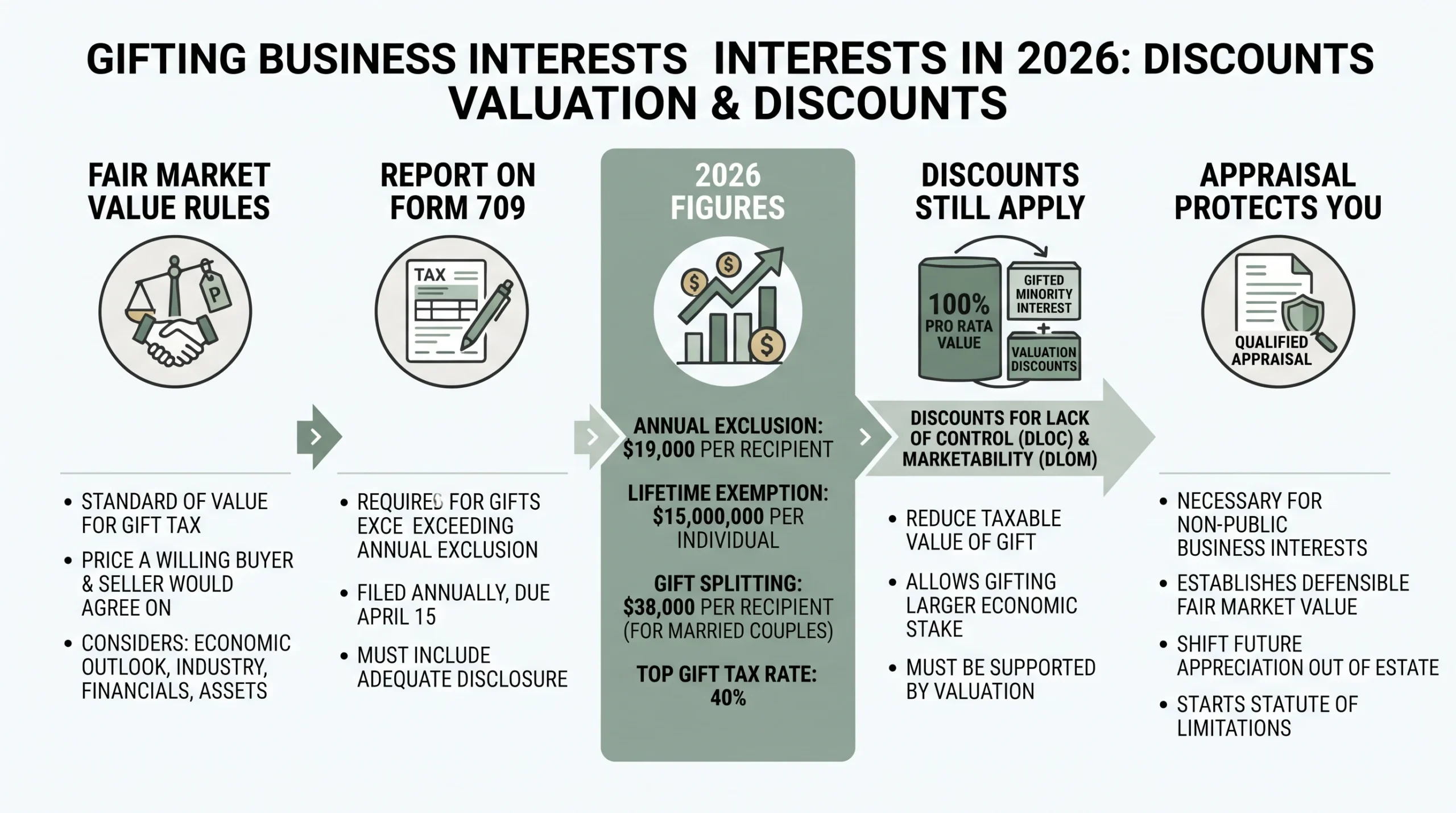
- Fair market value rules: A gifted business interest is reported at fair market value, the standard set by IRS Revenue Ruling 59-60.
- Report on Form 709: Gifts above the annual exclusion are reported on IRS Form 709, the gift tax return.
- 2026 figures: The annual exclusion is $19,000 per recipient, and the lifetime exclusion is $15,000,000 per person (IRS, Revenue Procedure 2025-32).
- Discounts still apply: Minority interests often qualify for a discount for lack of control and a discount for lack of marketability.
- Appraisal protects you: A qualified appraisal supports the discounts and helps start the clock on the IRS review period.
Why do gifts of business interests need a valuation?
A gift of private stock has no market quote. No exchange tracks its price. So an appraiser must estimate the value. The IRS requires that estimate to reflect fair market value.
Fair market value is a legal standard. It is the price a willing buyer and a willing seller would agree on. Neither side is forced to act. Both know the relevant facts. This definition drives every gift tax valuation.
Owners gift business interests for many reasons. Some want to pass the company to their children. Others fund trusts for the next generation. In each case, the transfer locks in today’s value for tax purposes. Future growth then belongs to the recipient, not the estate.
The number you report matters. It sets how much of your exclusion you use. It also sets the figure the IRS may later test. A weak valuation invites questions. A strong one holds up under review.
How does the IRS set fair market value?
The IRS points to Revenue Ruling 59-60. This 1959 ruling still guides the valuation of closely held stock. It tells appraisers what to weigh and why. Decades later, it remains the core reference for gift and estate work.
Revenue Ruling 59-60 lists eight factors to consider. These include the company’s history and the nature of its business. They cover its earning power and its ability to pay dividends. The ruling also weighs book value, the industry outlook, and the broader economy. Goodwill and any prior sales of the stock round out the list.
Appraisers use three main approaches to put these factors to work. Each looks at value from a different angle. A good report tests more than one.
The income approach looks at future earnings. It converts expected cash flow into a value today. The market approach compares the company to similar businesses that have sold. The asset approach measures the net value of what the company owns. An appraiser weighs the three and reaches a single conclusion of value.
What discounts apply to gifted minority interests?
Many gifts involve a minority stake. A minority owner cannot control the company. That lack of control lowers what a buyer would pay. Appraisers capture this with the discount for lack of control, or DLOC.
Think about what a minority owner cannot do. They cannot set strategy. They cannot hire or fire management. They cannot force a sale or declare a dividend. A rational buyer pays less for that limited power. The DLOC reflects that gap in value.
Private shares also lack a ready market. You cannot sell them with one click. Finding a buyer takes time and money. This is the discount for lack of marketability, or DLOM. It reflects the cost and delay of turning the shares into cash.
The two discounts are separate. One is about control. The other is about marketability. A single gift may qualify for both. The size of each depends on the facts of the case. There is no fixed percentage that applies to every deal.
To be clear, an appraiser might apply an illustrative figure on one engagement. Say a 20% marketability discount. A different deal could call for a very different number. The figure must be backed by data, not a rule of thumb. Restricted stock studies and court-tested methods support these conclusions.
A few facts tend to raise or lower the discounts. A small ownership stake points toward a larger control discount. Strong transfer restrictions can push the marketability discount higher. Steady dividends and an easy path to a sale push it lower. The appraiser studies the specific company and its documents. Then the report ties each discount to those facts.
Are valuation discounts still allowed in 2026?
Yes. Discounts for lack of control and lack of marketability remain available in 2026 when they are properly supported.
Some background helps here. In 2016, the Treasury proposed regulations under Internal Revenue Code Section 2704. Those rules would have limited valuation discounts on transfers within families. They drew heavy criticism from owners and advisors.
The proposed regulations were withdrawn in 2017. They never took effect. So the feared limits on family-entity discounts did not happen. Well-supported discounts still apply to gifts of closely held interests.
That said, support is everything. The IRS can challenge a discount it views as too high. A clear appraisal, tied to real market data, is the best defense. Judgment alone does not carry the day.
What are the 2026 gift tax numbers?
Two figures drive most gift planning. The first is the annual exclusion. The second is the lifetime exclusion. Both apply in 2026.
The annual gift tax exclusion is $19,000 per recipient for 2026. You can give that amount to any number of people. No gift tax return is due on gifts at or below that line. The figure comes from the IRS in Revenue Procedure 2025-32.
The lifetime estate and gift exclusion is $15,000,000 per person for 2026. The 2025 tax law made this higher amount permanent. Gifts above the annual exclusion draw down this lifetime figure. Most donors use the lifetime exclusion rather than pay tax today.
Married couples can combine their annual exclusions. This is called gift splitting. Together they can give $38,000 to one recipient in 2026. Gift splitting is reported on Form 709.
These figures shape how owners time a gift. Spreading transfers over several years stretches the annual exclusion. A larger gift of stock often reaches past that line. The excess then uses part of the lifetime exclusion. Future growth on the gifted shares falls outside the estate. That is the core appeal of gifting a business interest early.
| Item | 2026 amount |
|---|---|
| Annual gift tax exclusion, per recipient | $19,000 |
| Gift-split amount, married couple, per recipient | $38,000 |
| Lifetime estate and gift exclusion, per person | $15,000,000 |
Source: IRS, Revenue Procedure 2025-32.
Why does a qualified appraisal matter?
A gift of a business interest goes on Form 709. The IRS can review that return. A qualified appraisal gives the return a solid foundation.
The appraisal does more than set a number. It can start the clock. Under the “adequate disclosure” rules, a proper report and full disclosure begin the statute of limitations on the gift. Once that period runs out, the IRS generally cannot revalue the gift.
Skip the appraisal and that clock may never start. The IRS could then revisit the value years later. A missing or thin report also puts any discount at risk. The agency may reduce or reject a discount it cannot trace to real data.
A strong report shows its work. It states the valuation date. It describes the company and the interest gifted. It explains the methods and the data behind each discount. It is signed by a qualified appraiser. That record is what defends the value if questions come. The cost of a solid report is small next to the tax at stake. It can also save hours of dispute later.
Frequently Asked Questions
What is the annual gift tax exclusion for 2026?
The annual exclusion is $19,000 per recipient for 2026. You can give that amount to as many people as you like without filing a gift tax return. A married couple can give $38,000 to one person through gift splitting. These figures come from the IRS in Revenue Procedure 2025-32.
Do I have to file Form 709 for a gift of a business interest?
You file Form 709 when a gift to one person tops the annual exclusion. A gift of private stock usually does. The return reports the gift and tracks your lifetime exclusion. It is generally due with your income tax return for that year.
Who pays the gift tax, the donor or the recipient?
The donor is responsible for any gift tax, not the recipient. Most donors owe no cash tax. They apply the gift against the lifetime exclusion instead. The recipient takes the donor’s cost basis in the shares, known as a carryover basis.
What is a discount for lack of control?
It is a reduction in value for a minority stake. A minority owner cannot direct the company. They cannot force a sale or set dividends. A buyer pays less for that limited power, so the appraiser lowers the value.
What is a discount for lack of marketability?
It reflects how hard it is to sell private shares. There is no public market for them. A sale takes time, effort, and cost. The discount accounts for that burden. It is separate from the control discount.
Did the Section 2704 rules eliminate valuation discounts?
No. The IRS proposed rules under Section 2704 in 2016 that would have curbed family discounts. Treasury withdrew them in 2017, and they never took effect. Well-supported discounts for lack of control and marketability still apply.
What makes an appraisal “qualified” for gift tax purposes?
A qualified appraisal is prepared by a trained, credentialed appraiser. It uses recognized methods and real data. It states the valuation date and explains each conclusion. This report supports the value and the discounts on Form 709.
Can I use an old valuation for a new gift?
Usually not. The value must reflect the business as of the gift date. Markets, earnings, and ownership change over time. An old report can be out of date and hard to defend. A fresh valuation keeps the discounts current.
What is the difference between fair market value and fair value?
Fair market value is the IRS standard for gifts, set by Revenue Ruling 59-60. It assumes a willing buyer and a willing seller. Fair value is a different legal term used in some disputes, and it may ignore certain discounts. Using the wrong standard can cause problems on audit.
Related Case Studies
- Minority Interest and Marketability Discounts in Business Valuation
- CRUT Valuation: Contributing Business Interests
- CLAT Business Interest Valuation: A Guide for Owners
Executive Summary
A gifted business interest is reported at fair market value, the standard set by IRS Revenue Ruling 59-60. Gifts above the annual exclusion are reported on IRS Form 709, the gift tax return. The annual exclusion is $19,000 per recipient, and the lifetime exclusion is $15,000,000 per person (IRS, Revenue Procedure 2025-32). Minority interests often qualify for a discount for lack of control and a discount for lack of marketability. A qualified appraisal supports the discounts and helps start the clock on the IRS review period.
What Should You Do Next?
Start by listing the interests you plan to gift and the timing. Match the plan to the 2026 exclusions so you use them well. Then engage a qualified appraiser before you file Form 709, so your value and discounts rest on current data. Sofer Advisors prepares independent gift tax valuations led by David Hern CPA ABV ASA CVA. Schedule a consultation to review your situation with your tax advisor.
People Also Read
- SLAT Valuation: Funding a Trust With Business Interests
- Noncontrolling Interest (NCI) Valuation in a Business Combination
About the Author
This guide was prepared by David Hern CPA ABV ASA CVA, founder of Sofer Advisors, a business valuation firm headquartered in Atlanta, GA serving clients across the United States. David holds accreditations as an Accredited Senior Appraiser (ASA) and is Accredited in Business Valuation (ABV), credentials recognized by the IRS, SEC, and FINRA, and is also a Certified Valuation Analyst (CVA). David has served as an expert witness in dozens of cases across multiple jurisdictions, and Sofer Advisors is an Inc. 5000 honoree in 2024 and 2025 with 240+ five-star Google reviews.
For professional business valuation services, visit soferadvisors.com/about-us/ or contact Sofer Advisors at soferadvisors.com/contact-us/.
Disclaimer: This content is for informational purposes only and does not constitute professional valuation advice. Business valuation conclusions depend on specific facts and circumstances. Contact Sofer Advisors for guidance regarding your specific situation.