


Last Updated: October 2026
A SLAT valuation is a professional appraisal of a business interest being transferred to a Spousal Lifetime Access Trust. The value sets the size of the gift for federal gift tax reporting. For 2026, the federal gift and estate tax exemption is $15 million per person, set by the 2025 tax law and indexed for inflation. A defensible valuation is what makes the transfer hold up under IRS review, both now and years later.
The team at Sofer Advisors prepares these appraisals for owners, estate attorneys, and CPAs, backed by Inc. 5000 recognition in both 2024 and 2025. Owners fund a SLAT with business interests to move future growth out of their estate, which makes the valuation central to the whole plan. The appraisal must qualify as a qualified appraisal and reflect fair market value on the gift date.
This guide explains what a SLAT is, how the IRS views these valuations, which methods apply, how discounts work, and the risks to avoid. The goal is a report that funds the trust at a supported value and closes the audit window on time.
Key Takeaways
- Purpose: a SLAT valuation sets the fair market value of business interests for federal gift tax reporting.
- Compliance: the report must be a qualified appraisal to defend the filing and start the statute of limitations.
- Discounts: discounts for lack of control and lack of marketability help maximize use of the lifetime exemption.
- Timing: the valuation must be contemporaneous with the gift date; a stale report can undermine the transfer.
- Risk: weak support can trigger an audit, disallowed discounts, and accuracy penalties.
Each point below builds on the one before it, from the structure of the trust to the records the appraisal needs. The sections that follow examine each in detail.
Why Is a SLAT Valuation Important to Understand?
A SLAT valuation sets the dollar figure the entire plan rests on, and the IRS reviews it against clear standards. To accept the value reported on Form 709, the agency requires a qualified appraisal that follows Revenue Ruling 59-60, the framework for valuing closely held interests. The report must also meet the adequate disclosure rules under Treasury Regulation Section 301.6501(c)-1(f), which starts the three-year statute of limitations once satisfied. USPAP governs how the appraiser develops and reports the conclusion. A weak or stale valuation can trigger an audit, disallowed discounts, and accuracy penalties, so the report is the difference between a settled gift and an open one.
What Is a SLAT and Why Fund It With a Business?
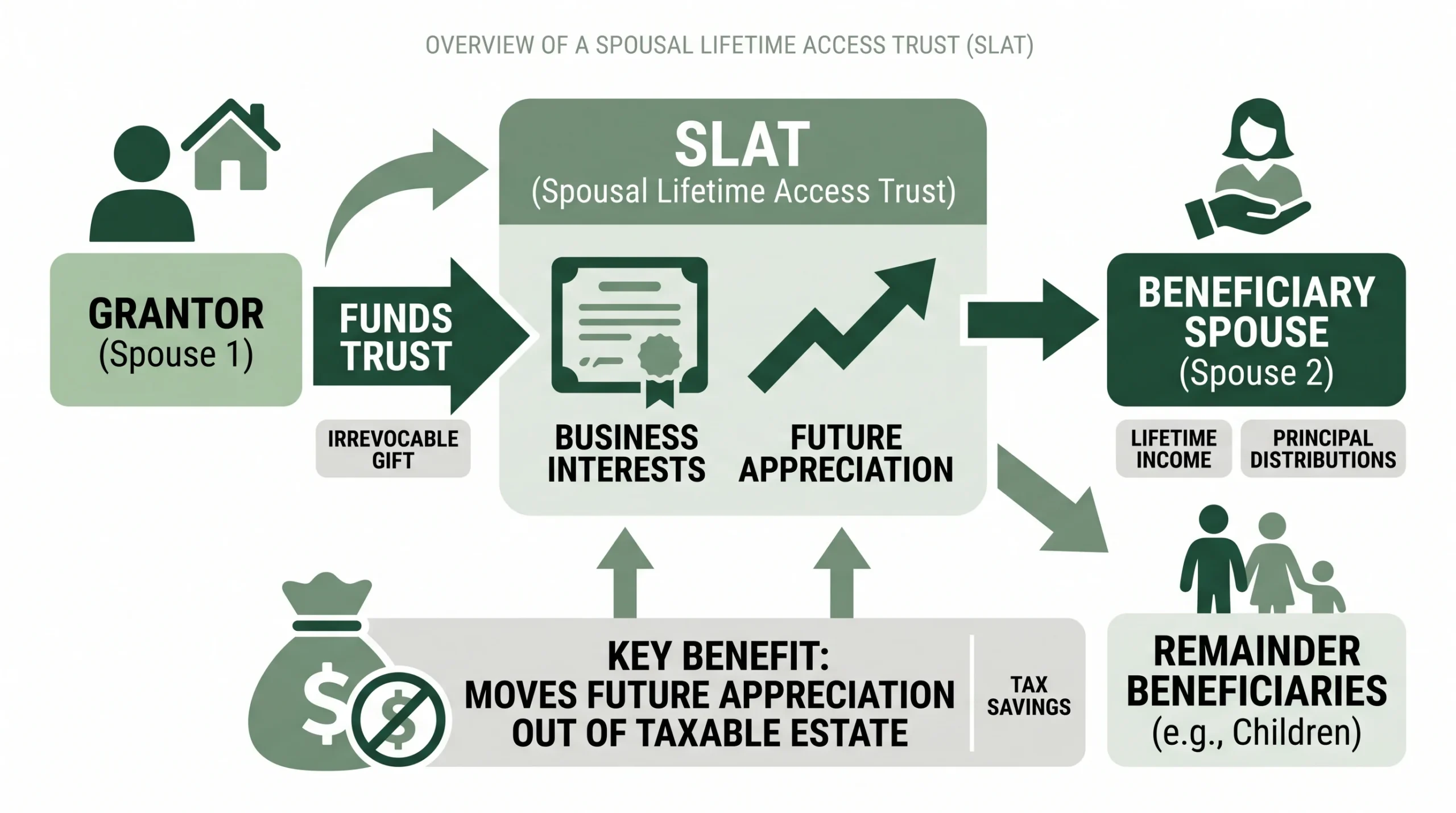
A Spousal Lifetime Access Trust is an irrevocable trust in which one spouse makes a gift for the benefit of the other. The assets leave the couple’s combined estate, but the family keeps indirect access through the beneficiary spouse. Funding it with business interests shifts future appreciation out of the taxable estate, since the growth then happens outside it. The strategy uses the grantor’s lifetime gift exemption on business assets today. Non-cash interests add another benefit, because the owner can apply valuation discounts to lower the gift’s reported value, letting more equity transfer within the same exemption. A sound, well-documented valuation is what keeps the entire transfer defensible.
How Does the IRS View SLAT Business Valuations?
The IRS applies strict scrutiny to these transfers. To accept the value on Form 709, it requires a qualified appraisal from an independent professional, and that report is the primary evidence for the gift amount. Without it, the agency can challenge the reported value during an exam. A strong valuation follows Revenue Ruling 59-60 and meets the adequate disclosure rules, which starts the statute of limitations. Meeting those rules also gives the family certainty, since a clean filing closes the audit window after three years. A report written in the Heart of a Teacher style explains the reasoning behind every figure, which is exactly what a reviewer wants to see.
What Valuation Methods Are Used for a SLAT?
A SLAT valuation considers all three approaches: income, market, and asset. The analyst synthesizes the results to fit the specific entity, aiming for a value that reflects the economic reality of the interest moving into the trust. The income approach values projected cash flows at present value. The market approach applies multiples from comparable transactions, often from a database like DealStats. The asset approach analyzes the net value of the underlying holdings. For a profitable operating company, the income and market approaches usually lead; for a holding company, the asset approach often carries more weight. The analyst then adjusts for the lack of control and lack of marketability and explains the weighting so a reviewer can follow the logic.
How Do Valuation Discounts Impact a SLAT?
Discounts reduce the reported value of the gifted interest, which lets a grantor transfer more equity within the lifetime exemption. A discount for lack of control reflects that a minority owner cannot direct operations, declare dividends, or force a sale. A discount for lack of marketability reflects how hard it is to sell closely held stock with no public market. So the gift’s value is lower than a simple pro-rata share of total equity, and more shares can move for each dollar of exemption used. Each discount must rest on market data, because unsupported discounts are the first thing the IRS attacks. The analyst supports a marketability discount with restricted stock and pre-IPO studies, and a control discount with control premium data.
Maximizing the exemption while keeping the discounts defensible is a balance best struck with experience. Talk to a Sofer Advisors valuation specialist about the appraisal your SLAT funding needs.
How Does a SLAT Compare to Other Gifting Tools?
A SLAT is one of several ways to move business value out of an estate, and its distinct feature is indirect access through the beneficiary spouse. Other tools serve different goals. The table below compares the common ones.
| Tool | How it works | Best suited for |
|---|---|---|
| SLAT | Gift to an irrevocable trust for a spouse, using the lifetime exemption | Married owners who want indirect access to the gifted value |
| GRAT | Transfer with a retained annuity, with less reliance on the exemption | Assets expected to appreciate quickly |
| IDGT | Sale to an intentionally defective grantor trust, funded by a note | Shifting value without using much exemption |
| Outright gift | Direct transfer of the interest to the recipient | Simple transfers with no ongoing trust |
Every one of these tools depends on a defensible appraisal of the business interest, so the choice of valuation partner matters. Larger national firms such as Alvarez & Marsal, Stout, and Kroll serve big public companies with broad advisory teams. Sofer Advisors focuses on defensible, partner-led estate and gift valuations for closely held and middle-market businesses, with expert witness testimony in 11+ cases behind its reports. It works through a four-phase process it calls The Sofer Difference, moving from Discovery to Diligence to Analysis to Delivery, so each appraisal arrives with a clear trail of evidence.
What Are the Biggest Risks in SLAT Valuations?
The main risk is an IRS challenge to a weak valuation. When the agency questions the reported value, it can disallow discounts, assess more tax, and add accuracy penalties. Using an unqualified appraiser or a stale report raises that risk sharply, so a contemporaneous, well-supported appraisal is the best defense. Two tax doctrines add further risk. The step-transaction doctrine lets the IRS collapse a series of transfers that lack independent purpose. The reciprocal trust doctrine can apply when two spouses create mirror-image trusts, pulling the assets back into the estate. Careful structuring, paired with a defensible valuation, is how planners address both before they become a problem.
Frequently Asked Questions
What is a SLAT valuation?
A SLAT valuation is a professional appraisal of the fair market value of business interests gifted to a Spousal Lifetime Access Trust. The value sets the reported gift on Form 709 and determines how much of the lifetime exemption the transfer uses. A qualified appraisal ensures the figure aligns with federal tax requirements and can be defended if the IRS reviews it. Sofer Advisors prepares that appraisal independently, so the trust funding rests on a supported number.
Why is a qualified appraisal required to fund a SLAT?
It substantiates the fair market value of the gifted interest, which anchors the entire funding strategy. Without it, the IRS may treat the transfer as inadequately disclosed, so the statute of limitations never starts and the agency can audit the value years later. A qualified appraisal that follows USPAP and Revenue Ruling 59-60 is the primary evidence for the gift amount. Sofer Advisors prepares that report so the filing is complete and the three-year clock begins on time.
What valuation methods are used for a SLAT?
The analyst considers the income, market, and asset approaches, then synthesizes them to fit the specific entity. The income approach values projected cash flows, the market approach applies multiples from comparable transactions, and the asset approach analyzes the net value of the holdings. The result is adjusted for the lack of control and lack of marketability in a minority, non-marketable interest, with Revenue Ruling 59-60 guiding the analysis. Sofer Advisors documents the weighting so a reviewer can follow the logic.
How do valuation discounts work in a SLAT?
Discounts for lack of control and lack of marketability lower the reported value of the gifted interest. A control discount reflects that a minority owner cannot direct operations or force a sale, while a marketability discount reflects how hard it is to sell closely held stock. That lets more equity transfer within the lifetime exemption. Each discount must be supported with market data to survive IRS review. Sofer Advisors ties every discount to that evidence, not to a round figure.
What happens if the IRS disputes my SLAT valuation?
The IRS may reject the discounts and assign a higher value, which can mean extra gift tax and accuracy penalties for the donor. A formal rebuttal then needs a defensible, expert-backed report and an appraiser who can stand behind the methodology. Strong analysis and complete documentation are what maintain the original conclusion under challenge. Sofer Advisors builds reports to withstand that scrutiny and can serve as an expert witness if the matter is contested.
What are the step-transaction and reciprocal trust risks?
The step-transaction doctrine lets the IRS collapse a series of linked transfers that lack an independent purpose, erasing the intended tax benefit. The reciprocal trust doctrine can apply when two spouses create mirror-image trusts, letting the IRS pull the assets back into each estate. Careful structuring by the estate attorney, paired with a defensible valuation, is how planners address the two risks before they become a problem. Sofer Advisors supplies the valuation piece of that defense.
How long does a SLAT valuation take?
A full business valuation usually takes four to eight weeks. The timeline depends on the entity’s complexity and the quality of the financial data available. Because the value must match the gift date, and many SLAT gifts are made near year-end, the engagement should start well before the transfer. Rushing a report at the deadline raises the risk of errors an auditor can exploit. Sofer Advisors scopes the work early so the appraisal is ready on the gift date.
How much does a SLAT valuation cost?
A business valuation for a SLAT usually ranges from $7,500 to $25,000. The fee depends on the complexity of the entity, the discounts involved, and the purpose of the report. A flat scope is quoted up front, so the cost is clear before any work begins, with no hourly surprises. For a multi-entity structure, the engagement sits toward the upper end. Sofer Advisors sets the scope first, then quotes a fixed price. Request a free estimate for your trust funding.
Related Case Studies
- Dynasty Trust Business Valuation: Funding With a Family Interest
- Business Valuation Services United States: Expert Guide 2025
- Healthcare Business Valuation Methods Guide
Executive Summary
A SLAT valuation sets the fair market value of business interests gifted to a Spousal Lifetime Access Trust, which fixes the reported gift on Form 709. The report must be a qualified appraisal that follows USPAP and Revenue Ruling 59-60 and meets the adequate disclosure rules, so the three-year statute of limitations begins. For 2026, the lifetime exemption is $15 million per person, made permanent by the 2025 tax law, and discounts for lack of control and lack of marketability let more equity transfer within it. A four-to-eight-week engagement should start before the gift date. Most SLAT valuations run $7,500 to $25,000. The first step is to gather financial statements, ownership agreements, and a cap table.
What Should You Do Next?
Prepare for a SLAT transfer by gathering financial statements, ownership agreements, and prior tax returns, then confirm the exact interest being gifted and any buy-sell restrictions before the valuation date. Start early, since the appraisal must reflect value as of the gift date. This guide was prepared by David Hern CPA ABV ASA, founder of Sofer Advisors, an Inc. 5000 firm specializing in neutral third-party valuations for estate and gift tax reporting. Schedule a free consultation to discuss your specific situation.
People Also Read
About the Author
This guide was prepared by David Hern CPA ABV ASA, founder of Sofer Advisors, a business valuation firm headquartered in Atlanta, GA serving clients across the United States. David holds dual accreditations as an Accredited Senior Appraiser (ASA) and is Accredited in Business Valuation (ABV), credentials recognized by the IRS, SEC, and FINRA. He also holds the Certified Exit Planning Advisor (CEPA) designation. With 15+ years of valuation experience, David has served as an expert witness in 11+ cases across multiple jurisdictions and built Sofer Advisors into an Inc. 5,000-recognized firm with 180+ five-star Google reviews. Its full W2 employee team maintains subscriptions to all major valuation databases and operates under a next business day response policy.
For professional business valuation services, visit soferadvisors.com/about-us/ or contact Sofer Advisors at soferadvisors.com/contact-us/.
This content is for informational purposes only and does not constitute professional valuation advice. Business valuation conclusions depend on specific facts and circumstances. Contact Sofer Advisors for guidance regarding your specific situation.









