


Last Updated: November 2026
Yes. When you sell a business, goodwill is usually taxed, but often at a lower rate than owners expect. In most asset sales, the seller treats goodwill as a capital asset, so the gain is generally taxed at long-term capital gains rates. That is better than ordinary income rates. How goodwill gets taxed depends on how the deal is built.
The team at Sofer Advisors prepares independent appraisals for owners, CPAs, and attorneys involved in a sale.
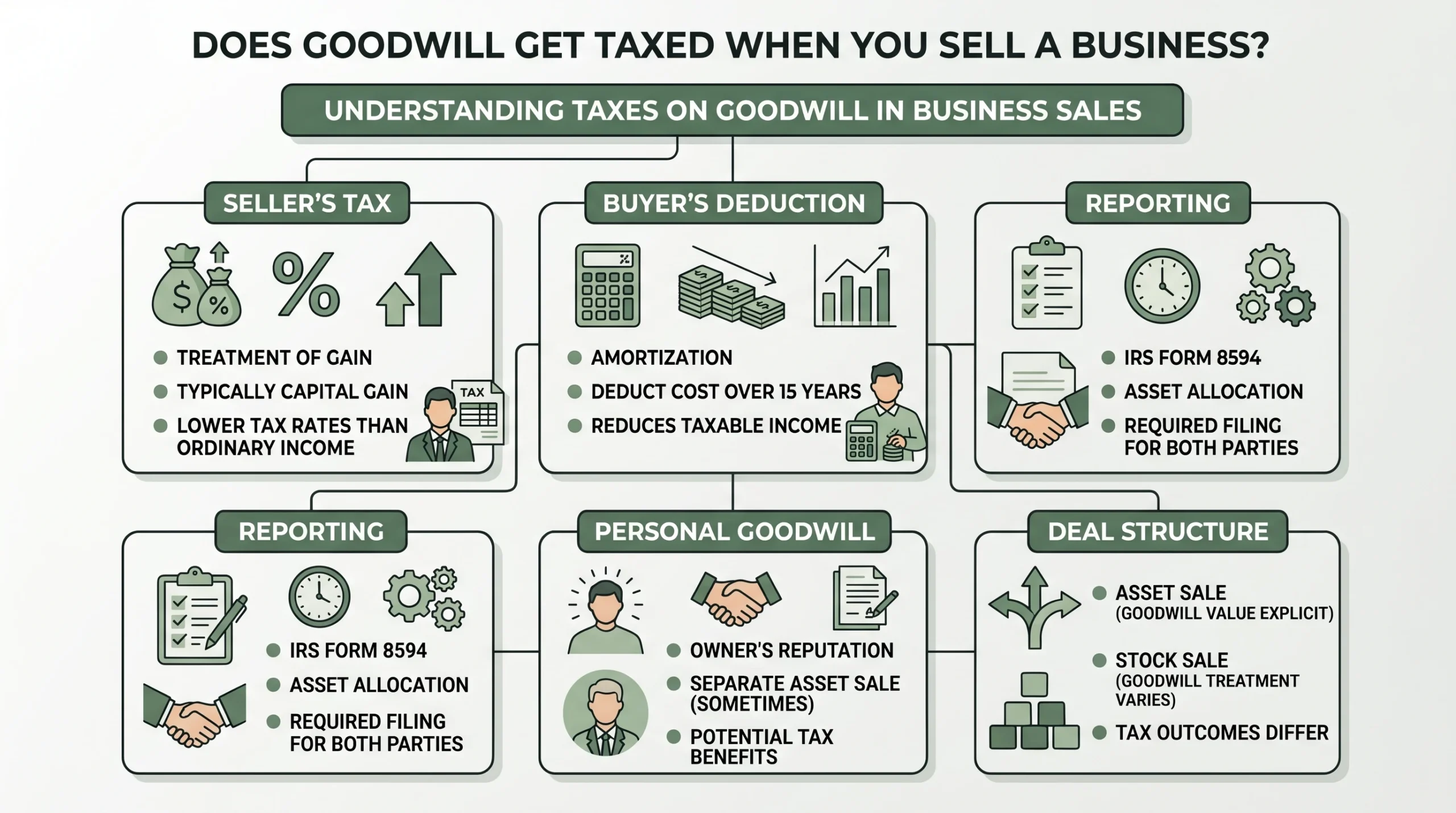
This guide covers the seller’s tax, the buyer’s deduction, personal goodwill, and how the sale is reported to the IRS.
Key Takeaways
- Seller’s tax: Gain on goodwill is usually a long-term capital gain, taxed at lower rates than ordinary income.
- Buyer’s deduction: A buyer amortizes acquired goodwill over 15 years under Section 197.
- Reporting: Both sides allocate the price under Section 1060 and file IRS Form 8594.
- Personal goodwill: It can be sold by the owner directly, which may ease the double tax on a C corporation sale.
- Deal structure: Whether the deal is an asset sale or a stock sale changes the tax outcome for both parties.
How is goodwill taxed for the seller?
For the seller, goodwill is usually a capital asset. In an asset sale, the gain on goodwill is generally a long-term capital gain. That holds when the business was owned for more than one year. Capital gains rates are lower than ordinary income rates. So this treatment favors the seller.
Not every part of a sale gets this treatment. Some assets face depreciation recapture. Recapture turns part of the gain on equipment into ordinary income. That happens up to the amount of past depreciation. Goodwill has no depreciable basis for the seller. So it stays free of recapture.
This is why the price allocation matters so much. Sellers often prefer to assign more value to goodwill. It keeps more of the gain in the capital gains bucket. Buyers often push the other way. The two sides negotiate the split as part of the deal.
The holding period is worth a close look. Capital gain treatment turns on owning the business for more than one year. Most sale goodwill clears that bar with ease. Still, the deal papers should show the timeline clearly. A short or unclear holding period can change the result.
Keep in mind that goodwill is only part of the sale. A typical deal also includes equipment, inventory, and real estate. Each class carries its own tax rule. So the seller’s total tax is a blend. Planning the split early helps avoid surprises at closing.
How does the buyer treat goodwill?
The buyer gets a tax benefit too, but it arrives slowly. Acquired goodwill is a Section 197 intangible. The buyer writes off its cost over 15 years. The write-off is straight-line, so the deduction is even each year.
This 15-year rule applies no matter how long the goodwill actually lasts. It gives the buyer a steady deduction against future income. That deduction lowers the real cost of the purchase over time.
Other intangibles follow the same path. Customer lists, trademarks, and covenants not to compete are also Section 197 intangibles. The buyer amortizes them over 15 years as well. This is one reason buyers care about how the price is split.
There is a trade-off for the buyer, though. A 15-year write-off is slow. Equipment often earns faster deductions through depreciation. So a buyer may prefer to assign more value to hard assets. This pull against the seller’s goals shapes the final numbers.
What is personal goodwill, and why does it matter?
Goodwill comes in two kinds. Enterprise goodwill belongs to the business. It comes from the company’s name, systems, and location. Personal goodwill belongs to the owner. It comes from that person’s own skill, reputation, and relationships.
The difference is not just academic. Personal goodwill can be sold by the owner directly. The business does not own it, so it is not part of the company’s assets. The owner sells it as a separate asset and reports the gain personally.
This can help owners of a C corporation. When a C corporation sells its assets, the gain is taxed twice. The company pays tax first. Then the owners pay tax again when the cash is paid out. Personal goodwill can sidestep part of that. The owner sells it outside the corporate layer and is taxed only once, at capital gains rates.
Courts have backed this idea. In Martin Ice Cream Co. v. Commissioner, the Tax Court treated a shareholder’s personal relationships as his own asset. They were not the company’s property. The Bross Trucking v. Commissioner case reached a similar result. Both rulings turned on real facts, such as whether the owner had signed a non-compete with the company.
The split between personal and enterprise goodwill must be supported. A defensible valuation helps show the IRS where the value truly sits. Sofer Advisors prepares independent appraisals to support that line.
How do asset sales and stock sales differ?
The deal structure drives the tax result. In an asset sale, the buyer buys the assets one by one. In a stock sale, the buyer buys the owner’s shares. Goodwill is treated differently in each.
In an asset sale, the buyer gets a fresh cost basis in the goodwill. That basis can be amortized over 15 years. So the buyer gains a future deduction. The seller reports capital gain on the goodwill, as covered above.
In a stock sale, the buyer steps into the seller’s shoes. The buyer inherits the old tax basis in the assets. If that basis is low or zero, there is no new goodwill to amortize. So the buyer loses the deduction. For the seller, a stock sale is often simpler. The whole gain on the shares is usually a capital gain.
Some deals bridge the gap with a Section 338 election. It lets a stock purchase be taxed like an asset sale. The buyer then gets the stepped-up basis and the 15-year write-off. But this can raise the seller’s tax, so both sides weigh it with care.
The table below sums up the main points.
| Feature | Asset sale | Stock sale |
|---|---|---|
| Seller’s gain on goodwill | Capital gain on the allocated amount | Capital gain as part of the share price |
| Buyer’s basis in goodwill | New, stepped-up basis | Inherited from the seller, often low |
| Buyer’s amortization | Yes, over 15 years | Usually none without a Section 338 election |
| Typical seller preference | Varies by asset mix | Often simpler and favorable |
How is the purchase price reported to the IRS?
The IRS wants to know how the price was split. Section 1060 sets the rules for this. It applies to most sales of a trade or business. The total price is spread across classes of assets by fair market value.
Goodwill sits in the final class. First, value is assigned to cash, then to other named assets. Whatever is left over is goodwill. This is called the residual method. It makes sure the full price is accounted for.
Both the buyer and the seller report the split. They each file IRS Form 8594, the Asset Acquisition Statement. The two filings should match. A gap between them can draw IRS attention. Covenants not to compete need care here as well. The IRS watches these amounts, since a non-compete payment is ordinary income to the seller, not capital gain.
A supported allocation protects both parties. It should rest on real values, not round guesses. Sofer Advisors prepares the valuation that backs up the split on Form 8594.
What role does a valuation play?
A valuation gives the numbers a solid base. The IRS looks for fair market value behind each class of assets. A clear appraisal shows how the price was spread. It also shows how much of the total is goodwill.
This matters most when personal goodwill is in play. The owner must prove the value tied to them alone. A valuation separates that piece from the company’s own goodwill. It explains the facts behind the split, such as client ties and the owner’s role.
Strong support also helps if the IRS asks questions later. A short, vague memo rarely holds up. A full report that lists each assumption is far easier to defend. It spells out the method and the reason for each value.
Timing counts as well. The best time to value goodwill is before the deal closes. Early work lets both sides plan the tax with real numbers. It also keeps the two Form 8594 filings in step. Waiting until after closing leaves less room to fix a weak split. Early planning gives both sides more control over the result.
Frequently Asked Questions
Is goodwill taxed as ordinary income or capital gains?
For the seller, goodwill is usually a capital asset. In an asset sale held more than one year, the gain is generally a long-term capital gain. That rate is lower than the rate on ordinary income.
What is the difference between personal and enterprise goodwill?
Enterprise goodwill belongs to the business. It comes from the company’s name, systems, and place. Personal goodwill belongs to the owner. It comes from the owner’s own skill, reputation, and relationships.
How long does a buyer amortize goodwill?
A buyer amortizes acquired goodwill over 15 years. The rule comes from Section 197 of the tax code. Other intangibles, like customer lists and trademarks, follow the same 15-year path.
What is IRS Form 8594?
Form 8594 is the Asset Acquisition Statement. Both the buyer and the seller file it. It reports how the purchase price was split across asset classes, including goodwill.
Does a stock sale change how goodwill is taxed?
Yes. In a stock sale, the buyer inherits the old tax basis. There is often no new goodwill to amortize. The seller usually reports a capital gain on the whole share price.
Can a non-compete agreement change the tax?
Yes. A payment for a covenant not to compete is ordinary income to the seller. It is not a capital gain. This is why a non-compete is kept separate from goodwill in the price split.
How is goodwill taxed in an S corporation sale?
An S corporation passes gains through to its shareholders. In an asset sale, the gain on goodwill is usually a long-term capital gain for the owners. The exact result depends on the deal and each owner’s basis.
Why does personal goodwill help C corporation owners?
A C corporation asset sale is taxed twice, at the company level and again on payout. Personal goodwill is the owner’s own asset. Selling it directly can be taxed once, at capital gains rates, outside the corporate layer.
Do the buyer and seller report the same allocation?
They should. Each files Form 8594 with the same split of the price. A mismatch between the two filings can invite an IRS review.
Related Case Studies
- What Is an Earnout in a Business Sale?
- BDIT Business Sale Valuation: A Complete Guide
- How to Get a Business Valuation: Complete Hiring Guide
Executive Summary
Gain on goodwill is usually a long-term capital gain, taxed at lower rates than ordinary income. A buyer amortizes acquired goodwill over 15 years under Section 197. Both sides allocate the price under Section 1060 and file IRS Form 8594. It can be sold by the owner directly, which may ease the double tax on a C corporation sale. Whether the deal is an asset sale or a stock sale changes the tax outcome for both parties.
What Should You Do Next?
Start by reviewing your financial statements and your draft sale terms. Then get an independent valuation to support the goodwill split. Sofer Advisors provides that work, led by David Hern CPA ABV ASA CVA. Schedule a free consultation to talk through your sale.
People Also Read
- How to Value Personal Goodwill: Complete Guide for Business
- How Does Seller Financing Work in a Business Sale?
About the Author
This guide was prepared by David Hern CPA ABV ASA CVA, founder of Sofer Advisors, a business valuation firm headquartered in Atlanta, GA serving clients across the United States. David holds accreditations as an Accredited Senior Appraiser (ASA) and is Accredited in Business Valuation (ABV), credentials recognized by the IRS, SEC, and FINRA, and is also a Certified Valuation Analyst (CVA). David has served as an expert witness in dozens of cases across multiple jurisdictions, and Sofer Advisors is an Inc. 5000 honoree in 2024 and 2025 with 240+ five-star Google reviews.
For professional business valuation services, visit soferadvisors.com/about-us/ or contact Sofer Advisors at soferadvisors.com/contact-us/.
Disclaimer: This content is for informational purposes only and does not constitute professional valuation advice. Business valuation conclusions depend on specific facts and circumstances. Contact Sofer Advisors for guidance regarding your specific situation.