


Last Updated: November 2026
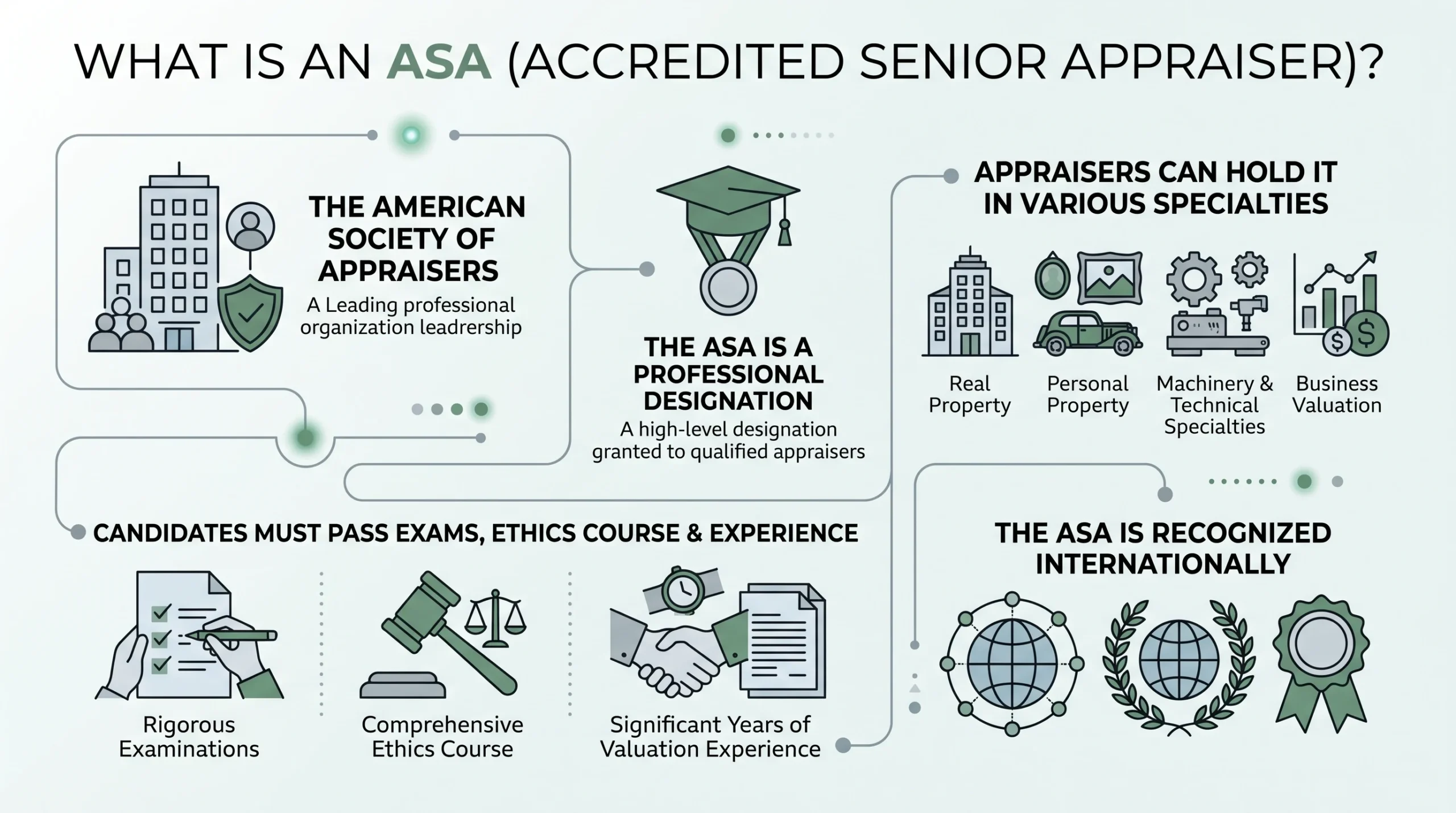
An Accredited Senior Appraiser (ASA) is a senior appraisal designation awarded by the American Society of Appraisers. It signals deep experience and tested skill, typically about five years of full-time appraisal work. To earn it, a candidate must complete college-level study, pass the required exams, meet ethics and USPAP requirements, and submit real reports for peer review. The credential is recognized in litigation, by the IRS, and in financial reporting.
The team at Sofer Advisors holds the ASA among its valuation credentials and serves owners, CPAs, and attorneys.
This guide explains what the designation means, how you earn it, where it carries weight, and how it compares to the ABV and CVA.
Key Takeaways
- The American Society of Appraisers awards the ASA designation.
- The ASA is a senior credential that typically asks for about five years of full-time appraisal experience.
- Appraisers can hold it in fields such as business valuation, machinery and equipment, real property, personal property, and gems and jewelry.
- Candidates must pass exams, meet ethics and USPAP requirements, and submit reports for peer review.
- The ASA is recognized in litigation, by the IRS, and in financial reporting.
What does the ASA designation mean?
The ASA designation means an appraiser has met a senior standard. It points to proven skill and long experience. It also points to ethical conduct. The American Society of Appraisers reviews each candidate before granting it. So the title is not self-awarded. A third party checks the work.
For a client, the credential is a useful signal. It suggests the appraiser can handle complex engagements. It suggests the work will follow a recognized standard of care. That matters when a number must hold up. A valuation can face review by the IRS, a court, or an auditor. In those settings, the appraiser’s qualifications carry weight.
The ASA is not the only mark of a good appraiser. Competence, independence, and a defensible report matter most. The designation supports those qualities. It does not replace them. A credible appraiser can explain every assumption in the report.
It also helps to know what the title does not mean. The ASA is not a license from the government. It is a professional designation from a private body. It does not set a fee or a turnaround time. It does not promise a specific result. What it offers is a tested standard of skill and conduct. The appraiser still owes you clear work and honest judgment.
Who issues the ASA, and in what fields?
The American Society of Appraisers issues the ASA. The group serves appraisers in several disciplines. An appraiser earns the credential in a chosen field. The field reflects the kind of property the person values.
The main disciplines include business valuation, machinery and equipment, real property, personal property, and gems and jewelry. A business valuation appraiser values ownership interests in companies. A machinery and equipment appraiser values industrial assets. A real property appraiser values land and buildings. A personal property appraiser values items such as art or furnishings. A gems and jewelry appraiser values precious stones and metals. Each field has its own body of knowledge.
Business valuation is the field most relevant to company owners. It covers the worth of a business or a share in one. This work feeds into tax filings, disputes, and deals.
An appraiser can hold the ASA in more than one field. Most, though, build deep skill in a single area. The fields differ a great deal in method. A machine on a factory floor is not valued like a private company. So the credential is tied to the field it was earned in. When you hire an ASA, match the field to your need. For a company, you want a business valuation appraiser.
How do you earn an ASA?
The American Society of Appraisers uses more than one credential level. The two common levels are the Accredited Member and the Accredited Senior Appraiser. The gap between them is mostly experience. Both levels sit on the same core requirements.
An Accredited Member (AM) typically needs about two years of full-time appraisal experience. An Accredited Senior Appraiser (ASA) typically needs about five years. So the ASA sits above the AM. The extra years reflect a deeper track record. Both levels require more than time in the field.
Candidates at both levels share a set of steps. They must complete college-level education. They must pass the required examinations. They must meet ethics and USPAP requirements. USPAP stands for the Uniform Standards of Professional Appraisal Practice. These are the performance and ethics rules that guide appraisers. Candidates must also submit appraisal reports for peer review. Experienced appraisers judge whether the work meets the standard.
Each step tests a different thing. Education builds the base of theory. The exams test whether the person can apply it. The ethics and USPAP rules set how the work must be done. Peer review checks real reports, not just test answers. That last step is important. It shows the appraiser can do the job in practice. A candidate cannot simply study and pass. The person must prove it on actual engagements.
The experience must be full-time appraisal work. Casual or part-time work does not count the same way. This is why the path takes years. An appraiser builds the record one engagement at a time. By the ASA level, that record runs long and deep.
Where is the ASA recognized?
The ASA carries weight in high-stakes settings. Three stand out. The credential is recognized in litigation, by the IRS, and in financial reporting.
In litigation, qualifications shape how a court views an expert. An ASA can help an appraiser qualify to give expert testimony. The designation shows training and a recognized method. It does not guarantee a court will accept the opinion. The judge still weighs the facts and the analysis. But a strong credential supports the appraiser’s standing.
With the IRS, a defensible appraisal matters for tax filings. Estate, gift, and charitable matters often need one. An ASA signals that the report follows accepted practice. That can help the filing survive review. In financial reporting, auditors look for the same rigor. A credentialed appraiser helps a valuation stand up to audit.
Why hire an ASA for a complex job? The answer is defensibility. A high-stakes valuation gets tested. The other side in a dispute may push back. An auditor may ask hard questions. The IRS may review the filing. In each case, the work must hold. A credentialed appraiser follows a recognized method. The report shows the data and the logic behind each step. That makes it easier to defend. It also lowers the risk of a costly delay.
Not every job needs this level of rigor. A rough internal estimate may not. But a formal engagement usually does. A sale, a tax filing, or a lawsuit raises the stakes. In those cases, the credential earns its place.
How does the ASA compare to the ABV and CVA?
The ASA is one of several business valuation credentials. Two others come up often. These are the ABV and the CVA. Each comes from a different organization. Each has its own focus and requirements.
The table below shows the basic differences.
| Credential | Issuing body | Typical holder |
|---|---|---|
| ASA | American Society of Appraisers | Full-time appraisers across several fields |
| ABV | AICPA | Licensed CPAs who focus on valuation |
| CVA | NACVA | Valuation analysts, often CPAs |
The ASA comes from the American Society of Appraisers. It spans several appraisal fields, not just business valuation. The ABV is Accredited in Business Valuation. The AICPA grants it, and it is held by licensed CPAs. The CVA is the Certified Valuation Analyst credential. The NACVA grants it, and many holders are CPAs or financial analysts.
No single credential is universally better than the others. Each has value. What matters is the appraiser behind the letters. Look for real competence in the relevant field. Look for independence from the outcome. Above all, look for a report you can defend. Many strong appraisers hold more than one of these credentials. David Hern, who leads Sofer Advisors, holds the ASA along with the CPA, ABV, and CVA.
How do you keep an ASA active?
An ASA is not a one-time award. The American Society of Appraisers asks members to stay current. Holders must meet continuing-education requirements. They must also meet recertification requirements. This keeps skills fresh over a career.
The reason is simple. Valuation practice changes over time. Standards and methods evolve. Continuing education helps appraisers keep up. Recertification confirms that a member still meets the mark. For a client, this means the credential stays meaningful. An active ASA is not resting on an old exam.
The practice of appraisal also rests on ongoing ethics. Members commit to the society’s ethics rules. They also commit to USPAP. Those duties do not expire. They apply to every engagement, year after year.
For a client, the upkeep is a quiet benefit. You do not see the training behind the report. But it shapes the work you receive. A current appraiser knows the latest standards. That appraiser is less likely to use an outdated method. When you check a credential, confirm it is active. An active ASA reflects a member in good standing today.
Frequently Asked Questions
What does ASA stand for?
ASA stands for Accredited Senior Appraiser. It is a professional designation. The American Society of Appraisers awards it to experienced appraisers.
Who awards the ASA designation?
The American Society of Appraisers awards it. The society is a multidiscipline body for appraisers. It sets the requirements and reviews each candidate.
What is the difference between an AM and an ASA?
Both come from the American Society of Appraisers. The main difference is experience. An Accredited Member typically needs about two years of full-time appraisal experience. An Accredited Senior Appraiser typically needs about five years.
How long does it take to earn an ASA?
It takes several years. The ASA level typically asks for about five years of full-time appraisal experience. Candidates also need education, exams, and peer-reviewed reports. The full path is not quick.
Does the IRS recognize valuations by an ASA?
The ASA is recognized by the IRS. A credentialed appraiser signals that the report follows accepted practice. That can help a tax filing stand up to review. The report still needs sound analysis and clear support.
Is the ASA better than the ABV or CVA?
No credential is universally better. Each comes from a respected body. What matters is the appraiser’s competence, independence, and a defensible report. Many appraisers hold more than one of these credentials.
Can one appraiser hold more than one valuation credential?
Yes. It is common for appraisers to hold several. For example, David Hern holds the ASA plus the CPA, ABV, and CVA. Multiple credentials can reflect training across different standards.
How do I verify that an appraiser holds the ASA?
Check with the American Society of Appraisers. The society maintains a member directory. You can confirm a person’s credential and standing there.
What is USPAP?
USPAP stands for the Uniform Standards of Professional Appraisal Practice. These are the ethics and performance rules for appraisers. ASA candidates and members must meet USPAP requirements.
Related Case Studies
- Business Valuation Appraiser
- Do You Really Need a Commercial Opportunity Zone Appraiser?
- IRC 6695A Appraiser Penalty: What Puts You at Risk
Executive Summary
The American Society of Appraisers awards the ASA designation. The ASA is a senior credential that typically asks for about five years of full-time appraisal experience. Appraisers can hold it in fields such as business valuation, machinery and equipment, real property, personal property, and gems and jewelry. Candidates must pass exams, meet ethics and USPAP requirements, and submit reports for peer review. The ASA is recognized in litigation, by the IRS, and in financial reporting.
What Should You Do Next?
Start with the purpose of your valuation. Is it for tax, litigation, a deal, or financial reporting? The purpose shapes the right approach. Then check the appraiser’s credentials and relevant experience. Ask whether the report will hold up to review. Sofer Advisors provides independent business valuations led by David Hern CPA ABV ASA CVA. Schedule a free consultation to discuss your situation.
People Also Read
- How to Choose a Business Appraiser: Credentials and Red Flags
- Why Independence Matters in Valuation: AICPA, ASA, Court Standards
About the Author
This guide was prepared by David Hern CPA ABV ASA CVA, founder of Sofer Advisors, a business valuation firm headquartered in Atlanta, GA serving clients across the United States. David holds accreditations as an Accredited Senior Appraiser (ASA) and is Accredited in Business Valuation (ABV), credentials recognized by the IRS, SEC, and FINRA, and is also a Certified Valuation Analyst (CVA). David has served as an expert witness in dozens of cases across multiple jurisdictions, and Sofer Advisors is an Inc. 5000 honoree in 2024 and 2025 with 240+ five-star Google reviews.
For professional business valuation services, visit soferadvisors.com/about-us/ or contact Sofer Advisors at soferadvisors.com/contact-us/.
Disclaimer: This content is for informational purposes only and does not constitute professional valuation advice. Business valuation conclusions depend on specific facts and circumstances. Contact Sofer Advisors for guidance regarding your specific situation.