


Last Updated: September 2026
A noncontrolling interest valuation under ASC 805 measures the fair value of the equity in an acquired company that the buyer does not own. It fixes that value on the acquisition date. The standard applies when a buyer takes control but holds less than 100% of a subsidiary. Under US GAAP, the buyer records this minority stake at acquisition-date fair value, an approach known as the full goodwill method. That single figure shapes both the equity section and the goodwill on the combined balance sheet.
This measurement matters because it drives real numbers in the financial statements. A wrong figure can misstate goodwill and future earnings. It can also draw hard questions in an audit. Getting it right means pricing the minority stake as a market participant would, not treating it as a simple slice of book value. That distinction sits at the center of the work.
Sofer Advisors provides independent financial reporting valuations for business owners, CFOs, and their CPAs. It measures each noncontrolling interest using market participant assumptions under ASC 820. Its valuation professionals hold dual ABV and ASA credentials. They build reports that stand up to auditor review.
Key Takeaways
- Fair value, not book value: ASC 805 records NCI at its acquisition-date fair value, the full goodwill method.
- Not a simple slice: fair value is not the NCI percentage times the acquiree’s identifiable net assets.
- No control premium: the premium a buyer pays for control does not pass to the minority stake.
- Discounts apply: a discount for lack of control, and often lack of marketability, lowers the per-share value.
- Goodwill rises: a higher NCI fair value increases the goodwill the buyer records, not the reverse.
Each point below builds on these rules. The sections that follow explain the measurement, the discounts, the goodwill math, the methods, and how to pick the right specialist.
Why does NCI valuation matter under ASC 805?
NCI valuation matters because ASC 805 requires the buyer to report the minority stake at fair value on the acquisition date. That figure flows straight into the balance sheet. It sits in equity, and it helps set the goodwill the buyer records. A small change in the input can move both numbers at once. When the value is weak, the financial statements can misstate goodwill and later earnings.
A defensible number protects the whole filing. It supports a clean audit and steady reporting in the years after the deal. The SEC Financial Reporting Manual addresses disclosures for acquired businesses, which frames how these figures reach investors. Sofer Advisors builds these values with clear documentation, so each assumption can be traced from start to finish.
How is NCI measured under ASC 805?
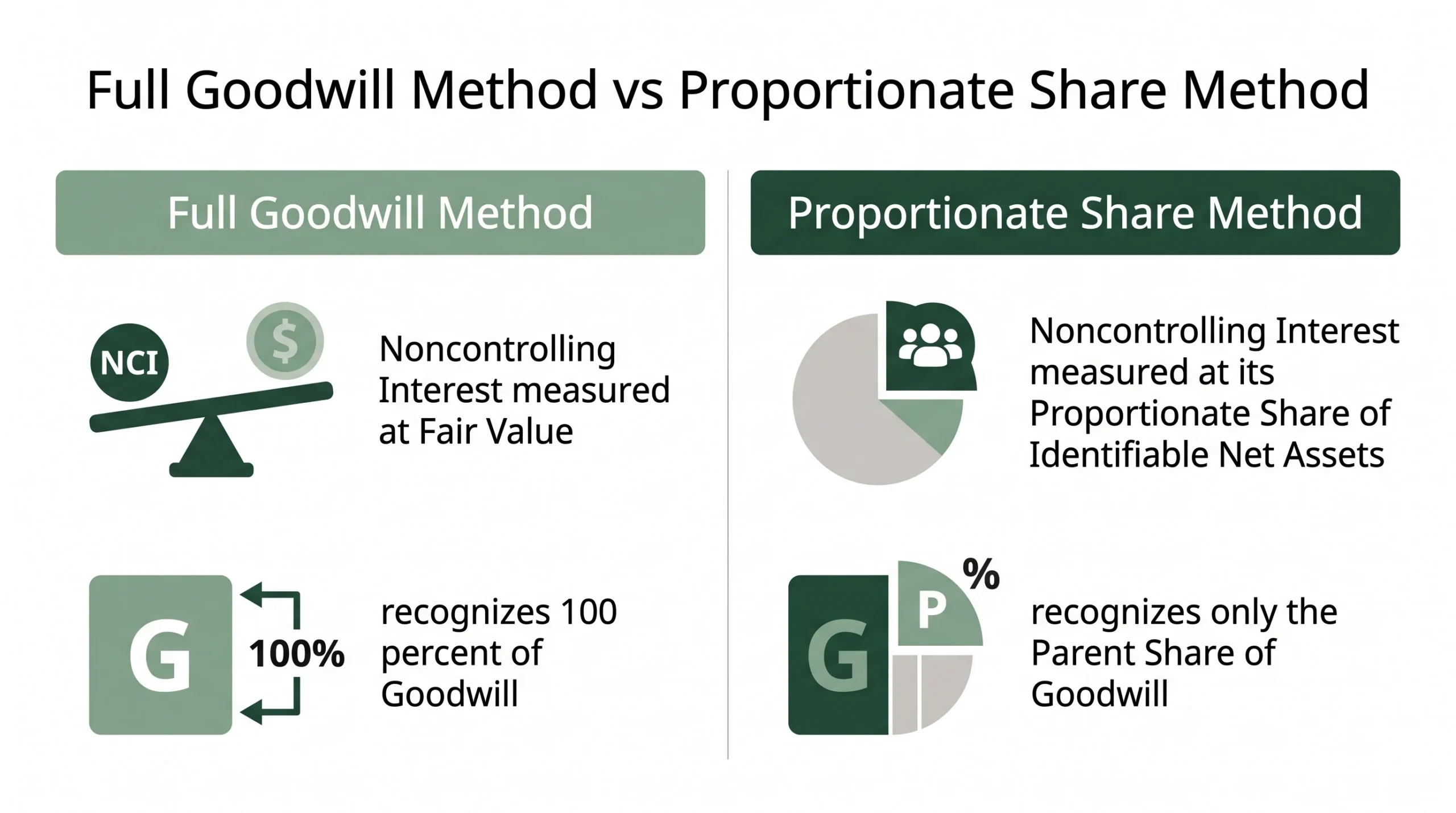
A buyer measures NCI at its acquisition-date fair value, using the price a market participant would pay for that minority block. It is not the NCI percentage times the acquiree’s identifiable net assets. That shortcut is the proportionate share method, which US GAAP does not allow for this purpose. IFRS 3 permits either path, but ASC 805 points to fair value.
To reach fair value, an appraiser often values the whole equity first. The income approach and the market approach both help here. The analyst then isolates the minority block and adjusts for its limited rights. For the full allocation that surrounds this step, see our purchase price allocation guide. The table below compares the two measurement bases.
| Feature | Fair Value Method (US GAAP, ASC 805) | Proportionate Share Method (IFRS 3 option) |
| Basis | Market price for the minority block on the deal date | NCI percentage of identifiable net assets |
| Goodwill | Full goodwill, covering both interests | Partial goodwill, only the buyer’s share |
| Discounts | Reflects lack of control and marketability | No separate discount step |
| Scrutiny | Higher; a standalone valuation the auditor tests | Lower; a simpler calculation |
The two methods can produce very different balance sheets. Fair value usually records more goodwill, because it captures value tied to the minority stake as well. Proportionate share records less. US filers use the fair value method, so the standalone valuation becomes a focus in the audit. Clear support for every input keeps that review short and the reported figures defensible.
Does a control premium or discount apply to NCI?
A control premium does not apply to a noncontrolling interest. The buyer pays that premium to run the company, and a minority holder cannot. So the per-share fair value of the NCI is usually lower than the per-share price the buyer paid for control. To get there, an appraiser applies a discount for lack of control. A discount for lack of marketability often applies too, since a private minority stake is hard to sell.
These discounts are a key judgment area. An appraiser must show why each one fits the facts. Auditors test these estimates under PCAOB guidance on auditing fair value measurements, so the basis has to be clear. Using the wrong basis can overstate the NCI and distort goodwill. Sofer Advisors documents each discount with market data, so a reviewer can follow the reasoning without guesswork.
How does NCI valuation affect goodwill?
A higher NCI fair value increases the goodwill the buyer records. Goodwill is the amount paid above the fair value of the identifiable net assets. Under the full goodwill method, the buyer adds the NCI fair value to the consideration before subtracting those net assets. So a larger NCI raises the residual, which is goodwill. This is the opposite of a common misread that treats a higher NCI as a cut to goodwill.
The method also affects future testing. Full goodwill covers both the controlling and noncontrolling interests. That larger balance can face a bigger write-down if the business later underperforms. The proportionate share method records less goodwill, but US filers do not have that choice. Careful measurement at the deal date sets the base for every later impairment test under ASC 350.
What methods determine NCI fair value?
Appraisers determine NCI fair value with the same tools used for the whole company, then adjust for the minority position. The income approach discounts expected cash flows to present value. The market approach applies multiples from comparable deals or public peers. Both give a view of total equity value. The analyst then carves out the minority block and applies the right discounts.
Some deals need more detail. When a company has several share classes, an option pricing model can split value across them. A probability-weighted method can value a stake tied to future exit paths. These tools help when simple math cannot capture the specific rights a minority holder owns. Each input still traces back to fair market value on the acquisition date.
How do you choose a valuation specialist for ASC 805?
An independent specialist sets the NCI fair value that drives the balance sheet, so the choice matters. The right partner is objective and can defend the work in an audit. Large firms like Alvarez & Marsal, Stout, and Kroll serve the biggest deals. Middle-market companies often want senior attention and quick answers instead. Auditors also weigh the work of an outside expert under PCAOB rules on using a specialist’s work.
Sofer Advisors keeps the valuation independent from any deal broker, so the number stays neutral. Its process, The Sofer Difference, runs in four phases: Discovery, Diligence, Analysis, and Delivery. It also uses a Heart of a Teacher approach, so clients see why each figure lands where it does. That clarity supports the financial reporting valuation work an auditor can trace end to end.
These rules reward careful, well-documented work. The questions below cover what owners and finance teams ask most.
Frequently Asked Questions
How is a noncontrolling interest measured under ASC 805?
A noncontrolling interest is measured at its acquisition-date fair value, the price a market participant would pay for that minority block. Under US GAAP, this is the full goodwill method. The value is not the NCI percentage of the acquiree’s net assets. An appraiser usually values the whole equity first, then isolates the minority stake and adjusts for its limited rights. The result must reflect market participant assumptions under ASC 820.
What is the difference between fair value and proportionate share for NCI?
Fair value prices the minority stake as a market participant would, which records full goodwill covering both interests. The proportionate share method instead takes the NCI percentage of the acquiree’s identifiable net assets, which records only partial goodwill. US GAAP requires the fair value method under ASC 805. IFRS 3 allows either one. The two paths can lead to very different goodwill balances for the same deal.
Does a minority discount apply when valuing a noncontrolling interest?
Yes, a discount for lack of control usually applies, because a minority holder cannot direct strategy, set dividends, or force a sale. A discount for lack of marketability often applies too, since a private minority stake is hard to sell quickly. Together these discounts lower the per-share value below the price a buyer pays for control. The size of each discount depends on the facts and must be supported with market data.
How does noncontrolling interest valuation affect goodwill?
Under the full goodwill method, a higher NCI fair value increases the goodwill recorded. The buyer adds the NCI value to the consideration, then subtracts the fair value of the identifiable net assets. Whatever remains is goodwill, so a larger NCI raises that residual. This larger balance also sets a bigger base for future impairment tests under ASC 350. Accurate measurement at the deal date keeps both figures defensible.
How is NCI recorded at the acquisition date?
At the acquisition date, the noncontrolling interest is recorded within the equity section of the consolidated balance sheet as a separate line. The amount equals the fair value of the minority stake from an independent valuation. It is shown apart from the equity attributable to the parent. Clear support for that opening figure helps the company meet ASC 805 and hold up under an auditor’s review of the acquisition accounting.
What is a discount for lack of control (DLOC) in NCI valuation?
A discount for lack of control is a reduction that reflects the limited power of a minority holder. That holder cannot set strategy, control dividends, or decide on a sale. The discount lowers the value from a control level to a minority level. Appraisers size it using market studies and transaction data, then document the basis. A clear DLOC is central to a defensible NCI value under ASC 805.
Why is NCI valuation a frequent focus in an audit?
NCI valuation draws audit focus because small input changes can shift reported goodwill and net income. Auditors want to see that the discounts, the cash flow assumptions, and the market data all fit the facts. They test whether the model reflects the minority position rather than the buyer’s control. Strong documentation answers those questions quickly. Weak support can slow the close and raise the risk of a later restatement.
How much does a purchase price allocation (ASC 805) from Sofer Advisors cost?
An NCI valuation is measured within a business-combination purchase price allocation, so it falls under the ASC 805 PPA tier. That work generally ranges from $15,000 to $50,000. The final fee depends on deal size, the number of intangible assets, the share structure, and the reporting timeline. For a quote tied to your transaction, schedule a consultation with Sofer Advisors and share your deal details.
What happens to the noncontrolling interest after the acquisition date?
After the acquisition date, the noncontrolling interest balance changes with the minority owner’s share of later earnings, losses, and dividends. These amounts are reported within total equity in the consolidated financial statements. The opening fair value from the acquisition sets the base for all of these later adjustments. A sound initial figure keeps the ongoing equity reporting accurate and consistent through each reporting period.
Related Case Studies
- Minority Interest and Marketability Discounts Guide
- Control Premium in Business Valuation: When It Applies
- Calculating Goodwill in an Acquisition: Formula Explained
Executive Summary
Under ASC 805, a buyer records the noncontrolling interest at its acquisition-date fair value, the full goodwill method. That value is not the NCI percentage of the acquiree’s identifiable net assets. The control premium a buyer pays for control does not pass to the minority stake, so a discount for lack of control, and often lack of marketability, brings the per-share value below the control price. A higher NCI fair value increases the goodwill recorded and sets a larger base for later impairment tests under ASC 350. Sofer Advisors delivers independent NCI valuations, typically scoped within a PPA priced from $15,000 to $50,000, that support a clean audit.
What Should You Do Next?
First, gather the deal documents that show the company’s equity structure and the terms of the minority stake. Second, confirm whether the buyer holds control but less than 100%, since that is what triggers NCI measurement under ASC 805. Third, plan the valuation early, because the fair value work drives both the equity line and the goodwill on your balance sheet.
David Hern CPA ABV ASA, founder of Sofer Advisors, helps finance teams measure noncontrolling interests for ASC 805 reporting. Schedule a consultation to discuss your specific situation.
People Also Read
- Purchase Price Allocation ASC 805 and IFRS 3: Complete Guide for Business Leaders
- ASC 820 Fair Value Measurement: Hierarchy Levels Explained
About the Author
This guide was prepared by David Hern CPA ABV ASA, founder of Sofer Advisors, a business valuation firm headquartered in Atlanta, GA serving clients across the United States. David holds dual accreditations as an Accredited Senior Appraiser (ASA) and is Accredited in Business Valuation (ABV), credentials recognized by the IRS, SEC, and FINRA. He also holds the Certified Exit Planning Advisor (CEPA) designation. With 15+ years of valuation experience, David has served as an expert witness in 11+ cases across multiple jurisdictions and built Sofer Advisors into an Inc. 5000-recognized firm with 180+ five-star Google reviews. Its full W2 employee team maintains subscriptions to all major valuation databases and operates under a next business day response policy.
For professional business valuation services, visit soferadvisors.com/about-us/ or contact Sofer Advisors at soferadvisors.com/contact-us/.
Disclaimer: This content is for informational purposes only and does not constitute professional valuation advice. Business valuation conclusions depend on specific facts and circumstances. Contact Sofer Advisors for guidance regarding your specific situation.









