


Last Updated: November 2026
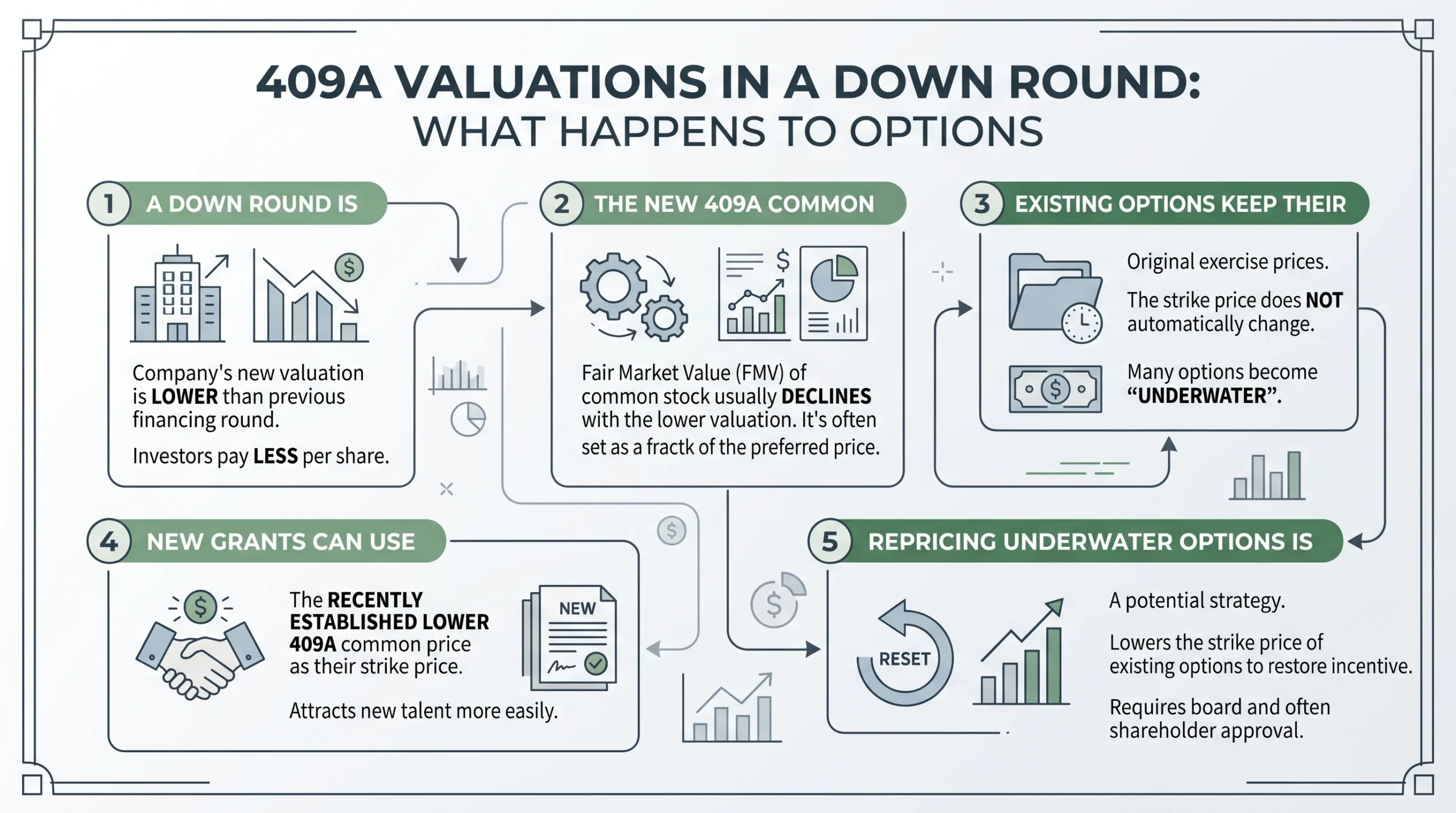
When a company raises money at a lower price per share, a down round, it usually triggers a fresh 409A valuation, and that new report typically lowers the common stock fair market value. Existing options keep their old, higher strike price, so many go underwater. New grants can use the new, lower strike instead. A down round is a material event under IRC Section 409A, which is why the old valuation can no longer be relied on.
The team at Sofer Advisors builds 409A valuations for founders, boards, and finance leaders across the country.
This guide explains why a down round forces a new 409A, what happens to existing and new options, how the math shifts, and when a board should weigh a repricing.
Key Takeaways
- A down round is a material event. It usually triggers a new 409A valuation.
- The new 409A common stock FMV usually falls after a down round.
- Existing options keep their old strike price. Many go “underwater.”
- New grants can use the lower strike, which helps new hires.
- Repricing underwater options is possible. But it raises tax and accounting issues.
Why does a down round trigger a new 409A valuation?
A 409A valuation stays valid for up to 12 months. That holds only if nothing major changes. A material event can end that window early. A down round is a clear example.
IRC Section 409A lets a company earn a “safe harbor.” An independent valuation is presumed reasonable for up to 12 months. That presumption also ends when a material event occurs. A new financing round changes the company’s value. So the old report no longer reflects reality.
A down round signals a drop in value. The last 409A was built on higher numbers. Pricing new options off that stale report is risky. The strike could sit below true FMV. That is the exact problem 409A is meant to prevent.
Most startups rely on the independent appraisal safe harbor. Under this method, a qualified appraiser values the common stock. The valuation is presumed reasonable for up to 12 months. A down round breaks that presumption early. Keeping the appraisal current is what preserves the protection.
The stakes are real for employees. If a strike sits below FMV, Section 409A can impose a 20% additional federal tax on the option holder, plus interest. A fresh valuation avoids that trap. It resets the common stock FMV to current terms. It also restores the safe harbor for the next grants. Boards usually order the new report soon after the round closes.
How does a down round change the common stock value?
Preferred shares and common shares are not worth the same. Investors buy preferred stock. It carries extra rights. Employees hold common stock. It sits last in line.
A down round lowers the price investors pay per share. That lower price feeds straight into the new 409A. Analysts use it to reset the company’s implied value. From there, they work out the common stock FMV.
The common figure almost always lands below the preferred price. The gap comes from investor rights. Preferred holders get paid first in a sale. They may also hold anti-dilution and participation terms. Each right pulls value away from common stock.
Down rounds often add new rights, too. A fresh round may carry a larger liquidation preference. It may add participation on top. These terms push the common value down further. A careful model has to capture each one.
What happens to existing stock options?
An option lets an employee buy stock at a fixed price. That price is the strike. It is set at the FMV on the grant date. It does not change on its own.
A down round lowers today’s FMV. But old options keep their old, higher strike. So the strike can sit above current value. That option is now “underwater.”
An underwater option has no built-in gain. An employee would pay more to exercise than the stock is worth. The option can still hold time value. Yet it often feels worthless to staff. That can hurt morale and retention.
New grants do not share this problem. They use the new, lower FMV as the strike. A new hire can get options with real upside. This is one quiet benefit of a down round.
Should a company reprice underwater options?
A repricing lowers the strike on existing options. It can bring them back above water. Many boards weigh this after a down round. The choice is not simple.
First comes the tax rule. Under IRC Section 409A, the new strike must still meet or beat current FMV. So a fresh valuation has to support the lower price. A strike set below FMV creates the same penalties 409A punishes.
Second comes accounting. Under ASC 718, a repricing counts as a modification. The company may record extra stock compensation expense. That cost can hit the income statement. Model it carefully before a board votes.
Third come incentive stock options, or ISOs. Repricing an ISO can be treated as a new grant. That can reset holding periods for favorable tax treatment. It can also put the option’s ISO status at risk. Each affected grant needs a close look.
Repricing is not the only path. Some companies run an option exchange instead. Employees swap underwater options for new grants. The new grants may carry fewer shares or a later vesting date. The same 409A and ASC 718 rules still apply.
Boards balance these costs against retention. Repricing can keep key people on board. But it can also upset investors and add dilution. There is no single right answer. The facts of each cap table drive the call.
Here is a simple way to see the effect. The numbers below are illustrative only.
| Option detail | Before down round | After down round |
|---|---|---|
| Common stock FMV | $4.00 | $2.00 |
| Existing option strike | $4.00 | $4.00, now underwater |
| New grant strike | n/a | $2.00 |
How is the new 409A calculated after a down round?
Analysts start with the new financing terms. The lower preferred price is the key input. It sets a fresh view of the company’s total value. From there the work moves to the common stock.
Most reports use an option pricing model, or OPM. The OPM treats each share class as a claim on company value. It accounts for the order of payouts in a sale. That order is the liquidation waterfall.
The waterfall is where down round terms bite. Senior preferences get paid first. Participation rights take a second slice. The model runs these claims in sequence. Whatever is left flows to common stock.
More senior claims mean less value for common. That is why a down round can cut the common FMV sharply. A thorough report shows each step. Clear support is what makes the number hold up in an audit.
The OPM is not the only tool. Some reports use a probability-weighted expected return method, or PWERM. PWERM models several future exits and weights each one. It fits companies with a clearer path to a sale or an IPO. Analysts pick the method that matches the facts.
A marketability discount usually applies as well. Private common stock is hard to sell quickly. So appraisers apply a discount for lack of marketability. This further separates the common FMV from the preferred price. A down round can widen that gap.
Is a lower 409A ever good news?
A lower 409A reflects a setback. The company raised at a weaker price. Still, it carries a silver lining. New option grants get cheaper.
A lower strike means more upside for new hires. If the company recovers, those options can gain real value. This makes equity offers more appealing. It can help a company rebuild after a hard round.
The benefit does not reach existing underwater holders. Their strike stays high. That is why boards also look at repricing. The goal is to keep equity meaningful for all employees.
When should a board act on the new valuation?
Timing matters after a down round. The material event starts the clock. Waiting too long leaves grants priced on a stale report. That raises the risk of a strike below FMV.
A good practice is to order the new 409A as the round closes. The board can then price fresh grants with confidence. It can also decide on repricing with real numbers in hand. Good records support each step.
Clear documentation pays off later. An audit can arrive years after the grant date. A report that explains each input is far easier to defend. It shows why the common stock FMV landed where it did.
Frequently Asked Questions
What is a down round?
A down round is a financing at a lower price per share than the prior round. It usually signals a drop in the company’s value. Investors pay less for the same type of stock. The event affects both the cap table and employee equity.
Does a down round always lower the 409A valuation?
Usually, but not always. The common stock FMV often falls after a down round. Other facts can soften or offset the drop. A careful valuation weighs the full picture, not just the new price.
What is an underwater stock option?
An underwater option has a strike price above current FMV. The employee would pay more to exercise than the shares are worth. The option has no built-in gain. It may still hold time value until it expires.
Can a company reprice underwater options after a down round?
Yes. A board can lower the strike on existing options. The new strike must still meet or beat current FMV under IRC Section 409A. A fresh valuation supports that new price. Repricing also brings tax and accounting effects.
Does repricing options create an accounting charge?
It can. Under ASC 718, a repricing is a modification. The company may record extra stock compensation expense. That cost can hit the income statement. Model it before a board votes.
How does repricing affect incentive stock options?
Repricing an ISO can count as a new grant. That may reset the holding period for favorable tax treatment. It can also put the option’s ISO status at risk. Each ISO grant needs its own review.
Why is common stock worth less than preferred stock?
Preferred stock carries rights that common stock lacks. Preferred holders get paid first in a sale. They may also hold participation and anti-dilution terms. Those rights pull value away from common shares.
How long is a 409A valuation valid?
A 409A is generally valid for up to 12 months. That holds only if no material event occurs. A down round is a material event. It usually requires a new valuation right away.
What triggers a new 409A valuation?
The first option grant triggers one. So does any material event after that. Common triggers include new financing, a down round, a merger, or a big change in the business. A secondary sale of shares can count too. Each of these can shift the company’s value.
Related Case Studies
- What Happens If You Skip a 409A Valuation: Penalties
- How Often Do You Need a 409A Valuation Update?
- 409A Valuation for Startups: Complete Compliance Guide 2025-2026
Executive Summary
A down round is a material event. It usually triggers a new 409A valuation. The new 409A common stock FMV usually falls after a down round. Existing options keep their old strike price. Many go “underwater.”. New grants can use the lower strike, which helps new hires. Repricing underwater options is possible. But it raises tax and accounting issues.
What Should You Do Next?
Start by gathering your latest term sheet and cap table. These show the new rights that drive your common stock value. A fresh 409A then resets your strike prices on solid ground. Sofer Advisors, led by David Hern CPA ABV ASA CVA, can help you handle a down round and keep your option grants compliant.
People Also Read
- 409A Valuation Requirements: Complete Compliance Guide 2025
- 409A vs 8-K Valuation: Key Differences for Startups
About the Author
This guide was prepared by David Hern CPA ABV ASA CVA, founder of Sofer Advisors, a business valuation firm headquartered in Atlanta, GA serving clients across the United States. David holds accreditations as an Accredited Senior Appraiser (ASA) and is Accredited in Business Valuation (ABV), credentials recognized by the IRS, SEC, and FINRA, and is also a Certified Valuation Analyst (CVA). David has served as an expert witness in dozens of cases across multiple jurisdictions, and Sofer Advisors is an Inc. 5000 honoree in 2024 and 2025 with 240+ five-star Google reviews.
For professional business valuation services, visit soferadvisors.com/about-us/ or contact Sofer Advisors at soferadvisors.com/contact-us/.
Disclaimer: This content is for informational purposes only and does not constitute professional valuation advice. Business valuation conclusions depend on specific facts and circumstances. Contact Sofer Advisors for guidance regarding your specific situation.