


Last Updated: November 2026
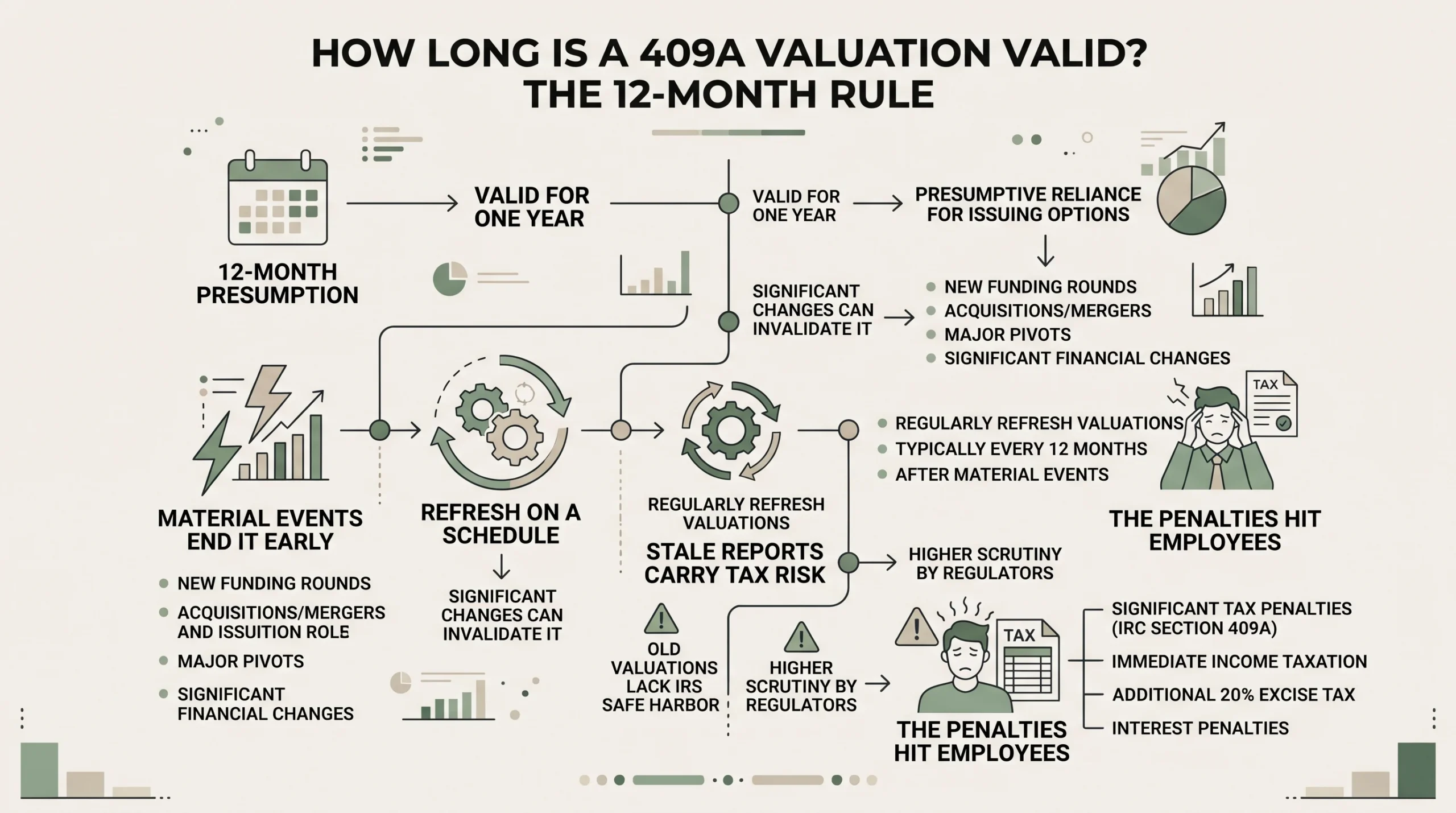
A 409A valuation is valid for up to 12 months from the valuation date, but less if the business changes in a meaningful way. The IRS gives a qualified, independent appraisal a safe harbor, and under that safe harbor the valuation is presumed reasonable for up to 12 months. That presumption does not run on its own for the full year. A material event, such as a new priced funding round, can end it sooner.
Sofer Advisors builds these valuations for founders, CPAs, and attorneys.
This guide explains the 12-month rule, what ends it early, and what happens if you grant options on a stale report.
Key Takeaways
- 12-month presumption: An independent-appraisal 409A is presumed reasonable for up to 12 months from the valuation date.
- Material events end it early: A priced round, an acquisition offer, or a planned IPO can void the presumption before 12 months pass.
- Refresh on a schedule: A company that grants options needs a fresh 409A at least every 12 months, even with no event.
- Stale reports carry tax risk: Options priced below fair market value can be treated as noncompliant deferred compensation.
- The penalties hit employees: A failed option triggers income inclusion, a 20% additional federal tax, and a premium interest tax.
What Is the 12-Month Safe Harbor Rule?
The safe harbor is a presumption set by Treasury Regulation 1.409A-1(b)(5)(iv). It says a qualified valuation is presumed reasonable. That presumption holds for up to 12 months from the valuation date. During that window, the company can price option grants off the same report.
The rule comes with conditions. The valuation must be done by someone qualified to do it. For most private companies, that means an independent appraisal. The method must be reasonable and applied in good faith. And no material event can have occurred since the valuation date.
The presumption matters most in an audit. If the IRS questions the stock price, the burden shifts. The IRS must show the valuation was grossly unreasonable. Without the safe harbor, the company carries that burden instead. That is why the 12-month window is worth protecting.
What Are the Three 409A Safe Harbors?
The regulation offers more than one path to the presumption. The independent appraisal is the most common. Two other methods also qualify a valuation as reasonable.
The first is the independent appraisal method. An outside, qualified appraiser values the stock. This path works for companies at almost any stage. It is the route most venture-backed startups use.
The second is the illiquid startup method. It is open to young private companies that meet set conditions. The business must be less than 10 years old. It cannot have publicly traded stock. And it cannot expect a sale or public offering in the near term. The valuation must be done by a person with real knowledge and experience. It also has to be in writing.
The third is the binding formula method. Here the company sets a formula to price the stock. The same formula must be used for all purposes, not just option grants. This path is less flexible, so fewer companies rely on it.
All three share the same payoff. They shift the burden of proof to the IRS in an audit. And all three still depend on the 12-month window and the absence of a material event.
What Events End the Window Early?
A material event is any change that could move the fair market value of the common stock. When one happens, the 12-month clock stops. The old report no longer carries the presumption. The company needs a fresh 409A before its next option grant.
Some events are clear triggers. A new priced financing round resets the equity price. An acquisition offer or a signed term sheet signals a market value. A secondary sale of shares shows what buyers will pay. A planned IPO changes the whole picture.
Performance can also be a trigger. Results that run far ahead of plan raise the value. Results that fall far behind lower it. A missed milestone or a shift in the business model can do the same. Any of these can end the safe harbor early.
The table below sorts common situations.
| Situation | New 409A needed? |
|---|---|
| Priced equity financing round | Yes |
| Acquisition offer or term sheet | Yes |
| Secondary sale of common stock | Yes |
| Large over- or under-performance | Yes |
| Planned IPO or business-model change | Yes |
| 12 months passed with no event | Yes, routine refresh |
| Small results inside the forecast | No |
Can You Extend a 409A Past 12 Months?
No. The safe harbor does not stretch past 12 months. Once the window closes, the presumption is gone. A new option grant priced off that report loses its protection. The only fix is a fresh valuation.
This is true even if nothing has changed. The 12-month limit is a hard ceiling, not a target. A company that keeps granting options needs a current report on file. Many boards schedule the refresh a little early to avoid a gap.
A gap is risky. Suppose the old report has expired and no new one exists. Option pricing then sits on weak ground. An auditor can set the stale report aside. The company must defend the price with no safe harbor behind it.
How Often Does a Company Need a New 409A?
At a minimum, once every 12 months. That is the baseline for any company that grants options. The safe harbor simply does not last longer than a year.
In practice, the pace is driven by events, not just the calendar. A fast-moving startup may raise capital, sign a term sheet, or hit a big milestone inside a single year. Each of those is a material event. Each one can call for a new valuation before the 12 months are up.
A stable, slow-changing company often fits the annual pattern well. Its value does not swing much from quarter to quarter. A company in a rapid growth phase is different. It should expect to refresh whenever a material event lands, not only on the anniversary.
How Does a 409A Fit Into Option Pricing?
A 409A gives the board a fair market value for the common stock. The board uses that figure to set the strike price on new options. The strike price should not sit below fair market value. When it does, the option can trigger the Section 409A penalties.
This is why timing matters so much. A strike price is only as sound as the valuation behind it. A current 409A supports a clean grant. A stale one puts every grant made against it at risk. Boards that grant options often keep a valid report on hand at all times.
What Makes a 409A Defensible?
A valuation earns the safe harbor only if it is sound. Three features carry the most weight.
First, the appraiser must be qualified and independent. The person needs real training in valuation work. Second, the method must be reasonable for the company. A common approach weighs income, market, and asset-based views of value. Third, the work must reflect current facts. That means recent financials, an up-to-date cap table, and honest forecasts.
A report that meets these tests tends to hold up. One that skips them invites a challenge. The goal is a file a reviewer can follow and trust. Good documentation is what turns a number into a defensible conclusion.
What Happens If You Use a Stale 409A?
The core risk is simple. If options are priced below fair market value, they can fail Section 409A. The grant is then treated as noncompliant deferred compensation. That label carries real tax cost. And the cost falls on the option holder.
Three things can follow. First, the option value is included in the employee’s income as it vests, not when they sell. Second, the IRS adds a 20% additional federal tax on that amount. Third, a premium interest tax applies under Section 409A(a)(1)(B).
The company feels it too. Payroll and withholding grow complicated. Employees may dispute how their equity was handled. In a later financing or sale, buyers run diligence on past grants. A stale or unsupported 409A is a flag they will raise.
A current, well-supported valuation avoids most of this. It keeps the safe harbor in place. It gives the board a defensible basis for the strike price. And it keeps the tax burden off employees who did nothing wrong.
Frequently Asked Questions
How long is a 409A valuation valid?
Up to 12 months from the valuation date, under the IRS safe harbor. That window assumes no material event occurs in the meantime. If one does, the valuation can expire sooner. Either way, a company that keeps granting options refreshes at least once a year.
When does the 12-month clock start?
It starts on the valuation date in the report, not the day you receive it. The report states the effective date of the opinion. Count 12 months forward from that date. Grants made after that point need a current valuation, unless a material event already forced a refresh.
What is a material event for 409A purposes?
It is any development that could change the fair market value of the common stock. Common examples are a priced funding round, an acquisition offer, or a secondary share sale. Big swings in performance and a planned IPO also count. When one occurs, the old valuation loses its safe harbor.
Does a new funding round require a new 409A?
Almost always, yes. A priced round sets a fresh market price for the company’s equity. That new price flows through to the common stock value. Relying on a pre-round valuation after a raise is high-risk and rarely holds up in an audit.
Can a 409A valuation be extended beyond 12 months?
No. The safe harbor has a firm 12-month limit. It cannot be renewed or stretched. To keep pricing options under the safe harbor, the company must get a new valuation.
Is a 409A valuation required every year?
A company needs a valid valuation whenever it grants options. Because the safe harbor lasts at most 12 months, any company granting options over time needs a fresh report each year. Many update more often when material events occur.
Who can perform a 409A valuation?
To claim the independent-appraisal safe harbor, the valuation should be done by a qualified, independent appraiser. The appraiser must use a reasonable method, applied in good faith. Other safe harbors exist in narrow cases, but the independent appraisal is the most defensible route.
What are the penalties for a noncompliant 409A?
If options are priced below fair market value, they can be treated as deferred compensation that fails Section 409A. The holder then faces several costs. The option value is included in income as it vests. The IRS adds a 20% additional federal tax. A premium interest tax also applies under Section 409A(a)(1)(B).
Is a 409A valuation a public record?
No. It is a private, internal document. A company does not have to publish it. Employees and investors usually learn the common stock price from the company or the board, not from a public filing.
Related Case Studies
- How Often Do You Need a 409A Valuation Update?
- 409A Valuation for Startups: Complete Compliance Guide 2025-2026
- 409A Valuation Requirements: Complete Compliance Guide 2025
Executive Summary
An independent-appraisal 409A is presumed reasonable for up to 12 months from the valuation date. A priced round, an acquisition offer, or a planned IPO can void the presumption before 12 months pass. A company that grants options needs a fresh 409A at least every 12 months, even with no event. Options priced below fair market value can be treated as noncompliant deferred compensation. A failed option triggers income inclusion, a 20% additional federal tax, and a premium interest tax.
What Should You Do Next?
Check the date on your current 409A. If it is close to 12 months old, or if a material event has occurred, plan a refresh before your next option grant. Sofer Advisors provides independent 409A valuations, led by David Hern CPA ABV ASA CVA. Schedule a free consultation to discuss your situation.
People Also Read
- What Happens If You Skip a 409A Valuation: Penalties
- 409A vs 8-K Valuation: Key Differences for Startups
About the Author
This guide was prepared by David Hern CPA ABV ASA CVA, founder of Sofer Advisors, a business valuation firm headquartered in Atlanta, GA serving clients across the United States. David holds accreditations as an Accredited Senior Appraiser (ASA) and is Accredited in Business Valuation (ABV), credentials recognized by the IRS, SEC, and FINRA, and is also a Certified Valuation Analyst (CVA). David has served as an expert witness in dozens of cases across multiple jurisdictions, and Sofer Advisors is an Inc. 5000 honoree in 2024 and 2025 with 240+ five-star Google reviews.
For professional business valuation services, visit soferadvisors.com/about-us/ or contact Sofer Advisors at soferadvisors.com/contact-us/.
Disclaimer: This content is for informational purposes only and does not constitute professional valuation advice. Business valuation conclusions depend on specific facts and circumstances. Contact Sofer Advisors for guidance regarding your specific situation.