


Last Updated: November 2026
IRC Section 6166 lets the executor of an estate pay the federal estate tax tied to a closely held business in installments, rather than all at once about nine months after death. The relief can stretch the payments across roughly 14 years, which can save a family from selling the business just to cover the bill. To qualify, the value of the business interest must be more than 35% of the adjusted gross estate.
The team at Sofer Advisors prepares valuations that support both the reported value and the 35% threshold for owners, executors, and their advisors.
This guide explains who qualifies, how the installment schedule works, how interest is charged, and what can end the deferral early.
Key Takeaways
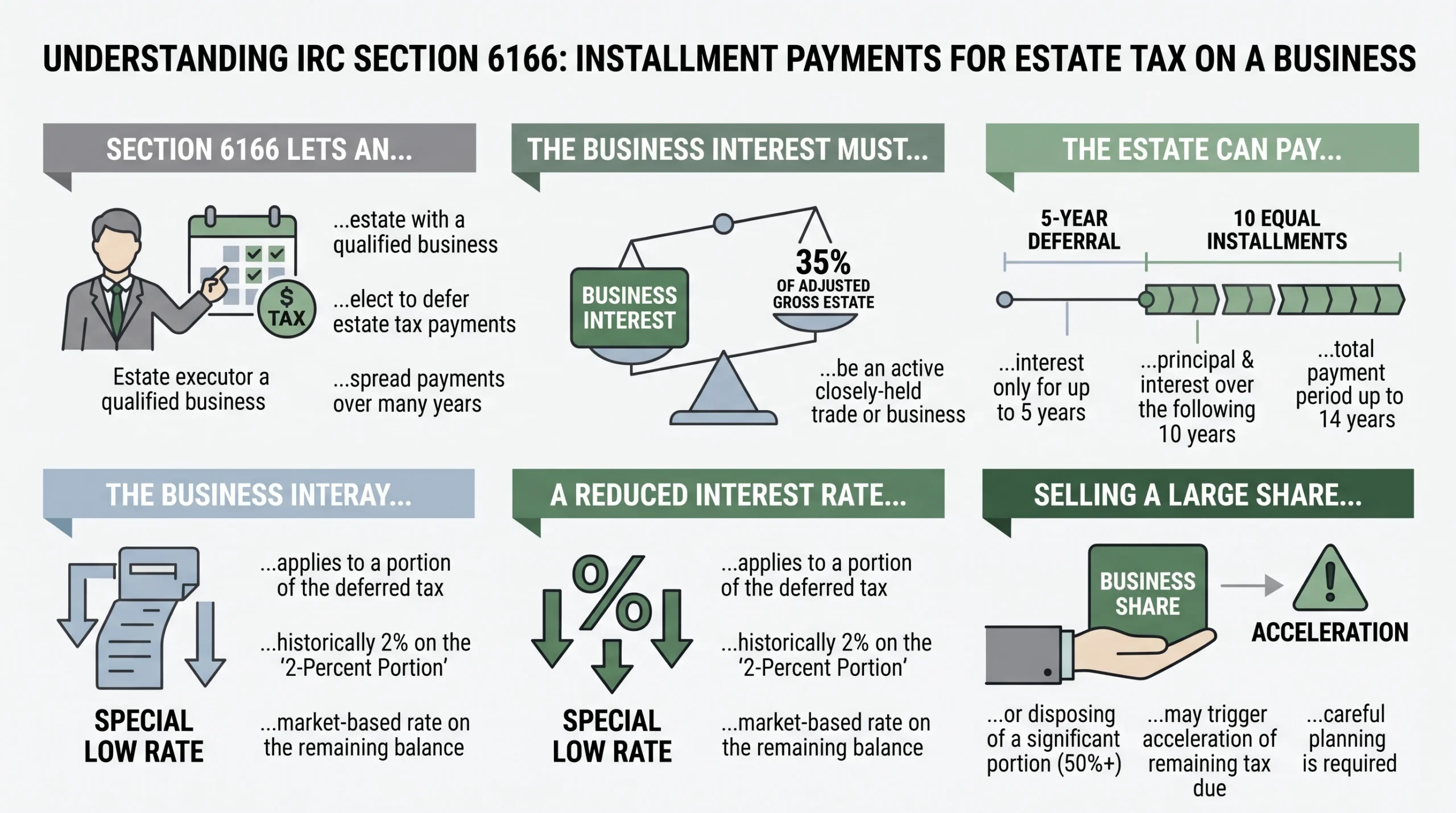
- Section 6166 lets an executor pay estate tax on a closely held business in installments, not all at once.
- The business interest must exceed 35% of the adjusted gross estate to qualify.
- The estate can pay interest only for up to 5 years, then pay the tax over up to 10 annual installments.
- A reduced interest rate applies to the tax on a limited, inflation-indexed portion of the business value.
- Selling a large share of the business, or missing a payment, can trigger immediate payment of the full balance.
What is Section 6166 and who qualifies?
Section 6166 is a relief provision in the federal tax code. It applies to estates that hold an interest in a closely held business. The executor can elect to pay the estate tax on that interest over time. The goal is simple. It helps the family keep the business running instead of selling it to raise cash.
The provision exists to solve a cash problem. Many families hold most of their wealth inside a private business. The business is valuable, but it is not liquid. Selling it quickly to pay a tax bill can destroy value. Section 6166 gives the estate time instead.
The main test is the 35% rule. The value of the closely held business interest must be more than 35% of the adjusted gross estate. The adjusted gross estate is the gross estate less certain deductions and expenses. If the business does not clear that bar, the estate cannot use Section 6166.
The law also defines a closely held business. A sole proprietorship counts. A partnership counts if the estate includes at least 20% of its capital interest, or if it has 45 or fewer partners. A corporation counts under the same 20% rule, or if it has 45 or fewer shareholders. The business must carry on an active trade or business. Passive holdings, like idle investments, do not count toward the test.
Several businesses can sometimes count as one. If the estate holds 20% or more of each, the law may let the executor combine them to meet the 35% test. This rule helps families that own more than one company. Each interest still has to be an active business, not a passive asset.
The executor makes the election on the estate tax return, Form 706. The election is due with a timely filed return. Careful planning before that deadline matters, since the choice is hard to undo. A tax advisor should confirm that the estate meets each part of the test.
How does the installment schedule work?
The schedule has two phases. In the first phase, the estate can pay interest only. This phase runs for up to 5 years. During that time, the estate defers the principal and keeps its cash working in the business.
In the second phase, the estate pays the tax in installments. It can spread the principal over up to 10 annual payments. The first principal payment comes due no more than 5 years after the original due date. Each later installment then falls due once a year.
Put together, the two phases can stretch the payments across about 14 years. That long runway is the heart of the relief. It gives the family time to fund the tax from business earnings. The alternative is often a rushed sale at a poor price.
The estate still files and reports on time each year. The executor tracks every due date closely. A single late payment can put the whole plan at risk, as the next section explains.
What interest rate applies to the deferred tax?
Interest still accrues on the unpaid tax. Section 6166 splits that interest into two parts. A reduced rate, often called the 2-percent rate, applies to the tax on a limited portion of the business value. That portion is indexed for inflation each year.
The tax above that portion accrues at a reduced regular rate. This rate is a fraction of the standard underpayment rate the IRS sets. Both parts together lower the cost of carrying the tax over the years.
The exact dollar figures change every year with inflation. Because of that, an executor should confirm the current numbers before relying on them. An estate tax advisor can supply the figures that apply in the year of death. The interest is not deductible, so the real cost deserves a close look.
The split matters most for larger estates. A big share of the tax may fall into the higher-rate part. The estate should model both parts before it elects. That way the family knows the true cost of spreading the payments out.
How is the business valued for the 35% test?
The 35% test turns on value. So the estate needs a sound fair market value for the business interest. Value is measured as of the date of death. That figure decides both the tax and whether the estate clears the 35% bar.
Appraisers follow long-standing IRS guidance here. Revenue Ruling 59-60 lays out the factors to weigh. These include earnings, asset values, and the nature of the business. A credentialed valuation applies those factors and documents the result in a clear report.
A strong report does two jobs. It supports the value on Form 706. It also helps the estate defend that reported value if the IRS reviews the return. Weak support can push the interest below 35%. That would cost the estate the election and the deferral with it.
What can accelerate the remaining tax?
Some events end the deferral early. The tax code calls this acceleration. When it happens, the IRS can demand the full unpaid balance at once.
Two triggers are common. The first is disposition. If the estate sells or withdraws 50% or more of the business interest, the deferral can end. The second is a missed payment. If the estate fails to pay an installment or the interest on time, the balance can come due.
Not every change counts as a disposition. Certain reorganizations and transfers to heirs may be allowed. Each transaction needs a close review against the rules before the estate acts. A single misstep can undo years of planning.
There is also a rule about undistributed income. If the business holds back cash instead of paying the tax, that too can speed up the balance. The estate must put available earnings toward the installments. Planning around this rule keeps the deferral in place.
Good records help here too. The executor should document each transfer and payment. That paper trail shows the IRS that the estate still qualifies year after year.
How does Section 6166 compare to other options?
Section 6166 is one tool among several. An estate may also use a Section 303 stock redemption, or simply pay the tax in a lump sum. The right choice depends on the estate’s cash, the business, and the family’s goals.
A lump sum ends the matter fast, but it needs cash on hand. A Section 303 redemption lets a corporation buy back stock to raise cash for taxes and costs. Section 6166 spreads the tax out and keeps the business intact. Many estates combine these tools rather than pick just one.
| Option | Best for | Timing |
|---|---|---|
| Section 6166 election | Cash-poor estates with an active business | Up to about 14 years |
| Section 303 redemption | Raising cash from company stock | Varies with the redemption |
| Lump-sum payment | Estates with enough liquid assets | About 9 months after death |
The common thread is documentation. A defensible valuation supports whichever path the estate takes. It also stands up best if the IRS asks questions later. An executor should weigh each option with a tax advisor early in the process.
Frequently Asked Questions
How does IRC Section 6166 work?
It lets an executor pay estate tax on a closely held business over time. The estate can pay interest only for up to 5 years. It then pays the tax in up to 10 annual installments. The business interest must exceed 35% of the adjusted gross estate to qualify.
What counts as a closely held business?
A sole proprietorship counts. A partnership counts if the estate holds at least 20% of its capital, or if it has 45 or fewer partners. A corporation counts under the same 20% rule, or if it has 45 or fewer shareholders. The business must run an active trade or business.
Which form is used to make the election?
The executor elects Section 6166 on Form 706, the federal estate tax return. The election must ride along with a timely filed return. Missing the deadline can forfeit the option.
What is the 2-percent interest portion?
A reduced rate applies to the tax on a limited slice of the business value. That slice is indexed for inflation each year. Tax above the slice accrues at a reduced regular rate. The exact figures change annually, so confirm the current ones.
Can you make a protective Section 6166 election?
Yes. An executor can file a protective election when it is unclear if the estate meets the 35% test. This preserves the right to pay in installments. It helps if a later audit changes the estate’s or the business’s value.
What assets do not qualify for Section 6166?
Passive assets do not qualify. Idle investments, and holdings that do not support an active business, fall outside the relief. The entity must conduct real operations. Documentation should show that activity clearly.
What can trigger acceleration of the tax?
Selling or withdrawing 50% or more of the business interest can end the deferral. So can a missed installment or interest payment. In either case, the IRS can demand the full remaining balance at once.
How long can the deferral last?
The payments can span about 14 years from the original due date. That includes up to 5 years of interest-only payments. It then allows up to 10 annual installments of both principal and the remaining interest.
What if the IRS disputes the valuation for the 35% test?
A lower value could push the business interest below 35% and end eligibility. A well-documented, independent appraisal is the best defense. It supports the reported value and the estate’s right to elect.
Related Case Studies
- Section 6166: Deferring Estate Tax on a Business
- Installment Sale of a Business: Tax Deferral and Buyer Pushback
- Closely Held Business Valuation for Estate Tax: Atlanta Guide
Executive Summary
Section 6166 lets an executor pay estate tax on a closely held business in installments, not all at once. The business interest must exceed 35% of the adjusted gross estate to qualify. The estate can pay interest only for up to 5 years, then pay the tax over up to 10 annual installments. A reduced interest rate applies to the tax on a limited, inflation-indexed portion of the business value. Selling a large share of the business, or missing a payment, can trigger immediate payment of the full balance.
What Should You Do Next?
Start by estimating whether the business clears the 35% test. Gather recent financials and a current date-of-death value. If the numbers are close, a protective election may be worth a look. Sofer Advisors prepares independent valuations that support a Section 6166 election, led by David Hern CPA ABV ASA CVA. Schedule a consultation to review your estate’s situation, and coordinate the plan with your own estate attorney and tax advisor.
People Also Read
- Valuation of Closely Held Business for Estate Tax Purposes
- Estate Planning Business Valuation Georgia: Gift & Tax Compliance Guide
About the Author
This guide was prepared by David Hern CPA ABV ASA CVA, founder of Sofer Advisors, a business valuation firm headquartered in Atlanta, GA serving clients across the United States. David holds accreditations as an Accredited Senior Appraiser (ASA) and is Accredited in Business Valuation (ABV), credentials recognized by the IRS, SEC, and FINRA, and is also a Certified Valuation Analyst (CVA). David has served as an expert witness in dozens of cases across multiple jurisdictions, and Sofer Advisors is an Inc. 5000 honoree in 2024 and 2025 with 240+ five-star Google reviews.
For professional business valuation services, visit soferadvisors.com/about-us/ or contact Sofer Advisors at soferadvisors.com/contact-us/.
Disclaimer: This content is for informational purposes only and does not constitute professional valuation advice. Business valuation conclusions depend on specific facts and circumstances. Contact Sofer Advisors for guidance regarding your specific situation.