


Last Updated: September 2026
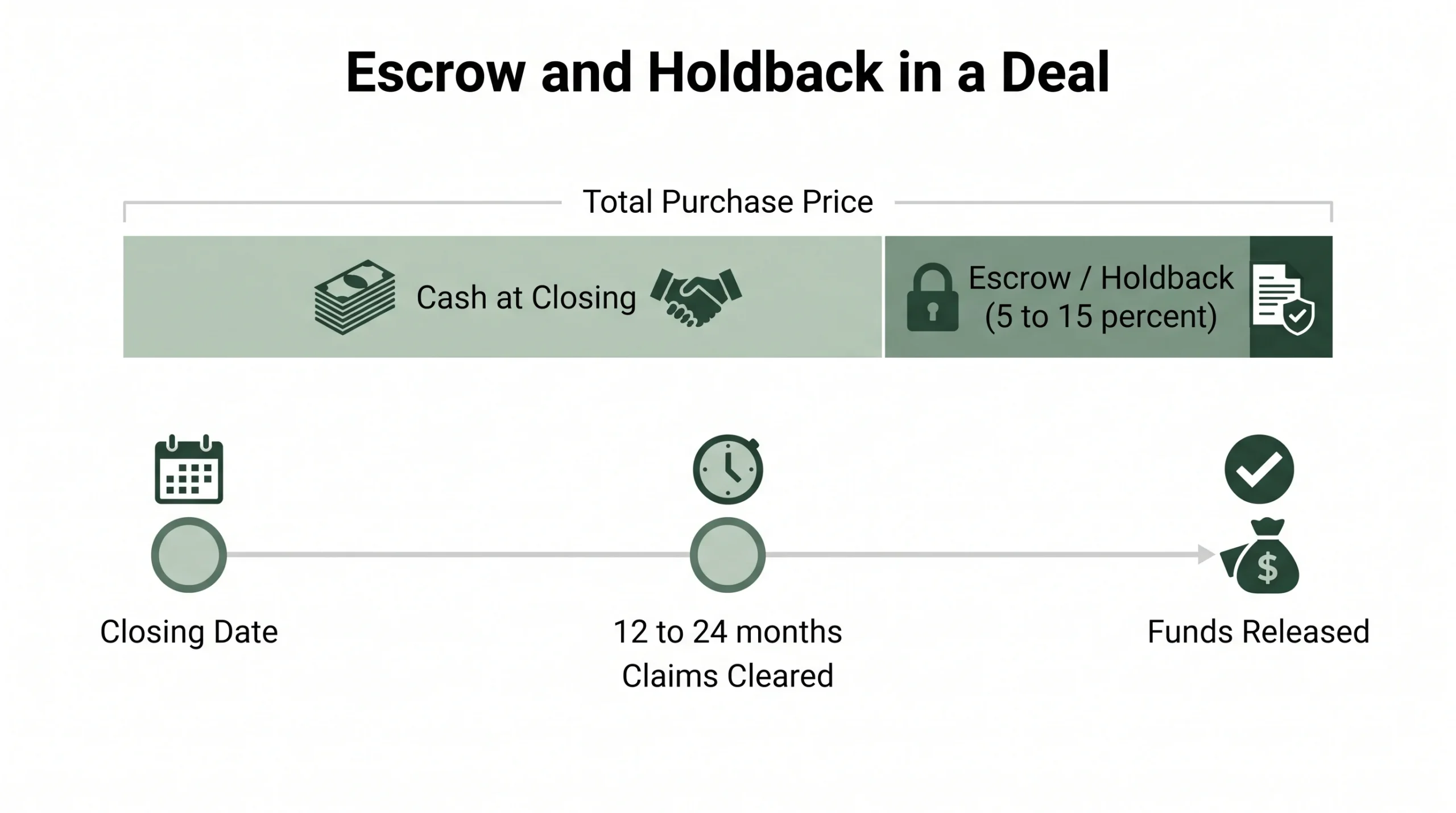
An escrow or holdback in an M&A deal is a slice of the purchase price kept back at closing instead of paid to the seller. A third-party escrow agent usually holds the cash. The money secures the seller’s promises. It covers representations and warranties, indemnification obligations, and any post-closing price adjustment, such as a working-capital true-up. A common holdback runs about 5% to 15% of deal value and sits in escrow for 12 to 24 months.
The valuation question is easy to state and easy to get wrong. The seller is not sure it will collect the full amount, so the held cash is worth less than its face value today. The buyer wants enough cover without overpaying for a risk that may never appear. Both sides need a present value for money that is at risk and deferred.
Sofer Advisors provides neutral, third-party valuations for buyers and sellers working through a deal. The firm brings a Heart of a Teacher approach to complex deal terms, backed by 180+ five-star Google reviews and expert witness testimony in 11+ cases. Its analysts price escrow and holdback terms the way an accountant and a court would read them.
Key Takeaways
- Escrow secures the seller’s promises: a holdback withholds part of the price to cover indemnity claims, breached reps and warranties, and price adjustments.
- Size is typical, not fixed: most holdbacks run 5% to 15% of deal value for 12 to 24 months, set by risk, not a formula.
- At-risk cash is worth less today: the held amount is valued at present value, discounted for claim risk and the wait to release.
- A holdback is not an earnout: a holdback returns fixed money unless a claim reduces it, while an earnout pays more only if the business performs.
- Reporting may need fair value: a payout tied to a future event can count as contingent consideration measured at fair value under ASC 805.
These points shape both the deal terms and the accounting. The sections below show how each side prices the held amount.
What is an escrow or holdback in a deal?
An escrow or holdback is money the buyer keeps back at closing to protect against problems that surface later. The buyer pays most of the price up front. It parks the rest with a neutral agent or, in a pure holdback, on its own books. If the seller breaks a promise or a claim lands, the buyer draws from that pool first. If nothing goes wrong, the seller collects the full amount at the end.
The held cash guards three things. It covers a breach of the reps and warranties in the contract. It funds the seller’s indemnification duties for known or hidden liabilities. It also settles a post-closing adjustment, most often a working-capital true-up. Our guide to the working capital peg shows how that true-up can move the final price.
How is the at-risk amount valued?
The held amount is valued at its present value, not its face value. The cash is at risk and it is deferred, so both traits cut its worth today. A valuer starts with the face amount, weighs the chance of a claim, then discounts the expected payout to today at a rate that fits the risk and the wait.
This is a probability-weighted, present-value job. The analyst studies the diligence findings, the survival period for the reps, and the claim history in similar deals. A clean target supports a small risk weight; a messy one supports a larger weight. Sofer Advisors values these positions from the buyer side and the seller side, since each party books the same dollars in a different way.
How does a holdback differ from an earnout?
A holdback and an earnout both defer part of the price, but they point in opposite directions. A holdback is money the seller expects to receive. It comes back in full unless a claim reduces it. An earnout is money the seller might earn on top. It pays out only if the business hits agreed targets after closing. The table below sets the two side by side.
| Feature | Escrow or holdback | Earnout |
| Purpose | Protects the buyer from breaches and claims | Bridges a gap on future value |
| Direction | Money the seller expects back | Money the seller may still earn |
| Trigger | A claim reduces it; silence releases it | Hitting revenue or profit targets |
| Base amount | Part of the fixed price | Extra pay above the fixed price |
The line matters because the two are valued and reported in different ways. Our explainer on what an earnout is covers the performance side in depth. A holdback stays closer to the fixed price, while an earnout leans on a forecast.
What sets the holdback percentage and timing?
The percentage and the term come from risk, not a set rule. A buyer sizes the holdback against the reps it worries about most and the gaps diligence turns up. A cleaner target and a shorter list of concerns push the number toward the low end near 5%. A riskier target or a thin set of records push it toward 15% or beyond. The main drivers are:
- The depth and results of buyer quality of earnings and diligence work
- The survival period for the reps and warranties in the contract
- The size and odds of tax, legal, or environmental exposure
- Whether the deal carries reps and warranties insurance
Timing tracks those same risks. Most escrows release after 12 to 24 months, long enough for a full tax year and an audit cycle to pass. Some deals split the release, freeing part at 12 months and the rest at 24. A seller wants a small holdback for a short term. A buyer wants a larger pool held longer.
How is a contingent holdback reported?
Reporting depends on whether the payout is fixed or contingent. A plain indemnity holdback is part of the fixed price the buyer already agreed to pay. It sits inside the consideration transferred, and the buyer may book an indemnification asset for expected recoveries. This is standard purchase accounting, covered in our guide to purchase price allocation under ASC 805.
A holdback that pays out only on a future event is different. When the payment depends on an outcome, it can count as contingent consideration measured at fair value under ASC 805. The buyer estimates the fair value at the acquisition date, weights the possible outcomes, and discounts them to present value. The AICPA guidance on business combinations and the SEC Financial Reporting Manual both confirm that contingent consideration enters the purchase price at acquisition-date fair value. Later changes in that value flow through earnings. Sofer Advisors builds these fair value models for financial reporting and for the deal itself.
Which provider prices deal terms best?
Owners choose among independent valuation firms, large advisory shops, and deal brokers. All three can put a number on an escrow, but their incentives and standards differ. An independent firm follows valuation standards and stays neutral. A broker often treats the number as a step toward closing a sale. Large firms such as Alvarez & Marsal, Stout, and Kroll serve the biggest cross-border deals. The table compares the options.
| Provider type | Service focus | Conflict of interest |
| Sofer Advisors | Neutral, defensible opinion of value | None; fee is flat, not tied to a sale |
| Deal broker | Marketing and closing a listing | High; commission based on price |
| Large advisory firm | Enterprise and cross-border deals | Moderate; success fees on the deal |
The Sofer Difference runs through four phases: Discovery, Diligence, Analysis, and Delivery. In Discovery the team learns the deal and the risks behind the holdback. In Diligence it reviews the reps, the survival terms, and the findings. In Analysis it builds the present-value model for the held cash. In Delivery it hands over a report that holds up in negotiation and review. That work fits within its transaction advisory practice, which keeps the appraisal separate from any broker fee.
Escrow terms reward careful risk pricing and a neutral hand. The questions below cover what buyers and sellers ask most.
Frequently Asked Questions
What is the typical escrow amount for an M&A transaction?
The typical escrow runs about 5% to 15% of the deal value, though the exact figure depends on the risk. A clean target with strong records sits near the low end. A riskier target or a thinner diligence file sits higher. The number is a starting point for negotiation, not a hard rule, and it moves with the reps at stake and the odds of a claim.
What is a holdback in M&A?
A holdback is part of the purchase price the buyer keeps back at closing rather than paying it all to the seller. It gives the buyer a ready source of funds if the seller breaks a promise or a claim appears after the deal closes. If no valid claim lands during the holdback term, the seller receives the full amount when the period ends.
What does escrow holdback mean?
An escrow holdback means the retained money is placed with a neutral third-party agent instead of held by the buyer. The agent releases the funds only under the terms in the escrow agreement. This setup gives the seller comfort that the money exists and is not simply on the buyer’s books. It also gives the buyer a clear process to draw on the funds if a claim is valid.
Who pays for an escrow holdback?
The seller funds the holdback in effect, because the money comes out of the price the seller would otherwise receive at closing. The buyer keeps the cash back rather than paying it over. The two sides usually split the escrow agent’s fee, though the split is a point of negotiation. The seller still owns the claim to the funds unless a valid indemnity claim reduces the balance.
How is an escrow or holdback valued?
An escrow is valued at present value, not face value, because the cash is at risk and deferred. A valuer weighs the chance of a claim against the face amount, then discounts the expected release back to today. The discount reflects both the wait and the risk. A clean deal supports a value close to face, while a risky one supports a larger markdown from face value.
What is the difference between an escrow and an earnout?
An escrow protects the buyer and holds money the seller expects back unless a claim reduces it. An earnout rewards the seller and pays more only if the business hits future targets. An escrow leans on the fixed price, while an earnout leans on a forecast. The two are valued in different ways, so a deal that mixes both needs a separate model for each piece.
How long does an M&A escrow last?
Most M&A escrows last 12 to 24 months, long enough for a full tax year and an audit cycle to pass. The term tracks the survival period for the reps and warranties in the contract. Some deals stage the release, freeing part at 12 months and the balance at 24. A longer term protects the buyer more, while a shorter term returns cash to the seller sooner.
How is contingent consideration measured under ASC 805?
Contingent consideration is measured at fair value on the acquisition date under ASC 805. The buyer weights the possible payouts by their odds, then discounts them to present value. That fair value enters the purchase price at closing. After closing, changes in the estimate usually flow through earnings until the amount settles. A fixed indemnity holdback is treated differently, since it is already part of the price the buyer agreed to pay.
How much does an escrow or holdback valuation cost?
An escrow or holdback valuation from Sofer Advisors typically runs $15,000 to $50,000 and takes six to twelve weeks, in line with its purchase price allocation work under ASC 805, since a contingent payout uses the same fair value tools. Cost depends on deal size and the number of contingent pieces to model. For a quote tied to your deal, contact our team with your term sheet.
Related Case Studies
- Negotiating Earnouts: 4 Seller-Friendly Structures Beyond the Basics
- Mid-Market M&A Due Diligence Checklist: 14 Categories Buyers Review
- Asset Sale vs Stock Sale: Tax and Deal Structure Guide
Executive Summary
An escrow or holdback keeps 5% to 15% of the M&A purchase price back at closing, usually with a neutral agent, for 12 to 24 months. The held cash secures the seller’s reps and warranties, its indemnity duties, and post-closing price adjustments. Because the money is at risk and deferred, it is valued at present value, not face value. A holdback differs from an earnout, which pays only on future performance. A payout tied to a future event can count as contingent consideration measured at fair value under ASC 805. A neutral opinion sets a firm base for both sides.
What Should You Do Next?
Map the reps and warranties that carry the most risk, then size the holdback against the diligence findings rather than a round number. Ask for a present-value opinion on the held cash so you negotiate on real worth, not face value. Settle the release schedule and the reporting treatment before you sign, since a contingent payout may need a fair value model under ASC 805.
David Hern CPA ABV ASA, founder of Sofer Advisors, provides neutral, defensible valuations for buyers and sellers in transactions. Schedule a consultation to discuss your deal.
People Also Read
About the Author
This guide was prepared by David Hern CPA ABV ASA, founder of Sofer Advisors, a business valuation firm headquartered in Atlanta, GA serving clients across the United States. David holds dual accreditations as an Accredited Senior Appraiser (ASA) and is Accredited in Business Valuation (ABV), credentials recognized by the IRS, SEC, and FINRA. He also holds the Certified Exit Planning Advisor (CEPA) designation. With 15+ years of valuation experience, David has served as an expert witness in 11+ cases across multiple jurisdictions and built Sofer Advisors into an Inc. 5000-recognized firm with 180+ five-star Google reviews. Its full W2 employee team maintains subscriptions to all major valuation databases and operates under a next business day response policy.
For professional business valuation services, visit soferadvisors.com/about-us/ or contact Sofer Advisors at soferadvisors.com/contact-us/.
Disclaimer: This content is for informational purposes only and does not constitute professional valuation advice. Business valuation conclusions depend on specific facts and circumstances. Contact Sofer Advisors for guidance regarding your specific situation.









