


Last Updated: June 2026
The working capital peg is a contractual mechanism in M&A deals. It defines how much net working capital the seller must leave in the business at closing. It also adjusts the purchase price up or down based on whether the actual amount delivered exceeds or falls short of that target. Sellers who do not understand how the peg is set routinely walk away from closing with far less than they expected. The shortfall can range from $200,000 to $1,000,000 below the headline deal price they celebrated when signing the letter of intent.
The peg matters because of a fundamental asymmetry: buyers negotiate pegs; sellers react. When a buyer delivers a purchase agreement with a defined working capital target and a true-up mechanism, the specific numbers often receive less attention from sellers than the headline price. But the working capital adjustment is frequently a larger variable in final net proceeds than deal costs. Sellers who ignore it pay a steep price at closing. Sofer Advisors helps owners and their advisors work through exactly these questions and turn the analysis into a defensible business valuation they can act on.
The following takeaways summarize the key valuation and transaction factors covered in this guide.
Key Takeaways
- Working Capital Peg Defines – The working capital peg defines the adjusted level of net working capital that the seller must deliver at closing; deviation above or below the peg adjusts the final purchase price.
- Pegs Set Trailing 12month – Most pegs are set as a trailing 12-month average of net working capital – but the specific trailing period, inclusion/exclusion of items, and calculation method are all negotiable.
- Sellers Frequently Lose 200K – Sellers frequently lose $200K–$1M+ at closing through working capital shortfalls that they did not anticipate because they did not model the peg against historical actuals.
- Cash Almost Always Excluded – Cash is almost always excluded from working capital in a cash-free, debt-free deal structure – but what counts as “cash” and what counts as “debt” requires precise contractual definition.
- Deferred Revenue One Contested – Deferred revenue is one of the most contested working capital items – buyers want it included as a liability; sellers often argue it represents future obligation, not a working capital deficiency.
- Financial Advisor Certified Valuator – A financial advisor or certified valuator reviewing the target peg before LOI signing is the most cost-effective protection a seller can buy in any M&A deal.
Each of these factors is examined in depth in the sections that follow.
What Is a Working Capital Peg and Why Does It Exist?
In almost all middle-market M&A deals, the deal is structured on a cash-free, debt-free basis. This means the seller keeps all cash in the business at closing. The seller also pays off all funded debt before or at closing. The buyer acquires the working business free of cash and debt.
Working capital is what remains: current assets (accounts receivable, inventory, prepaid expenses) minus current liabilities (accounts payable, accrued liabilities, accrued pay). This is the short-term working liquidity of the business, the fuel that keeps it running between customer payments and vendor invoices.
The working capital peg exists because without a defined target, a seller could strip working capital before closing. They could collect AR aggressively, delay AP payments, and run down inventory, leaving the buyer with a business that cannot operate at day one without an immediate cash injection. The peg protects the buyer from receiving a “hollowed out” business.
From the seller’s perspective, the peg should reflect normal, steady-state working requirements. It should not reflect a maximum or a peak. Setting the peg at or above normal operations effectively requires the seller to leave extra value in the business at closing.
Analysis at this level is the work of a credentialed valuation professional operating under the AICPA Statement on Standards for Valuation Services, which governs how a defensible conclusion of value is developed and documented.
How Is the Working Capital Peg Calculated?
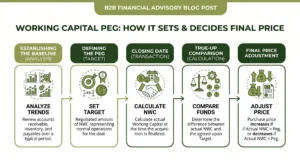
Buyers typically prepare a working capital schedule using the seller’s historical monthly financial statements. They calculate the average net working capital over the trailing 12 months. That average becomes the target peg. The trailing period is almost always negotiable.
The calculation includes: accounts receivable (net of allowance for doubtful accounts), inventory (at cost or net realizable value depending on the definition), and prepaid expenses. It excludes: cash, the current portion of funded debt, deferred revenue (often, see below), and items the parties agree are one-time or unusual.
The disputes begin in the definitions. Consider the following examples:
Accounts receivable: Should the peg AR include current AR only (under 90 days), or all AR including aged receivables? A seller with $500,000 in AR over 180 days might argue those should be in working capital. A buyer argues they are uncollectible and worth zero.
Inventory: Is inventory valued at cost, FIFO, or weighted average? Does slow-moving inventory get written down, and who decides what is obsolete?
Accrued liabilities: Does the peg include accrued but unpaid bonus or vacation? These can be $200,000–$500,000 for a mid-sized business.
Deferred revenue: Buyers say deferred revenue is a working capital liability. Sellers often say no, the cash was already swept out and the obligation is working, not financial.
The table below illustrates a simplified working capital calculation with common line-item disputes:
| Working Capital Component | Typical Inclusion | Common Dispute |
|---|---|---|
| Accounts receivable (current, <90 days) | Yes | Aged AR cutoff, allowance method |
| Inventory | Yes | Valuation method, obsolescence write-down |
| Prepaid expenses | Yes – current year only | Multi-year prepaid allocation |
| Accounts payable | Yes (as liability) | Timing of large vendor payments pre-close |
| Accrued liabilities | Yes (as liability) | Accrued bonus, accrued vacation |
| Deferred revenue | Disputed | Buyer includes; seller often excludes |
| Customer deposits | Disputed | Long-term vs short-term distinction |
| Cash | Excluded | What counts as “cash” (restricted cash?) |
| Current portion of debt | Excluded | What qualifies as “debt” |
What Is the Difference Between Locked Box and Completion Accounts?
Two primary deal structures govern how working capital adjustments work in practice: completion accounts and locked box.
Completion accounts are the dominant structure in North American M&A. They set a target working capital peg at signing. Actual working capital is then calculated at closing. The difference between actual and target adjusts the purchase price, dollar for dollar. Neither party knows the final number until the true-up is complete.
Locked box structures fix the purchase price by reference to a specific historical balance sheet date, the “locked box” date. The seller cannot extract value (“leakage”) from the business after that date. There is no post-closing true-up. There is no working capital dispute.
Locked box favors sellers because it provides price certainty at signing. When a locked box is not available, sellers should negotiate completion accounts protections: a narrow definition of working capital and a tight timeline for the buyer’s working capital certificate (typically 60–90 days post-close).
Why Do Sellers Frequently Lose Money on Working Capital Adjustments?
Sellers lose money on working capital adjustments for several reasons:
The peg was set without the seller modeling actual deliverability. A buyer proposes a $2.3M working capital target based on TTM averages. The seller agrees without running their own monthly calculation to verify that $2.3M is achievable at the closing date. At closing, actual working capital is $1.9M. The seller owes $400,000 back to the buyer.
Seasonality creates a timing trap. A business with seasonal revenue patterns may have high AR in November (post-peak season) and low AR in February (pre-season). If the deal closes in February, the seller may be structurally unable to hit the TTM average target.
Pre-close cash management destroys working capital. Sellers who accelerate collections or delay payments in the weeks before closing can create a working capital shortfall. Lower AR (because you collected it) reduces working capital below the target.
Accruals are missed. Sellers often do not include accrued but unpaid pay, vacation, or bonus in their closing balance sheet. A $250,000 accrued bonus not included in the seller’s estimate becomes a $250,000 working capital shortfall.
David Hern CPA ABV ASA, founder of Sofer Advisors, brings a Heart of a Teacher to every engagement – translating complex valuation methodology into clear, actionable guidance that clients can act on before and after the report is delivered. With 15+ years of valuation experience, 11+ expert witness cases across multiple jurisdictions, and 180+ five-star Google reviews, David built Sofer Advisors into an Inc. 5000-recognized firm. The Sofer Difference is a four-phase process of Discovery, Diligence, Analysis, and Delivery that ensures every conclusion is defensible, documented, and tied to the specific facts of the business.
While national firms like Stout and Kroll serve large enterprise clients, Sofer Advisors specializes in middle-market businesses that require personalized attention, direct access to credentialed professionals, and a next business day response policy.
How to Negotiate a Seller-Favorable Working Capital Peg
Sellers who engage working capital negotiations proactively have much better outcomes. The key is to act at the LOI stage, not in the purchase agreement. The single most important step is to perform their own working capital analysis before signing the LOI. If the buyer proposes a target that exceeds the historical average, that is a negotiation point, not an immutable fact.
Specific seller-favorable negotiation positions:
Use a trailing period that excludes seasonality distortions. If the business is seasonal and the TTM average includes an anomalous peak, negotiate for a longer trailing period (18 months) or a method that excludes the top and bottom months.
Narrow the working capital definition. Exclude contested items (deferred revenue, aged AR, obsolete inventory) from the target by defining working capital precisely in the purchase agreement.
Define the dispute resolution mechanism explicitly. If the buyer and seller disagree on the final working capital calculation, the standard is an independent accounting firm, with costs split. Sellers should negotiate to have a specific, mutually-agreed accountant named in the agreement.
Set a collar. A “collar” or “dead band” is a range around the target within which no price adjustment is made. A collar of ±$100,000 eliminates disputes over small amounts.
Consider a locked box structure. For deals where the seller has leverage, advocating for a locked box eliminates post-closing uncertainty entirely.
How Does a Valuation Expert Protect Sellers in Working Capital Negotiations?
A certified valuation professional provides two specific services: independent calculation review and expert support in post-closing disputes.
Before the deal, a valuation advisor reviews the buyer’s proposed peg. They also model the sensitivity of the closing date true-up. This analysis typically costs $5,000–$20,000 for a mid-market deal. It has a direct payoff when it identifies a $200,000+ favorable adjustment to the target.
Post-closing, working capital disputes go to an accounting arbitrator. The seller’s best asset is a financial expert who understands purchase accounting, GAAP, and the specific contract language. Sellers who represent themselves in post-closing arbitration consistently underperform those with professional representation.
The questions below address the most common issues business owners raise before engaging a qualified appraiser for a working capital peg negotiation engagement.
Frequently Asked Questions
What is a working capital peg in simple terms?
The working capital peg is the amount of short-term working liquidity (receivables minus payables, roughly) that the seller must leave in the business at closing. If you deliver more, you get a price increase; if you deliver less, the price decreases by the same amount.
How is the working capital peg typically set in a middle-market deal?
Most buyers propose the trailing 12-month average of monthly net working capital as the target. The specific period, the line items included, and the calculation method are all negotiable at the LOI stage.
What happens if actual working capital at closing is below the target?
The purchase price is reduced dollar-for-dollar by the shortfall. This adjustment often flows from escrow, so the seller may not feel the impact until the escrow is released.
Can a working capital dispute prevent a deal from closing?
Working capital disputes rarely prevent a deal from closing, both parties typically want the deal done. But a large disputed adjustment can delay closing or trigger earnout/escrow provisions that defer a significant portion of proceeds.
What is the escrow and holdback mechanism related to working capital?
Most purchase agreements escrow 5%–10% of the purchase price for 12–18 months to cover post-closing claims, including working capital adjustments. The working capital true-up is typically resolved within 90–120 days of closing.
How does deferred revenue affect the working capital peg?
Deferred revenue, cash received from customers for services not yet delivered, is treated as a current liability in GAAP accounting. Buyers typically want it included in working capital as a liability, which increases the target and makes it harder for the seller to achieve.
Should a seller accept the buyer’s proposed peg without analysis?
No. Sellers should always perform their own independent working capital calculation before signing the LOI. The buyer’s proposed peg may be technically correct but structured in a way that favors the buyer.
What does “locked box” mean and when should sellers request it?
A locked box fixes the purchase price to a specific historical balance sheet and eliminates post-closing working capital adjustments. Sellers with leverage, competitive processes, clean financials, sophisticated buyers, should request locked box structures when possible.
How long does a post-closing working capital dispute typically take to resolve?
Most purchase agreements require the buyer to deliver a working capital certificate within 60–90 days of closing. The full process, from closing to final resolution, typically takes 4–9 months.
Who pays for the accounting arbitrator in a working capital dispute?
Typically the losing party pays, or costs are split proportionally based on the outcome. The specific cost allocation is defined in the purchase agreement.
Related Case Studies
- Business Valuation For Mergers Buy Side Vs Sell Side
- Fairness Opinion In MA Atlanta What Georgia Business Owners And Boards Need To Know
- Selling A Business In Georgia Complete Exit Planning Guide 2026
Executive Summary
- The working capital peg adjusts the final purchase price based on how much short-term working capital the seller delivers at closing versus the defined target.
- Most pegs are set as the TTM average of monthly net working capital – but this method can be disadvantageous to sellers with growing or seasonal businesses.
- Engaging a financial advisor to review the peg at the LOI stage is the highest-ROI risk management step available to a selling business owner.
What Should You Do Next?
If you are in the process of selling your business, or early in planning an exit, the working capital peg is a critical deal term that deserves expert attention before you sign a letter of intent. David Hern CPA ABV ASA, founder of Sofer Advisors, holds dual ASA and ABV credentials recognized by the IRS, SEC, and FINRA, with 15+ years of valuation experience and 180+ five-star Google reviews. Schedule a consultation to discuss your business valuation needs.
People Also Read
- Why You Must Start Planning Your Business Exit Now With The Right Valuation Expert
- When To Start Succession Planning Your Strategic Timeline Guide
About the Author
This guide was prepared by David Hern CPA ABV ASA, founder of Sofer Advisors – a business valuation firm headquartered in Atlanta, GA serving clients across the United States. David holds dual accreditations as an Accredited Senior Appraiser (ASA) and is Accredited in Business Valuation (ABV), credentials recognized by the IRS, SEC, and FINRA. He also holds the Certified Exit Planning Advisor (CEPA) designation. With 15+ years of valuation experience, David has served as an expert witness in 11+ cases across multiple jurisdictions and built Sofer Advisors into an Inc. 5000-recognized firm with 180+ five-star Google reviews. The firm’s full W2 employee team maintains subscriptions to all major valuation databases and operates under a next business day response policy.
For professional business valuation services, visit soferadvisors.com/about-us/ or schedule a consultation at soferadvisors.com/contact-us/.
This content is for informational purposes only and does not constitute professional valuation advice. Business valuation conclusions depend on specific facts and circumstances. Contact Sofer Advisors for guidance regarding your specific situation.









