


Last Updated: August 2026
The enterprise value to EBITDA multiple is a ratio. It compares a company’s total value to its earnings before interest, taxes, depreciation, and amortization. In short, it shows what buyers pay for each dollar of profit. Recent data from Equidam, drawn from more than 40,000 public companies, puts most industries between 5x and 8x. Semiconductors trade near 17x. Sofer Advisors uses this measure to frame value before deeper work begins.
The multiple matters because it ignores how a company is funded. Two firms with equal profit can carry very different debt. Enterprise value looks past those choices to the business itself. That makes the ratio a clean way to compare peers. It also helps set a starting price in a sale or tax filing.
Key Takeaways
- Total value, not just equity: The multiple uses enterprise value, which adds debt and subtracts cash.
- Neutral to financing: EBITDA sits above interest and taxes, so the ratio weighs profit, not debt.
- Growth priced in: A high multiple signals strong growth or low risk. A low one signals the reverse.
- Sector sets the baseline: Software trades far above factories, so a multiple only means something against peers.
- It has blind spots: The ratio skips capital spending, working capital, and weak EBITDA quality.
These points tie value to risk and funding. The sections below show how to build the number, read it, and know its limits.
How Do You Calculate the EV/EBITDA Multiple?
You calculate the EV/EBITDA multiple by dividing enterprise value by yearly EBITDA. The first figure is the market value of equity, plus total debt, minus cash. The second is core operating profit. Divide one by the other and you get a single number, such as 6x or 12x. It shows how many years of profit the whole business costs today.
The inputs must be clean. Analysts normalize EBITDA first. They strip out one-time gains, owner perks, and other items that do not repeat. A mislabeled cost can move the ratio and skew the read. Sofer Advisors recasts several years of records before any multiple is applied. This reflects the Heart of a Teacher approach the firm brings to each job: show the owner the math, not just the result.
How Does Enterprise Value Differ From Equity Value?
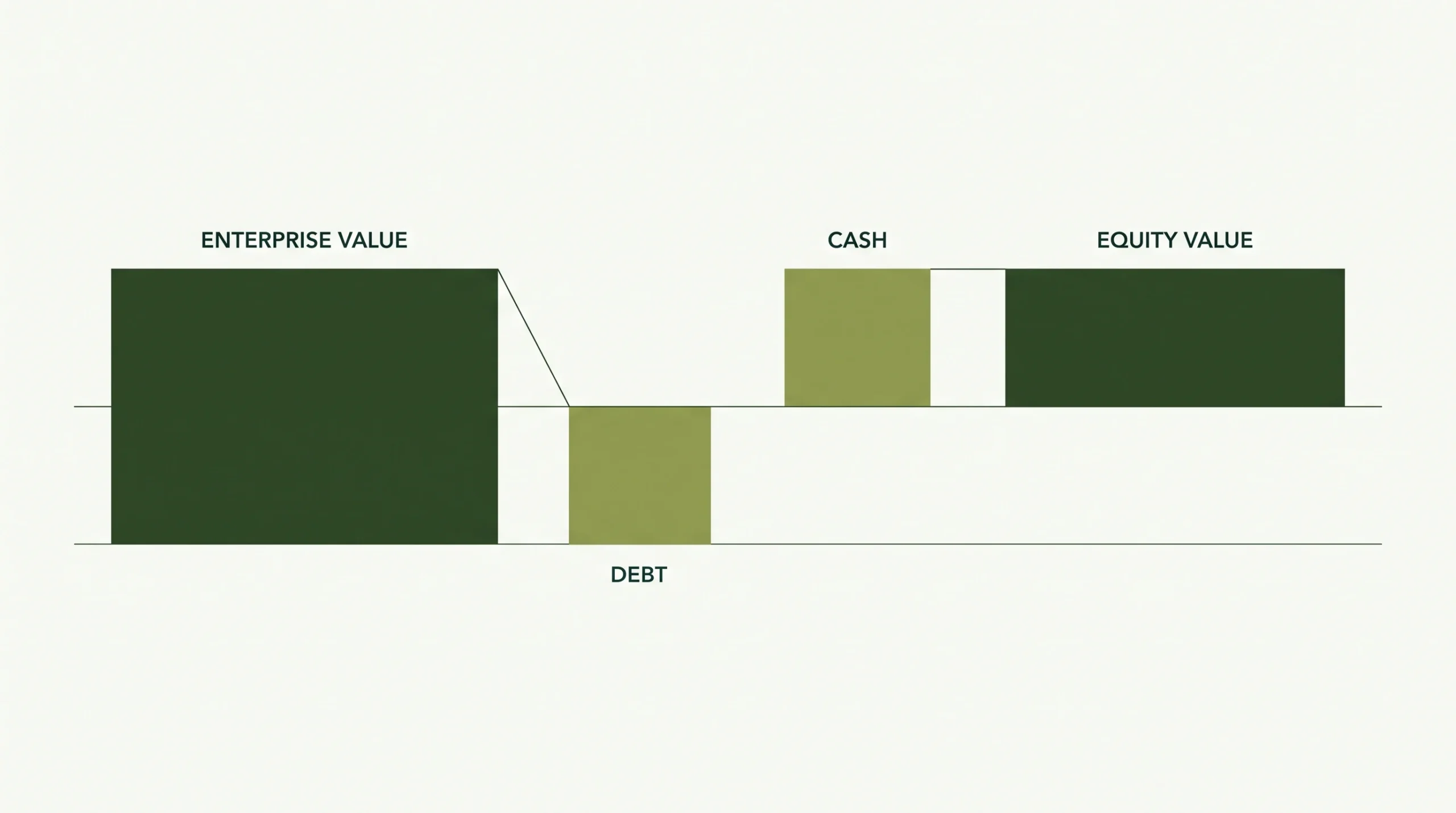
Enterprise value differs from equity value because it covers the whole business, not just the owners’ stake. You start with equity value, add total debt, then subtract cash. The logic is simple. A buyer who takes on a company also takes on its debt. But the buyer gets to use its cash. So enterprise value shows the real cost of the business, whatever its funding.
| Feature | Enterprise value | Equity value |
|---|---|---|
| What it measures | The whole operating business | The owners’ residual stake |
| Total debt | Added in | Left out |
| Cash and equivalents | Subtracted | Left out |
| Best used for | Comparing peers with EV/EBITDA | Price paid to a shareholder |
The gap between the two figures shapes most deals. They quote enterprise value first, then work back to a price per share. To bridge from one to the other, an analyst reverses the steps. Subtract net debt from enterprise value. What remains is the equity a seller actually receives. When a company holds heavy debt, that check can be far smaller than the headline value. Owners who miss this step often misjudge what a sale will pay.
Why Is EBITDA the Denominator?
EBITDA is the denominator because it measures profit before financing and tax choices. Interest depends on how much a firm borrows. Taxes depend on structure and location. Depreciation and amortization depend on past spending and accounting rules. Strip all four out, and you see what the core business earns. That is why the ratio can weigh firms that fund themselves in very different ways.
This neutrality is the whole point. A price-to-earnings ratio moves with debt and tax rates. That muddies any peer comparison. EV/EBITDA does not. It pairs a value that ignores funding with a profit that ignores it too. Analysts working under IRS Revenue Ruling 59-60 rely on this. It helps them isolate the true earning power of a private company. The measure keeps the focus on the business, not the balance sheet.
What Drives a High or Low Multiple?
A high multiple is driven by strong growth, wide margins, low risk, and larger size. A low multiple reflects the opposite: slow growth, thin margins, or a shaky outlook. Buyers pay more for profit they trust to grow and last. A fast-growing software firm may trade above 15x. A mature factory with flat sales may sit near 6x.
Size matters too. Larger firms usually earn higher multiples. They carry less risk and draw more buyers. This is where an entity-specific read beats any average. Large advisory firms such as Alvarez and Marsal or Kroll focus on big enterprise clients. Sofer Advisors brings that same senior-level rigor to middle-market owners. And unlike a solo practitioner, it backs each conclusion with a full W2 team of 14 and major deal databases.
How Do Industries Change the Multiple?
Industries change the multiple because each sector carries its own growth, margin, and risk. Capital-light fields like software and semiconductors earn high multiples. They enjoy strong margins and easy scale. Capital-heavy fields like factories and airlines sit lower. Equipment costs and thin margins weigh them down. A ratio that looks rich in one sector can look cheap in another.
Current figures make the spread clear. Data from Equidam, drawn from more than 40,000 public companies as of July 2026, puts semiconductors near 17x and airlines close to 6x. Most industries fall between 5x and 8x. Advanced medical gear lands around 8x. Sofer Advisors matches each firm to its own sector, not a broad average. The right baseline keeps a value from running too high or too low. That protects both the buyer and the seller.
What Are the Limits of the EV/EBITDA Multiple?
The main limit of the EV/EBITDA multiple is that it ignores the cash a business must reinvest. EBITDA sits above capital spending. So a firm that pours money into equipment can look richer than it is. The ratio also skips working capital swings. And it says nothing about EBITDA quality. A number padded with soft add-backs will overstate value. For these reasons, the multiple works best beside other methods.
A capital-heavy firm and an asset-light one can share the same multiple. Yet their real cash flow can differ sharply. That gap is why AICPA valuation standards, set out in the Statement on Standards for Valuation Services, push valuators to weigh several approaches. Sofer Advisors pairs the multiple with a discounted cash flow model and normalized earnings. This runs under The Sofer Difference, a four-phase process of Discovery, Diligence, Analysis, and Delivery. The result is a value that holds up under audit or court review.
Frequently Asked Questions
What is a good EV/EBITDA multiple?
A good multiple depends on the company’s growth, margins, and risk. It only means something against the right peers. Private firms often trade in the low to mid single digits. High-growth sectors command far more. A rich multiple in one industry can be plain in another. The firm tests each ratio against sector data. That shows whether it fits the real risk and return of the business.
How do you calculate enterprise value from equity value?
You take equity value, add total debt, and subtract cash. Equity value is the market price of the shares. Debt gets added because a buyer inherits it. Cash gets subtracted because a buyer can use it. The result is the cost of the whole business. To move back to equity value, you reverse the steps and subtract net debt.
Why use EBITDA instead of net income?
EBITDA gives a cleaner view of profit than net income. Net income moves with interest, taxes, and non-cash charges. Those items differ from firm to firm. They hide how the core business performs. Strip them out, and two companies compare on equal footing. The firm uses this measure so tax and debt choices do not distort a deal price.
Does debt raise the EV/EBITDA multiple?
Debt raises enterprise value, the top of the ratio. So it can lift the multiple if profit stays flat. But EBITDA sits above interest. The profit figure does not change with borrowing. That is why the ratio can weigh firms with different debt on a fair basis. The firm isolates these effects. Owners then judge two businesses on their operations, not their balance sheets.
What is a normal EV/EBITDA multiple for a small business?
Small firms usually trade at lower multiples than large public ones. They carry more risk and draw fewer buyers. Many land in the low to mid single digits. A strong niche can push the number higher. Customer concentration and owner reliance often pull it down. The firm sizes each multiple to a company’s own risk, not a broad market figure.
Can the EV/EBITDA multiple be negative?
The ratio turns negative when a company reports an EBITDA loss. A negative multiple has little meaning. The denominator no longer reflects steady profit. Early-stage or troubled firms often fall into this case. Analysts then move to revenue-based or asset-based methods. The firm applies these tools so an unprofitable business still gets a sound estimate of value.
How is EV/EBITDA different from EV/Sales?
EV/EBITDA compares total value to profit. EV/Sales compares total value to revenue. Sales-based ratios suit young firms that are not yet profitable. Profit-based ratios suit steady, established firms. Each answers a different question about the business. The firm picks the ratio that matches a company’s stage and profit. That way the result reflects real performance.
How much does a business valuation from Sofer Advisors cost?
Business valuations from Sofer Advisors typically run from $7,500 to $25,000, depending on complexity and scope. Simpler jobs for planning or tax fall toward the lower end. Deals, disputes, and multi-entity work need deeper analysis, so they sit higher. The purpose of the report and the state of your records also affect the fee. Contact Sofer Advisors for a quote matched to your situation.
Related Case Studies
- Guideline Public Company Method: Comp Sets
- Precedent Transaction Analysis: Deal Comps
- Debt Capacity: How Much Leverage a Business Supports
Executive Summary
The enterprise value to EBITDA multiple compares a company’s total value to its operating profit. Enterprise value adds debt and subtracts cash from the equity price. So the ratio stays neutral to how a firm is funded. Current data puts most industries between 5x and 8x. Semiconductors trade near 17x and airlines near 6x. High multiples reflect growth, margins, and size. The measure skips capital spending and working capital. So it works best beside a discounted cash flow model. Sofer Advisors builds each value on IRS Revenue Ruling 59-60 and AICPA standards, backed by 180+ five-star Google reviews.
What Should You Do Next?
Start by normalizing your EBITDA so one-time items do not distort the number. Then pull the right sector multiple, not a broad market average. Finally, bridge from enterprise value back to equity value. That tells you what a sale would actually pay.
For a multiple you can defend, work with David Hern CPA ABV ASA. His team has given expert witness testimony in 11+ cases across Georgia, Florida, California, and New Mexico. Schedule a consultation to discuss the multiple that fits your business.
People Also Read
- Excess Earnings: Valuing Goodwill and Assets
- EBITDA Add-Backs: What Buyers Accept and What They Reject
About the Author
This guide was prepared by David Hern CPA ABV ASA, founder of Sofer Advisors, a business valuation firm headquartered in Atlanta, GA serving clients across the United States. David holds dual accreditations as an Accredited Senior Appraiser (ASA) and is Accredited in Business Valuation (ABV), credentials recognized by the IRS, SEC, and FINRA. He also holds the Certified Exit Planning Advisor (CEPA) designation. With 15+ years of valuation experience, David has served as an expert witness in 11+ cases across multiple jurisdictions and built Sofer Advisors into an Inc. 5000-recognized firm with 180+ five-star Google reviews. Its full W2 employee team maintains subscriptions to all major valuation databases and operates under a next business day response policy. For professional business valuation services, visit soferadvisors.com/about-us/ or contact Sofer Advisors at soferadvisors.com/contact-us/.
Disclaimer: This content is for informational purposes only and does not constitute professional valuation advice. Business valuation conclusions depend on specific facts and circumstances. Contact Sofer Advisors for guidance regarding your specific situation.









