


Last Updated: October 2026
An EV/EBITDA multiple shows a company’s total value as a multiple of its earnings before interest, taxes, depreciation, and amortization. In healthcare services, these multiples help owners and investors judge what a practice is worth against its profits. Per BVR and its DealStats database, healthcare services often trade between 8.0x and 15.0x EBITDA. Behavioral health and dermatology sit at the higher end.
The team at Sofer Advisors values dental, home health, behavioral, and specialty practices for owners and investors, backed by 180+ five-star Google reviews. The multiple lets buyers compare practices of different sizes and regions on a level footing. Owners use it to see where their practice sits against recent deals. Private equity uses it to price platforms and add-on acquisitions.
This guide explains why these multiples matter and what drives them higher. It also covers how they vary by sub-sector and how appraisers adjust them for a private company.
Key Takeaways
- Typical ranges: healthcare services often trade between 8.0x and 15.0x EBITDA, per BVR / DealStats data, with higher figures in behavioral health and dermatology.
- Private equity drives pricing: roll-ups and scalable platform companies push multiples up for practices with strong recurring revenue.
- Sub-sector matters: dental groups, home health, and specialty practices often earn higher multiples than generalist practices.
- EBITDA is normalized first: buyers run a Quality of Earnings review, so the price rests on adjusted, not reported, earnings.
- Private-company discounts apply: appraisers adjust for size, specific risk, and lack of marketability before setting a final figure.
Each point below connects to how a practice is priced. The sections that follow work through them one at a time.
Why Are Healthcare EV/EBITDA Multiples Important to Understand?
EV/EBITDA is the common language of healthcare M&A. The standards shape how it is applied to a private practice. The AICPA statement on valuation services sets the method. The USPAP rules from The Appraisal Foundation guide how a credentialed appraiser normalizes earnings and sets discounts. For tax or estate work, Revenue Ruling 59-60 frames the analysis. A multiple applied without this discipline can misstate value. It can mislead an owner before a sale. It can also fail under the scrutiny of a buyer’s advisor or an IRS examiner.
What Drives Higher Healthcare Multiples?
Multiples run higher for platform-ready practices with recurring revenue and a diversified payor mix. Buyers pay a premium for scale and a clear roll-up path. Both lower risk and raise future cash flow. A practice that grows across several sites starts to look like a platform. That shift draws private equity interest.
Buyers also study how stable the income is. A diversified payor mix cuts reliance on any single insurer or state program, which protects earnings when policy shifts. Practices with efficient systems and a record of absorbing smaller clinics tend to show the strongest exit potential. A roll-up buyer then adds value by folding small clinics into shared infrastructure. That creates economies of scale and supports a higher multiple.
How Do Multiples Vary by Sub-Sector?
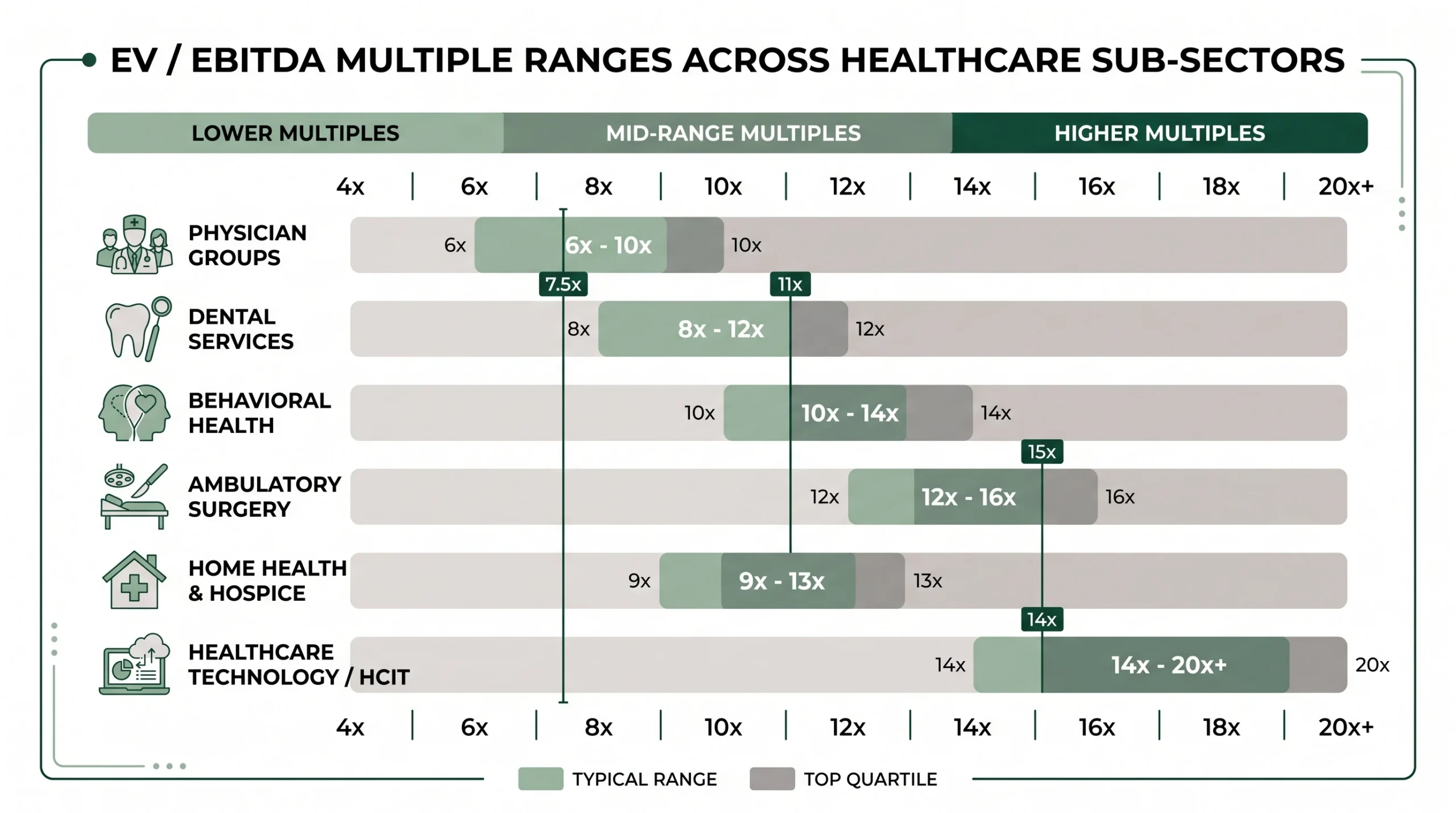
Multiples vary with the service line, the regulatory setting, and how fragmented the market is. General medical practices tend to trade at the lower end. High-growth niches like dermatology, orthopedics, and behavioral health usually earn premium figures. Per BVR / DealStats 2025 data, buyers pay more where cash flows are stable and the model can scale.
The gap comes from how capital enters each market. Dental service groups and home health providers use mature models that scale well. That lifts their multiples. Behavioral health draws interest from rising demand and a shift to value-based payment. Fragmented markets let buyers create value through consolidation. These niches attract more private equity than standalone practices.
How Do PE Buyers Apply These Multiples?
Private equity buyers start with a sector baseline multiple. They then adjust it using a Quality of Earnings (QoE) review to reach a normalized EBITDA. The QoE separates real cash-generating power from reported accounting figures. It strips out one-time costs and gains that will not repeat, which leaves a defensible earnings base.
The buyer then weighs cost savings and company-specific risk against the baseline. High client concentration or unusual operating hurdles can pull the multiple down. A clear growth path or strong margins can push it up. The final adjusted figure is what a financial buyer will pay for the future earnings of the business. It is not a price for raw accounting results.
How Do You Turn EBITDA Into Enterprise Value?
You turn EBITDA into enterprise value by multiplying normalized earnings by a market multiple. A simple example shows how it works. Suppose a dental group reports $2,000,000 in EBITDA. A review finds $300,000 of above-market owner pay and one-time legal costs. Adding those back lifts normalized EBITDA to $2,300,000.
Now apply a sector multiple. At 10x, the enterprise value is $23,000,000. At 12x, it is $27,600,000. The same practice gains $4,600,000 in value from a two-turn change in the multiple. This is why owners work to earn a higher multiple, not just higher earnings. Scale, recurring revenue, and a clean payor mix all help move the number up.
Setting the right multiple and defending the add-backs is easier with an independent valuation in hand. Talk to a Sofer Advisors valuation specialist about benchmarking your practice before a sale.
How Do Appraisers Adjust Multiples for Private Companies?
Appraisers adjust public-company multiples with two discounts. A discount for lack of marketability (DLOM) reflects how hard private shares are to sell. A discount for lack of control (DLOC) reflects a minority position with limited say. Public shares trade daily on open markets, so private shares need both adjustments to be comparable.
A credentialed appraiser sets these percentages using empirical studies, such as restricted stock or pre-IPO data. The work follows AICPA and Appraisal Foundation guidance. This step is key for an IRS-defensible result. It matters most in tax and estate work, where the taxpayer carries the burden of proof. Applied correctly, the discounts turn a raw public multiple into a fair market value for the private stake.
Who Performs These Valuations, and How Do Options Compare?
Different advisors serve different goals. Sell-side brokers focus on marketing a deal and maximizing price. Strategy advisors focus on operations and planning. Valuation specialists focus on a defensible, independent figure that holds up in diligence, tax review, or litigation. Large national firms such as Alvarez & Marsal, Stout, and Kroll serve big health systems with broad advisory teams. Sofer Advisors focuses on partner-led valuations for practices and middle-market healthcare groups, with expert witness testimony in 11+ cases behind its reports. The table below shows the trade-offs.
| Provider | Primary focus | Best for |
|---|---|---|
| Valuation specialist (e.g. Sofer Advisors) | Independent, defensible valuation (fair market value / fair value) | Transactions, tax, and financial reporting that must withstand scrutiny |
| Sell-side broker | Price and speed; deal marketing | Owners running an exit who want buyer outreach |
| Strategy advisor | Operational planning | Long-term business planning, not formal valuation |
Sofer Advisors works through a four-phase process it calls The Sofer Difference, moving from Discovery to Diligence to Analysis to Delivery. Bringing in a neutral valuation early creates a defensible number and reduces the risk of a price cut during due diligence. This reflects the Heart of a Teacher approach, which focuses on explaining the data behind a multiple rather than simply quoting one.
Frequently Asked Questions
What is a reasonable EV/EBITDA multiple for a healthcare practice?
A reasonable multiple matches similar-sized practices in your clinical niche, usually within the 8.0x to 15.0x range reported by BVR / DealStats. Broad healthcare averages exist, but the right figure adjusts for your growth rate, payor mix, and operating maturity. The goal is a range that reflects the real financial health of the business, not just a market average. Sofer Advisors benchmarks your practice against current deal data to set that range.
What is a healthy EV/EBITDA ratio?
A healthy ratio reflects steady, long-term cash flow rather than a short-term spike. Buyers look for consistent margins and low reliance on any single revenue source or payor. A rigorous normalization of earnings shows the repeatable cash flow that professional buyers use to judge health, which is what supports a credible multiple. Sofer Advisors normalizes your earnings first, so the ratio rests on dependable numbers a buyer will accept.
Which healthcare sectors have the highest EBITDA multiples?
Scalable niches with strong consolidation potential, such as behavioral health and dermatology, tend to see the highest multiples. They appeal to private equity because they are fragmented and suit roll-up strategies that build regional platforms. Targeted benchmarking shows where a practice sits against these high-growth segments and where its own multiple could move. Sofer Advisors maps your practice to the right sub-sector comparables before applying a figure.
How does company size affect healthcare multiples?
Smaller practices often trade at lower multiples because of owner dependency and limited infrastructure. Larger platforms earn higher multiples, since they offer institutional systems, diversified revenue, and a management team that can run without the founder. Size-related risk is one of the main adjustments an appraiser makes to a raw market multiple. Sofer Advisors quantifies that size premium or discount using empirical data, not a rule of thumb.
What is the difference between EV/EBITDA and Seller’s Discretionary Earnings (SDE)?
EV/EBITDA suits larger, institutional-style businesses, while SDE suits smaller owner-operated practices. SDE adds the owner’s salary and benefits back to net income to show the total financial benefit to a single working owner. Which metric fits depends on the size and stage of the practice and on who the likely buyer is. Sofer Advisors selects the right metric for your practice so the value reflects a realistic buyer pool.
How is normalized EBITDA calculated for a healthcare valuation?
Normalization removes non-recurring costs, above-market owner pay, personal expenses, and temporary revenue swings to reveal repeatable earnings. That creates a clean baseline to compare against market deals and apply a multiple. The result reflects the ongoing profit a new owner could reasonably expect to keep. Sofer Advisors documents each add-back with support, so the adjusted figure holds up when a buyer’s Quality of Earnings team tests every line.
Do recurring revenue models earn higher multiples?
Yes. Models like membership-based primary care or subscription telehealth earn higher multiples because their income is predictable and easier to forecast. Buyers value that lower uncertainty over traditional fee-for-service revenue, which can swing with volume and payor mix. A stable, recurring model lifts the expected purchase price for the same level of earnings. Sofer Advisors reflects the quality of your revenue, not just its size, when setting a multiple.
How much does a healthcare business valuation from Sofer Advisors cost?
A healthcare practice valuation usually runs from $10,000 to $30,000. The fee depends on the complexity of the practice, the number of locations, and whether the report is for a sale, tax, or litigation, since those uses need more detail. Sofer Advisors quotes a flat fee up front, so the cost is clear before the work begins. Request a free estimate for a range specific to your practice.
Related Case Studies
- How to Value an HVAC or Home Services Business: Multiples Guide
- How to Value a Healthcare Management Services Organization (MSO)
- Business Valuation Services United States: Expert Guide 2025
Executive Summary
EV/EBITDA is the standard benchmark in healthcare services, where practices often trade between 8.0x and 15.0x per BVR / DealStats, with behavioral health and dermatology at the high end. Private equity drives pricing, paying more for scale, recurring revenue, and a diversified payor mix. Buyers normalize EBITDA through a Quality of Earnings review before applying a multiple. A two-turn move, from 10x to 12x on $2,300,000 of normalized EBITDA, adds $4,600,000 of value. Appraisers then apply DLOM and DLOC under AICPA and Appraisal Foundation guidance. Most practice valuations run $10,000 to $30,000.
What Should You Do Next?
Start a review of practice earnings 12 to 18 months before any sale or transition, and identify the non-recurring costs that affect EBITDA normalization. Fix key-person or payor-concentration risks early, since a buyer would otherwise discount them. Pull a current valuation so the discussion stays anchored to real numbers. This guide was prepared by David Hern CPA ABV ASA, founder of Sofer Advisors, an Inc. 5000 firm specializing in neutral third-party valuations for healthcare. Schedule a free consultation to discuss your specific situation.
People Also Read
About the Author
This guide was prepared by David Hern CPA ABV ASA, founder of Sofer Advisors, a business valuation firm headquartered in Atlanta, GA serving clients across the United States. David holds dual accreditations as an Accredited Senior Appraiser (ASA) and is Accredited in Business Valuation (ABV), credentials recognized by the IRS, SEC, and FINRA. He also holds the Certified Exit Planning Advisor (CEPA) designation. With 15+ years of valuation experience, David has served as an expert witness in 11+ cases across multiple jurisdictions and built Sofer Advisors into an Inc. 5,000-recognized firm with 180+ five-star Google reviews. Its full W2 employee team maintains subscriptions to all major valuation databases and operates under a next business day response policy.
For professional business valuation services, visit soferadvisors.com/about-us/ or contact Sofer Advisors at soferadvisors.com/contact-us/.
This content is for informational purposes only and does not constitute professional valuation advice. Business valuation conclusions depend on specific facts and circumstances. Contact Sofer Advisors for guidance regarding your specific situation.









