
Last Updated: October 2026
A developed technology valuation measures the fair value of the software, source code, and technical know-how a company already uses to earn revenue. In a software or tech acquisition, that technology is an identifiable intangible asset under ASC 805. The buyer must value it apart from goodwill and record it on the opening balance sheet. Get the number wrong and the whole purchase price allocation drifts off course.
This matters because developed technology often carries the largest slice of value in a software deal. Sofer Advisors values these assets for buyers, CPAs, and deal counsel, with Inc. 5000 recognition in both 2024 and 2025 behind its reports. Price the technology well and the financial statements hold up. Price it loosely and the auditors send it back.
This guide covers the two main methods, how to pick a royalty rate, how to set useful life, and how developed technology differs from in-process R&D.
Key Takeaways
- Identifiable asset: developed technology is valued apart from goodwill under ASC 805, with its own finite life and amortization.
- Two income methods: analysts price it with the relief-from-royalty method or the multi-period excess earnings method.
- Royalty rate drives value: under relief-from-royalty, the rate comes from real software license deals, not a round number.
- Contributory asset charges: the excess-earnings method subtracts a rent for the other assets that help the technology earn, so value is not overstated.
- Useful life and obsolescence: a decay curve reflects how fast code ages, and that sets the amortization period.
Each piece feeds the next. The sections below take them one at a time.
Why Is Developed Technology Valued on Its Own?
Developed technology is valued on its own because ASC 805 requires a buyer to assign fair value to every identifiable intangible asset in an acquisition. Pulling the technology out of goodwill gives it a separate line and a finite life. That line is amortized over time, which creates a real expense on the income statement. Goodwill is not amortized, so the split changes reported earnings.
The separation also sharpens the rest of the deal. When the technology, customer lists, and trade names each carry their own value, the leftover goodwill shrinks and is easier to defend. For tax, acquired intangibles are amortized over 15 years under Section 197, which can differ from the book life an appraiser sets. The two numbers answer different questions, so a clean report tracks both.
What Counts as Developed Technology Under ASC 805?
Developed technology means the working software, source code, patents, and trade secrets that an acquired company already uses to make money. It has moved past the lab and into a product that ships. That finished state is what separates it from in-process R&D, which is still under development. Internal tools can also count, though they are valued differently from software built to sell.
The line between developed technology and in-process R&D is a timing line. Once a product is approved or placed in service, in-process R&D is reclassified as developed technology and starts to amortize. Research costs before that point follow their own tax rules under Section 174. The internal-use versus software-to-be-sold split matters too. Software a company sells or licenses tends to drive direct revenue, while internal tools mostly cut costs, so the cash flows look different.
How Does the Relief-from-Royalty Method Work?
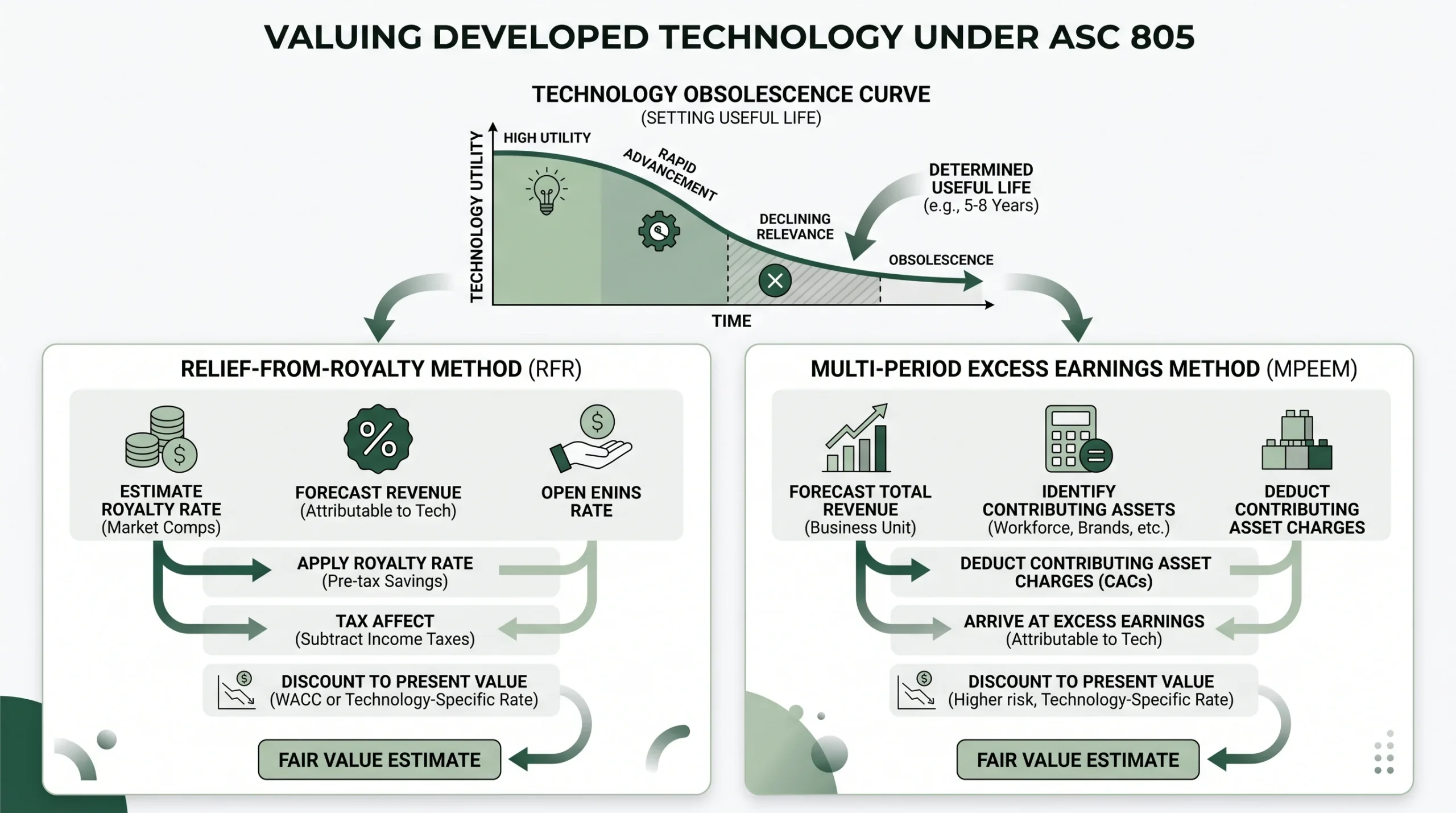
The relief-from-royalty method values technology by the license fees a company avoids because it owns the asset. The idea is plain. If you own the code, you do not pay to license it. That saved royalty is a cash flow. You apply a royalty rate to the revenue the technology supports, subtract tax, and discount the result to present value.
The royalty rate is the input that moves the answer most. It should come from real license deals for similar software, drawn from royalty databases, not a number picked for convenience. A rate that is too high inflates the asset and the amortization that follows. The method works best when comparable licenses exist, which is common for mature software. Our walkthrough of the relief-from-royalty method shows how the rate and the revenue base fit together.
When Do You Use the Multi-Period Excess Earnings Method?
The multi-period excess earnings method, or MPEEM, is used when the technology is the main engine of a group of cash flows. It takes the revenue tied to the technology, subtracts operating costs, and then subtracts a charge for every other asset that helps produce those earnings. What is left is the excess earnings that belong to the technology alone. Those earnings are discounted to present value.
Those charges for the other assets are called contributory asset charges. They act like rent. Working capital, fixed assets, the assembled workforce, and trade names all help the software earn, so each takes a slice before the technology gets credit. Skip them and the technology absorbs profit it did not create, which auditors catch fast. MPEEM needs a full financial model, so it takes more effort than relief-from-royalty. Our guide to the multi-period excess earnings method breaks down each step.
How Do You Set Useful Life and Model Obsolescence?
Useful life is how long the technology will keep earning before a rewrite or a replacement takes over. For software, that life is short. Code ages as platforms shift and customers expect new features. An appraiser models this with a decay curve, which shows the share of current technology still in use each year. The curve usually falls fast, often inside three to seven years.
Technological obsolescence is the reason the curve bends down. Each year, part of the existing code is retired and replaced by new work, so the acquired technology earns less of the revenue over time. The decay curve sets both the cash flow forecast and the amortization period on the books. A longer life spreads the expense and lifts near-term earnings, so auditors expect the life to match how the product really ages. The record behind the curve is what makes the life defensible.
A defensible number rests on the royalty rate, the useful life, and the asset charges all tying back to evidence. If you are working through an ASC 805 allocation, Sofer Advisors offers independent business valuation services built for audit review.
Who Values Developed Technology, and How Do the Options Compare?
Buyers choose a valuation partner based on the size of the deal, the audit exposure, and the budget. Large national firms such as Alvarez and Marsal, Stout, and Kroll serve big public companies with broad teams. Sofer Advisors focuses on partner-led, defensible valuations for closely held and middle-market software businesses, with expert witness work in 11+ cases behind its reports. The table below lays out the common options.
| Provider | Typical role | Best for |
|---|---|---|
| Specialized valuation firm (e.g. Sofer Advisors) | Prices the technology and documents the method for the purchase price allocation | Middle-market software deals needing audit-ready support |
| Large national firm | Broad advisory plus valuation at enterprise scale | Large public companies with complex, multi-entity deals |
| In-house finance team | Gathers data and builds early estimates | Internal planning before an audit or a transaction |
Sofer Advisors runs each engagement through a four-phase process it calls The Sofer Difference, moving from Discovery to Diligence to Analysis to Delivery. That order keeps every royalty rate and useful life tied to the evidence behind it. It reflects the Heart of a Teacher approach, which means explaining why a number lands where it does rather than just handing over a figure. For a value that survives review, an independent appraiser supplies both the number and the trail behind it.
Frequently Asked Questions
What is developed technology in a business combination?
Developed technology is the working software, source code, patents, and trade secrets an acquired company already uses to earn revenue. Under ASC 805, it is an identifiable intangible asset, so the buyer values it apart from goodwill and gives it a finite life. The asset then amortizes over that life on the income statement. Sofer Advisors identifies and prices this technology so the purchase price allocation reflects where the value truly sits.
What is the difference between developed technology and goodwill?
Developed technology is a specific asset with its own cash flows and a finite life, such as code that earns license revenue. Goodwill is the leftover value an acquirer pays above all identifiable assets, and it is not amortized. Because the technology amortizes and goodwill does not, splitting them changes reported earnings. Sofer Advisors performs careful purchase price allocations so each intangible asset is separated from goodwill with support an auditor can test.
How is the relief-from-royalty method used for software?
The relief-from-royalty method values software by the license fees a company avoids because it owns the code. An appraiser applies a royalty rate to the revenue the technology supports, subtracts tax, and discounts the result to present value. The rate should come from real license deals for similar software, not a round figure. Sofer Advisors builds this model with market-based royalty rates so the value reads as evidence, not assumption.
When is MPEEM used instead of relief-from-royalty?
The multi-period excess earnings method is used when the technology is the primary driver of a group of cash flows. It isolates the earnings left after subtracting operating costs and a charge for every other asset that helps produce them. That makes it more data-heavy than relief-from-royalty, which suits assets with clear license comparables. Sofer Advisors selects the method that fits the facts and documents why, so the choice holds up in an audit.
What is a contributory asset charge?
A contributory asset charge is a rent the model subtracts for the other assets that help the technology earn. Working capital, fixed assets, the assembled workforce, and trade names each support the software, so each takes a slice before the technology gets credit. Skipping these charges overstates the asset. Sofer Advisors calculates each contributory asset charge and documents the returns, so the technology is credited only with the earnings it actually creates.
How do you estimate the remaining useful life of developed technology?
Remaining useful life is how long the current technology will keep earning before a rewrite or replacement takes over. For software, that life is short, often three to seven years, because platforms shift and features age. An appraiser models it with a decay curve showing the share of today’s code still in use each year. Sofer Advisors ties the life to how the product really ages, which sets a defensible amortization period.
How does developed technology differ from in-process research and development?
Developed technology is finished and already in service, while in-process R&D, or IPR&D, is still under development on the acquisition date. Under ASC 805, acquired IPR&D is recorded at fair value and carried as an indefinite-lived asset until the project is complete or abandoned. Once the product ships, it is reclassified as developed technology and begins to amortize. Sofer Advisors values both, keeping the line between them clear for financial reporting.
Is internal-use software valued differently from software built to sell?
Yes. Software a company sells or licenses tends to earn direct revenue, so income methods like relief-from-royalty fit well. Internal-use software mostly cuts costs rather than earning fees, so its value often rests on what it would cost to rebuild, with obsolescence subtracted. The purpose and the cash flows drive the method. Sofer Advisors matches the approach to how the software is actually used, so the value reflects the benefit it provides.
How much does a developed technology valuation cost?
Most developed technology valuations run from $7,500 to $35,000 and take about four to eight weeks, depending on the code, the data, and the reporting standard. The range covers the royalty or excess-earnings modeling and the obsolescence work that support the number. Sofer Advisors scopes each engagement first, then quotes a fixed fee, so the cost is clear before work starts. Request a free estimate for your situation.
Related Case Studies
- Valuing Developed Technology in an Acquisition
- Valuing Acquired In-Process Research and Development (IPR&D)
- Valuing Customer Relationships in a Purchase Price Allocation
Executive Summary
Developed technology is an identifiable intangible asset under ASC 805, valued apart from goodwill and amortized over a finite life. Two income methods carry most of the work. Relief-from-royalty prices the license fees the owner avoids, driven by a market royalty rate. MPEEM isolates the excess earnings left after contributory asset charges for every supporting asset. Useful life is short for software, often three to seven years, and a decay curve models how fast the code ages. Developed technology is finished and amortizing, while in-process R&D waits until a product ships. A defensible value ties each input back to evidence an auditor can test.
What Should You Do Next?
Start by gathering the acquired company’s revenue by product, the development cost records, and any license agreements, since clean data supports a defensible royalty rate and useful life. Confirm with your auditor which reporting standard the report must meet before the work begins. This guide was prepared by David Hern CPA ABV ASA, founder of Sofer Advisors, an Inc. 5000 firm that provides independent business valuation services for financial reporting. Schedule a free consultation through our contact page to discuss your specific situation.
People Also Read
- Purchase Price Allocation ASC 805 and IFRS 3: Complete Guide for Business Leaders
- SaaS Valuation: Complete Guide to Software Company Value
About the Author
This guide was prepared by David Hern CPA ABV ASA, founder of Sofer Advisors, a business valuation firm headquartered in Atlanta, GA serving clients across the United States. David holds dual accreditations as an Accredited Senior Appraiser (ASA) and is Accredited in Business Valuation (ABV), credentials recognized by the IRS, SEC, and FINRA. He also holds the Certified Exit Planning Advisor (CEPA) designation. With 15+ years of valuation experience, David has served as an expert witness in 11+ cases across multiple jurisdictions and built Sofer Advisors into an Inc. 5,000-recognized firm with 180+ five-star Google reviews. Its full W2 employee team maintains subscriptions to all major valuation databases and operates under a next business day response policy.
For professional business valuation services, visit soferadvisors.com/about-us/ or contact Sofer Advisors at soferadvisors.com/contact-us/.
This content is for informational purposes only and does not constitute professional valuation advice. Business valuation conclusions depend on specific facts and circumstances. Contact Sofer Advisors for guidance regarding your specific situation.