


Last Updated: August 2026
The relief from royalty method is an income-based way to value an intangible asset by measuring the license fees an owner avoids by owning it rather than renting it. You own the trademark, so you pay no royalty to a third party. That saved fee, over the life of the asset, is the value. Trademark royalty rates in licensing data often run from about 1 percent to 5 percent of revenue. Sofer Advisors uses this method to value brands, trade names, and patents.
The method matters most during a deal. Under ASC 805, a buyer must record each acquired intangible asset at fair value. A trademark rarely sells on its own, so appraisers estimate its worth from the royalties it would earn. The same logic supports gift tax filings, yearly impairment tests, and damages claims in court.
Key Takeaways
- Core idea: The value equals the royalties you are relieved from paying because you own the asset.
- Where it fits: ASC 805 purchase price allocations, ASC 350 impairment tests, tax filings, and disputes.
- The hard part: Picking a defensible royalty rate from real market data is the most subjective step.
- Five inputs: Revenue forecast, royalty rate, tax rate, discount rate, and remaining useful life.
- Extra value: A tax amortization benefit, or TAB, adds the tax savings from writing off the asset.
Each input shapes the final number, and small changes can move it a lot. The sections below walk through the idea, the math, and the choices that make a report hold up. They also show where the method fits and where a different one serves you better.
What is the relief-from-royalty method?
The relief from royalty method values an intangible asset by the royalties its owner avoids paying. Picture a company that owns a strong brand. If it did not own that brand, it would license the name from someone else and pay a fee on every sale. Because it owns the name, it keeps that fee. The stream of saved fees, brought back to today’s dollars, is the value of the trademark. The idea rests on a simple market fact. Brands, patents, and trade names get licensed for money every day.
How do you calculate relief from royalty?
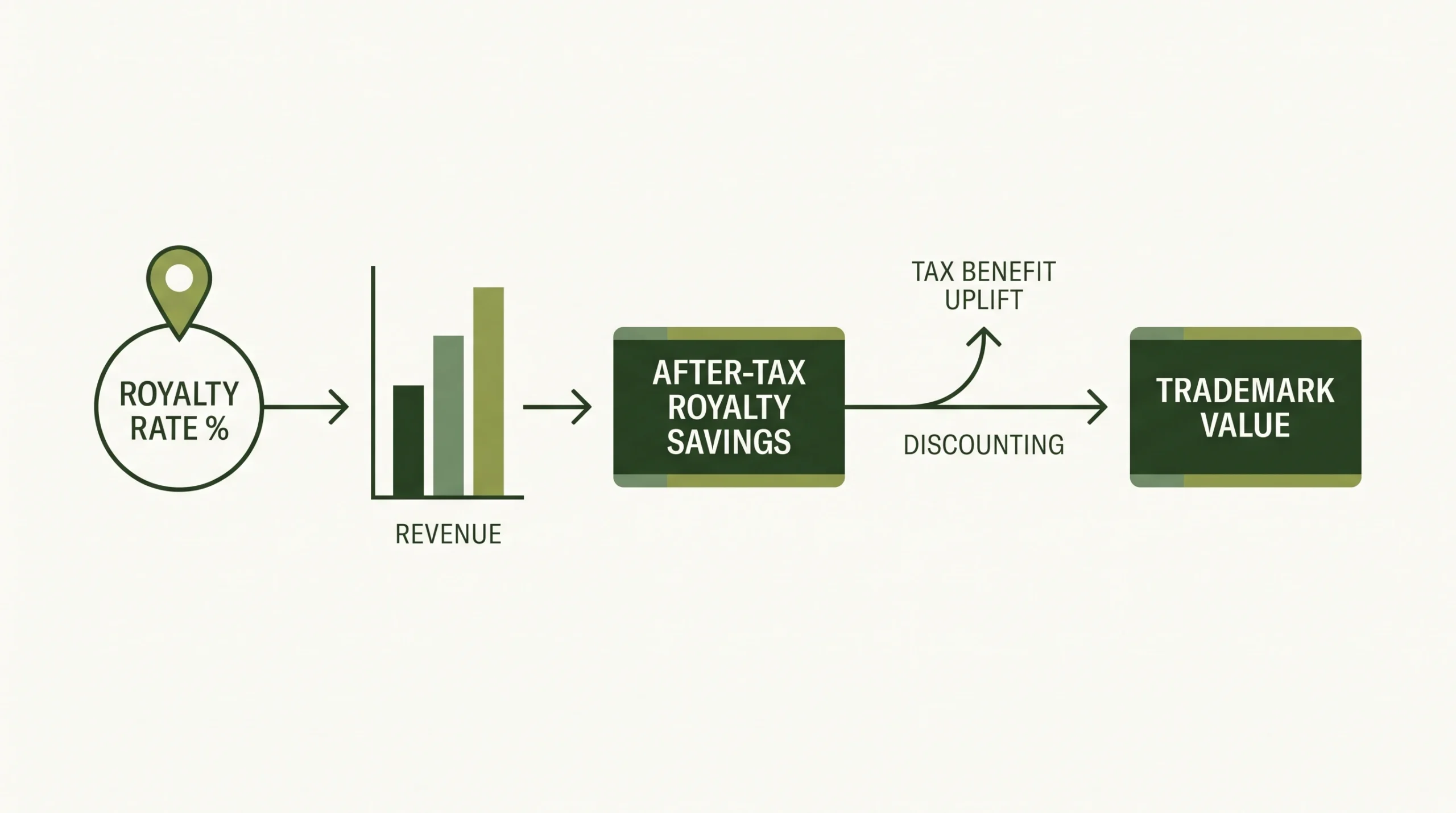
You calculate relief from royalty in five clear steps. First, forecast the revenue the asset will help earn over its useful life. Second, pick a royalty rate from similar license deals. Third, multiply revenue by the rate to get the yearly royalty you save. Fourth, subtract taxes, since a real royalty would be tax deductible. Fifth, discount the after-tax savings to present value with a rate that fits the asset’s risk.
The table below shows the five inputs and what each one controls. Get any one wrong and the value can swing hard. That sensitivity is why every input needs support from evidence, not a guess. A clean revenue forecast and a well-sourced rate carry most of the weight.
| Input | What it does | Common source |
|---|---|---|
| Revenue forecast | Sets the base the royalty applies to | Management plan, market data |
| Royalty rate | Turns revenue into yearly savings | Comparable license deals |
| Tax rate | Cuts savings to an after-tax figure | Company and jurisdiction rate |
| Discount rate | Brings future savings to today | Asset-specific risk, WACC |
| Useful life | Sets how many years to count | Brand history, contracts, law |
How do you select the royalty rate?
You select the royalty rate from real licensing deals for similar assets. This is the heart of the method and the step auditors test hardest. Analysts pull comparable rates from databases such as ktMINE, which holds more than 86,000 royalty rates drawn from over 26,000 license agreements. Providers like RoyaltyRange supply similar arm’s length data. The goal is a rate a willing licensee would really pay.
When close matches are thin, appraisers turn to a profit-split check. The old 25 percent rule offers a rough test. It suggests a licensee might pay the owner about one quarter of the profit the brand helps produce. Courts no longer accept that rule on its own, so it only frames the answer. The chosen rate still has to reflect the brand’s strength, its industry, and the profit it drives. Sofer Advisors weighs each of these against current market evidence.
What is the tax amortization benefit?
The tax amortization benefit, or TAB, is the added value from writing the asset off on future tax returns. When a buyer records an intangible asset in a taxable deal, it can often deduct that value over time. Those deductions cut future tax bills, and that saving is worth money today. The TAB captures it. Appraisers add a step that grosses up the value to include this benefit, since a real buyer would pay for it. Under fair value rules, the report reflects what a market participant would enjoy, not just the seller’s own tax position.
How do you set the discount rate and useful life?
You set the discount rate to match the risk of the trademark itself, not the whole company. A brand’s cash flows can be safer or riskier than the business around it. Appraisers often start from the company’s weighted average cost of capital, or WACC, then adjust up for the asset’s own risk. Data from sources like the Kroll Cost of Capital Navigator helps anchor that build. A higher rate lowers the present value of the savings.
Useful life sets how many years of royalty savings you count. A trademark can have a very long, even indefinite, life if the owner keeps renewing it and the brand stays strong. A patent has a fixed legal life, which caps its window. History, contracts, and law all inform the call. When the asset is indefinite-lived, ASC 350 asks the owner to test its value every year for impairment rather than amortize it.
When does this method fit best?
The relief from royalty method fits best when an asset earns money mainly through its name or brand. Trademarks, trade names, and licensed technology suit it well. It struggles when you cannot tie revenue to the asset, or when no license market exists to source a rate. In those cases, appraisers reach for another tool. The table below sets the method against two common alternatives so you can see the trade-offs.
| Method | Best for | Main limit |
|---|---|---|
| Relief from royalty | Trademarks, trade names, brands | Needs comparable royalty data |
| Multi-period excess earnings | The primary income-driving asset | Complex, many moving inputs |
| Cost approach | Software, assets built in-house | Ignores future earning power |
Choosing among them is a matter of judgment and standards, not preference. The AICPA Accounting and Valuation Guide for Business Combinations steers method selection under ASC 805, and IRS Revenue Ruling 59-60 frames fair market value for tax work. USPAP governs the wider appraisal. Large firms such as Alvarez and Marsal or Kroll bring this rigor to big public deals. Sofer Advisors brings the same senior-level care to middle-market owners. Unlike a solo practitioner, it backs each rate with database evidence and a full W2 team of 14. This reflects The Sofer Difference, a four-phase path of Discovery, Diligence, Analysis, and Delivery. Its Heart of a Teacher approach means the team shows owners the math, not just the answer.
Frequently Asked Questions
Is the relief from royalty method an income approach?
Yes, it is an income approach because it values an asset from its future economic benefit. It also borrows from the market approach, since the royalty rate comes from real license deals. The result is a present value of after-tax savings. Sofer Advisors uses it for assets with clear, traceable revenue and ties each figure to the standard of value your report requires.
What is a good royalty rate for a trademark?
A good royalty rate depends on the industry, the brand’s strength, and the profit it drives. Many trademark deals settle between about 1 percent and 5 percent of revenue, though strong consumer brands can command more. The right figure comes from comparable license data, not a rule of thumb. Sofer Advisors benchmarks each rate against current transactions so the choice holds up under audit or court review.
What is the 25 percent rule for royalties?
The 25 percent rule is an old shortcut. It suggests a licensee might pay the asset owner about one quarter of the profit the licensed item helps earn. Courts have rejected it as a stand-alone basis for a rate. It still works as a quick sanity check on a market-based number. Sofer Advisors uses real transaction data first and treats the rule only as a secondary test.
How does the tax amortization benefit affect value?
The tax amortization benefit raises the value. When a buyer can deduct an intangible asset over time on its tax return, those deductions save real cash. Fair value asks what a market participant would pay, and a buyer would pay for that saving. So appraisers add a step that includes the benefit in the final figure. The size of the TAB depends on the tax rate and the write-off period.
When is the relief from royalty method not appropriate?
It is not a good fit when you cannot link revenue to the specific asset. Some intangibles, like an assembled workforce, earn nothing you can isolate as a royalty. No license market may exist to source a rate either. In those cases the cost approach or the multi-period excess earnings method often serves better. Sofer Advisors reviews the full context before it settles on any single method.
What assets can this method value?
The method can value most intangibles that companies license for a fee. Trademarks, trade names, and brands are the common targets. It also fits patents, proprietary technology, and know-how that trade in real markets. The shared trait is a clear tie between the asset and a stream of revenue. Sofer Advisors applies it to brand portfolios in deals, tax filings, and disputes across many industries.
How is this method used under ASC 805?
Under ASC 805, a buyer must value each acquired intangible asset at fair value in a purchase price allocation. Trademarks and trade names are prime candidates for the relief from royalty method. Auditors then review the rate, the discount rate, and the revenue forecast against fair value rules. Sofer Advisors builds each assumption to survive that review through its Financial Reporting Valuation work.
What is the difference between this and the market approach?
The relief from royalty method is an income approach that borrows one market input. It uses market royalty rates but then builds value from projected savings over time. A pure market approach instead prices the whole asset against completed sales of similar assets. The royalty method suits brands that rarely sell on their own. Sofer Advisors picks the approach that fits the asset and the purpose of the report.
How much does an ASC 805 intangible valuation from Sofer Advisors cost?
Purchase price allocations and ASC 805 intangible valuations from Sofer Advisors usually run from 15,000 to 50,000 dollars. The fee depends on the size of the deal and how many intangible assets need separate values. A single trademark costs less than a full portfolio of brands, patents, and technology. Sofer Advisors gives a clear fee quote up front, matched to the scope of your specific engagement.
Related Case Studies
- Reasonable Royalty: Valuing IP Infringement Damages
- Valuing Contingent Consideration (Earnouts) under ASC 805
- Excess Earnings: Valuing Goodwill and Assets
Executive Summary
The relief from royalty method values a trademark by the license fees its owner avoids by owning it. An appraiser forecasts revenue, applies a market royalty rate near 1 to 5 percent, subtracts taxes, and discounts the savings to present value. A tax amortization benefit lifts the figure to reflect future write-offs. The rate choice, drawn from databases such as ktMINE, is the most tested step. The method anchors ASC 805 purchase price allocations and ASC 350 impairment tests, and it must meet IRS Revenue Ruling 59-60 and USPAP. Sofer Advisors, an Inc. 5000 firm with 180+ five-star Google reviews, builds each input to hold up under scrutiny.
What Should You Do Next?
Start by gathering the revenue tied to each brand and any past license or franchise agreements. Then define a clear useful life for the trademark, since that window drives the count of savings. Finally, match the royalty rate to real market deals rather than a rule of thumb, so the value survives audit.
For a valuation you can stand behind, work with David Hern CPA ABV ASA. His team has given expert witness testimony in 11+ cases across Georgia, Florida, California, and New Mexico. Schedule a consultation to discuss the intangible assets in your business.
People Also Read
- The Net Asset Value Method: Balance Sheet Over Earnings
- When the Cost Approach Wins: Valuing Asset-Heavy Businesses
About the Author
This guide was prepared by David Hern CPA ABV ASA, founder of Sofer Advisors, a business valuation firm headquartered in Atlanta, GA serving clients across the United States. David holds dual accreditations as an Accredited Senior Appraiser (ASA) and is Accredited in Business Valuation (ABV), credentials recognized by the IRS, SEC, and FINRA. He also holds the Certified Exit Planning Advisor (CEPA) designation. With 15+ years of valuation experience, David has served as an expert witness in 11+ cases across multiple jurisdictions and built Sofer Advisors into an Inc. 5000-recognized firm with 180+ five-star Google reviews. Its full W2 employee team maintains subscriptions to all major valuation databases and operates under a next business day response policy. For professional business valuation services, visit soferadvisors.com/about-us/ or contact Sofer Advisors at soferadvisors.com/contact-us/.
Disclaimer: This content is for informational purposes only and does not constitute professional valuation advice. Business valuation conclusions depend on specific facts and circumstances. Contact Sofer Advisors for guidance regarding your specific situation.









