
Last Updated: September 2026
An in-process research and development valuation assigns a fair value to unfinished R&D projects a company acquires in a business combination. Under ASC 805, the buyer records these projects as identifiable intangible assets on the acquisition date, even when the technology has no alternative use yet. Purchase price allocation work for deals like this commonly runs from $15,000 to $50,000, and the IPR&D piece often carries the most measurement risk.
Acquired IPR&D matters because it separates the price paid for future innovation from goodwill. Get the number wrong and the balance sheet can mislead readers and invite audit questions. The sections below explain what qualifies as IPR&D, how analysts measure it, and how the asset is treated after the deal closes.
Sofer Advisors helps owners, controllers, and their advisors value acquired R&D for financial reporting. Its analysts apply ASC 805 to many kinds of deal structures, and David Hern CPA ABV ASA has testified as an expert witness in 11+ cases across several states. That courtroom experience shapes documentation built to hold up under audit review.
Key Takeaways
- Fair value is required: ASC 805 makes the buyer record acquired IPR&D at fair value on the acquisition date, apart from goodwill.
- Indefinite-lived at first: the asset is capitalized as an indefinite-lived intangible and is not amortized until the project is completed or abandoned.
- Income approach leads: the multiperiod excess earnings method estimates value from the project’s own cash flows, net of contributory asset charges.
- Risk sets the rate: a project-specific discount rate, higher than the deal rate, reflects the technical and market risk of unfinished research.
- Later treatment splits: once the project is complete, the asset is amortized over its useful life; if it is abandoned, it is written off.
Each takeaway points to one goal: a defensible fair value that auditors and regulators accept. The rest of this guide walks through the definition, the method, the key inputs, and the accounting that follows once the deal is done.
What is IPR&D in a business combination?
IPR&D is research and development a buyer acquires that has not yet reached technological feasibility and has no alternative future use. Under ASC 805, the buyer must recognize these projects as identifiable intangible assets at fair value on the acquisition date. That differs from internal R&D, which US GAAP requires a company to expense as it is incurred.
The rule stops buyers from folding the cost of unfinished innovation into goodwill. By naming the asset, the balance sheet shows what the buyer paid for products still under development. Common examples include a drug candidate in clinical trials or a software platform that is coded but not yet released. Each holds value that a willing buyer would pay for, so the standard treats it as its own asset rather than a hidden part of the deal premium.
Why is acquired IPR&D valued separately from goodwill?
Acquired IPR&D is valued on its own because it is an identifiable asset with a distinct future benefit, while goodwill is the residual that cannot be tied to any single asset. Splitting the two gives readers a clearer view of the deal. It also sets up the right accounting for each item in later periods.
Goodwill captures value like assembled workforce and general market position. IPR&D, by contrast, points to a specific project with its own cash flow path. Once a company separates the project, it can track and test that value on its own terms. Our guide to purchase price allocation under ASC 805 and IFRS 3 shows how the full allocation fits together across every acquired asset.
What method is used to value IPR&D?
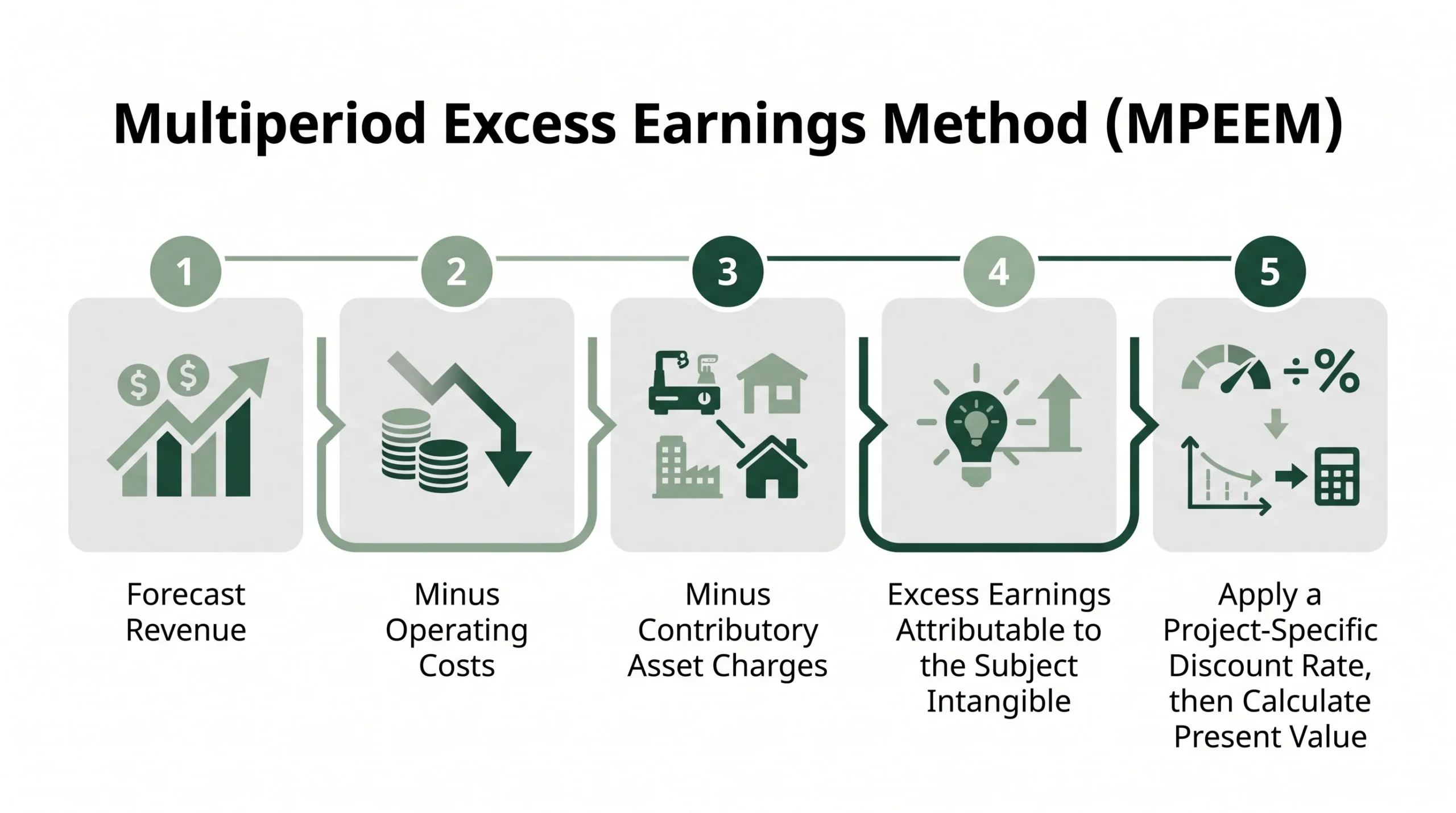
The income approach, and within it the multiperiod excess earnings method (MPEEM), is the standard way to value IPR&D. MPEEM measures the present value of the cash flows the finished project is expected to earn. Analysts strip out earnings tied to other assets so the result reflects only the IPR&D itself.
To isolate those cash flows, an analyst subtracts contributory asset charges. These charges reflect a fair return on the working capital, fixed assets, and workforce that help the project earn. What remains is the excess earnings that belong to the IPR&D alone. A project-specific discount rate then sits at the center of the work. Because unfinished research can fail, this rate runs higher than the rate used for the business as a whole. It reflects technical hurdles and market risk that a finished product would not carry.
Analysts often add a decision-tree analysis, which weights cash flows by the odds of clearing each development milestone. Work that follows USPAP and answers the evidence expectations in PCAOB AS 2501 on auditing estimates tends to hold up better when reviewers test the model. Sofer Advisors builds each IPR&D model to that standard as part of its financial reporting valuation work, so the logic is clear from input to conclusion.
What inputs drive an IPR&D fair value?
The main inputs are project-specific revenue forecasts, the remaining cost to complete, a risk-adjusted discount rate, and a probability of success at each milestone. Together they turn an unfinished project into a defensible number. A small change in any one of them can move the value a great deal.
Each input carries its own judgment. The core drivers are:
- Revenue forecasts for the finished product, adjusted for launch timing and expected market share
- Remaining costs to complete development and reach technological feasibility
- A project-specific discount rate that reflects technical and commercial risk
- The probability of success at each development milestone
Balancing these inputs takes a close read of the project status and the market it aims to enter. Revenue that arrives later, or a milestone with long odds, pulls the value down. Costs still needed to reach feasibility reduce the net benefit as well. The final figure should reflect what the project can realistically earn, not a best-case story.
How is acquired IPR&D treated after the deal closes?
After the deal closes, acquired IPR&D is carried as an indefinite-lived intangible asset and is not amortized. Instead, it is tested for impairment at least once a year under ASC 350 until the project is completed or abandoned. This treatment reflects that the asset holds future potential rather than current earnings.
The status of the project decides what happens next. If the research reaches completion, the asset becomes a definite-lived intangible and is amortized over its useful life, since the technology can now earn steady revenue. If the project is abandoned, the asset is written down to zero, because no future benefit remains. Auditors watch these calls closely to confirm the carrying value still lines up with the project’s real status each year.
How do you choose an IPR&D valuation provider?
Choosing a provider comes down to technical depth, independence, and how well the report explains its own logic. Owners weigh independent valuation firms against large advisory practices and Big 4 teams. National names such as Alvarez & Marsal, Stout, and Kroll serve the largest filers, while independent firms focus on middle-market deals and closer contact with management.
| Provider type | Approach to IPR&D | Report depth | Best fit |
| Sofer Advisors | MPEEM with client-specific assumptions, explained in plain terms | Full detail on inputs, model mechanics, and ASC 805 support | Middle-market and PE-backed companies and their advisors |
| Large advisory firm | Data-heavy models built for complex, high-volume deals | Technical reports suited to large transactions | Large private and public filers |
| Big 4 valuation practice | Standardized global methodology | Compliance-focused reports for multinational audits | Large-cap and multinational filers |
Sofer Advisors built its process, The Sofer Difference, around four stages: Discovery, Diligence, Analysis, and Delivery. Each stage keeps the client informed, in line with its Heart of a Teacher approach. Owners see how every assumption was reached, which makes the final value easier to defend when an audit team asks how the model was built.
The right choice depends on the size of the deal and the scrutiny the audit team expects. With that groundwork set, the questions below cover what owners and controllers ask most about acquired IPR&D.
Frequently Asked Questions
What are the three major types of intangible assets?
Intangible assets are usually grouped into marketing-related, customer-related, and technology-related categories. Marketing assets include trademarks and trade names. Customer assets cover client lists and contracts. Technology assets include patents, software, and IPR&D. These groups help a company sort the drivers of future value during a purchase price allocation and record each asset on the right line of the balance sheet.
Does R&D fall under COGS?
Research and development is usually recorded as an operating expense, not as cost of goods sold. COGS captures the direct costs of making a product that is already for sale. R&D reflects the investment in creating new products or improving existing ones. Keeping the two apart matters because it protects the accuracy of gross margin and gives a truer read on how the business spends to grow.
Is R&D expensed or capitalized?
Internal R&D is generally expensed as it is incurred, because the future benefit is uncertain when the work is done. Acquired R&D follows a different path. When a buyer picks up an unfinished project in a business combination, it is recognized as an intangible asset at fair value. So the same activity can be an expense in one setting and a capitalized asset in another, depending on how the project was obtained.
Are R&D expenses capitalized for GAAP?
Under US GAAP, companies typically expense internally developed R&D in the period it occurs. The main exception is R&D acquired as part of a business combination, which ASC 805 requires the buyer to record as an asset. This rule keeps firms from inflating the balance sheet with unproven internal work, while still showing the price paid for outside innovation in a clear and consistent way.
How is IPR&D different from internally developed R&D?
IPR&D is acquired in a deal and carries a measurable fair value on the acquisition date, while internally developed R&D is expensed as incurred. The IPR&D asset has a defined starting value because a buyer paid a specific price to obtain it. Internal R&D has no such recorded asset. This gap shapes how each is tracked, tested, and reported in the periods that follow.
What is a contributory asset charge in an IPR&D valuation?
A contributory asset charge is a deduction from a project’s income to reflect the return owed to other assets that support it. Those assets can include working capital, fixed assets, and the workforce. Subtracting the charge leaves only the cash flows that belong to the IPR&D itself. The step keeps the valuation from crediting one asset with earnings that several assets helped produce.
What discount rate is used to value IPR&D?
IPR&D is valued with a project-specific discount rate that usually sits higher than the rate for the overall business. The higher rate reflects the risk that unfinished research may never reach the market. Technical hurdles, trial results, and competitive threats all add to that risk. As a project clears milestones and its odds improve, the rate that fits the remaining work can decline.
Who performs an in-process research and development valuation?
IPR&D valuations are usually done by credentialed analysts who hold the Accredited in Business Valuation (ABV) credential or the Accredited Senior Appraiser (ASA) designation. These analysts use income-based models to estimate the fair value of unfinished projects. Experience with ASC 805 and financial reporting standards is essential, since the work must satisfy both auditors and, in some cases, securities regulators.
How much does an IPR&D valuation from Sofer Advisors cost?
An IPR&D valuation is part of a purchase price allocation, which typically ranges from $15,000 to $50,000 depending on project complexity, the number of assets, and the timeline. IPR&D projects often need the most analysis, because their value rests on forecasts and milestone risk. For a scope and quote tied to your deal, contact Sofer Advisors with your transaction details.
Related Case Studies
- Purchase Price Allocation ASC 805 and IFRS 3: Complete Guide for Business Leaders
- Intangible Asset Valuation: Methods for Measuring Hidden Value
- How to Value Intellectual Property: Patents and Trademarks
Executive Summary
Acquired IPR&D is unfinished research a buyer records at fair value under ASC 805, separate from goodwill. Analysts value it with the multiperiod excess earnings method, subtracting contributory asset charges and applying a project-specific discount rate that runs higher than the deal rate to reflect technical and market risk. Key inputs include revenue forecasts, costs to complete, and the probability of success at each milestone. The asset stays indefinite-lived and is tested for impairment until the project completes, when it is amortized, or is abandoned, when it is written off. Purchase price allocation work of this kind typically ranges from $15,000 to $50,000.
What Should You Do Next?
Start by listing each acquired R&D project and marking whether it has reached technological feasibility. Gather the revenue forecasts, remaining cost estimates, and milestone plans that support each one, since those inputs drive the fair value. Then update your records before the year-end reporting cycle so the numbers match the project’s real status when auditors review them.
David Hern CPA ABV ASA, founder of Sofer Advisors, leads a team focused on clear, defensible intangible asset valuations. Schedule a consultation to discuss your financial reporting valuation needs.
People Also Read
- Goodwill Impairment Testing ASC 350: Complete Guide for 2025-2026
- ASC 820 Fair Value Measurement: Hierarchy Levels Explained
About the Author
This guide was prepared by David Hern CPA ABV ASA, founder of Sofer Advisors, a business valuation firm headquartered in Atlanta, GA serving clients across the United States. David holds dual accreditations as an Accredited Senior Appraiser (ASA) and is Accredited in Business Valuation (ABV), credentials recognized by the IRS, SEC, and FINRA. He also holds the Certified Exit Planning Advisor (CEPA) designation. With 15+ years of valuation experience, David has served as an expert witness in 11+ cases across multiple jurisdictions and built Sofer Advisors into an Inc. 5000-recognized firm with 180+ five-star Google reviews. Its full W2 employee team maintains subscriptions to all major valuation databases and operates under a next business day response policy.
For professional business valuation services, visit soferadvisors.com/about-us/ or contact Sofer Advisors at soferadvisors.com/contact-us/.
Disclaimer: This content is for informational purposes only and does not constitute professional valuation advice. Business valuation conclusions depend on specific facts and circumstances. Contact Sofer Advisors for guidance regarding your specific situation.