


Last Updated: August 2026
A customer relationship intangible is the future profit tied to a company’s existing customers. Customer relationship intangible valuation measures that profit as its own asset. It shows up in a purchase price allocation after one firm buys another. Under ASC 805, the buyer must value it apart from goodwill. A one point change in the attrition rate can shift the result by six figures. Sofer Advisors builds these values to hold up under audit review.
The value matters because it reshapes the buyer’s balance sheet after a deal. A larger customer asset means more amortization, which lowers reported profit for years. Book too little, and goodwill swells and hides an asset that is fading. Buyers, auditors, and the IRS all study how the price gets split across the assets.
Key Takeaways
- Separate from goodwill: ASC 805 makes the buyer value customer relationships on their own, apart from goodwill.
- MPEEM does the work: The multi-period excess earnings method is the main way to value an acquired client base.
- Attrition sets the life: The customer attrition rate fixes how long the asset lasts and how fast it amortizes.
- Charges strip out other assets: Contributory asset charges remove the return owed to working capital and fixed assets.
- The discount rate swings value: A small move in the discount rate can shift the final value by a wide margin.
These five ideas guide a clean purchase price allocation. The sections below walk through each one. You will see how the relationships get valued, aged, and defended for an auditor.
Why value customer relationships on their own?
A customer relationship is valued on its own when it meets one of two ASC 805 identifiability tests. The first is the contractual test. A signed service contract or a renewal right meets it. The second is the separable test. A base can pass this if a buyer could sell or license it alone. Meeting either test pulls the value out of goodwill. That split gives the balance sheet a clearer picture after a deal.
This split matters for honest books. A buyer who folds the base into goodwill overstates goodwill. It also hides an asset that fades over time. Sofer Advisors sorts each intangible under the AICPA SSVS standard. The team does this early, before the model starts. Clear labels here save real trouble in a later audit.
How does the MPEEM value the relationships?
The multi-period excess earnings method, or MPEEM, values the relationships by the cash they alone produce. It starts with revenue from the acquired customers. Then it subtracts the cost to serve them. Next it removes contributory asset charges. What remains is the excess earnings tied to the base. The analyst discounts those earnings to present value. That present value is the fair value of the asset.
MPEEM suits customer assets better than a market approach does. Client bases rarely trade on their own, so few sales exist to compare. The income approach reads the actual cash instead. David Hern CPA ABV ASA relies on this method for ASC 805 work. It ties each dollar of value to a real stream of profit. That link is what an auditor wants to see.
What sets the attrition rate and useful life?
The customer attrition rate is the share of customers lost each year. It sets the useful life of the asset. Analysts study past retention to find it. They group customers by the year each one joined. This cohort view shows how fast the base decays. From it, they draw a survivor curve. The curve projects how long the relationships keep paying.
Useful life is the span over which the base earns. A short life means faster amortization and lower reported profit for a while. The model usually runs until most of the projected cash has arrived. When a buyer lacks clean history, analysts turn to industry data for a proxy. An auditor will still want a clear reason for that choice. So the file must show the math behind the curve.
What are contributory asset charges?
Contributory asset charges, or CACs, remove the return owed to other assets. A client base does not earn on its own. It needs working capital, equipment, trained staff, and a brand. Each of those assets deserves a fair return. The analyst charges the base for using them. Taking out these charges leaves only the profit the relationships truly drive. Skipping this step would double count income.
CACs keep the sum of all intangibles honest. Without them, two assets would claim the same dollars twice. The total would then run past the price the buyer paid. Auditors check this math with care. Sofer Advisors documents every charge against market return data. Each one then holds up when the review gets hard.
How is the discount rate set?
The discount rate turns future excess earnings into value today. It reflects the risk that the earnings may not arrive. A base with a few large accounts carries more risk. That risk lifts the rate and lowers the value. Most analysts start from the deal’s overall return. Then they adjust it for the specific risk of the customer asset.
The anchor is the company’s weighted average cost of capital, built from current market inputs. Large firms such as Alvarez and Marsal and Kroll price the cost of capital the same way for their enterprise clients. Sofer Advisors brings that senior-level rigor to middle-market deals. A rate built on market data will survive a hard audit. A rate picked by feel will not.
How do customer relationships differ from goodwill?
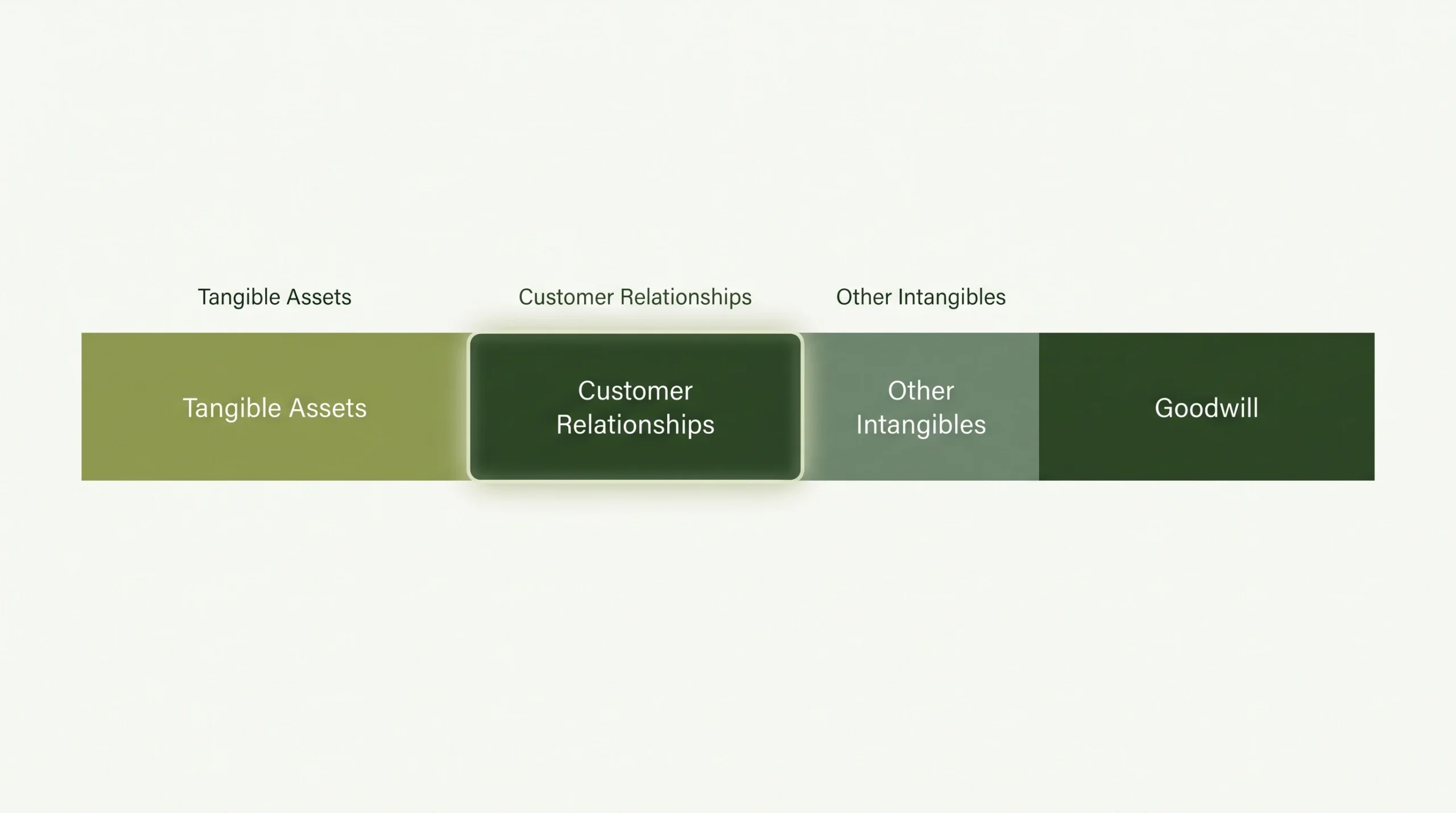
Customer relationships differ from goodwill in one key way. The relationships can be valued and amortized on their own. Goodwill cannot. Goodwill is what remains after every named asset is valued. It gets tested for impairment, not amortized. Other intangibles, such as a trade name, follow their own path. The table below sorts the three so the balance sheet stays clear.
| Asset | Valued on its own? | How it is expensed | Common method |
|---|---|---|---|
| Customer relationships | Yes, under ASC 805 | Amortized over useful life | MPEEM |
| Goodwill | No, it is the residual | Tested for impairment | Price minus net assets |
| Trade name | Yes, if separable | Amortized or held open | Relief from royalty |
These lines can blur in real deals. A steady sales stream may come from the brand, the base, or plain market presence. The analyst has to show which asset earns the cash. That proof is where The Sofer Difference shows up, a four-phase process of Discovery, Diligence, Analysis, and Delivery. It reflects the Heart of a Teacher approach the firm brings to each job: show the owner the math, not just the total. Sofer Advisors has earned 180+ five-star Google reviews for this kind of clear, defensible work. IRS Revenue Ruling 59-60 still guides how the income gets tied to each asset.
Frequently Asked Questions
How are customer relationships valued in a purchase price allocation?
Customer relationships are valued by the future cash the acquired base will bring in. An analyst projects the revenue from those customers, then removes the cost to serve them and the contributory asset charges. What is left gets discounted to present value. That figure is the fair value of the asset. Sofer Advisors uses the multi-period excess earnings method to keep this value apart from goodwill.
What is the multi-period excess earnings method?
The multi-period excess earnings method, or MPEEM, values an intangible by the cash it alone earns. It projects the net earnings from the customer base over several years. Then it subtracts a fair return for every other asset that helps produce those earnings. The excess that remains gets discounted to today’s value. This income approach is the standard for ASC 805 customer relationship work.
How is the customer attrition rate estimated?
An analyst estimates attrition by studying how long past customers stayed. Customers get grouped by the year they joined, which is a cohort view. That view shows the pace at which each group leaves. From the pattern, the analyst draws a survivor curve for the future. When a buyer lacks clean history, industry data can fill the gap. Sofer Advisors ties each curve to the real behavior of the acquired base.
What are contributory asset charges?
Contributory asset charges are the returns owed to the other assets that support the customer base. A client base needs working capital, equipment, staff, and a brand to earn. Each of those assets deserves a market return. The analyst subtracts those returns from the projected cash. This step leaves only the profit the relationships truly drive. Without it, the model would count the same income twice.
How does the discount rate affect the value?
The discount rate sets how much future earnings are worth today. A higher rate means more risk and a lower value. The analyst usually starts from the deal’s weighted average cost of capital. Then the rate is tuned for the risk of the customer base alone. A small change here can swing the value by a wide margin. That is why the rate must rest on market data.
What is the useful life of a customer relationship?
Useful life is the span over which the acquired base keeps earning. It comes straight from the attrition pattern in the model. A base that renews for years supports a longer life. A base that churns fast supports a short one. Life sets the schedule for amortization on the books. Sofer Advisors matches the life to the survivor curve so the expense tracks real economics.
Why can a market approach not value customer relationships?
A market approach leans on sales of similar assets. Customer relationships almost never trade on their own, so those sales are scarce. Without good comparables, the market approach gives a weak answer. The income approach reads the actual cash the base produces instead. That is why MPEEM is the accepted method for these assets. Regulators expect an income model for ASC 805 customer work.
How does customer concentration change the value?
Customer concentration raises risk when a few accounts drive most of the revenue. Losing one of them would hurt earnings sharply. An analyst reflects this by raising the discount rate or shortening the useful life. Both moves lower the present value of the asset. Sofer Advisors measures concentration early and prices the risk into the model. The result is a value an auditor can accept.
How much does a purchase price allocation from Sofer Advisors cost?
A purchase price allocation and ASC 805 intangible work from Sofer Advisors usually runs 15,000 to 50,000 dollars. The price tracks the deal size and the number of intangibles to value. A single customer asset sits toward the lower end. Several intangibles with thin data sit higher. Simpler engagements run lower still. Contact Sofer Advisors for a fee quote matched to your deal.
Related Case Studies
- Valuing Contingent Consideration (Earnouts) under ASC 805
- Excess Earnings: Valuing Goodwill and Assets
- When the Cost Approach Wins: Valuing Asset-Heavy Businesses
Executive Summary
A customer relationship intangible is the value of an acquired client base. Under ASC 805, a buyer must value it apart from goodwill. The multi-period excess earnings method does most of this work. It isolates the cash the base earns, then removes contributory asset charges. The customer attrition rate sets the useful life and the pace of amortization. The discount rate, drawn from the Kroll Cost of Capital Navigator, turns future earnings into value today. A one point shift in either rate can move the result by six figures. Sofer Advisors builds each figure to meet IRS Revenue Ruling 59-60, the AICPA SSVS standard, and a hard audit. The firm holds Inc. 5000 recognition for 2024 and 2025.
What Should You Do Next?
Start by gathering your customer contracts, renewal history, and revenue by account. Next, pull the attrition data an analyst needs to build the survivor curve. Then set the valuation before your audit deadline, not after it.
For a purchase price allocation that holds up, work with David Hern CPA ABV ASA. He has given expert witness testimony in 11+ cases across Georgia, Florida, California, and New Mexico. Schedule a consultation to discuss your deal.
People Also Read
- The Net Asset Value Method: Balance Sheet Over Earnings
- Reasonable Royalty: Valuing IP Infringement Damages
About the Author
This guide was prepared by David Hern CPA ABV ASA, founder of Sofer Advisors, a business valuation firm headquartered in Atlanta, GA serving clients across the United States. David holds dual accreditations as an Accredited Senior Appraiser (ASA) and is Accredited in Business Valuation (ABV), credentials recognized by the IRS, SEC, and FINRA. He also holds the Certified Exit Planning Advisor (CEPA) designation. With 15+ years of valuation experience, David has served as an expert witness in 11+ cases across multiple jurisdictions and built Sofer Advisors into an Inc. 5000-recognized firm with 180+ five-star Google reviews. Its full W2 employee team maintains subscriptions to all major valuation databases and operates under a next business day response policy. For professional business valuation services, visit soferadvisors.com/about-us/ or contact Sofer Advisors at soferadvisors.com/contact-us/.
Disclaimer: This content is for informational purposes only and does not constitute professional valuation advice. Business valuation conclusions depend on specific facts and circumstances. Contact Sofer Advisors for guidance regarding your specific situation.









