


Last Updated: September 2026
A cash-free debt-free valuation prices a business sale on enterprise value, while the seller keeps the cash and the company’s debt is paid off at closing. The headline number is the enterprise value. What the seller receives, the equity value, is smaller because net debt comes out first. In many middle-market deals, this one step moves the payout by millions of dollars.
This structure is the default in most private company sales. Owners often celebrate the enterprise value in a letter of intent, then feel shortchanged at closing when net debt and a working-capital true-up shrink the figure. Knowing the equity bridge before you sign keeps the final wire transfer from becoming a surprise.
Sofer Advisors provides neutral, third-party valuations for owners heading into a sale. With 180+ five-star Google reviews and a full W2 employee team, it maps the equity bridge so owners see their true proceeds. Its work has held up in court, including expert witness testimony in 11+ cases.
Key Takeaways
- Deals price on enterprise value: the headline number values the whole business, before cash and debt are settled.
- Seller keeps the cash, debt is cleared: the seller sweeps the cash, and the company’s debt is paid off at closing.
- Net debt comes out first: net debt is total debt minus cash, and it reduces the price directly.
- The peg trues up the price: delivering more than the target lifts the price, delivering less cuts it.
- Equity value is your real payout: after net debt, working capital, and other items, it is the cash you take home.
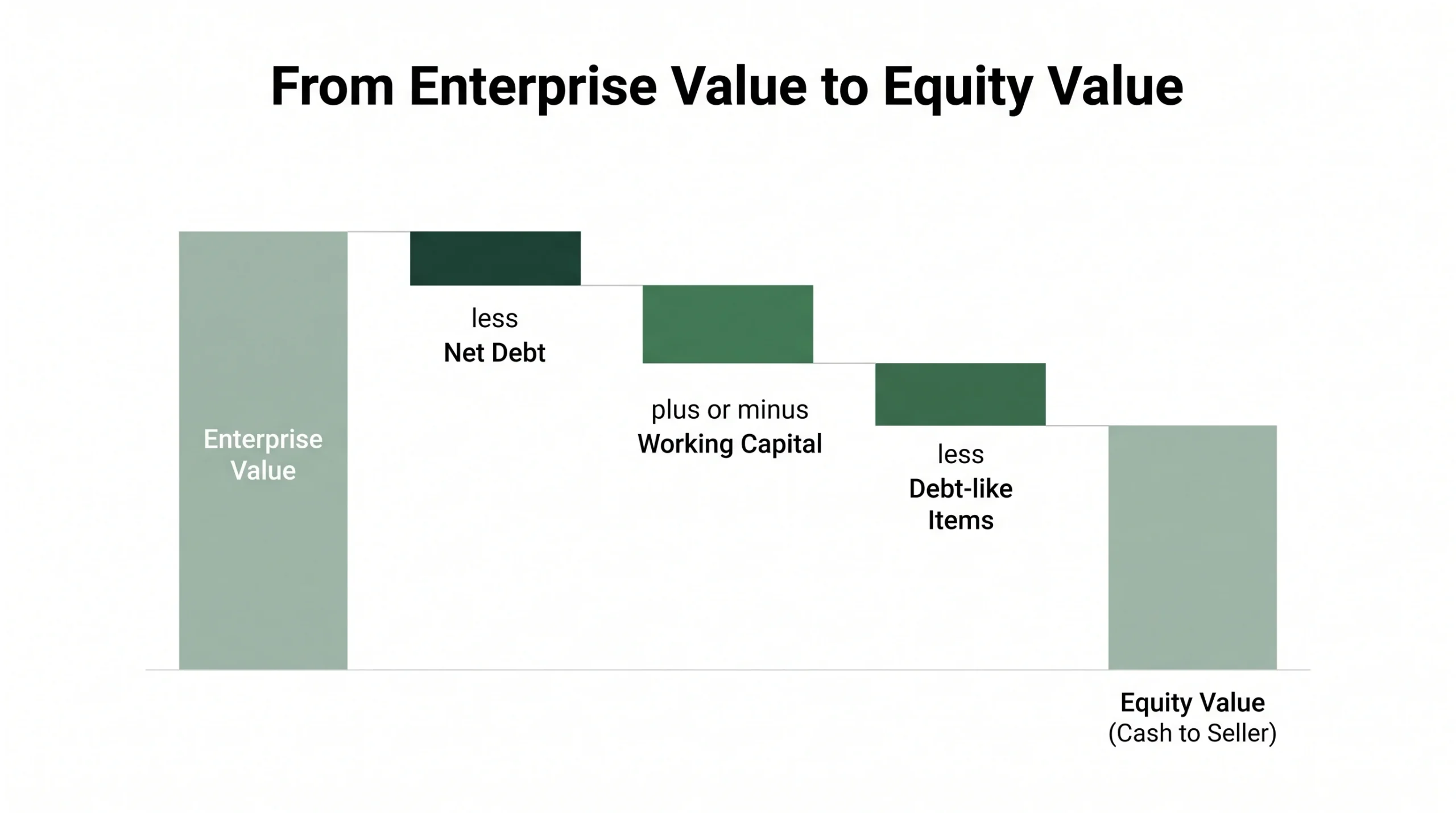
These five items form the equity bridge, the short walk from a headline enterprise value to the money in your account. The sections below take that walk one step at a time.
What does cash-free debt-free mean in a deal?
Cash-free debt-free means the buyer buys the business assuming it has no cash and no debt at closing. The seller keeps the cash in the accounts and uses the proceeds to pay off the company’s debt. So the buyer receives a clean balance sheet, and both sides price the deal on enterprise value, the worth of the core operating business. This keeps talks focused on how the business runs, not on how its accounts look that week.
The logic is simple. Enterprise value answers one question: what is the operating business worth? Cash and debt are financing choices layered on top. A company might hold lots of cash or carry heavy loans, yet neither changes what the operations are worth. Stripping both out lets buyers and sellers compare businesses on the same footing. Cash and debt are then settled in the bridge.
How does the equity bridge turn enterprise value into deal price?
The equity bridge is the set of adjustments that convert enterprise value into equity value, the cash a seller receives. You start at enterprise value, subtract net debt, add or subtract the working-capital true-up against the target, then subtract debt-like items and transaction costs. What remains is the equity value. Sofer Advisors builds this bridge for owners so the closing figure is known long before the signing table.
A short example makes it concrete. The parties agree on a $50 million enterprise value. The business carries $12 million of debt and holds $2 million of cash, so net debt is $10 million. A working-capital true-up adds $0.5 million, since the seller delivered a little more than the target. Debt-like items and transaction costs take out $1 million. The table below walks the bridge to a $39.5 million equity value.
| Step | Line item | Example ($M) |
| Starting point | Enterprise value | 50.0 |
| Less | Net debt (debt minus cash) | (10.0) |
| Plus or minus | Working-capital true-up vs target | +0.5 |
| Less | Debt-like items and transaction costs | (1.0) |
| Equals | Equity value (cash to seller) | 39.5 |
Read top to bottom, the bridge shows why a $50 million deal pays $39.5 million. The headline enterprise value sets the ceiling. Net debt, working capital, and the smaller items decide the check. Owners who model this early can push back on any line with evidence, not emotion.
How is net debt calculated in a deal?
Net debt is total interest-bearing debt minus cash and cash equivalents. Buyers add up loans, credit lines, notes, and the current portion of long-term debt, then subtract the cash the business holds. The result reduces enterprise value dollar for dollar. So heavy borrowing yields far less to the owner, while a cash-rich seller keeps that cash.
The definition sounds tidy, but the edges get negotiated. Buyers often argue that certain accruals act like debt and should count, while sellers argue the opposite. Restricted cash and cash needed to run the business day to day can become sticking points. Each dollar counted as debt is a dollar off the price, so this line rewards careful preparation.
How does the working-capital peg change the price?
The working-capital peg is an agreed target level of normal working capital the seller must deliver at closing. Working capital funds daily operations, mostly receivables and inventory, less payables. Hand over more than the target and the price rises by the difference; deliver less and it drops. The peg stops a seller from stripping receivables or delaying payments to pad cash before closing. It also protects the buyer from inheriting a business that cannot fund itself.
Setting the peg is often the quietest fight in a deal. Both sides study a year or more of history to find a normal level. A peg set too high forces the seller to leave extra cash behind; a peg set too low hands the buyer a windfall. Sofer Advisors studies the working-capital trend so owners negotiate the target from data, not guesswork. Our guide to the working-capital peg covers the mechanics.
What other items adjust the equity bridge?
Beyond net debt and working capital, the bridge captures debt-like items and transaction costs. Debt-like items are obligations that behave like borrowing even though they are not called loans, so buyers subtract them from the price. Transaction costs, such as advisor and legal fees, also come out of the seller’s proceeds. Together these items can move the final check by a real margin.
Sellers reduce these surprises by finding the items first. The most common debt-like items include:
- Accrued but unpaid taxes and payroll obligations
- Customer deposits and deferred revenue the buyer must still fulfill
- Capital leases and equipment financing
- Earnout or deferred payments owed from prior deals
- Accrued bonuses, severance, and unpaid legal settlements
Clean books make this step fairer. A buyer’s diligence team hunts for each of these, so a seller who documents them early keeps control. Our mid-market due diligence checklist shows what buyers review, and our look at earnout valuation covers deferred payments.
Which firm should map your equity bridge?
Owners choose among independent valuation firms, large advisory groups, and business brokers. Their incentives differ in ways that shape the number. An independent firm gives a neutral opinion of value and builds the bridge to standards like the American Society of Appraisers business valuation discipline and the Uniform Standards of Professional Appraisal Practice. A broker earns a commission on the sale, so the estimate can lean high. Large firms serve the biggest deals. The table below compares the options.
| Provider type | Deal role | Conflict of interest |
| Sofer Advisors | Neutral opinion of value and equity bridge | None; flat fee, not tied to the close |
| Alvarez & Marsal, Stout, Kroll | Large-cap deal and restructuring advisory | Varies; often success-based fees |
| Business broker | Marketing and closing the listing | High; commission on sale price |
Sofer Advisors follows The Sofer Difference, a four-phase process of Discovery, Diligence, Analysis, and Delivery. It also applies a Heart of a Teacher approach, so owners understand every line of the bridge, not just the total. Large firms like Alvarez & Marsal serve enterprise clients; Sofer brings that rigor to middle-market deals. See how a neutral opinion supports a sale in our transaction advisory work.
These questions cover what owners ask.
Frequently Asked Questions
What does cash-free debt-free mean in an M&A deal?
Cash-free debt-free means the buyer acquires the business with no cash and no debt on it. The seller keeps the cash and uses proceeds to pay off the company’s debt at closing. Both sides price the deal on enterprise value, the worth of the operating business. Cash and debt are then settled in the equity bridge to reach the seller’s equity value.
How is net debt calculated in the equity bridge?
Net debt is total interest-bearing debt minus cash and cash equivalents. You add up loans, credit lines, notes, and the current portion of long-term debt, then subtract available cash. That figure comes straight off enterprise value in the equity bridge. A business with heavy borrowing yields less to its owner, while a cash-rich seller keeps that cash. The exact items counted as debt are usually negotiated during diligence, so documentation matters.
Why does the headline price differ from the cash a seller receives?
The headline price is enterprise value, the worth of the whole operating business. The cash a seller receives is equity value, which sits lower on the bridge. Between the two, net debt comes out, working capital is trued up against the target, and debt-like items and costs are subtracted. That is why a $50 million enterprise value can turn into a payout closer to $40 million.
How does the working-capital peg fit into the cash-free debt-free bridge?
The working-capital peg is an agreed target level of normal working capital the seller must deliver at closing. If the seller delivers more than the target, the price rises by the difference. If they deliver less, the price falls. The peg prevents last-minute balance sheet tricks and makes sure the buyer inherits a business that can fund itself. Both sides study historical trends to set a fair target before signing.
Who bears the debt in a cash-free debt-free transaction?
The seller bears the company’s debt in a cash-free debt-free deal. Because the buyer prices the business as if it had no debt, the seller uses sale proceeds to settle the loans at closing. In exchange, the seller keeps the cash. The effect flows through the bridge as net debt, debt minus cash, and reduces the seller’s equity value dollar for dollar.
What counts as a debt-like item?
A debt-like item is an obligation that behaves like borrowing even though it is not a loan, so buyers subtract it from the price. Common examples include unpaid taxes, accrued bonuses, deferred revenue, capital leases, unfunded pensions, and pending legal settlements. Each is negotiated during diligence. Sellers who identify these early avoid last-minute cuts to their proceeds.
What is the difference between enterprise value and equity value?
Enterprise value is the worth of the operating business, before cash and debt. Equity value is what the owner keeps after net debt and other adjustments, and it is the cash that lands at closing. Buyers usually negotiate on enterprise value, then move down the bridge to equity value. The gap between the two depends on how much debt the business carries and how the working-capital and debt-like items land.
Do I keep the cash in my business when I sell?
In a cash-free debt-free deal, yes, the seller keeps the cash in the accounts. Because the buyer prices the business as if it had no cash and no debt, the cash belongs to the seller, who also settles the debt from proceeds. Some cash needed for daily operations may count as working capital, so confirm which accounts are swept and which support the peg.
How much does a transaction valuation from Sofer Advisors cost?
A transaction valuation from Sofer Advisors generally runs $7,500 to $25,000 and takes four to eight weeks, in line with its standard business valuation range. Cost depends on company size, deal complexity, and how many debt-like items and adjustments the bridge involves. Larger or multi-entity deals reach the higher end. For a quote tied to your situation, contact us with your financials and deal terms.
Related Case Studies
- Business Valuation for Mergers: Buy-Side vs Sell-Side
- Asset Sale vs Stock Sale: Tax and Deal Structure Guide
- Customer Concentration: Why It Cuts Sale Price 10 to 30 Percent
Executive Summary
Cash-free debt-free is the standard convention in private company sales. The buyer prices the business on enterprise value, the seller keeps the cash, and the debt is paid off at closing. The equity bridge then converts that headline number into the equity value a seller receives. You subtract net debt, add or subtract a working-capital true-up against an agreed target, then subtract debt-like items and transaction costs. In a $50 million deal, those steps can leave a payout near $40 million. Owners who model the bridge before signing negotiate each line from evidence.
What Should You Do Next?
Gather three years of financial statements, a debt schedule, and a monthly working-capital history, then build your own bridge from enterprise value down to equity value. List every debt-like item a buyer might raise, so none surprises you at closing. Set a defensible working-capital target from the data before a buyer proposes one, since the party with the evidence usually wins that line.
David Hern CPA ABV ASA, founder of Sofer Advisors, builds neutral, defensible equity bridges for owners preparing to sell. Schedule a consultation to review your deal terms and true proceeds.
People Also Read
- After-Tax Proceeds: How to Model the Net of a Business Sale
- Quality of Earnings Reports: What Buy-Side QofE Actually Tests
About the Author
This guide was prepared by David Hern CPA ABV ASA, founder of Sofer Advisors, a business valuation firm headquartered in Atlanta, GA serving clients across the United States. David holds dual accreditations as an Accredited Senior Appraiser (ASA) and is Accredited in Business Valuation (ABV), credentials recognized by the IRS, SEC, and FINRA. He also holds the Certified Exit Planning Advisor (CEPA) designation. With 15+ years of valuation experience, David has served as an expert witness in 11+ cases across multiple jurisdictions and built Sofer Advisors into an Inc. 5000-recognized firm with 180+ five-star Google reviews. Its full W2 employee team maintains subscriptions to all major valuation databases and operates under a next business day response policy.
For professional business valuation services, visit soferadvisors.com/about-us/ or contact Sofer Advisors at soferadvisors.com/contact-us/.
Disclaimer: This content is for informational purposes only and does not constitute professional valuation advice. Business valuation conclusions depend on specific facts and circumstances. Contact Sofer Advisors for guidance regarding your specific situation.









