


Last Updated: June 2026
After-tax proceeds are what a seller actually keeps from a business sale once federal and state taxes are paid, and they are almost always materially lower than the headline purchase price, often by 20% to 40%. Every selling owner should run a pro forma net proceeds model before accepting a letter of intent, not after signing the purchase agreement. The tax burden is determined by how the transaction is structured (asset sale versus stock sale), how the purchase price is allocated across asset categories, and whether deferral strategies like installment sales, qualified opportunity zones, or ESOPs are used.
The blended effective tax rate depends on how the buyer and seller allocate the purchase price across asset categories. Goodwill allocated in an asset sale generally qualifies for long-term capital gains rates. Inventory and equipment with prior depreciation trigger ordinary income tax (up to 37% federal). Getting the allocation right before signing is critical. Sofer Advisors helps owners and their advisors work through exactly these questions and turn the analysis into a defensible business valuation they can act on.
Key Takeaways
- Aftertax Net Proceeds Business – After-tax net proceeds from a business sale are typically 60%–80% of the headline enterprise value, depending on deal structure, tax basis, and deferral strategies employed.
- Asset Sales Better Buyers – Asset sales are better for buyers (depreciation step-up) but worse for sellers (ordinary income on multiple categories); stock sales are better for sellers but require buyers to pay a premium to compensate.
- Longterm Capital Gains Goodwill – Long-term capital gains on goodwill (taxed at 20% federal plus 3.8% NIIT) versus ordinary income on inventory, AR, and recaptured depreciation (up to 37%) creates a wide spread – purchase price allocation negotiation is a tax negotiation.
- Georgia Imposes Flat 539 – Georgia imposes a flat 5.39% individual income tax rate in 2026 on capital gains and ordinary income from business sales; this stacks directly on top of federal tax.
- Installment Sales Defer Recognition – Installment sales defer recognition of gain, spreading the tax burden over multiple years, but create interest income and buyer credit risk.
- Section 1202 QSBS Exclusion – Section 1202 QSBS exclusion can eliminate up to 100% of federal capital gains tax for qualifying C-corp shareholders who have held stock for 5+ years.
Each of these factors is examined in depth in the sections that follow.
Are Proceeds from a Business Sale Taxable Income?
Yes, but the tax rate depends on the deal structure and purchase price allocation. Business sale proceeds are not a single income type. They are a bundle of taxable events, each governed by different rules.
In an asset sale, the tax treatment follows the nature of each asset sold:
- Goodwill and going-concern value: Long-term capital gain, taxed at 0%, 15%, or 20% federal depending on taxpayer income, plus 3.8% NIIT for taxpayers above the $200K/$250K threshold.
- Fixed assets (machinery, equipment): Gain to the extent of prior depreciation is ordinary income under Section 1245. Any gain above the original cost basis is capital gain.
- Real property: Section 1250 recapture applies to straight-line depreciation taken; this is taxed at a maximum 25% rate.
- Inventory: Ordinary income – up to 37% federal.
- Accounts receivable: Ordinary income if the business uses the cash method.
- Covenant not to compete: Ordinary income to the seller, amortizable over 15 years for the buyer.
In a stock sale, the seller typically recognizes a single capital gain on the difference between the sale proceeds and their adjusted basis in the stock. For long-term holdings, this is a long-term capital gain taxed at the preferential rate. The effective federal rate on long-term capital gain is 23.8% (20% + 3.8% NIIT) for most business sellers at these income levels.
How the proceeds are taxed depends on how the transaction is structured, which the IRS explains in its guidance on the sale of a business.
What Is the Tax Difference Between an Asset Sale and a Stock Sale?
The asset sale versus stock sale distinction is the most consequential tax decision in a business sale transaction. The two sides of the table have opposite incentives.
Sellers prefer stock sales because the entire gain (less adjusted stock basis) is treated as capital gain. There is no depreciation recapture, no ordinary income on AR or inventory. The seller converts what would be multiple income streams into a single capital gain taxed at 20% federal (plus state).
Buyers prefer asset sales because they get a “step-up” in tax basis on the acquired assets to fair market value. The buyer can depreciate the full purchase price allocation over applicable asset lives, creating post-acquisition tax deductions. For a $10M business with $7M allocated to goodwill, the buyer gets $7M in amortizable goodwill deductions over 15 years under Section 197.
This structural conflict is resolved commercially. Buyers who insist on an asset sale typically pay a premium, often called a “gross-up”, to compensate the seller for the more tax burden. A common rule of thumb is that the seller requires a 5%–10% higher gross purchase price to accept an asset sale. For S-corporations and LLCs, buyers who want “asset sale” economics can request a Section 338(h)(10) or Section 754 election. These allow asset-sale tax treatment for the buyer while maintaining a single legal entity transfer.
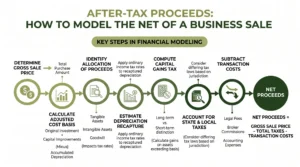
How to Model After-Tax Proceeds: A Pro Forma Example
The following illustrates the after-tax proceeds calculation for a hypothetical $10M asset sale of a Georgia-based S-corporation. This is illustrative only, actual tax outcomes depend on specific facts and professional tax advice is required.
Transaction: $10M asset sale of an S-corp manufacturing business
| Purchase Price Component | Amount | Character | Federal Rate | GA Rate | Net After Tax |
|---|---|---|---|---|---|
| Goodwill / Intangibles | $6,000,000 | Long-term capital gain | 23.8% (20% + 3.8% NIIT) | 5.39% | $4,242,000 |
| Covenant Not to Compete | $500,000 | Ordinary income | 37% | 5.39% | $287,600 |
| Fixed Equipment (above basis) – Section 1245 recapture | $800,000 | Ordinary income | 37% | 5.39% | $460,880 |
| Real Property – Section 1250 recapture | $600,000 | 25% recapture rate | 25% | 5.39% | $417,660 |
| Inventory | $400,000 | Ordinary income | 37% | 5.39% | $230,440 |
| Accounts Receivable | $700,000 | Ordinary income | 37% | 5.39% | $403,270 |
| Total Enterprise Value | $9,000,000 | ||||
| Less: Adjusted Basis | ($1,000,000) | ||||
| Net Taxable Gain | $8,000,000 | ||||
| Blended Tax Rate (about) | ~31% | ~5.39% | |||
| Estimated After-Tax Proceeds | ~$5.9M–$6.4M |
Note: Installment sale treatment, Section 1202 QSBS, or other strategies can materially alter this outcome. This is illustrative only.
The practical takeaway: a $10M headline price in a heavy asset sale allocation produces about $5.9M–$6.4M after tax for a Georgia seller. A stock sale on the same $8M net gain would yield about $6.6M–$6.8M, a difference of $400,000–$800,000 solely from deal structure.
What Tax Deferral Strategies Are Available to Business Sellers?
Several strategies can defer or reduce the tax burden from a business sale. None are simple. Sellers should engage a transaction tax advisor, not just a general CPA, well before closing.
Installment sale. Under Section 453, a seller who receives deferred payments may report gain as payments are received. This spreads the tax burden over multiple years. The risk is buyer credit risk, if the buyer does not pay, the seller has already sold the business but may not collect the full proceeds.
Qualified Opportunity Zone (QOZ) reinvestment. A seller who reinvests capital gains into a Qualified Opportunity Fund within 180 days can defer the original gain. Gains from the QOF investment held for 10+ years are permanently excluded from federal income tax.
ESOP (Employee Stock Ownership Plan). C-corp owners who sell at least 30% of company stock to an ESOP may elect Section 1042 deferral. They reinvest the proceeds into Qualified Replacement Property and defer the capital gains indefinitely.
Section 1202 QSBS exclusion. Section 1202 excludes up to 100% of federal capital gains on the sale of qualified small business stock in a C-corporation. The cap is the greater of $10M or 10x the taxpayer’s basis. Requirements include: C-corp structure at issuance, gross assets under $50M at issuance, and a 5+ year holding period.
Personal goodwill allocation. For professional service businesses, a formal personal goodwill allocation may allow the selling owner to recognize capital gain directly. This requires documentation and should be established well before the transaction.
David Hern CPA ABV ASA, founder of Sofer Advisors, brings a Heart of a Teacher to every engagement – translating complex valuation methodology into clear, actionable guidance that clients can act on before and after the report is delivered. With 15+ years of valuation experience, 11+ expert witness cases across multiple jurisdictions, and 180+ five-star Google reviews, David built Sofer Advisors into an Inc. 5000-recognized firm. The Sofer Difference is a four-phase process of Discovery, Diligence, Analysis, and Delivery that ensures every conclusion is defensible, documented, and tied to the specific facts of the business.
While national firms like Stout and Kroll serve large enterprise clients, Sofer Advisors specializes in middle-market businesses that require personalized attention, direct access to credentialed professionals, and a next business day response policy.
How Does Georgia State Tax Affect Business Sale Proceeds?
Georgia imposes a flat individual income tax rate of 5.39% in 2026, applicable to both ordinary income and capital gains. Unlike some states, Georgia does not offer a preferential rate for capital gains, a business seller in Georgia pays the same state rate on long-term capital gains as on ordinary income.
The Georgia tax stacks directly on top of federal tax. For a Georgia seller realizing a $5M long-term capital gain: federal LTCG at 20% = $1,000,000; NIIT at 3.8% = $190,000; Georgia at 5.39% = $269,500. Total: $1,459,500, an effective blended rate of about 29.2%.
Georgia residents who relocate to a no-income-tax state before closing can potentially avoid the Georgia state tax. But the exit must be a genuine change of domicile, established well before the transaction. Georgia aggressively audits domicile changes that coincide with large income events. It does not conform to federal QOZ deferral, Georgia taxes QOZ gains when the federal gain is recognized.
What Advisors Help with Tax-Efficient Deal Structuring?
A complete advisory team for a tax-efficient business sale includes:
A transaction tax advisor (CPA with M&A tax specialization) to model the net proceeds under multiple deal structures, negotiate purchase price allocation, and implement deferral strategies.
A business valuation professional to provide a defensible, independent valuation that supports purchase price allocation. If the IRS challenges an allocation, an independent appraisal is the seller’s primary defense.
An M&A attorney to negotiate the purchase agreement representations, allocation schedule, and indemnification provisions that interact with tax exposure.
A wealth advisor to model the post-sale portfolio and allocate proceeds into tax-efficient investment structures.
The questions below address the most common issues business owners raise before engaging a qualified appraiser for a after tax proceeds business engagement.
Frequently Asked Questions
How much tax do you pay after selling a business?
The effective combined federal and state tax rate on a business sale depends on deal structure and asset allocation. A Georgia business seller in a well-structured stock sale or asset sale with goodwill-heavy allocation should expect an effective rate of 28%–36% on the taxable gain.
Are proceeds from the sale of a business taxable income?
Yes. All proceeds are taxable, but the tax rate varies by asset category. Goodwill is taxed as long-term capital gain (favorable); inventory and AR are taxed as ordinary income (less favorable); depreciation recapture is taxed at ordinary income rates or the 25% Section 1250 rate for real property.
How to avoid paying capital gains tax after selling a business?
Complete elimination is rare; mitigation is achievable. Strategies include Section 1202 QSBS exclusion, ESOP Section 1042 rollover, installment sale deferral, and Qualified Opportunity Zone reinvestment, none are available if initiated after closing.
What is depreciation recapture and how does it affect my sale proceeds?
When you sell depreciable assets for more than their depreciated book value, the IRS “recaptures” the prior depreciation deductions as ordinary income. Section 1245 recapture on personal property is taxed at ordinary income rates (up to 37%); Section 1250 recapture on real property is taxed at a maximum 25% rate.
What is the net investment income tax and when does it apply?
The 3.8% NIIT applies to the lesser of net investment income or the amount by which modified AGI exceeds $200,000 (single) or $250,000 (married filing jointly). For most business sellers, the 3.8% NIIT applies in the sale year because the gain pushes income well above the threshold.
Can I spread out the tax from a business sale using installment payments?
Yes, under Section 453 an installment sale allows you to recognize gain as payments are received rather than in one lump sum. But installment sales create buyer credit risk and interest income, and they do not defer ordinary income on depreciation recapture, which is due in the year of sale.
What is Section 1202 QSBS and how does it eliminate capital gains?
Section 1202 excludes up to 100% of federal capital gains on the sale of qualified small business stock (QSBS) in a C-corporation, subject to a per-issuer cap of the greater of $10M or 10x the taxpayer’s basis. Requirements include: C-corp structure at stock issuance, gross assets under $50M at issuance, and a 5+ year holding period.
Should I accept a stock sale or an asset sale structure?
Stock sales generally produce better after-tax outcomes for sellers; asset sales generally produce better post-acquisition depreciation for buyers. Whether a gross-up offer is adequate requires modeling the after-tax proceeds under both structures with your specific tax basis and asset mix.
Related Case Studies
- Tax Implications Of Selling A Business Owners Guide
- Selling A Business In Georgia Complete Exit Planning Guide 2026
- Estate Planning Business Valuation Georgia Gift Tax Compliance Guide
Executive Summary
- After-tax business sale proceeds are typically 60%–80% of gross enterprise value; the gap is primarily driven by ordinary income tax on depreciation recapture, inventory, and non-compete allocations.
- The asset sale versus stock sale decision can alter net after-tax proceeds by $400,000–$1M+ on a $10M transaction – this is the most important structural decision in any business sale.
- Modeling after-tax proceeds before signing an LOI is the most important step a seller can take; changing the deal structure after LOI signing is possible but difficult.
What Should You Do Next?
If you are planning a business sale and want to understand your real net proceeds, not just the headline price, you need a certified valuation and a coordinated advisory team before you negotiate with buyers. David Hern CPA ABV ASA, founder of Sofer Advisors, holds dual ASA and ABV credentials recognized by the IRS, SEC, and FINRA, with 15+ years of valuation experience and 180+ five-star Google reviews. Schedule a consultation to discuss your business valuation needs.
People Also Read
- Valuation Of Closely Held Business For Estate Tax Purposes
- Personal Goodwill Vs Enterprise Goodwill Tax Divorce Guide For Atlanta Business Owners
About the Author
This guide was prepared by David Hern CPA ABV ASA, founder of Sofer Advisors – a business valuation firm headquartered in Atlanta, GA serving clients across the United States. David holds dual accreditations as an Accredited Senior Appraiser (ASA) and is Accredited in Business Valuation (ABV), credentials recognized by the IRS, SEC, and FINRA. He also holds the Certified Exit Planning Advisor (CEPA) designation. With 15+ years of valuation experience, David has served as an expert witness in 11+ cases across multiple jurisdictions and built Sofer Advisors into an Inc. 5000-recognized firm with 180+ five-star Google reviews. The firm’s full W2 employee team maintains subscriptions to all major valuation databases and operates under a next business day response policy.
For professional business valuation services, visit soferadvisors.com/about-us/ or schedule a consultation at soferadvisors.com/contact-us/.
This content is for informational purposes only and does not constitute professional valuation advice. Business valuation conclusions depend on specific facts and circumstances. Contact Sofer Advisors for guidance regarding your specific situation.









