


Last Updated: September 2026
A business valuation for lifetime gifting is a formal appraisal that sets the fair market value of a private company interest you give to another person. The value fixes how much of your federal gift and estate tax exemption the transfer uses. In 2026, that exemption is $15 million per person, made permanent by the 2025 federal tax law. Because most family gifts involve minority or restricted shares, the appraisal must weigh specific valuation discounts.
The larger, permanent exemption gives business owners real room to move equity to the next generation. A defensible valuation lets you gift more of that value while staying inside the limit. It also removes future growth from your taxable estate. The number you report must hold up if the IRS reviews the gift. So the quality of the appraisal matters as much as the strategy itself.
Sofer Advisors prepares these valuations for business owners, attorneys, and tax professionals across the country. It brings 15+ years of valuation experience, dual ABV and ASA credentials, and 180+ five-star Google reviews to each engagement. With testimony in 11+ expert witness cases, its appraisers write reports built to withstand IRS review. This work follows a Heart of a Teacher approach that explains every number in plain language.
Key Takeaways
- Permanent $15M exemption: the federal gift and estate tax exemption is $15 million per person for 2026, made permanent and indexed by the 2025 tax law, so owners have lasting room to transfer equity.
- Valuation sets the gift: a qualified appraisal fixes the fair market value reported on Form 709, and that number decides how much exemption each gift uses.
- Discounts stretch the exemption: minority interests can qualify for discounts for lack of control and lack of marketability, so more of the company moves per dollar of exemption.
- Adequate disclosure protects you: filing a qualified appraisal with Form 709 starts the three year statute of limitations, without which the IRS can question the value later.
- Freeze future growth: gifting equity now removes later appreciation from your taxable estate, and a defensible valuation supports both the transfer and the GST exemption you allocate.
Each factor shapes how much value you can move and how well the gift holds up. The sections below explain the exemption, the discounts, and the reporting steps in order.
What is the lifetime gift tax exemption in 2026?
The lifetime gift tax exemption is the total value you can give away during life without paying federal gift tax. For 2026, it stands at $15 million per person, or $30 million for a married couple. The 2025 federal tax law, the One Big Beautiful Bill Act, made this amount permanent and indexed it for inflation, so it will not fall back to earlier levels. The IRS confirms the $15 million figure for 2026.
The exemption is unified with the estate tax. Gifts you make during life and assets left at death draw from the same pool. This is separate from the annual gift exclusion, which lets you give a set amount per recipient each year. For an owner whose company has grown, the permanent limit creates a clear path. You can move equity to heirs and keep future growth out of the estate.
Why is a business valuation required to gift a business interest?
A business valuation is required because the IRS needs a defensible fair market value for any private business interest you report on Form 709. When you gift shares, the tax code asks the donor to support the value with a qualified appraisal. This prevents later disputes over how much exemption the gift used.
Adequate disclosure is the main reason to obtain a formal report. Filing a complete appraisal with the return starts the three year statute of limitations for the IRS to challenge the value. Without that documentation, the agency can review the gift far into the future. A qualified appraiser follows IRS Revenue Ruling 59-60, which sets the factors for valuing closely held stock. For gifts tied to estate planning, this connects to broader Tax and Estate Valuation work.
How do valuation discounts stretch the $15M exemption?
Valuation discounts stretch the exemption by lowering the taxable value of the interest you transfer. When you gift a minority stake, the recipient cannot control the company or force a sale. A discount for lack of control, or DLOC, reflects that limit. A discount for lack of marketability, or DLOM, reflects that private shares are hard to sell quickly.
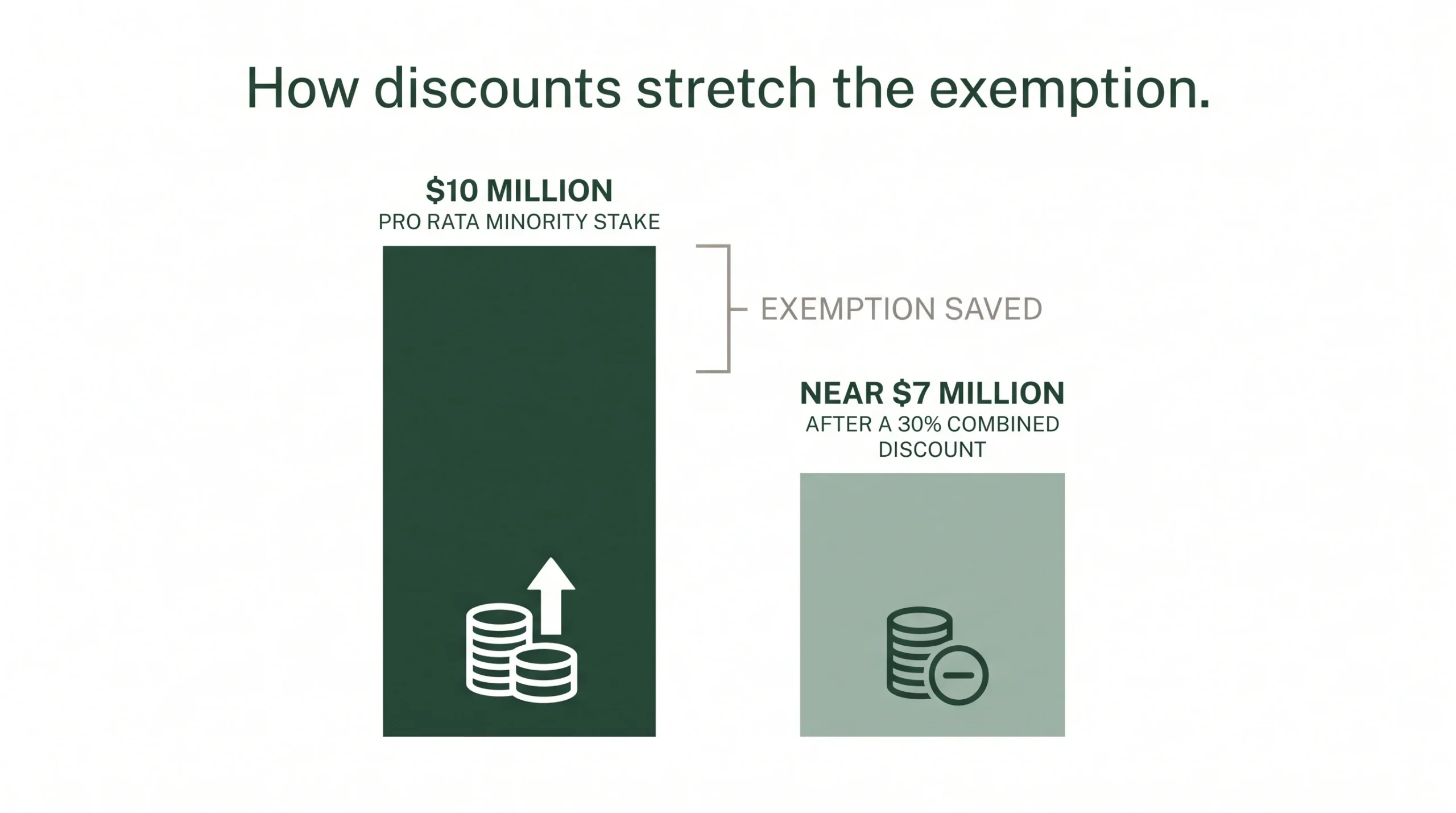
Together, these discounts can lower the gift value by a meaningful margin. Suppose a 30% combined discount applies. A minority stake worth $10 million on a pro rata basis may be valued near $7 million for the gift. You transfer the same ownership while using less exemption. Sofer Advisors documents each discount so the reduction holds up under review. Our guide to valuation discounts on estate and gift tax returns covers the support these figures need, and the annual gift exclusion can layer on top.
How is the fair market value of a business interest set?
Fair market value is the price a willing buyer and seller would agree on, with neither under pressure and both fully informed. To reach it, an appraiser weighs three approaches. The income approach projects future cash flow and discounts it to present value. The market approach compares sales of similar companies. The asset approach nets the value of the balance sheet.
For a gift, the appraiser selects the approach that best fits the company and the interest. A mature, profitable firm often leans on the income approach. The analysis then applies any control and marketability discounts to the specific stake. Revenue Ruling 59-60 guides the weight given to earnings, dividends, and comparable data. The result is a supportable value for the shares you gift.
What are the steps in a gift tax valuation?
A gift tax valuation follows a clear, four phase process that produces a report the IRS can rely on. The structure gives every appraisal a documented trail from raw data to final value. This protects the donor if the gift is ever reviewed.
Sofer Advisors runs each engagement through The Sofer Difference, a sequence of four stages. Discovery defines the interest and gathers financial records. Diligence tests the data for accuracy. Analysis applies the valuation approaches and discounts. Delivery produces a written report that explains the value and the reasoning. The work meets professional standards such as the Uniform Standards of Professional Appraisal Practice, which examiners expect to see.
Choosing a provider depends on the size of the gift, the complexity of the company, and the scrutiny you expect. The table below compares common options.
| Provider type | Typical cost | What you get | Best for |
| Sofer Advisors | $7,500 to $25,000 | Full USPAP and AICPA compliant report with multiple methods, discount analysis, and audit support | Owners who need a defensible gift valuation for high stakes planning |
| Large national firm (Alvarez & Marsal, Stout, or Kroll) | $20,000 to $75,000 and up | Formal report from a large team, often bundled with wider advisory work | Ultra high net worth families with complex, multi entity structures |
| Local CPA or solo practitioner | $3,000 to $10,000 | May be a limited scope report that lacks ASA or ABV credentials | Very small, low risk transfers where a full appraisal is not needed |
Credentials matter most when the IRS reviews a gift. Look for an appraiser who holds the Accredited Senior Appraiser (ASA) or Accredited in Business Valuation (ABV) designation. These signal training in the standards examiners apply. A well documented report from a credentialed appraiser lowers the odds of a successful challenge. The right depth matches the size and risk of the transfer, so owners pay for the rigor the situation calls for.
How do you report the gift and use the GST exemption?
You report a gift of a business interest on IRS Form 709, the federal gift tax return. The return is due the year after the gift, by the normal tax filing date. You attach the qualified appraisal to meet adequate disclosure. This documents the value and starts the statute of limitations.
Large family transfers often skip a generation, so the generation skipping transfer (GST) tax can apply. Each person has a separate $15 million GST exemption for 2026. You allocate part of that exemption on Form 709 to shield gifts to grandchildren or trusts for them. Careful allocation keeps future growth in those trusts free of another layer of tax. Coordinating the appraisal, Form 709, and the GST allocation is where planning pays off.
A permanent exemption rewards owners who plan and document well. The questions below cover what owners ask most.
Frequently Asked Questions
What happens to the estate exemption in 2026?
The federal estate and gift tax exemption rises to $15 million per person in 2026. The 2025 federal tax law made this amount permanent and indexed it for inflation. Because it is permanent, the exemption will not fall back to earlier levels. A married couple can shield up to $30 million combined from federal estate and gift tax.
How large a lifetime gift can you make in 2026?
In 2026 you can give up to $15 million over your lifetime without paying federal gift tax, or $30 million as a married couple. Gifts above the annual exclusion count against this lifetime amount and are tracked on Form 709. Because the exemption is now permanent, owners can plan large transfers on their own timeline.
How does the IRS know if you gift money?
The IRS tracks gifts through Form 709, which the donor files after giving more than the annual exclusion to any person. The form records the value and the exemption used. Filing a qualified appraisal with it starts the three year window for the IRS to question the value. Skipping the filing can leave the value open to review for a long time.
How much can you inherit from your parents without paying taxes?
Heirs generally pay no federal income tax on an inheritance. The estate itself may owe tax only if it exceeds the federal exemption, which is $15 million per person in 2026. Most families fall well below that limit. Owners of larger companies should value their equity early to see whether estate tax planning is worthwhile.
Do I need a valuation to gift a small percentage of my company?
Yes. Almost any gift of a private business interest needs a qualified appraisal so the value reported to the IRS is defensible. Small stakes are often harder to value because they qualify for minority discounts that require support. A documented appraisal protects the reported value and the exemption used if the gift is later reviewed.
What is the difference between the annual exclusion and the lifetime exemption?
The annual exclusion lets you give a set amount per recipient each year with no gift tax return in most cases. The lifetime exemption is the cumulative total you can transfer before gift tax applies. The two work together. Owners often use annual gifts to move small stakes and the lifetime exemption for larger transfers.
How long is a business valuation valid for gifting purposes?
A business valuation reflects value on a specific date, so it applies to the transfer made near that date. Most advisors prefer an appraisal dated in the same year as the gift. If the company changes in a major way, an updated report keeps the value defensible. A fresh appraisal is wise for each significant transfer.
What information is needed for a gift tax business valuation?
A gift tax valuation usually needs three to five years of financial statements and tax returns, plus the current operating or shareholder agreement. Details on ownership rights, recent transactions, and any buy-sell terms also help. This information lets the appraiser set fair market value and support the discounts applied to the interest.
How much does a gift tax business valuation cost?
A gift tax valuation from Sofer Advisors typically ranges from $7,500 to $25,000, based on the complexity of the company and the timeline. The fee covers the research, financial analysis, discount study, and final report needed for your Form 709 filing. For a quote tied to your business, request a consultation.
Related Case Studies
- Valuation of Closely Held Business for Estate Tax Purposes
- How Family Limited Partnerships Are Valued for Gift and Estate Tax
- Chapter 14 Rules: How IRC 2701 and 2703 Affect Family Transfers
Executive Summary
The federal gift and estate tax exemption is $15 million per person for 2026, made permanent by the 2025 federal tax law and indexed for inflation. That gives business owners lasting room to move equity to heirs. A qualified appraisal sets the fair market value reported on Form 709 and fixes how much exemption each gift uses. Discounts for lack of control and lack of marketability can lower that value, so more ownership transfers per dollar. Filing the appraisal starts the three year statute of limitations. A defensible gift valuation, typically for $7,500 to $25,000, supports both the gift and the GST exemption you allocate.
What Should You Do Next?
Start by gathering three to five years of financial statements, tax returns, and your current operating agreement. Next, decide which interest to gift and confirm the value with a qualified appraisal that documents any discounts. Then file Form 709 with the appraisal attached, and allocate GST exemption where a gift skips a generation.
David Hern CPA ABV ASA, founder of Sofer Advisors, prepares defensible valuations for lifetime gifting and estate planning. Schedule a consultation to discuss your situation.
People Also Read
- Estate Freeze Strategies: How Valuations Lock In Today’s Value
- What Is a GRAT and How Does It Transfer Business Value to Heirs?
About the Author
This guide was prepared by David Hern CPA ABV ASA, founder of Sofer Advisors, a business valuation firm headquartered in Atlanta, GA serving clients across the United States. David holds dual accreditations as an Accredited Senior Appraiser (ASA) and is Accredited in Business Valuation (ABV), credentials recognized by the IRS, SEC, and FINRA. He also holds the Certified Exit Planning Advisor (CEPA) designation. With 15+ years of valuation experience, David has served as an expert witness in 11+ cases across multiple jurisdictions and built Sofer Advisors into an Inc. 5000-recognized firm with 180+ five-star Google reviews. Its full W2 employee team maintains subscriptions to all major valuation databases and operates under a next business day response policy.
For professional business valuation services, visit soferadvisors.com/about-us/ or contact Sofer Advisors at soferadvisors.com/contact-us/.
Disclaimer: This content is for informational purposes only and does not constitute professional valuation advice. Business valuation conclusions depend on specific facts and circumstances. Contact Sofer Advisors for guidance regarding your specific situation.









