


Last Updated: September 2026
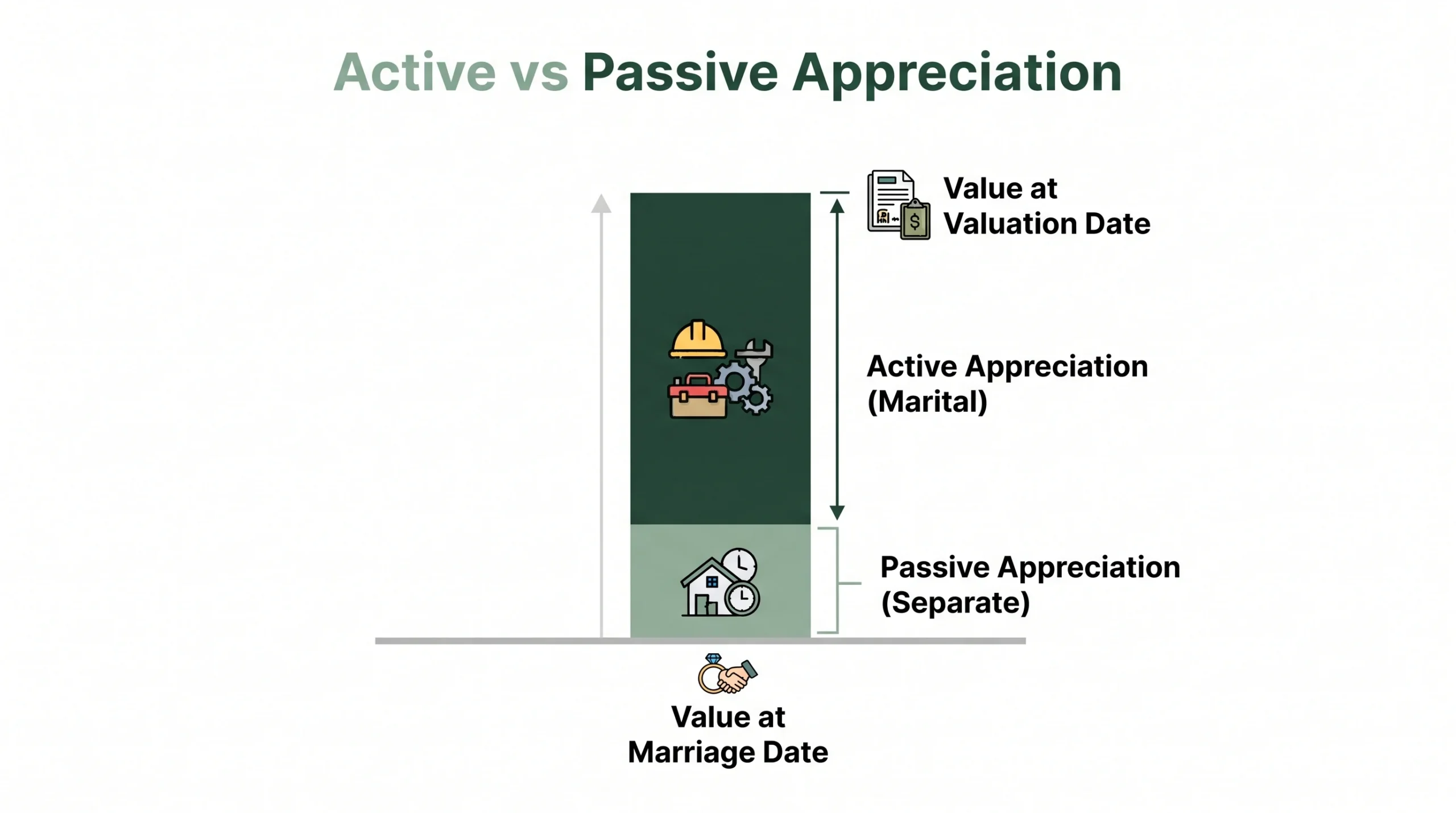
In a divorce, active versus passive appreciation decides how much of a business’s growth is shared. When one spouse owned a company before the marriage, or inherited it, that business usually stays separate property. The contested part is how much its value grew during the marriage. Active appreciation comes from a spouse’s work, skill, or reinvested marital money, and courts often treat it as marital. Passive appreciation comes from outside forces, such as inflation or a rising market, and usually stays separate. Over a long marriage, this increase can hold most of a company’s current value.
The rule is not automatic. Treatment and the burden of proof vary by jurisdiction, and commingling can turn separate property into marital property. An appraiser sets a value at the date of marriage and again at the valuation date, then studies why the value changed. This guide explains active passive appreciation in a business divorce and how the premarital baseline is traced. It gives no legal advice, so speak with your own attorney.
Sofer Advisors provides neutral, third-party valuations for family law matters across the United States. The firm brings court-tested experience, including expert witness testimony in 11+ cases, and 180+ five-star Google reviews. Its work follows fair market value standards and the professional rules, taught by bodies like the NACVA, that make a report hold up in court.
Key Takeaways
- Separate property, shared growth: a premarital or inherited business usually stays separate, but its rise in value during the marriage may be divided.
- Active appreciation is often marital: growth from a spouse’s work, skill, or reinvested marital money is frequently shared.
- Passive appreciation often stays separate: growth from market forces, inflation, or industry trends usually belongs to the owner.
- The baseline drives the number: appraisers value the business at the marriage date and again at the valuation date, then explain the change.
- Rules vary by state: treatment, tracing methods, and the burden of proof differ by jurisdiction, so consult counsel.
These points frame the analysis. The sections below show how each one works and where the money is won or lost.
What is active versus passive appreciation in a divorce?
Active appreciation is growth a spouse helped create, while passive appreciation is growth from forces no one controlled. This split matters because the business itself is usually separate, but the increase in its value during the marriage is not always separate. Courts look at the reason the value rose. If a spouse worked in the company, made key decisions, or put marital money back into it, the growth tied to that effort is often marital. If the value rose because the whole market rose, that part usually stays with the original owner. This line is where most divorce valuation fights start.
A private business is the hardest case, because its value moves for many reasons at once. A clear divorce business valuation separates those causes in plain terms, so counsel can argue which slice is marital.
Why does a premarital or inherited business start as separate property?
A business you owned before you married, or received by gift or inheritance, usually starts as your separate property. The title and timing set the starting point. So the company itself, as it stood on the wedding day, generally stays yours. What changes over the years is the open question, not the original ownership.
Two things can blur this clean start. Mixing marital money and separate money, called commingling, can make them hard to tell apart. Active effort during the marriage can also add value that the marital estate may claim. Neither one erases the separate base by itself, but both can shrink how much of the value stays separate.
How do appraisers set the premarital baseline value?
Appraisers set the premarital baseline by valuing the business as of the marriage date. This baseline is the anchor for the whole analysis. Without it, there is no way to measure how much the company grew or why. The appraiser gathers old tax returns, financial statements, and records near the wedding date, then applies standard methods to estimate value at that moment. The same methods are used again at the valuation date, so the two numbers compare on equal terms.
Old records are often thin, which makes this step harder than it sounds. When statements are missing, the appraiser may rebuild the picture from tax filings, bank data, and industry benchmarks. Normalizing the earnings matters too, since owner pay and one-time items distort the raw figures. Our guide to normalized earnings shows why those adjustments change the result. A well-built baseline is the difference between a defensible split and a guess.
How is the increase split between active and passive causes?
The increase is split by tracing each dollar of growth to either effort or outside forces. Once the baseline and current value are set, the gap between them is the appreciation. The appraiser then asks what drove that gap. Passive growth is measured with outside data, such as inflation rates, industry indexes, and comparable multiples. What remains after removing the passive part is active growth, tied to a spouse’s work. Some courts use a proportional or “but for” method, while others prefer direct tracing of specific decisions and investments.
Effort shows up in real evidence, not just claims. Salary studies show whether a spouse was paid a market wage or reinvested the difference. Hours, roles, and major decisions show how much a spouse shaped results. Where a business depends heavily on one owner, the analysis often overlaps with personal goodwill. The table below sorts the two types of growth.
| Factor | Active appreciation (often marital) | Passive appreciation (often separate) |
| Main cause | A spouse’s labor, skill, and decisions | Market forces, inflation, industry trends |
| Typical treatment | May be divided as marital property | Usually stays separate property |
| Evidence used | Salary studies, hours, reinvested profits | Index data, comparable multiples, sector reports |
| Appraiser’s task | Measure the value added by effort | Measure the value added by outside forces |
The table is a map, not a verdict. A single company can show both kinds of growth at once, and the mix decides the dollars in play. Good analysis names the share for each cause and backs it with data.
Does commingling change whether a business stays separate?
Commingling can change the result by mixing marital and separate property until they are hard to tell apart. When marital money pays for the business, or business money pays for the family, the once-clean line starts to fade. Some courts may treat heavily commingled assets as marital, while others still allow tracing if the records are strong. Clear books protect the separate share, and messy books put it at risk.
The burden of proof adds another layer, and it is not the same everywhere. In some states the owner must prove which part stayed separate. In others the spouse seeking a share must prove the active growth. Because these rules and outcomes vary by jurisdiction, treat every general statement here as background only and consult counsel about your state. A neutral appraiser does not decide the law. It supplies the value evidence for the court to apply.
How does The Sofer Difference guide a marital business appraisal?
This appraisal runs through four clear phases: Discovery, Diligence, Analysis, and Delivery. Discovery gathers the marriage-date and valuation-date records. Diligence tests them and fills the gaps. Analysis traces the growth to active and passive causes and sets the baseline. Delivery produces a report and, when needed, expert witness testimony that stands up in court. The process follows a Heart of a Teacher approach, so clients and counsel understand each step, not just the final figure.
Independence is the point of hiring an outside firm. Large firms like Alvarez & Marsal, Stout, and Kroll serve enterprise clients, while Sofer Advisors focuses on middle-market owners who need senior attention. The work follows USPAP and AICPA standards, so the opinion is defensible, not just persuasive. For family law matters, the firm offers litigation and dispute valuation built for the courtroom.
Frequently Asked Questions
How do you value a business for a divorce when it grew during the marriage?
You value the business twice: once as of the marriage date and once as of the valuation date. The gap between the two numbers is the appreciation. The appraiser then traces that growth to active causes, meaning a spouse’s effort, or passive causes, meaning market forces. Active growth is often marital, and passive growth usually stays separate. Old records and normalized earnings keep the baseline defensible.
What is the difference between active and passive appreciation in a divorce?
Active appreciation is growth a spouse helped create through work, skill, or reinvested marital money. Passive appreciation is growth from forces no one controlled, such as inflation, a rising market, or industry trends. The difference matters because active growth is often treated as marital and divisible, while passive growth usually stays with the original owner. An appraiser measures the passive part with outside data and treats the rest as active.
Is my spouse entitled to the increase in value of my premarital business?
A spouse may be entitled to part of the increase, but not always all of it. The original business usually stays separate property. The increase during the marriage is divided based on why the value rose. Value added through effort or marital funds may be marital, while growth from market forces usually stays separate. Rules vary by jurisdiction, so ask your attorney about your state.
How is passive market growth of a separate business measured?
Passive growth is measured with outside data that shows how much value rose without any spousal effort. Appraisers use inflation rates, industry indexes, comparable company multiples, and sector reports to model that baseline drift. The idea is to estimate what the business would be worth if it had simply floated with its market. Value above that passive estimate is treated as active growth.
Does spousal effort make business appreciation marital property?
Spousal effort often makes the related growth marital property, though the details depend on the court. When a spouse works in the company, makes key decisions, or reinvests marital money, the value tied to that work is commonly shared. Passive growth from outside forces usually is not. Appraisers support the effort claim with salary studies, hours, and records of reinvested profits. The final treatment varies by jurisdiction.
What is the premarital baseline value?
The premarital baseline is the value of the business as of the marriage date. It is the anchor for the entire split, because it shows where value started before the marriage added anything. Appraisers build it from old tax returns, financial statements, and industry data, then normalize the earnings for owner pay and one-time items. A solid baseline lets the appraiser measure how much the company grew.
Can commingling turn a separate business into marital property?
Commingling can put separate status at risk when marital and separate funds mix until they are hard to trace. If marital money funds the business, or business money pays family costs, the clean line fades. Some courts may treat heavily commingled property as marital, while others allow tracing when records are strong. Outcomes vary by jurisdiction, so consult counsel about your facts.
Who has the burden of proof for active versus passive appreciation?
The burden of proof depends on the state, and it can shift the result. In some places the owner must prove which growth stayed passive and separate. In others the spouse seeking a share must prove the growth was active. Either way, the party with the burden needs strong evidence, such as baseline records, salary studies, and market data. A neutral appraiser supplies that evidence for the court to weigh.
How much does a divorce business valuation cost?
A standard business valuation for a matrimonial matter generally runs $7,500 to $25,000, based on the size and complexity of the company and the quality of the records. Rebuilding an old marriage-date baseline can add work. Expert Witness Services, such as deposition and trial testimony, are billed at an hourly rate and quoted separately. For a fee tied to your case, contact Sofer Advisors through the contact page.
Related Case Studies
- Business Divorce in Georgia: Fair Distribution and Valuation
- Forensic Accounting in Business Valuation: When You Need Both
- Personal Goodwill vs Enterprise Goodwill: Tax & Divorce Guide
Executive Summary
When a spouse owns a business before marriage or inherits it, the company is usually separate property, but its rise in value during the marriage may be divided. Active appreciation, driven by a spouse’s work, skill, or reinvested marital money, is often marital. Passive appreciation, driven by market forces and inflation, usually stays separate. The appraiser values the business at the marriage date and again at the valuation date, measures the passive share with outside data, and traces the rest to effort. Some courts use a proportional or “but for” method and others use direct tracing, and the burden of proof varies by jurisdiction. A well-documented baseline turns a contested split into evidence.
What Should You Do Next?
Start by gathering records from near your wedding date and the present: tax returns, financial statements, and any proof of money moving in or out of the business. Next, list the roles, hours, and major decisions each spouse contributed, since that record supports the active-versus-passive split. Then bring in a neutral appraiser early, so the baseline and tracing rest on facts, not memory.
David Hern CPA ABV ASA, founder of Sofer Advisors, provides neutral, court-ready valuations for family law matters. Schedule a consultation to discuss your situation.
People Also Read
- USPAP Compliance: What Makes a Valuation Court Defensible
- Key Person Discount: What Is It and When Does It Apply?
About the Author
This guide was prepared by David Hern CPA ABV ASA, founder of Sofer Advisors, a business valuation firm headquartered in Atlanta, GA serving clients across the United States. David holds dual accreditations as an Accredited Senior Appraiser (ASA) and is Accredited in Business Valuation (ABV), credentials recognized by the IRS, SEC, and FINRA. He also holds the Certified Exit Planning Advisor (CEPA) designation. With 15+ years of valuation experience, David has served as an expert witness in 11+ cases across multiple jurisdictions and built Sofer Advisors into an Inc. 5000-recognized firm with 180+ five-star Google reviews. Its full W2 employee team maintains subscriptions to all major valuation databases and operates under a next business day response policy.
For professional business valuation services, visit soferadvisors.com/about-us/ or contact Sofer Advisors at soferadvisors.com/contact-us/.
Disclaimer: This content is for informational purposes only and does not constitute professional valuation advice. Business valuation conclusions depend on specific facts and circumstances. Contact Sofer Advisors for guidance regarding your specific situation.









