


Last Updated: August 2026
A working capital adjustment in a business valuation is a purchase agreement term. It compares a company’s net working capital at closing against a set target, called the peg. If the delivered amount misses that target, the price shifts dollar for dollar to fix the gap. The step protects a buyer from taking over a business drained of operating cash. Purchase price adjustments now appear in nearly every private deal, according to SRS Acquiom deal research. Sofer Advisors treats the peg as a central term in any sale.
The size of these swings can surprise a seller who has not planned for them. Working capital moves with the seasons, with growth, and with how fast a company collects from its customers. A peg set too high hands free value straight to the buyer. A vague definition invites a fight once the deal closes. Getting the number right early keeps the final price close to what both sides expected.
Key Takeaways
- Buyer protection: The adjustment makes sure the buyer gets enough operating cash to run the business the day after closing.
- The peg: The target is usually a trailing twelve month average of normalized net working capital, written into the contract.
- What counts: Only operating assets and liabilities count. Cash and interest-bearing debt sit outside the formula.
- The true-up: After closing, the parties compare the actual figure to the peg. The short side pays the difference.
- Dispute risk: Vague wording is the top reason a true-up turns into a conflict. A sample calculation prevents most of them.
Each of these pieces ties back to the purchase agreement. The sections below walk through how the peg is built, how it settles, and where deals go wrong.
Why do working capital adjustments matter?
Working capital adjustments matter because they keep the price honest at closing. A business needs a steady base of cash to fund receivables and inventory while it waits to get paid. Without a peg, a seller could collect early, pay late, and hand over an empty tank. The adjustment sets a fair level and corrects any shortfall. It also credits the seller for extra working capital left in the business.
The stakes are high because these terms are almost standard now. A 2024 study summarized by Fasken found that purchase price adjustments appear in nearly every private deal. Working capital is the most common trigger. It is also the single most frequent source of a post-closing claim. A small error in the peg can move six figures.
How is the working capital peg set?
The peg is set from a trailing twelve month average of the company’s net working capital. Analysts pull each month from the balance sheet, then adjust the figures to strip out one-time items. That average becomes the target written into the contract. The window smooths the ups and downs of a normal year. It gives both sides a level that reflects how the business truly runs, not a single snapshot.
The season changes the math. A retailer holds heavy inventory before the holidays and thin inventory after. As BDO explains in its guide on net working capital, the peg must account for that cycle and the timing of the close. Growth matters too, since a fast-growing firm needs more cash tied up in receivables each month. A good peg reflects the season the deal closes in, not a flat yearly average.
What counts as working capital?
Net working capital counts current operating assets minus current operating liabilities. The formula focuses only on items the business uses to run day to day. Assets such as accounts receivable, inventory, and prepaid expenses go in. Liabilities such as accounts payable and accrued expenses come out. Cash and any debt stay outside the formula. That line keeps the peg on operations, not on how the company was financed.
| Category | Typically included | Typically excluded |
|---|---|---|
| Assets | Accounts receivable, inventory, prepaid expenses | Cash and cash equivalents |
| Liabilities | Accounts payable, accrued expenses | Interest-bearing debt, income tax |
| Other | Customer deposits tied to operations | Deal fees, intercompany balances |
The tricky part is where a single account lands. A prepaid expense may count as operating, or it may not, based on the deal. Reserves for bad debt and slow inventory can shift the number in either direction. Both sides should apply the same accounting rules under GAAP and the AICPA reporting framework across the target and the closing statement. When the rules match, the peg holds up. When they differ, the gap between the two figures becomes a payment nobody planned for.
How does the true-up work after closing?
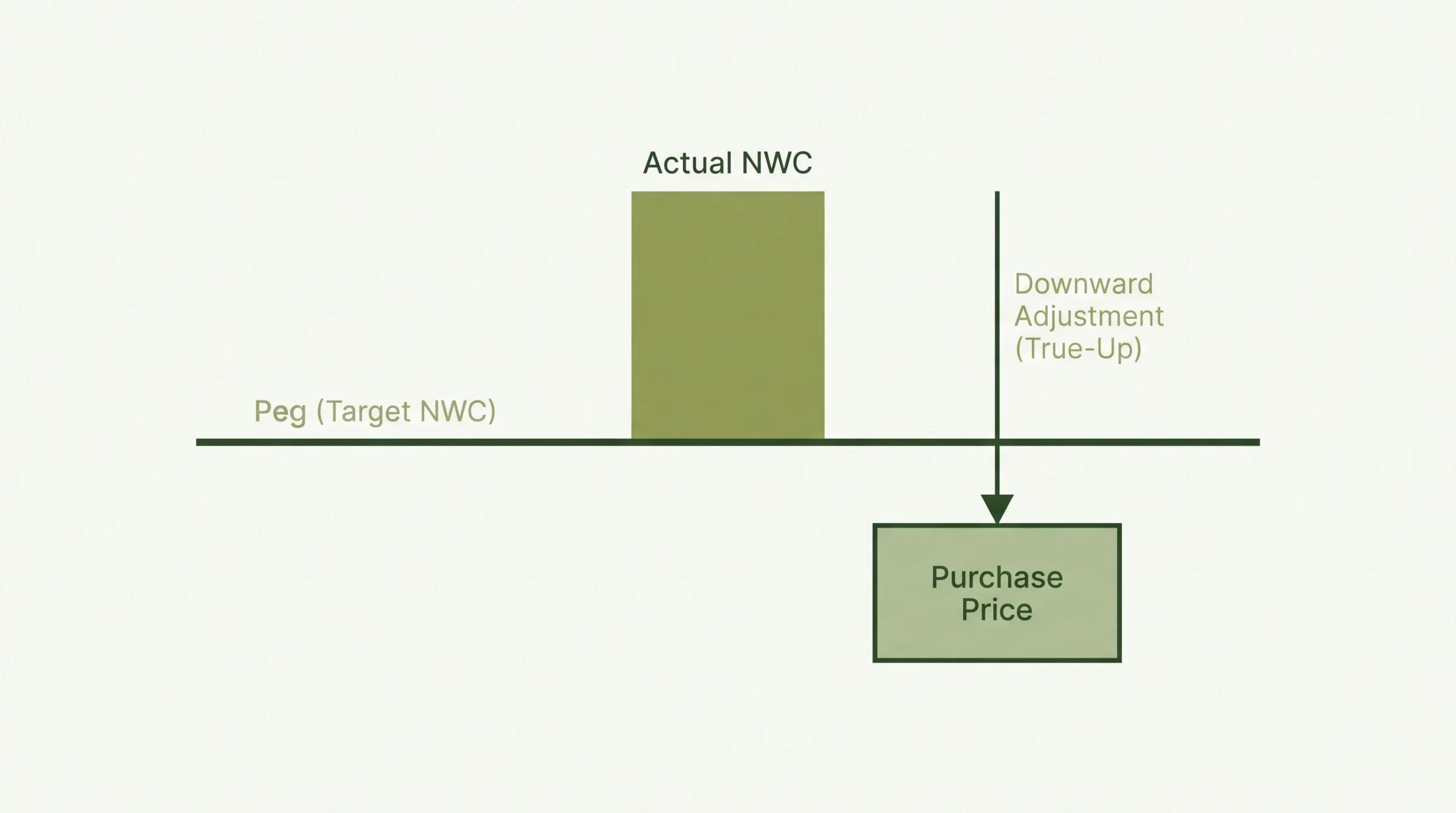
The true-up settles the final price after the deal closes. The buyer prepares a closing balance sheet and measures the actual net working capital on the sale date. Both sides compare that figure to the peg. If the amount falls short, the seller pays the difference. If it runs over, the buyer pays the excess. The step matches the estimate used at closing to the real number once the books are final.
Most deals set a window of 60 to 120 days for this review. As a National Law Review article on net working capital notes, the seller then gets time to object, and an independent accountant breaks any tie. Many contracts add a collar, a small band around the peg where no payment changes hands. The collar filters out trivial swings so the parties fight only over amounts that matter.
What does cash-free, debt-free mean?
Cash-free, debt-free is the standard frame for most private deals. It means the seller keeps the cash in the business and pays off the debt at closing. The buyer takes the operating engine, the receivables, the inventory, and the payables, without either the surplus cash or the loans. This is why cash and debt sit outside the working capital formula. The price reflects the enterprise value of the operations, measured on a clean and neutral base.
Under this frame, working capital is the one part of the balance sheet the buyer still inherits. So the peg carries real weight. Normalized earnings, often shown as EBITDA, set the headline price. The working capital peg then fine-tunes that price to match the assets that actually change hands.
Why do working capital disputes arise?
Working capital disputes arise when the two sides apply different accounting to the same accounts. One party may book a larger reserve for bad debt. Another may classify an item as operating that the other calls non-operating. Because the true-up moves money dollar for dollar, each judgment call has a price. Vague contract wording is the root of most of these fights.
A strong Quality of Earnings review during due diligence heads off much of the risk. It tests whether the historical figures reflect true operating trends. Big firms such as Alvarez and Marsal and the Big 4 valuation practices run this work for large clients. Sofer Advisors brings that same senior-level rigor to middle-market owners, and unlike many solo practitioners, it backs each figure with evidence. The firm has earned 180+ five-star Google reviews and holds Inc. 5000 recognition in 2024 and 2025.
This is where The Sofer Difference matters. It is a four-phase process of Discovery, Diligence, Analysis, and Delivery that produces a defensible peg and a clear sample calculation. That exhibit lists every account and shows how each one is measured. The Heart of a Teacher approach means David Hern CPA ABV ASA and his team show owners the math, not just the answer. When both sides can follow the logic, the true-up becomes a formality rather than a fight.
Frequently Asked Questions
What is a working capital adjustment in a business sale?
A working capital adjustment is a purchase agreement term. It compares the operating cash a business delivers at closing against a set target called the peg. If the business hands over less than the peg, the seller pays the gap. If it hands over more, the buyer pays the excess. It makes sure the price matches the real assets the buyer needs from day one.
How is the working capital peg calculated?
The peg is calculated from a trailing twelve month average of adjusted net working capital. Analysts pull each month from the balance sheet and remove one-time items that would skew the picture. The result is a target that reflects a full year of normal operations. Both sides then agree to that figure and write it into the contract. A clean average keeps the target fair for the buyer and the seller alike.
What is a net working capital true-up?
A true-up is the final check that settles the price after closing. The buyer prepares a closing balance sheet and measures the actual working capital on the sale date. Both sides compare that number to the peg. The party on the short side pays the difference. Most deals run this review within 60 to 120 days. The true-up matches the estimate used at closing to the real figure once the books are final.
Why is cash excluded from working capital?
Cash is excluded because most private deals close on a cash-free, debt-free basis. The seller keeps the cash and pays off the debt at closing. So neither one belongs in a formula meant to measure operating needs. Working capital tracks the assets a buyer must fund to run the business, such as receivables and inventory. Keeping cash and debt out gives a clean view of what the operations really require.
How does seasonality change the peg?
Seasonality changes the peg because working capital swings across the year for many companies. A retailer builds heavy inventory before the holidays and carries little after. A simple yearly average could set a target that misfits the month the deal closes. Experts study the pattern month by month and adjust the peg to the season of the closing. That keeps the seller from being penalized for a normal cyclical shift in the balance sheet.
Who pays if working capital is below the peg?
If working capital falls below the peg at closing, the seller pays the buyer the difference. The payment covers the operating cash the buyer expected but did not receive. It works as a straight price adjustment tied to the contract. If the figure runs above the peg instead, the buyer pays the seller for the extra cash left in the business. The rule cuts both ways and keeps the final price fair.
What is a working capital collar?
A collar is a small band around the peg where no payment changes hands. It sets a floor and a ceiling near the target. If the actual figure lands inside that band, the price stays put. Only a move outside the collar triggers a true-up payment. The tool filters out minor swings that are not worth a fight. It lets both sides focus their attention on gaps that are large enough to matter.
How do you prevent working capital disputes?
The best defense is a clear definition backed by a sample calculation. The purchase agreement should list every account in the peg and show how each is measured. Both the target and the closing statement should follow the same accounting rules. A Quality of Earnings review during due diligence confirms the historical figures. When the logic is written down, neither side can reread the numbers later to claim a payment.
How much does a business valuation from Sofer Advisors cost?
Business valuations from Sofer Advisors typically run from 7,500 to 25,000 dollars. The fee depends on the complexity of the financial statements and the scope of the work. Simpler engagements for planning or tax reporting fall toward the lower end. Deal support and dispute work need deeper analysis, so they fall higher. Contact Sofer Advisors for a quote matched to your situation and the intended use of the report.
Related Case Studies
- Mid-Market M&A Due Diligence Checklist: 14 Categories Buyers Review
- Negotiating Earnouts: 4 Seller-Friendly Structures Beyond the Basics
- Installment Sale of a Business: Tax Deferral and Buyer Pushback
Executive Summary
A working capital adjustment keeps a sale price honest by comparing operating cash at closing against a set peg. The peg is usually a trailing twelve month average of normalized net working capital, tuned for seasonality and growth. Only operating assets and liabilities count, since most deals close cash-free and debt-free. After closing, a true-up settles the gap dollar for dollar, most often within 60 to 120 days. Purchase price adjustments now appear in nearly every private deal, and working capital is the top source of post-closing claims. A clear definition and a sample calculation prevent most disputes.
What Should You Do Next?
Start by reviewing your purchase agreement for a sample calculation that names every account in the peg. Confirm the target and the closing statement follow the same accounting rules. Then run a sensitivity check to see how a swing in receivables or inventory could move the final price.
For a peg you can stand behind, work with David Hern CPA ABV ASA, whose team has served as expert witness in 11+ cases across Georgia, Florida, California, and New Mexico. Schedule a consultation to discuss the working capital terms in your deal.
People Also Read
- EBITDA Add-Backs: What Buyers Accept and What They Reject
- Customer Concentration: Why It Cuts Sale Price 10 to 30 Percent
About the Author
This guide was prepared by David Hern CPA ABV ASA, founder of Sofer Advisors, a business valuation firm headquartered in Atlanta, GA serving clients across the United States. David holds dual accreditations as an Accredited Senior Appraiser (ASA) and is Accredited in Business Valuation (ABV), credentials recognized by the IRS, SEC, and FINRA. He also holds the Certified Exit Planning Advisor (CEPA) designation. With 15+ years of valuation experience, David has served as an expert witness in 11+ cases across multiple jurisdictions and built Sofer Advisors into an Inc. 5000-recognized firm with 180+ five-star Google reviews. Its full W2 employee team maintains subscriptions to all major valuation databases and operates under a next business day response policy. For professional business valuation services, visit soferadvisors.com/about-us/ or contact Sofer Advisors at soferadvisors.com/contact-us/.
Disclaimer: This content is for informational purposes only and does not constitute professional valuation advice. Business valuation conclusions depend on specific facts and circumstances. Contact Sofer Advisors for guidance regarding your specific situation.









