


Last Updated: November 2026
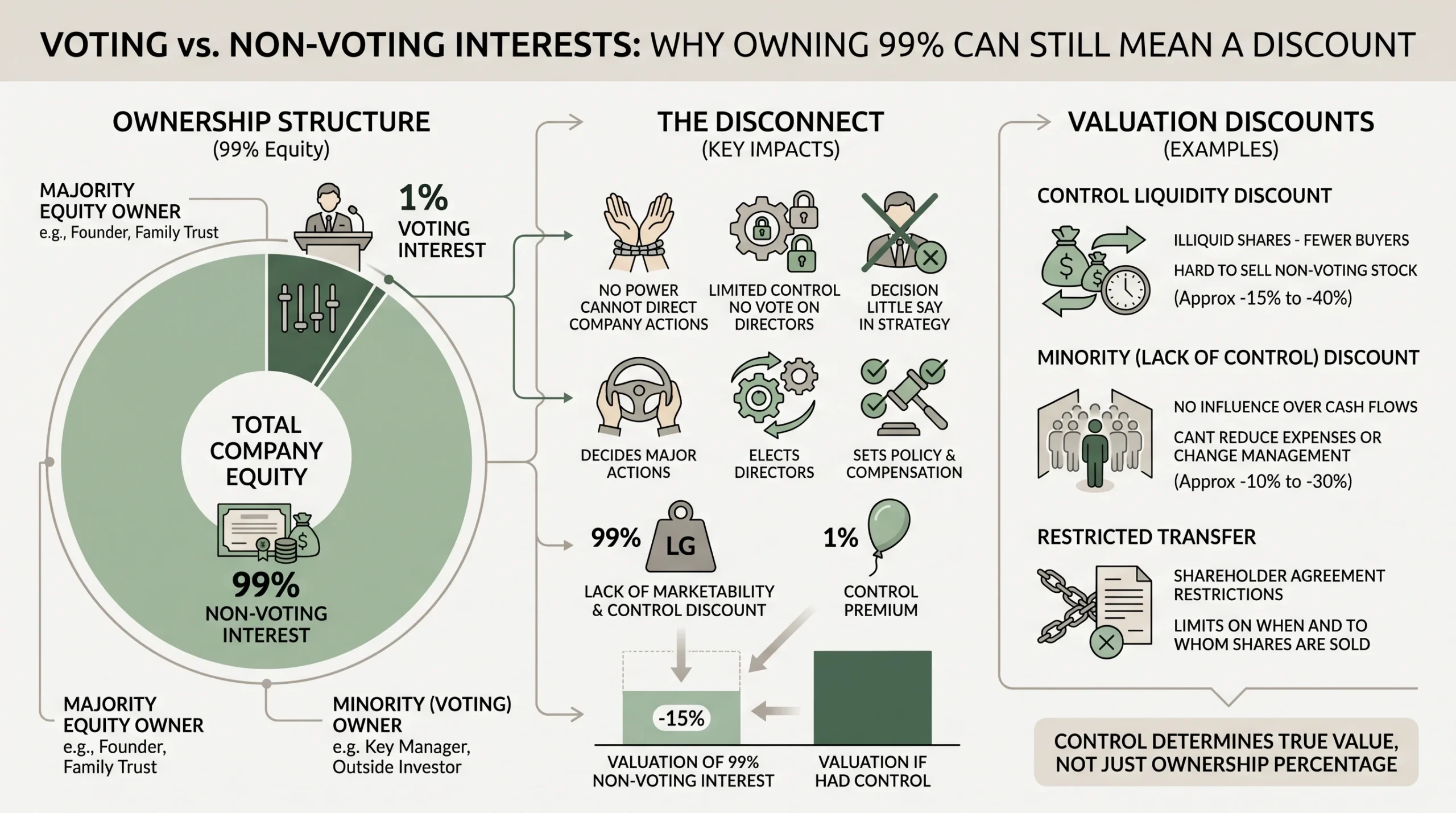
A 99 percent non-voting interest is worth less than 99 percent of the company’s assets, because it carries no control and cannot be sold easily. A non-voting owner cannot force a sale, set distributions, or replace management. Two discounts apply as a result. The discount for lack of control reflects the missing say in the business, and the discount for lack of marketability reflects the absence of a ready buyer. In Grieve v. Commissioner (2020), the Tax Court accepted a lack-of-control discount near 13 percent and a marketability discount of 25 percent.
The appraisers at Sofer Advisors value voting and non-voting interests in closely held companies for owners, CPAs, and attorneys, and defend those discounts when the IRS reviews them.
This guide explains what a non-voting interest owns, why it is discounted, and how Grieve shaped the way the IRS can challenge those discounts.
Key Takeaways
- Non-voting means no control: A large non-voting interest cannot force a sale, a distribution, or a change in management, so it is worth less than its share of the assets.
- Two discounts apply: Lack of control and lack of marketability both reduce the value of a non-voting interest, and each is measured on its own evidence.
- Grieve rejected the IRS shortcut: The Tax Court refused to assume a buyer would also capture the voting interest, so the full discounts stood.
- The discounts were large: The court accepted lack-of-control discounts near 13 percent and marketability discounts of 25 percent, which together came to about 34 to 35 percent.
- It lowers transfer tax: Smaller reported values mean less gift and estate tax, which is why the IRS scrutinizes every discount.
The sections that follow explain each point, the Grieve decision, and what defensible discounts look like on a gift or estate tax return.
What does a non-voting interest actually own?
A non-voting interest owns a share of the profits and the asset value, but no say in how the company runs. The holder cannot vote to sell the business, change managers, or start distributions. Those decisions sit with the voting owners, even when the voting stake is tiny. So the economic size of the interest and the control it carries are two different things.
Picture a company split into a 0.2 percent voting interest and a 99.8 percent non-voting interest. The non-voting owner holds almost all the money at stake but cannot act on it. They wait for distributions that someone else decides to pay. They cannot force a sale if the voting owner refuses. A buyer of that non-voting interest inherits the same position, so the price reflects what the interest can do.
Why does a 99% non-voting stake get a discount?
A 99 percent non-voting stake gets a discount because it cannot control the company or be sold easily. Two separate reductions apply. The discount for lack of control (DLOC) reflects the inability to direct the business. The discount for lack of marketability (DLOM) reflects the absence of a ready buyer. Together they can cut value by a third or more, even when the interest owns nearly all the economics.
Sofer Advisors values a non-voting interest on what it can do, not on its share of the assets, because the holder cannot force a sale or a distribution. From that starting point, DLOC lowers the value from a controlling level to a minority level. DLOM then reflects the months it takes to find a buyer and the price concession that buyer demands. The two are stacked, not averaged, which is how a near-total economic stake still loses a third of its value.
What happened in Grieve v. Commissioner?
Grieve v. Commissioner (2020) tested how far discounts go on a near-total non-voting interest. Pierson Grieve gifted 99.8 percent non-voting interests in two limited liability companies (LLCs) holding marketable securities. A separate 0.2 percent voting interest sat with an entity his daughter controlled. He reported discounts for lack of control and lack of marketability on Form 709, the gift tax return.
The IRS built its case on a hypothetical. Its expert argued a hypothetical willing seller would first acquire the 0.2 percent voting interest, then sell a controlling block and erase most of the discount. The Tax Court rejected it. The daughter testified she did not intend to sell, so the court found that outcome was not reasonably probable. Fair market value cannot rest on an event that is unlikely to happen, per the United States Tax Court (2020).
How big are the lack of control and marketability discounts?
In Grieve, the court accepted lack-of-control discounts near 13 percent and lack-of-marketability discounts of 25 percent. For one LLC the combined reduction reached 35.1 percent, and for the other 34.5 percent. These figures were not arbitrary. The appraiser measured the marketability discount against restricted stock studies, which track how far buyers pay below quoted prices for shares they cannot resell at once.
The size of each discount follows the facts. Several things push the lack-of-control discount higher:
- No right to force a distribution or a sale.
- No ability to replace the manager or amend the agreement.
- A long or uncertain wait before any cash is paid.
- Transfer restrictions that limit who the interest can be sold to.
The table below shows why a voting and a non-voting interest in the same company are not worth the same per unit.
| Feature | Voting interest | Non-voting interest |
|---|---|---|
| Vote on a sale or managers | Yes | No |
| Force a distribution | Often | No |
| A ready market to sell into | Limited | Very limited |
| Discount applied | Smaller or none | Lack of control plus lack of marketability |
What does this mean for gift and estate tax?
Discounts lower the value reported for gift and estate tax, so they lower the tax owed. A 99 percent non-voting interest valued at a 34 percent discount transfers at close to two-thirds of its asset share. In 2026 each person can shield up to 15 million dollars from federal gift and estate tax, per the IRS. Discounts let families move more of a business under that limit, which is why the IRS checks them closely.
Because the discount decides the tax, the IRS reviews the appraisal behind it. Reviewers look for a credentialed appraiser, market evidence for each discount, and facts that match the interest being transferred. Weak or copied discounts invite a challenge, and a challenge can mean penalties on top of extra tax. Our guide to Form 709 gift tax valuation covers how the return itself is prepared. The lesson from Grieve is that a well-supported discount holds, and a convenient one does not.
How do you support these discounts in an appraisal?
You support a discount with market data, not opinion. For lack of control, appraisers study the specific rights the interest lacks and how minority stakes trade. For lack of marketability, they use restricted stock and pre-IPO studies that measure real price concessions. A credentialed appraiser ties each number to evidence and to the facts of the interest, which is what survives an IRS challenge.
The appraiser also records the reasoning, not just the result. A clear report states the rights tested, the studies used, and why the chosen percentage fits this interest. National valuation firms prepare these appraisals, alongside accredited boutiques. What matters is not the name on the cover but whether each discount is tied to data a reviewer can follow.
Frequently Asked Questions
What is a non-voting interest?
A non-voting interest is an ownership stake with economic rights but no vote. The holder shares in profits and asset value yet cannot decide on a sale, a distribution, or who manages the company. Non-voting units are common in family businesses and holding structures, where owners want to pass on economic value while keeping control in a small voting class. Because the interest cannot act, it is valued on its rights, not on its share of the balance sheet.
Why is a 99% non-voting interest worth less than 99% of the assets?
A 99 percent non-voting interest is worth less than 99 percent of the assets because it cannot control the company or be sold quickly. The owner cannot force a sale, set distributions, or change management, so a buyer pays less than the economics suggest. There is also no ready market for the interest. Those two limits, lack of control and lack of marketability, reduce the value well below the asset share, often by a third or more.
What is the discount for lack of control?
The discount for lack of control (DLOC) is the reduction in value for an interest that cannot direct the business. A minority or non-voting owner cannot force a sale, change managers, or compel a distribution, so the interest is worth less than a controlling stake. The size depends on the specific rights the interest lacks. Appraisers measure it with studies of how minority interests trade relative to controlling ones, rather than a fixed percentage.
What is the discount for lack of marketability?
The discount for lack of marketability (DLOM) is the reduction for an interest that cannot be sold quickly at full value. Shares in a private company have no exchange, few buyers, and often transfer restrictions. A buyer who cannot resell demands a lower price for that illiquidity. Appraisers size the discount using restricted stock studies and pre-IPO studies, which record how far real buyers paid below quoted or later prices for shares they could not sell at once.
What did Grieve v. Commissioner decide?
Grieve v. Commissioner (2020) decided that large discounts stood on 99.8 percent non-voting interests in two LLCs. The donor reported discounts for lack of control and lack of marketability on his gift tax return. The IRS argued the discounts were far too large. The Tax Court sided with the donor, adopting discounts of about 13 percent for lack of control and 25 percent for marketability, and rejected the IRS’s theory that a seller would first acquire the voting interest to gain control.
Can the IRS ignore a discount by assuming a buyer gains control?
No, not unless that outcome is reasonably probable. In Grieve, the IRS argued a hypothetical seller would first acquire the tiny voting interest, then sell a controlling block, and the Tax Court rejected that attempt because the voting owner testified she would not sell. Fair market value rests on what is likely, not on a hypothetical path that lets the IRS reach a higher number.
How large can combined discounts be?
Combined discounts on a non-voting interest depend on the facts of the interest. In Grieve the court accepted 35.1 percent for one entity and 34.5 percent for the other, built from a lack-of-control discount near 13 percent and a marketability discount of 25 percent. An interest holding only operating assets, with heavy transfer limits, can support a larger discount. Holding cash and marketable securities usually supports a smaller discount.
Do discounts apply to both gift and estate tax?
Yes, the same discounts apply to both gift and estate tax, because both use fair market value. A non-voting interest given during life is valued on Form 709, and one passing at death is valued on Form 706. In each case, lack of control and lack of marketability reduce the reported value. The facts can differ between a lifetime gift and a transfer at death, so the appraisal is dated and documented to the transfer in question.
What makes a valuation discount defensible?
A valuation discount is defensible when it ties to market evidence and the facts of the interest. A credentialed appraiser states the rights the interest lacks, the studies used to size each discount, and why the chosen percentage fits. The report is dated to the transfer and consistent with recognized methods. Discounts that rest on data a reviewer can follow survive an IRS audit, while round numbers with no support invite a challenge.
Related Case Studies
- Minority Discount Gift Tax: Valuing a Non-Control Stake
- Discount Rate vs Capitalization Rate
- CRUT Valuation: Contributing Business Interests
Executive Summary
A non-voting interest is valued on what it controls, not on its share of the assets, so a 99 percent non-voting stake is worth far less than 99 percent of the company. Two discounts drive the gap: lack of control and lack of marketability. In Grieve v. Commissioner, the Tax Court rejected the IRS’s attempt to remove those discounts by assuming a hypothetical seller would first acquire the voting interest, unless that path was reasonably probable. The court adopted a lack-of-control discount of about 13 percent and a marketability discount of 25 percent. For families, that difference decides how much of a business moves under the gift and estate tax exemption, and a discount holds only when each number is tied to market evidence.
What Should You Do Next?
If you are planning a gift or an estate transfer of a non-voting interest, get the discount supported before the return is filed, not after the IRS asks. David Hern, CPA ABV ASA CVA, and the Sofer Advisors team prepare appraisals that document lack of control and lack of marketability with market evidence. Start with our Estate and Gift Tax valuation services to see how the work is scoped and defended.
People also read
- Valuing a Non-Compete Agreement in an Acquisition
- What is Discount for Lack of Marketability in Business Valuation?
About the Author
This guide was prepared by David Hern CPA ABV ASA CVA, founder of Sofer Advisors, a business valuation firm headquartered in Atlanta, GA serving clients across the United States. David holds accreditations as an Accredited Senior Appraiser (ASA) and is Accredited in Business Valuation (ABV), credentials recognized by the IRS, SEC, and FINRA, and is also a Certified Valuation Analyst (CVA). David has served as an expert witness in dozens of cases across multiple jurisdictions, and Sofer Advisors is an Inc. 5000 honoree in 2024 and 2025 with 240+ five-star Google reviews.
For professional business valuation services, visit soferadvisors.com/about-us/ or contact Sofer Advisors at soferadvisors.com/contact-us/.
Disclaimer: This content is for informational purposes only and does not constitute professional valuation advice. Business valuation conclusions depend on specific facts and circumstances. Contact Sofer Advisors for guidance regarding your specific situation.









