


Last Updated: October 2026
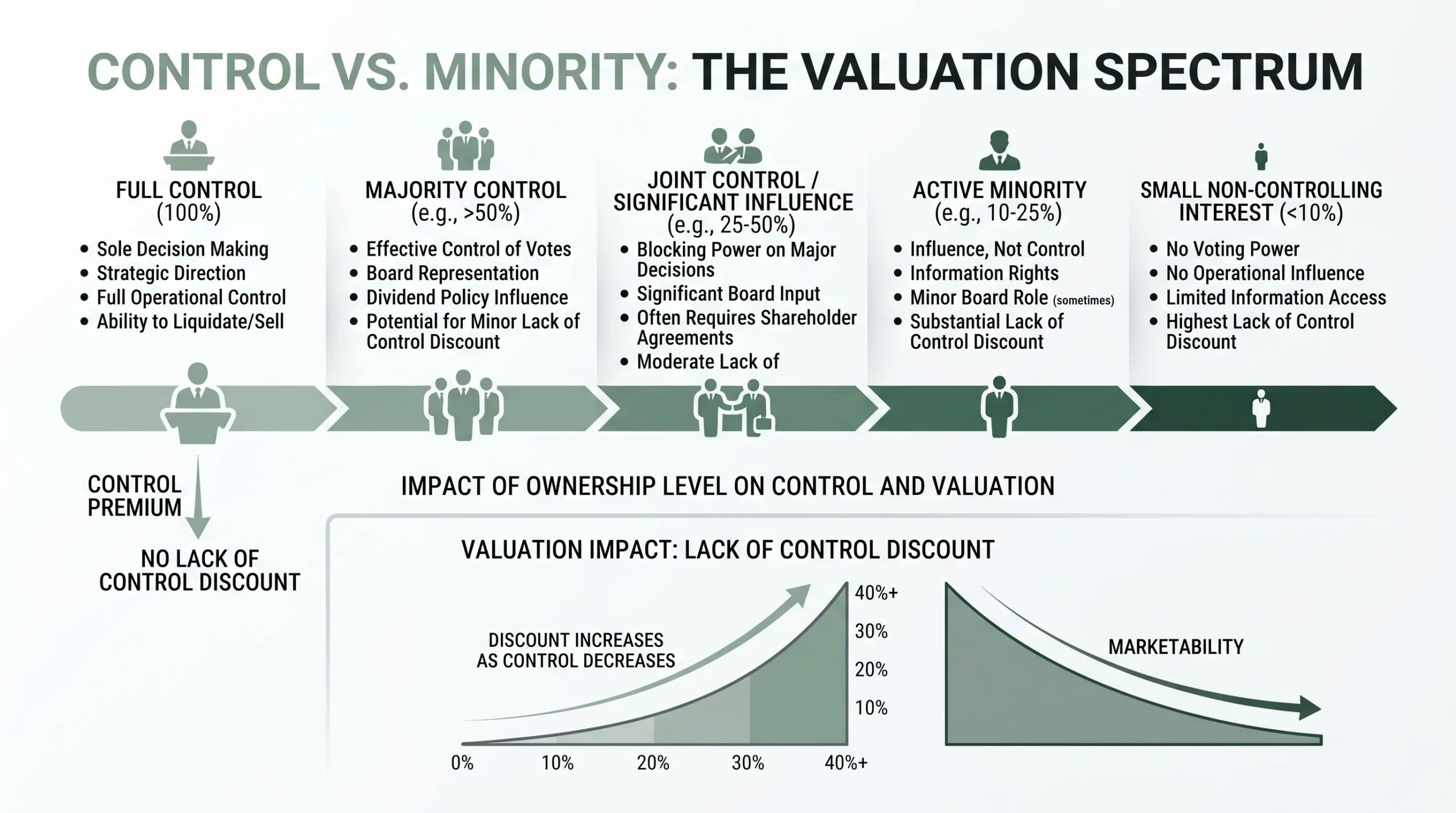
Control is a spectrum, not a switch. When you gift a non-controlling stake in a private business, the discount for lack of control should track what the holder can actually do with those shares. A ten percent block that cannot name a director or force a dividend is worth less than ten percent of the whole company. The minority discount for gift tax puts a number on that gap.
The team at Sofer Advisors values minority interests for gift tax purposes, backed by Inc. 5000 recognition in both 2024 and 2025. The size of the discount decides how much of the company moves to the next generation at the lowest tax cost. Price it well and the transfer stands. Claim too much and the IRS pushes back on audit.
This guide explains what a minority discount is, how it differs from a marketability discount, and how the IRS treats discounts between family members. It also covers how the discount is measured, how a gift is reported on Form 709, and the court cases behind the result.
Key Takeaways
- What a minority discount is: it lowers the value of a non-controlling interest to reflect that the holder cannot steer dividends, force a sale, or set strategy.
- Control is a spectrum: the discount should track the actual rights the gifted shares carry, not a flat percentage pulled from thin air.
- The IRS allows it, even in families: Revenue Ruling 93-12 confirms minority discounts apply to gifts among family members.
- Two discounts, not one: lack of control (DLOC) and lack of marketability (DLOM) are separate adjustments, often applied in sequence.
- Disclosure protects you: a qualified appraisal attached to Form 709 supports the discount and starts the audit clock running.
The sections below take these one at a time.
Why Is a Minority Discount for Gift Tax Important to Understand?
A minority discount decides how much value you can move for a given tax cost. The owner wants shares, and their future growth, out of the estate at the lowest cost. A discount lets a larger slice of the company pass under the annual exclusion or lifetime exemption. But the discount is only as good as the record behind it. A well-supported discount survives review. An aggressive guess invites the IRS to raise the taxable value, add tax, and charge penalties.
What Is a Minority Discount When You Gift a Business Interest?
A minority discount, or discount for lack of control, is a reduction in the pro rata value of a non-controlling interest. Start with the whole company and take the gifted share. A buyer of that share would pay less than the simple math suggests, because it cannot control the company. It cannot set the dividend, pick the board, or decide when to sell. That lost power has a price, and the discount is that price.
The size of the discount depends on how little the holder can do. A one percent interest with no voting rights sits at the deep end of the spectrum. A block large enough to swing a vote sits closer to control, so its discount is smaller. State law and the company agreement matter too. A shareholder deal that locks in a low dividend or bars a forced sale widens the discount. In 2026 the annual exclusion lets a donor give up to 18,000 dollars per recipient without filing, and larger gifts draw down the lifetime exemption.
Does the IRS Allow Minority Discounts, Even Among Family?
Yes. The IRS allows minority discounts because they reflect economic reality, and a willing buyer would pay less for a block that cannot control the company. For years the IRS argued that family shares should be added together, so no single gift looked like a minority. Revenue Ruling 93-12 ended that fight. It confirmed that each gifted interest is valued on its own, without attributing a relative’s shares to the donee. A gift of a minority block to a child gets a minority discount, even when the family owns the rest.
The deeper standard comes from Revenue Ruling 59-60, which sets out the factors for valuing closely held stock and treats control as a core part of fair market value. The gift tax rules point the same way. Under the Treasury regulation at 26 CFR 25.2512-1, the value of a gift is the price a willing buyer would pay a willing seller, and the statute at IRC Section 2512 fixes that value as of the gift date. A non-controlling block clears the market at a discount.
How Is the Minority Discount Quantified?
The minority discount is measured from control premium studies. These studies track what buyers pay to take control of public companies, above the trading price before the deal. Flip that premium around and you get the discount a non-controlling buyer would expect. A public premium does not map cleanly onto one private block, so the appraiser adjusts it.
That adjustment is where judgment comes in. The appraiser reads the voting rights, the shareholder agreement, the dividend history, and the ability to force a sale. Each right the holder lacks pushes the discount up. Each right kept pulls it down. Appraisers commonly land on a control discount in the range of 15 to 30 percent, scaled to the block. The discount is documented step by step, so a reviewer can see how it tracks what the holder can do.
How Does a Minority Discount Differ From a Marketability Discount?
A discount for lack of control and a discount for lack of marketability answer two different questions. Lack of control asks what the holder cannot make the company do. Lack of marketability, or DLOM, asks how hard it is to turn the shares into cash. A private interest has no ready market, so a buyer demands a further price cut for the wait and the risk of selling.
Appraisers usually apply them in sequence. First the control discount brings the pro rata value down to a non-controlling level. Then the marketability discount reduces that figure again. DLOM comes from its own evidence, mainly restricted stock and pre-IPO studies that measure the price gap between liquid and illiquid shares. Stacked together, the two discounts can meaningfully lower the reported value of a gift, so the IRS reviews each one on its own.
How Do You Report a Discounted Gift on Form 709?
A discounted gift is reported on Form 709, the United States Gift Tax Return. The return shows the discounted value and the discounts applied. The protection comes from adequate disclosure. When the taxpayer attaches a qualified appraisal that describes the method, the data, and the discounts, the three year statute of limitations starts to run. Without it, the IRS can revisit the gift long after the normal window closes. You can see how Sofer Advisors approaches tax and estate reporting valuations for these transfers.
Court precedent sets the guardrails. Revenue Ruling 93-12 remains the anchor for family minority discounts. In disputes such as Estate of Kelley and the family entity cases, the Tax Court has accepted sizable combined discounts where the evidence was strong, and cut them where it was thin. A discount backed by market data, a clear read of the rights, and a full report tends to hold. A round number with no support does not. The IRS page About Form 709 sets out who must file and what to include.
Who Values a Minority Interest for Gift Tax, and How Do the Options Compare?
Owners pick a valuation partner based on the size of the gift, the audit exposure, and the budget. Large national firms such as Alvarez & Marsal, Stout, and Kroll serve big public companies with broad advisory teams. Sofer Advisors focuses on defensible, partner-led valuations for closely held businesses, with expert witness testimony in 11+ cases behind its reports and 180+ five-star Google reviews. The table below sets out the options.
| Provider | Typical role | Best for |
|---|---|---|
| Specialized valuation firm (e.g. Sofer Advisors) | Prices the control and marketability discounts and documents them as fair market value | Family and closely held gifts needing audit-ready support |
| Large national firm | Broad advisory plus valuation at enterprise scale | Large public companies with complex, multi-entity plans |
| Estate attorney | Drafts the gift and the shareholder documents; does not value | Families needing the legal structure built and reviewed |
Sofer Advisors runs each engagement through a four-phase process it calls The Sofer Difference, moving from Discovery to Diligence to Analysis to Delivery. That structure keeps every discount tied to the data behind it. It reflects the Heart of a Teacher approach, which means explaining the reasoning behind a number rather than just handing over a figure. An independent valuation supplies both the discount and the evidence behind it.
Frequently Asked Questions
What is a minority discount for gift tax?
A minority discount, also called a discount for lack of control, lowers the value of a non-controlling business interest for gift tax. It reflects what a buyer would pay for shares that cannot direct dividends, force a sale, or steer strategy. The discount tracks what the holder can actually do. Sofer Advisors measures the control a gifted stake carries, then sets a defensible discount that holds up on a gift tax return.
Does the IRS allow minority discounts between family members?
Yes. Revenue Ruling 93-12 confirms that a gift of a minority interest gets a minority discount, even when the family owns the rest of the company. The IRS values each gifted block on its own and does not add a relative’s shares to the donee’s. This rule is the foundation for discounting family gifts. Sofer Advisors applies it and documents the record so the discount survives an IRS review.
What is the difference between DLOC and DLOM?
A discount for lack of control, or DLOC, reflects that a minority owner cannot direct company decisions. A discount for lack of marketability, or DLOM, reflects how hard it is to sell a private interest for cash. They answer different questions and come from different data. Appraisers usually apply them in sequence. Sofer Advisors sizes each discount separately so the final value mirrors the reality of your ownership stake.
How large is a typical minority discount?
Discounts for lack of control commonly fall in the range of 15 to 30 percent, but the figure depends entirely on the facts. Voting rights, the shareholder agreement, dividend history, and the ability to force a sale all move the number. A block with almost no rights sits at the high end. Sofer Advisors ties the percentage to control premium data and the specific rights the gifted shares carry.
How is a minority discount calculated?
Appraisers start with control premium studies, which measure what buyers pay to take control of public companies. Flipping that premium gives the discount a non-controlling buyer would expect. The analyst then adjusts the figure for the specific block, reading its voting rights and restrictions. The data sets the floor, and judgment refines it. Sofer Advisors shows each step so a reviewer can follow how the discount was built.
Do I report a discounted gift on Form 709?
Yes. A gift of a business interest above the annual exclusion is reported on Form 709, and the return should show the discounted value and the discounts applied. Attaching a qualified appraisal gives adequate disclosure, which starts the three year statute of limitations. Without it, the IRS can revisit the gift later. Sofer Advisors prepares reports built to meet the adequate disclosure standard the return requires.
What happens if the IRS challenges my valuation discounts?
If the IRS challenges your discounts, you must defend them with a qualified appraisal grounded in market data and accepted standards. A report that shows its method and ties the discount to the rights the shares carry tends to hold. A round number with no support does not. The IRS can raise the taxable value and add penalties. Sofer Advisors provides the documentation and expert support to defend its reports.
Can I use the annual exclusion to gift business shares?
Yes. In 2026 the annual exclusion lets a donor give up to 18,000 dollars per recipient each year without filing a return. A discount on a minority block lets more of the company fit under that limit, so more equity moves tax free over time. Larger gifts draw on the lifetime exemption. Sofer Advisors values the interest so the discounted amount per gift is clear before you transfer it.
How much does a minority interest valuation cost?
Most gift tax valuations run from 7,500 dollars to 25,000 dollars and take about four to eight weeks, depending on the business and the deadline. The range covers the control and marketability analysis needed to support the discount. A flat fee is quoted up front, so the cost is clear before the work starts. Request a free estimate at the Sofer Advisors contact page for your situation.
Related Case Studies
- Valuation Discounts (DLOC and DLOM) on Estate and Gift Tax Returns
- Adequate Disclosure on Form 709: Starting the Statute of Limitations
- Using the Annual Gift Exclusion to Transfer Business Interests
Executive Summary
A minority discount lowers the value of a non-controlling business interest for gift tax, because the holder cannot direct the company. Control is a spectrum, so the discount should track the actual rights the gifted shares carry. The IRS allows the discount even within a family under Revenue Ruling 93-12, and treats it as part of fair market value. The control discount comes from control premium studies and commonly runs 15 to 30 percent, with a separate marketability discount on top. Report the gift on Form 709, attach a qualified appraisal for adequate disclosure, and the audit clock starts. The first step is a fair market value of the company, then a discount backed by the data.
What Should You Do Next?
Gather the company’s financials, the shareholder agreement, and the rights the gifted block carries, since a clean file supports a defensible discount. Fix the gift date, because value is measured as of that day. This guide was prepared by David Hern CPA ABV ASA, founder of Sofer Advisors, an Inc. 5000 firm specializing in neutral third-party valuations for tax and estate reporting. Schedule a free consultation to discuss your specific situation.
People Also Read
- Minority Interest and Marketability Discounts Guide
- Valuing a Minority Stake Acquisition: DLOC, DLOM, and Investor Rights
About the Author
This guide was prepared by David Hern CPA ABV ASA, founder of Sofer Advisors, a business valuation firm headquartered in Atlanta, GA serving clients across the United States. David holds dual accreditations as an Accredited Senior Appraiser (ASA) and is Accredited in Business Valuation (ABV), credentials recognized by the IRS, SEC, and FINRA. He also holds the Certified Exit Planning Advisor (CEPA) designation. With 15+ years of valuation experience, David has served as an expert witness in 11+ cases across multiple jurisdictions and built Sofer Advisors into an Inc. 5,000-recognized firm with 180+ five-star Google reviews. Its full W2 employee team maintains subscriptions to all major valuation databases and operates under a next business day response policy.
For professional business valuation services, visit soferadvisors.com/about-us/ or contact Sofer Advisors at soferadvisors.com/contact-us/.
This content is for informational purposes only and does not constitute professional valuation advice. Business valuation conclusions depend on specific facts and circumstances. Contact Sofer Advisors for guidance regarding your specific situation.









