


Last Updated: November 2026
An embedded derivative is a feature hidden inside an ordinary contract that behaves like a derivative on its own. Under ASC 815, that feature sometimes has to be pulled out and valued separately. This step is called bifurcation. You separate the feature from the host contract and measure it at fair value. The goal is to show the real risk inside the deal, not hide it.
Sofer Advisors builds these valuations for CPAs, auditors, and business owners across the country.
This guide explains what an embedded derivative is, when you must separate one, how the math works, and where the work gets hard.
Key Takeaways
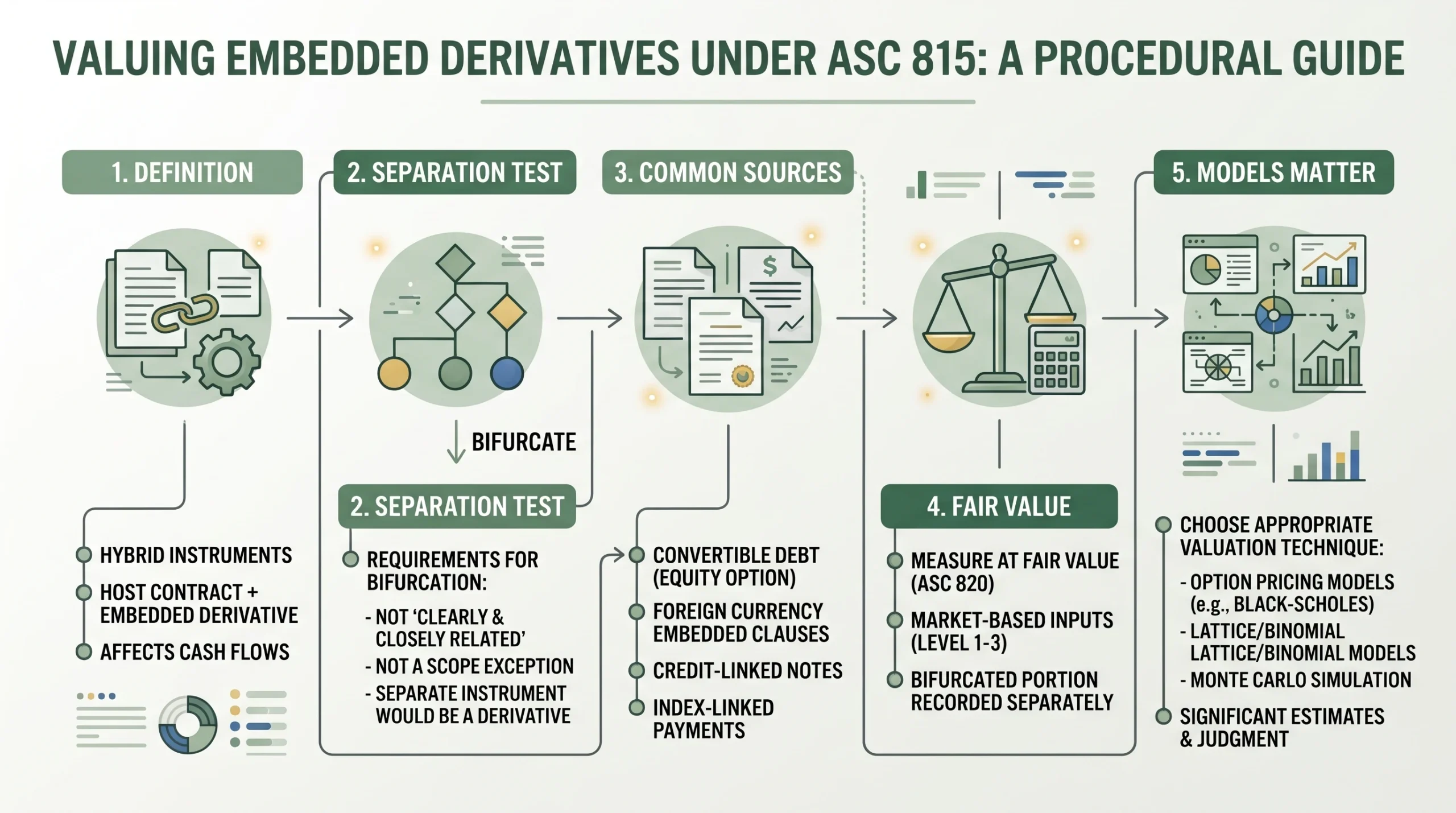
- Definition: An embedded derivative is a term inside a non-derivative contract whose value moves with an outside variable, like a stock price or a rate.
- Separation test: You bifurcate the feature only when three conditions under ASC 815 are all met.
- Fair value: Once separated, the derivative is measured at fair value under ASC 820, and that value is updated each reporting period.
- Common sources: These features show up most often in convertible debt, structured notes, and contracts with contingent payments.
- Models matter: Analysts value them with option-pricing math, such as Black-Scholes-Merton, binomial or lattice models, and Monte Carlo simulation.
What is an embedded derivative under ASC 815?
An embedded derivative is a feature built into a host contract. The host is not a derivative on its own. A loan, a bond, or a supply agreement are all normal host contracts. But a single clause can change how that contract pays out.
Think of a conversion option inside a bond. The bond is the host. The option to swap the bond for stock is the embedded feature. Its value rises and falls with the company’s share price. That behavior is what makes it a derivative.
Together, the host and the feature form one hybrid instrument. ASC 815 asks a direct question about that hybrid. Does the embedded feature need its own accounting? If it does, you separate it and value it apart from the host.
Common embedded features include conversion options, prepayment options, and interest-rate caps or floors. Some contracts tie a payment to inflation or to an equity index. Each of these can act like a standalone derivative.
The point of the rule is honesty in reporting. Without separation, a risky feature can hide inside a plain-looking contract. A reader of the financial statements would never see it. Bifurcation drags that risk into the open. It puts a number on the feature and shows how that number moves over time.
When must you separate an embedded derivative?
ASC 815 does not make you separate every feature. You bifurcate only when three conditions are all true at once. If even one fails, the feature stays with the host.
The first condition looks at economics. The embedded feature must not be clearly and closely related to the host contract. A conversion option tied to stock price is not closely related to a debt host, so it often qualifies. An interest-rate term inside a normal loan usually is related, so it often does not.
The second condition looks at how the hybrid is already measured. If the whole instrument is carried at fair value with changes going through earnings, you stop. There is no need to separate a feature that is already marked to market.
The third condition is a definition test. Imagine the embedded feature as a separate, standalone contract. Would that contract meet the definition of a derivative on its own? If yes, the third condition is met.
All three must hold. When they do, you carve the feature out and treat it as its own derivative. When any one fails, the hybrid stays whole and follows the accounting for the host.
How are embedded derivatives valued?
Once you separate a feature, you measure it at fair value. ASC 820 sets the fair value rules. The method you pick depends on how the feature behaves.
For simple features, analysts often use the Black-Scholes-Merton model. It fits a European-style option, one that can only be exercised at a single date. The model turns a few inputs into a single value.
Many features are not that simple. A holder may be able to convert early, or payouts may depend on the path a price takes. For these, analysts use a binomial or lattice model. A lattice maps out many possible future values step by step. That structure handles early exercise well.
The hardest cases need Monte Carlo simulation. This method runs thousands of random price paths. It then averages the results to find a value. Analysts reach for it when a contract holds several features that interact, or when the payoff is complex.
Each model runs on the same core inputs. These include the underlying value, the strike or conversion price, and the time to maturity. They also include volatility, the risk-free rate, and the credit risk of the issuer. Small changes in volatility or in the rate can move the answer a lot.
Credit risk deserves special care. An embedded feature inside a company’s own debt is tied to that company’s ability to pay. If the issuer’s credit weakens, the value of the feature can shift. A good model reflects that link rather than ignoring it.
A short example shows the idea. The numbers here are illustrative only. Say a bond carries a conversion option. An analyst feeds the share price, the conversion price, the time left, and an estimate of volatility into a model. The model returns a fair value for the option. That figure is the embedded derivative, reported apart from the bond. In a real engagement, the analyst documents every input and the reason behind it.
Which contracts contain embedded derivatives?
Some contracts hold these features far more often than others. Convertible debt is the classic case. The right to convert a note into shares is an embedded derivative when it meets the three conditions.
Structured notes are another common source. These instruments link a payout to an index, a basket of assets, or a rate. That link often behaves like a separate derivative inside the note.
Contracts with contingent payments also deserve a close look. A payment that turns on a future event, a price level, or a market index can hide a derivative. Supply and purchase agreements sometimes tie a price to a commodity index in the same way.
The warning signs are consistent. Watch for any term that changes value based on something outside the core deal. If a clause pays more when a stock, a rate, or an index moves, it may need separation under ASC 815.
What makes ASC 815 valuation difficult?
The first challenge is spotting the feature at all. Embedded derivatives sit inside the fine print of a contract. A reader who is not looking for them can miss a conversion clause or a contingent term. Early review of each new agreement is the best defense.
The second challenge is choosing the right model. A European option, an American option, and a path-dependent payoff each call for a different tool. Pick the wrong model and the value will not reflect the real economics of the deal.
The third challenge is the inputs. Private companies rarely have market prices for their own instruments. Analysts must estimate volatility and other assumptions from comparable public firms or from history. That judgment needs strong support to hold up in an audit.
A fourth challenge is time. The value does not sit still after the first report. It changes every period as prices and rates move. Teams that build a repeatable process handle those updates far better than teams that start fresh each quarter. Clear records from the first valuation make every later one faster and easier to defend in review.
The table below sums up how the common models line up with the features they fit best.
| Model | Best fit | Why it fits |
|---|---|---|
| Black-Scholes-Merton | European-style options | Single exercise date, closed-form math |
| Binomial / lattice | American or path-dependent features | Handles early exercise and step-by-step paths |
| Monte Carlo simulation | Complex or interacting features | Averages thousands of simulated outcomes |
A bifurcated derivative is not a one-time job. You remeasure it at fair value each reporting period. Changes in that value flow through earnings. So a shift in the share price or in rates can swing reported results from quarter to quarter.
Frequently Asked Questions
What is an embedded derivative in plain terms?
It is a feature inside a normal contract that acts like a derivative. The contract itself is not a derivative. But one of its terms moves in value with an outside variable, such as a stock price, a rate, or an index.
What does it mean to bifurcate an embedded derivative?
Bifurcation means separating the embedded feature from its host contract. You account for the feature as its own derivative. You account for the rest of the contract under its normal rules. The two parts then sit apart on the books.
What are the three conditions for separating one?
First, the feature must not be clearly and closely related to the host. Second, the whole instrument must not already be measured at fair value through earnings. Third, a standalone contract with the same terms would meet the definition of a derivative. All three must be true.
Which contracts most often contain embedded derivatives?
Convertible debt is the most common. Structured notes and contracts with contingent payments are also frequent sources. Supply or purchase agreements that tie a price to a commodity or market index can contain them too.
What models are used to value an embedded derivative?
Analysts use Black-Scholes-Merton for simple European options. They use binomial or lattice models for American or path-dependent features. They use Monte Carlo simulation for complex contracts with several interacting features.
What inputs drive the value?
The core inputs are the underlying value, the strike or conversion price, and the time to maturity. Volatility, the risk-free rate, and the issuer’s credit risk also matter. Volatility and the rate tend to have the largest effect.
How often must a bifurcated derivative be remeasured?
At every reporting period. The feature is carried at fair value, and that value is updated each period. Changes flow through earnings, so results can move as prices and rates change.
How does ASC 815 differ from IFRS 9?
ASC 815 is US GAAP and applies the three-part separation test to most hybrids. IFRS 9 treats embedded derivatives in a financial asset host differently. There, it classifies the whole instrument rather than separating the feature. For other hosts, IFRS 9 uses a separation idea close to the ASC 815 test.
Is a conversion option in convertible debt always separated?
No. It is separated only when all three conditions are met. Some conversion features fail a condition, often because the issuer already carries the instrument at fair value, or because of a scope exception. Each note needs its own review.
Related Case Studies
- Embedded Derivatives: A CFO’s Practical Guide to ASC 815 Identification and Reporting
- Valuing Contingent Consideration (Earnouts) under ASC 805
- Embedded Derivatives Definition: Atlanta Financial Guide
Executive Summary
An embedded derivative is a term inside a non-derivative contract whose value moves with an outside variable, like a stock price or a rate. You bifurcate the feature only when three conditions under ASC 815 are all met. Once separated, the derivative is measured at fair value under ASC 820, and that value is updated each reporting period. These features show up most often in convertible debt, structured notes, and contracts with contingent payments. Analysts value them with option-pricing math, such as Black-Scholes-Merton, binomial or lattice models, and Monte Carlo simulation.
What Should You Do Next?
Start by pulling every debt, equity, and purchase agreement that could hold a conversion, prepayment, or contingent-payment clause. Flag any term whose value depends on an outside price, rate, or index. Those are the clauses that may need separation under ASC 815. Sofer Advisors provides independent financial reporting valuations led by David Hern CPA ABV ASA CVA. Schedule a free consultation to review your contracts.
People Also Read
- Reporting Unit Determination Under ASC 350
- Assembled Workforce Under ASC 805: Why It Is Not Separate
About the Author
This guide was prepared by David Hern CPA ABV ASA CVA, founder of Sofer Advisors, a business valuation firm headquartered in Atlanta, GA serving clients across the United States. David holds accreditations as an Accredited Senior Appraiser (ASA) and is Accredited in Business Valuation (ABV), credentials recognized by the IRS, SEC, and FINRA, and is also a Certified Valuation Analyst (CVA). David has served as an expert witness in dozens of cases across multiple jurisdictions, and Sofer Advisors is an Inc. 5000 honoree in 2024 and 2025 with 240+ five-star Google reviews.
For professional business valuation services, visit soferadvisors.com/about-us/ or contact Sofer Advisors at soferadvisors.com/contact-us/.
Disclaimer: This content is for informational purposes only and does not constitute professional valuation advice. Business valuation conclusions depend on specific facts and circumstances. Contact Sofer Advisors for guidance regarding your specific situation.