


Last Updated: September 2026
An assembled workforce ASC 805 valuation measures the worth of a company’s trained, in-place staff during a business combination. Under ASC 805, this workforce is not recognized as a separate intangible asset. Its value counts, but it stays inside goodwill rather than on its own line. The rule in ASC 805-20-55-6 sets the test an asset must pass to stand apart from goodwill. An assembled workforce does not pass that test, so its worth stays folded into the goodwill figure.
This boundary matters because identifiable intangible assets often carry much of a deal’s value. If a workforce were counted twice, once on its own and once inside goodwill, the balance sheet would overstate assets. Correct classification keeps the purchase price allocation defensible when auditors review it. It also sets up the contributory asset charge that supports the value of other intangibles.
Sofer Advisors prepares purchase price allocations that meet financial reporting standards for owners, controllers, and their advisors. Its work reflects a Heart of a Teacher approach, explaining each figure in plain language. Backed by 180+ five-star Google reviews and 11+ expert witness cases, each allocation is built to hold up under audit review.
Key Takeaways
- Not a separate asset: ASC 805 does not let an assembled workforce sit on the balance sheet as its own intangible.
- Value goes to goodwill: the worth of a trained team is subsumed into goodwill during the purchase price allocation.
- Two tests decide: an intangible must meet the separability or the contractual-legal criterion, and a workforce meets neither.
- Still valued for charges: appraisers price the workforce by replacement cost to set contributory asset charges in the MPEEM.
- Same under IFRS 3: both US GAAP and IFRS 3 keep the assembled workforce inside goodwill, not on its own line.
These rules work together during a business combination. The sections below show how each test applies and how the workforce still shapes other values.
What is an assembled workforce under ASC 805?
An assembled workforce is the group of trained, in-place employees a buyer gains in an acquisition. Under ASC 805, it is not recognized as a separate intangible asset. Its value is real, but it stays inside goodwill rather than on its own line. The knowledge and skill of the staff are tied to the business, not held apart from it.
The cost to hire and train a team can be high. Even so, the asset itself does not qualify for its own spot on a balance sheet in a business combination. During the purchase price allocation, an appraiser treats this value as part of the total intangible base. It shows up in the residual goodwill, not as a named line item like a patent or a customer list.
Why is an assembled workforce not recognized separately?
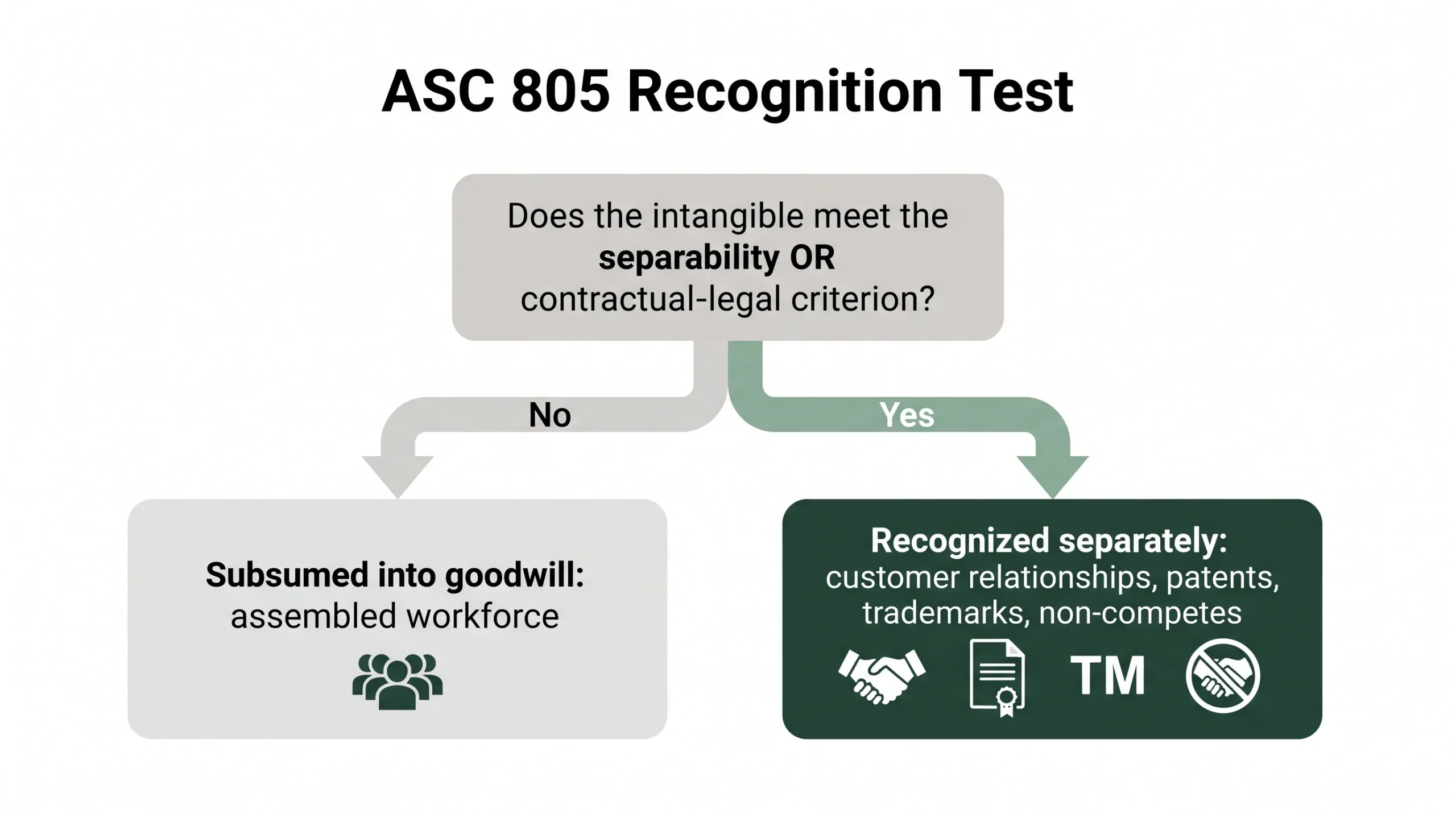
An assembled workforce is not recognized separately because it fails both recognition tests in ASC 805. An intangible must meet the separability criterion or the contractual-legal criterion to stand apart from goodwill. A workforce meets neither one, so its value stays in goodwill.
It fails the separability test because employees cannot be sold, transferred, or exchanged on their own, apart from the business. It also fails the contractual-legal test because at-will employment gives the company no enforceable right to future service. The guidance in ASC 805-20-55-6 spells out this line. A business may hold a strong, productive team, yet standard accounting still treats that group as part of residual goodwill.
How is workforce value captured in a business combination?
The value is captured inside goodwill. In a purchase price allocation, an appraiser first assigns fair value to every identifiable asset and liability. Goodwill is the amount of the purchase price left over once those values are subtracted. The assembled workforce sits inside that residual figure.
The logic is simple. The workforce is part of the premium a buyer pays for the ability to keep earning after the deal. Because the rules do not permit a separate line for it, that worth stays in goodwill. When Sofer Advisors performs a financial reporting valuation, it sorts every identifiable asset from the residual so the balance sheet is accurate. Public filers report these figures under SEC disclosure guidance, which keeps the acquiring company aligned with the fair value rules that guide a business combination.
Which intangibles are recognized separately in ASC 805?
Intangibles are recognized separately when they arise from contractual or legal rights, or when they can be sold or transferred on their own. Common examples are customer relationships, patents, technology, trademarks, and non-compete agreements. Each carries value that is distinct from the business itself.
A patent grants a legal right to exclude others from using a process. A customer list can be sold, since firms often transfer these lists in a sale. By contrast, an assembled workforce has no such legal protection and cannot be sold apart from the business. Our guide to intangible asset valuation covers how these separable assets are measured. Correct sorting keeps financial reporting accurate and defensible in an audit.
How is an assembled workforce valued for other assets?
An assembled workforce is valued by the cost approach, also called the replacement approach. This adds up recruiting and hiring costs, training costs, and lost output during the ramp-up period. The result is the price to rebuild an equal team from scratch. Although the workforce is not on the balance sheet, this figure still does real work in the analysis.
That value feeds the contributory asset charge. In the multi-period excess earnings method, or MPEEM, the appraiser isolates the cash flow of a subject intangible, such as customer relationships. A charge is then taken for each asset that helps produce that cash flow, including the workforce. This step prevents the overstatement of the other intangibles. Clear documentation of these costs, tied to observable market data for similar talent, keeps the allocation objective. A related concept, ASC 820 fair value measurement, sets the input hierarchy behind these figures.
When is an assembled workforce recognized separately?
An assembled workforce can be recognized separately outside a business combination. The ASC 805 bar applies only when a buyer acquires a business. In other settings, a workforce can stand on its own as a measured asset.
In an asset acquisition that does not meet the definition of a business, the buyer allocates cost to the assets acquired, and a workforce may be recorded as its own intangible. A transfer pricing study can also value workforce in place as a distinct item when related parties move operations across borders. The point is the context. In a business combination the workforce is subsumed into goodwill, while in these other cases it may be named and measured on its own. Both US GAAP and IFRS 3 hold the same line for business combinations, which keeps global reporting consistent.
How do valuation providers compare for ASC 805 work?
Providers differ in whether they produce an independent valuation or supply research tools. Large firms such as Alvarez & Marsal, Stout, and Kroll serve the biggest public filers. A dedicated valuation firm gives middle-market owners a defensible report built for their audit. The table below sets out the options.
| Provider type | Approach to assembled workforce | Typical client |
| Sofer Advisors | Replacement cost for contributory asset charges in a defensible report | Private middle-market companies |
| Global advisory firms | Enterprise-scale allocations for large filers | Public and Fortune 500 filers |
| Research databases | Interpretive guidance and checklists, not a signed opinion | Internal accounting teams |
The choice comes down to what an audit needs. Access to accounting guidance is useful, but it is not the same as a signed, independent valuation. Sofer Advisors follows The Sofer Difference, a four-phase process of Discovery, Diligence, Analysis, and Delivery, so each figure is traced and supported. Standards such as USPAP and PCAOB guidance on auditing estimates set the bar these reports must clear. Owners and controllers weigh both the technical detail and the independent support needed to defend an allocation under review.
Frequently Asked Questions
What is ASC 805 valuation?
ASC 805 valuation is the process of allocating the price paid in a business combination to the assets and liabilities acquired, measured at fair value on the acquisition date. It assigns value to each identifiable asset, then treats the remainder as goodwill. The work gives the acquiring company audit-ready figures for its balance sheet and its notes.
Is an assembled workforce an intangible asset?
An assembled workforce has economic value, but under ASC 805 it is not recognized as a separate intangible asset. It fails the tests for separability and for contractual-legal rights. Because of that, its value is folded into goodwill rather than shown on its own line. The team still matters to the deal, yet accounting rules keep it out of the named intangibles.
How do you value customer lists?
Customer lists are valued with the income approach, most often the multi-period excess earnings method. This method estimates the present value of future cash flows from existing customer relationships. The analysis accounts for customer churn, expected growth, and charges for the other assets that help produce those cash flows. The result is a defensible value that can stand up in an audit or a review.
What is the MPEEM method and how does it work?
The multi-period excess earnings method, or MPEEM, values one intangible by isolating the cash flow it produces. The appraiser strips out the earnings tied to other assets that support that cash flow. What remains is the excess earnings for the subject asset, which are then discounted to present value. Contributory asset charges, including one for the workforce, keep the method from double counting value.
What is the difference between goodwill and an assembled workforce?
Goodwill is the residual value of an acquisition that cannot be assigned to any identifiable asset or liability. An assembled workforce is a specific group of trained employees that accounting rules do not allow as a separate intangible. The workforce is one part of what makes up goodwill, but goodwill is the broader account. One is a named group, the other is the leftover premium in the deal.
Can a non-compete agreement be recognized under ASC 805?
A non-compete agreement can be recognized as a separate intangible asset when it meets the contractual-legal criterion. These agreements often appear when key staff hold knowledge that could harm the business if they left and competed. The value depends on the terms of the contract and the economic effect of the restriction. Unlike a workforce, a signed non-compete grants an enforceable legal right, so it can stand apart from goodwill.
What are contributory asset charges?
Contributory asset charges are returns taken for the supporting assets that help produce the cash flow of a subject intangible. Supporting assets can include working capital, fixed equipment, and the assembled workforce. The charge reflects a fair rent for using each asset. Without these charges, the value of the subject intangible would absorb earnings that other assets created, and the figure would be overstated.
Does IFRS 3 treat an assembled workforce differently?
IFRS 3 treats an assembled workforce the same way ASC 805 does. Both standards bar the separate recognition of a workforce as an intangible asset in a business combination. Its value stays inside goodwill under each framework. This match keeps reporting consistent for companies that file under either set of rules, which helps in cross-border deals and comparisons.
How much does a purchase price allocation (ASC 805) from Sofer Advisors cost?
A purchase price allocation under ASC 805 typically costs between $15,000 and $50,000. The range reflects this engagement tier and depends on the asset mix, the industry, and the timeline. This work usually takes 6 to 12 weeks to complete and document for an audit. For a quote tied to your deal, contact the team with your details.
Related Case Studies
- Purchase Price Allocation ASC 805 and IFRS 3: Complete Guide for Business Leaders
- Goodwill vs Intangible Assets: Key Differences Explained
- Calculating Goodwill in an Acquisition: Formula Explained
Executive Summary
Under ASC 805, an assembled workforce is not recognized as a separate intangible asset. It fails both the separability and the contractual-legal tests, so its value is subsumed into goodwill during the purchase price allocation. The workforce is still valued by replacement cost, and that figure sets a contributory asset charge in the MPEEM used to value other intangibles like customer relationships. IFRS 3 holds the same line. Outside a business combination, such as an asset acquisition or a transfer pricing study, a workforce can be recognized on its own. Correct sorting keeps the allocation accurate and defensible when auditors review it.
What Should You Do Next?
Start by reviewing your acquisition documents to list the identifiable intangible assets in the deal. Then value the assembled workforce by replacement cost, so you can support the contributory asset charges behind your other intangibles. Documenting these figures early keeps your purchase price allocation defensible and heads off questions during the audit.
David Hern CPA ABV ASA, founder of Sofer Advisors, brings deep experience in ASC 805 compliance and financial reporting valuation. Schedule a consultation to discuss your specific situation.
People Also Read
- What is PPA in Accounting? Purchase Price Allocation Explained
- Goodwill Impairment Testing ASC 350: Complete Guide for 2025-2026
About the Author
This guide was prepared by David Hern CPA ABV ASA, founder of Sofer Advisors, a business valuation firm headquartered in Atlanta, GA serving clients across the United States. David holds dual accreditations as an Accredited Senior Appraiser (ASA) and is Accredited in Business Valuation (ABV), credentials recognized by the IRS, SEC, and FINRA. He also holds the Certified Exit Planning Advisor (CEPA) designation. With 15+ years of valuation experience, David has served as an expert witness in 11+ cases across multiple jurisdictions and built Sofer Advisors into an Inc. 5000-recognized firm with 180+ five-star Google reviews. Its full W2 employee team maintains subscriptions to all major valuation databases and operates under a next business day response policy.
For professional business valuation services, visit soferadvisors.com/about-us/ or contact Sofer Advisors at soferadvisors.com/contact-us/.
Disclaimer: This content is for informational purposes only and does not constitute professional valuation advice. Business valuation conclusions depend on specific facts and circumstances. Contact Sofer Advisors for guidance regarding your specific situation.









