


Last Updated: November 2026
A warrant valuation sets the fair value of the right to buy a company’s stock at a fixed price before it expires. Because that right works like an option, analysts value it with option-pricing models rather than a simple formula. The value depends on the share price, the strike price, the time left, and how much the stock moves. When a company issues the warrant, exercising it creates new shares, so the valuation must also reflect that dilution.
The team at Sofer Advisors builds these models for business owners, CPAs, and attorneys across the country.
This guide explains what a warrant is, where warrants come from, which models fit, and the features that complicate the math.
Key Takeaways
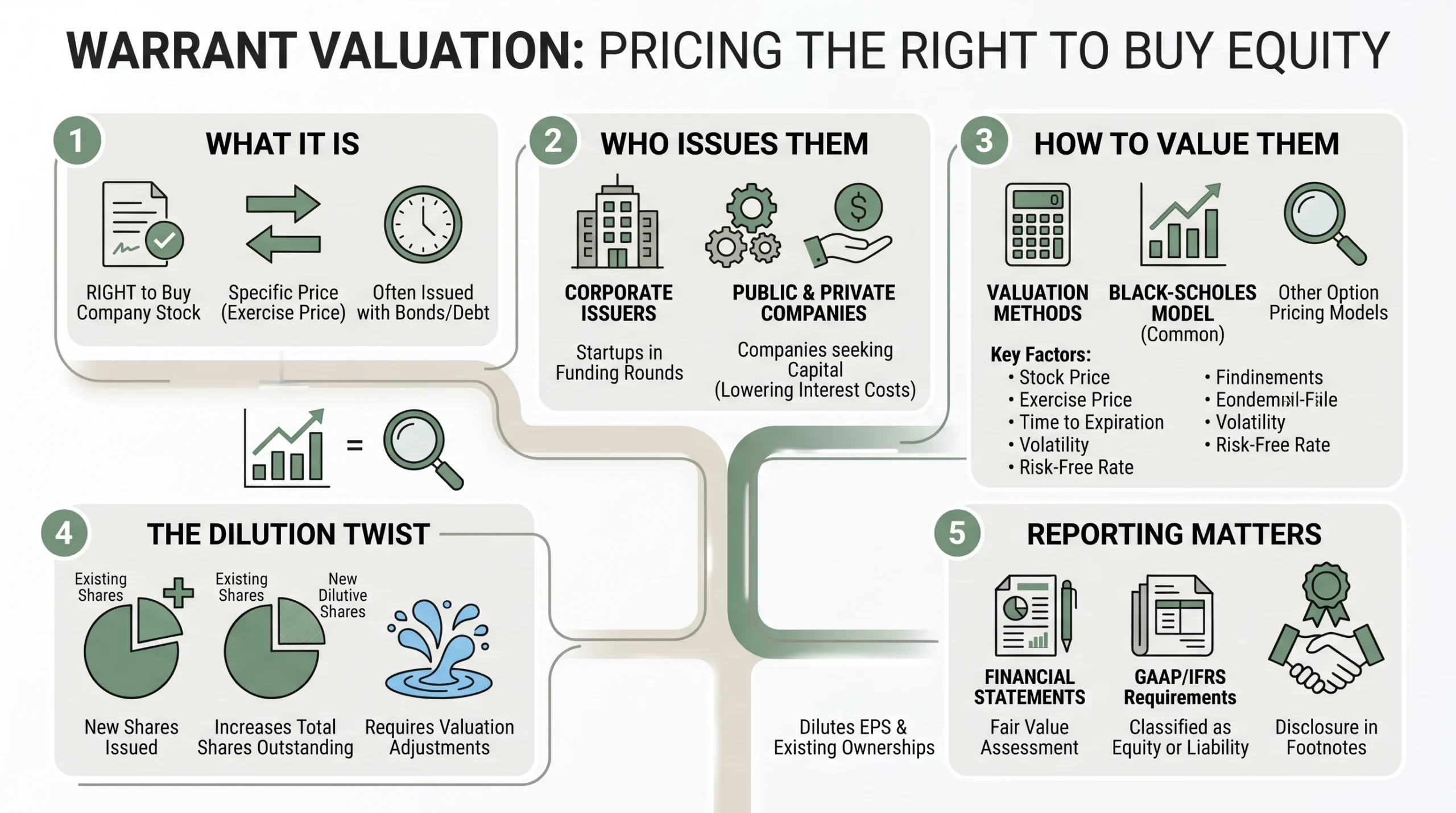
- What it is: A warrant gives the right to buy stock at a fixed price before it expires.
- Who issues them: Companies issue warrants in financings, bridge loans, and SPAC deals, often with long terms.
- How to value them: Analysts use the Black-Scholes-Merton model for simple warrants and lattice or Monte Carlo models for complex ones.
- The dilution twist: Exercising a company warrant creates new shares, so the value must reflect that dilution.
- Reporting matters: Under US GAAP, some warrants count as equity and others as liabilities that are remeasured each period.
What is a warrant, and why value it?
A warrant is a right to buy stock. The holder can buy a set number of shares. The price is fixed in advance. The right lasts until the warrant expires. The holder does not have to buy. That choice is what gives a warrant value.
Warrants differ from the options traded on an exchange. A company usually issues its own warrants. It may attach them to a loan or a stock sale. The goal is often to sweeten a deal. A lender who provides capital may get warrants too. That upside can make the terms more attractive.
Fair value matters for several reasons. A company must report warrants on its books. Tax filings may need a value. A sale or an audit can raise the same question. A clear, defensible number keeps each of these on solid ground.
Where do warrants come from?
Warrants show up in a few common settings. One is venture debt or a bridge loan. A lender takes on extra risk by funding an early-stage firm. Warrants give that lender a shot at equity upside. They help close a deal that debt alone could not.
Warrants also attach to equity raises. A company may add them to make a stock offering more appealing. Each investor gets shares plus a warrant for more shares later. The warrant is a sweetener that lifts the overall return.
SPAC deals are another source. Many SPACs issue warrants to early investors and sponsors. These warrants often trade on their own after the deal. Their terms can be detailed, which makes valuation a careful task.
What drives a warrant’s value?
Six inputs drive most warrant valuations. The first three are the underlying share value, the exercise price, and the time to expiration. The other three are volatility, the risk-free rate, and expected dividends. Each input shifts the odds that the warrant pays off.
Volatility and time matter the most. Higher volatility means bigger possible price swings. Those swings raise the chance of a large gain. A longer time to expiration works the same way. It gives the stock more room to rise.
The exercise price sets the bar. A low strike price next to the share value makes the warrant worth more. Expected dividends cut the other way. Cash paid to shareholders lowers the stock’s future price, which trims warrant value. The risk-free rate plays a smaller role for most private warrants.
Which models value a warrant?
Analysts pick a model to fit the warrant. Simple warrants call for the Black-Scholes-Merton model. It gives a closed-form answer from the six core inputs. It works well when the terms stay fixed. The holder exercises only at expiration, and nothing else changes.
Many warrants are not that simple. Some let the holder exercise early. Some have terms that shift with the share price. For these, a binomial or lattice model fits better. It maps the stock’s path step by step. At each step, it checks whether early exercise makes sense.
Monte Carlo simulation handles the hardest cases. It runs thousands of possible price paths. Then it averages the results to find a value. Analysts reach for it when a warrant’s payoff depends on the path the stock takes. Down-round protection is one common example.
No model is right for every warrant. The choice follows the terms in the contract. A model that ignores early exercise may undervalue the right. A model that ignores dilution may overvalue it. The analyst matches the method to the facts, then documents why.
The table below sums up the choices.
| Model | Best for | Handles early exercise or path features? |
|---|---|---|
| Black-Scholes-Merton | Simple warrants with fixed terms | No |
| Binomial or lattice | Warrants with early exercise or changing terms | Yes |
| Monte Carlo simulation | Path-dependent terms like down-round protection | Yes |
How do warrants differ from stock options?
The biggest difference is where the shares come from. When someone exercises an exchange-traded call option, no new shares appear. The shares change hands between investors. A company warrant works differently. Exercising it creates brand-new shares.
Those new shares dilute the existing owners. The share count rises, and each old share owns a bit less. A sound warrant valuation accounts for this dilution. Ignoring it can overstate the value of the warrant.
The size of the effect depends on scale. A small warrant on a large share base barely moves the needle. A large warrant on a small base can shift ownership a lot. The analyst weighs the warrant against the full capital structure.
Employee stock options sit in between. A company issues them too, but as pay for staff. Warrants usually go to investors or lenders instead. Warrants also tend to run longer. Many last several years, while listed options often expire within months.
What features complicate a warrant valuation?
Plain warrants are rare. Most carry extra terms that change their value. A cashless exercise lets the holder skip paying cash. The company nets out shares to cover the strike price instead. That feature changes how many shares the holder ends up with.
Anti-dilution and down-round terms add more complexity. They lower the exercise price if the company later sells stock at a lower price. This protects the holder. It also makes the warrant harder to model, since the strike price is no longer fixed. Redemption rights can cut the other way. They let the company force an early exit under set conditions.
Private warrants raise one more issue. A private warrant is hard to sell before it expires. Analysts may apply a discount for lack of marketability, or DLOM, to reflect that. The size of the discount takes careful judgment.
Each of these features can swing the final number. A small change in one term can move the value a lot. For that reason, the analyst reads the full warrant agreement first. The terms, not just the headline strike price, drive the result.
How are warrants treated under US GAAP?
Warrant accounting depends on the warrant’s terms. Under US GAAP, a warrant is classified as either equity or a liability. The split follows rules in ASC 480 and ASC 815. The terms of the contract decide which bucket applies.
The classification changes how a company reports the warrant. An equity-classified warrant is measured once, at issuance. A liability-classified warrant is different. It must be remeasured at fair value at each reporting date. That means a fresh valuation every period.
Fair value measurement itself follows ASC 820. Many warrant values rely on unobservable inputs, such as private-company volatility. That places them in Level 3 of the fair value hierarchy. Level 3 inputs demand strong support and clear documentation.
A short example shows the flow. Say a private company issues a warrant to a lender. The strike price matches the current share value. The warrant runs for five years. The analyst estimates volatility from similar public companies. These inputs are illustrative, not a quote for any real deal. The model returns a value, and the analyst then adjusts it for dilution and marketability.
Frequently Asked Questions
What is a stock warrant?
A stock warrant is a contract from a company. It gives the holder the right to buy shares at a fixed price. The right lasts until a set expiration date. The holder can choose to exercise it or let it lapse.
What is the difference between a warrant and a stock option?
A company issues a warrant to raise capital or sweeten a deal. Exercising it creates new shares. An exchange-traded option trades between investors, and exercising it does not create new shares. Warrants also tend to run longer than listed options.
Which model is best for valuing a warrant?
It depends on the terms. The Black-Scholes-Merton model fits simple warrants with fixed terms. A binomial or lattice model fits warrants with early exercise. Monte Carlo simulation fits warrants with path-dependent features.
What are the six inputs to a warrant valuation?
The six inputs are the underlying share value, the exercise price, and the time to expiration. The other three are volatility, the risk-free rate, and expected dividends. Volatility and time usually have the largest effect.
Why does dilution matter in warrant valuation?
A company warrant creates new shares when it is exercised. Those shares dilute the existing owners. A careful valuation reflects that dilution. Leaving it out can overstate the warrant’s value.
Is a warrant an asset or a liability?
It depends on the terms. Under US GAAP, a warrant is classified as either equity or a liability. The rules in ASC 480 and ASC 815 guide that call. A liability-classified warrant is remeasured at fair value each period.
What is a cashless exercise?
A cashless exercise lets the holder avoid paying cash for the strike price. The company withholds some shares to cover that cost instead. The holder receives the remaining shares. This affects the final share count.
Can you value a warrant in a private company?
Yes. The same models apply, but the inputs take more work. Private firms have no market price or observable volatility. Analysts estimate volatility from similar public companies. A marketability discount often applies as well.
What is down-round protection?
Down-round protection lowers a warrant’s exercise price if the company later raises money at a lower share price. It shields the holder from dilution. It also makes the warrant harder to value, since the strike price can change.
Related Case Studies
- 409A Valuation Cost: Pricing Guide for Startups
- Goodwill Valuation Methods: Which Approach Is Right?
- Business Valuation Cost Georgia: Complete Pricing Guide 2026
Executive Summary
A warrant gives the right to buy stock at a fixed price before it expires. Companies issue warrants in financings, bridge loans, and SPAC deals, often with long terms. Analysts use the Black-Scholes-Merton model for simple warrants and lattice or Monte Carlo models for complex ones. Exercising a company warrant creates new shares, so the value must reflect that dilution. Under US GAAP, some warrants count as equity and others as liabilities that are remeasured each period.
What Should You Do Next?
Start by gathering your warrant agreements. Note the strike price, the issue date, and the expiration date. Pull together recent financial statements too, since they feed the volatility estimate. Flag any special terms, such as a cashless exercise or down-round protection. Note whether the warrant counts as equity or a liability on your books. Good records up front make the valuation faster and easier to defend.
Sofer Advisors provides independent warrant valuations through its business valuation services practice. This work is led by David Hern CPA ABV ASA CVA. Schedule a free consultation to discuss your situation.
People Also Read
About the Author
This guide was prepared by David Hern CPA ABV ASA CVA, founder of Sofer Advisors, a business valuation firm headquartered in Atlanta, GA serving clients across the United States. David holds accreditations as an Accredited Senior Appraiser (ASA) and is Accredited in Business Valuation (ABV), credentials recognized by the IRS, SEC, and FINRA, and is also a Certified Valuation Analyst (CVA). David has served as an expert witness in dozens of cases across multiple jurisdictions, and Sofer Advisors is an Inc. 5000 honoree in 2024 and 2025 with 240+ five-star Google reviews.
For professional business valuation services, visit soferadvisors.com/about-us/ or contact Sofer Advisors at soferadvisors.com/contact-us/.
Disclaimer: This content is for informational purposes only and does not constitute professional valuation advice. Business valuation conclusions depend on specific facts and circumstances. Contact Sofer Advisors for guidance regarding your specific situation.