


Last Updated: June 2026
This article is for business owners, estate attorneys, and CPAs. You will learn what each factor covers, why appraisers weight methods differently, and what a defensible report must include.
IRS revenue ruling 59-60 application refers to the process of analyzing a closely held business using eight distinct factors established by the IRS in 1959. This ruling defines fair market value for estate and gift tax. Every qualified appraiser must address all eight factors to produce a defensible, IRS-accepted value for a private company.
When the IRS audits a business valuation, agents verify whether all eight factors were addressed. Missing one can trigger a deficiency notice or a revaluation at a higher number. Sofer Advisors, based in Atlanta, GA, performs valuations for estate planning, gift transfers, and buy-sell transactions governed by this ruling.
Key Takeaways
- Eight Mandatory Factors – Revenue Ruling 59-60 requires appraisers to address 8 specific factors when valuing a closely held business for estate or gift tax.
- Fair Market Value Standard – The ruling defines fair market value as the price a willing buyer and seller agree on, with neither under pressure and both having full knowledge of the facts.
- Three Approaches Required – Appraisers must weigh income, market, and asset approaches; no single method controls the conclusion.
- Qualified Appraiser Required – The IRS requires estate and gift tax appraisals from an appraiser holding ASA or ABV credentials.
- Top Audit Trigger – Failing to address all 8 factors is a leading reason the IRS challenges valuations and assesses higher values.
- Broader Applications – Revenue Ruling 59-60 applies in buy-sell disputes, litigation support, and S-corp conversion transactions.
These points map to specific factors and steps in the ruling. The sections below examine how appraisers apply the framework.
What Is IRS Revenue Ruling 59-60?
Revenue Ruling 59-60 is the IRS’s foundational framework for valuing closely held business interests. Issued in 1959, it defines fair market value and lists eight factors appraisers must address. It is the most-cited authority in business valuation.
The ruling defines fair market value as the price at which property changes hands between a willing buyer and seller, neither under compulsion, and both having reasonable knowledge of the facts. This anchors every appraisal in a hypothetical transaction.
Appraisers must weigh the income approach, market approach, and asset approach, then explain that weighting based on the specific facts. That multi-method requirement separates a defensible appraisal from one that collapses under IRS review. Buy-sell disputes, S-corp exits, and litigation contexts all reference this ruling.
What Are the 8 Factors Appraisers Must Address?
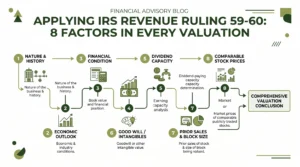
The eight factors give appraisers a structured checklist so no element of value goes unexamined. Their weight depends on the business type and appraisal purpose.
The eight factors are:
- The nature of the business and its history from inception
- The economic outlook and condition of the specific industry
- The book value of the stock and financial condition of the business
- The earning capacity of the company
- The dividend-paying capacity of the business
- Whether the enterprise has goodwill or other intangible value
- Sales of the stock and the size of the block to be valued
- The market price of stocks of corporations in the same or similar industry
Factors 4 and 5 feed the income approach. Factor 8 anchors the market approach. Factor 3 supports the asset approach. An appraiser who addresses all eight has built the foundation the IRS expects.
A profitable service business may carry book value of $500,000 and fair market value of $3.5 million because earning capacity and goodwill far exceed the balance sheet. Appraisers who skip this checklist expose clients to costly IRS challenges.
How Does the Income Approach Apply Factors 4 and 5?
Factor 4 – earning capacity – is the most influential factor for most operating businesses. It drives the income approach, which includes discounted cash flow (DCF) analysis and capitalization of earnings. Consistent cash flows push fair market value well above book value.
Appraisers normalize financial statements by removing personal expenses. They adjust owner pay to market rates and add back one-time charges. This produces true economic earnings – what the business generates for a typical buyer. Then the appraiser selects a capitalization rate.
For a stable manufacturer, the rate might be 18%. For a two-person firm dependent on one key client, it could reach 30% or higher. Factor 5 cross-checks whether projected earnings are realistic given actual cash needs. Appraisers who cannot explain a $120,000 pay adjustment or a 22% rate risk having the income approach disqualified.
Why Does Goodwill Matter Under Factor 6?
Factor 6 – goodwill and intangible value – is often the largest component of value in service businesses, healthcare practices, and professional firms. It captures value from customer relationships, brand reputation, and trained staff. These exceed what tangible assets alone can produce.
Goodwill splits into two types. Enterprise goodwill belongs to the business and transfers with a sale. Personal goodwill belongs to a specific individual and does not transfer automatically. A dental practice where patients follow one dentist carries significant personal goodwill. A franchise with a national brand carries enterprise goodwill that survives ownership change.
In an asset sale, personal goodwill can be sold directly by the shareholder at capital gains rates. That distinction can save business owners hundreds of thousands in exit tax. High personal goodwill can also reduce estate tax value, because the business is worth less without the key owner. This position requires a qualified appraiser to defend.
What Do the Three Valuation Approaches Show?
The three approaches under Revenue Ruling 59-60 serve different functions. Understanding how appraisers weight them helps you evaluate whether a report is complete.
| Approach | RR 59-60 Factors | Best Suited For | Common Methods |
|---|---|---|---|
| Income Approach | Factors 4, 5 | Operating businesses with stable cash flow | DCF, Capitalization of Earnings |
| Market Approach | Factors 7, 8 | Mid-market companies with comparable sales | Guideline Transactions, Public Multiples |
| Asset Approach | Factors 3, 6 | Holding companies, asset-heavy, liquidations | Adjusted Book Value, Net Asset Value |
The income approach dominates most operating valuations. Factors 4 and 5 address what the business earns and can distribute. The market approach anchors the conclusion in real EBITDA multiples from completed transactions. The asset approach sets a floor – no buyer pays less than liquidation value.
Weighting is professional judgment. A capital-intensive manufacturer might weight income and asset equally at 50% each. A SaaS business with 80% gross margins would weight the income approach at 80% or more. The Sofer Difference – Discovery, Diligence, Analysis, and Delivery – applies that same rigor to middle-market businesses.
How Does the IRS Review a 59-60 Appraisal?
When an estate or gift tax return includes a business interest, IRS reviewers check whether the appraiser addressed all eight factors. They also verify whether the report meets Treasury Regulation 20.2031-3. The review is not a rubber stamp.
Three common challenges arise: (1) pay adjustments not justified; (2) capitalization rates not tied to a recognized model; and (3) inappropriate DLOM percentages lacking support from restricted stock studies.
Every assumption must be explained and traceable to the eight factors. David Hern CPA ABV ASA, founder of Sofer Advisors, has served as an expert witness in over 11 cases and understands what the IRS looks for. A rushed appraisal near a gift tax deadline is harder to defend than one prepared early with full documentation.
The questions below address specific issues that come up most often from advisors and owners planning estate or gift transactions.
Frequently Asked Questions
What is IRS Revenue Ruling 59-60?
IRS Revenue Ruling 59-60 is the foundational authority for valuing closely held business interests for estate and gift tax. Issued in 1959, it defines fair market value as the price between a willing buyer and seller with neither under compulsion. It lists eight factors every appraiser must address and requires multiple valuation methods. Courts and the IRS cite it in nearly every contested valuation.
What are the 8 factors in Revenue Ruling 59-60?
The eight factors are: (1) nature and history of the business, (2) economic and industry conditions, (3) book value and financial condition, (4) earning capacity, (5) dividend-paying capacity, (6) goodwill and intangible value, (7) sales of stock and block size, and (8) market prices of comparable public companies. Appraisers must address all eight in every qualifying report. Each factor’s weight depends on the business type and appraisal purpose.
Does it really take 60 days for an IRS review of a valuation?
No. The 60-day figure refers to IRS correspondence deadlines for specific notices – not the full review cycle. Estate and gift tax returns with business interests typically face IRS review within 12 to 18 months of filing. Contested valuations reaching Tax Court can take several more years. Starting early with a qualified ASA or ABV appraiser reduces the risk of a prolonged dispute.
What is the fair market value standard under the ruling?
Fair market value is the price at which property changes hands between a willing buyer and willing seller, with neither under compulsion and both having reasonable knowledge of the facts. This hypothetical standard differs from investment value, which reflects what one specific buyer would pay. It is the required standard for estate, gift, and most tax-related business valuations in the United States.
How much does a Revenue Ruling 59-60 valuation from Sofer Advisors cost?
A standard business valuation at Sofer Advisors typically ranges from $7,500 to $25,000 depending on business size, capital structure, and appraisal purpose. Most engagements are completed within four to eight weeks. Rush engagements are available at a 25 to 50% premium for time-sensitive deadlines. Schedule a free consultation to receive a scoped estimate for your specific situation.
Is Revenue Ruling 59-60 only for estate and gift tax?
No. Courts have extended it to buy-sell disputes, S-corporation buyouts, charitable contribution deductions, and some divorce valuations. Revenue Ruling 68-609 applied its earnings capitalization approach to income tax contexts, expanding its reach beyond transfer tax. Any closely held business interest requiring a tax-related value typically starts with Revenue Ruling 59-60 as the governing standard.
What credentials should my appraiser hold for this ruling?
The IRS requires estate and gift tax appraisals from a qualified appraiser. Recognized credentials include ASA (Accredited Senior Appraiser) and ABV (Accredited in Business Valuation), both recognized by the IRS, SEC, and FINRA. An appraiser with dual ASA and ABV – like David Hern CPA ABV ASA, founder of Sofer Advisors – meets the highest credential standard in the field.
How do appraisers handle minority interest discounts under the ruling?
Factor 7 addresses the size of the block being valued. Appraisers apply a discount for lack of control and a discount for lack of marketability (DLOM) to minority interests. DLOM percentages draw from restricted stock studies and pre-IPO research. Combined, these discounts typically reduce a minority interest value by 25 to 45% from the business’s control-level value.
What happens if a valuation skips one of the eight factors?
The IRS can reject the appraisal and substitute its own higher value, resulting in more tax due and potential penalties. Courts may also exclude the expert report under Daubert standards. A complete, well-documented report where every assumption traces back to the eight factors of the ruling is the only reliable protection against these outcomes.
How does Revenue Ruling 59-60 interact with USPAP?
USPAP governs how appraisers work ethically and procedurally. Revenue Ruling 59-60 governs what they must analyze in closely held business valuations for tax purposes. A USPAP-compliant estate or gift tax appraisal must address all eight factors from the ruling. Both standards work together, and compliance with both is required for a defensible, IRS-ready final report.
Related Case Studies
- Estate Planning Business Valuation Georgia Gift Tax Compliance Guide
- Shareholder Dispute Valuation Atlanta Resolving Georgia Business Partner Conflicts
- Minority Interest And Marketability Discounts In Business Valuation
Executive Summary
IRS Revenue Ruling 59-60 is the governing standard for valuing closely held businesses for estate and gift tax. Its eight factors cover business history, industry conditions, financial position, earning capacity, dividend capacity, goodwill, stock transactions, and comparable public company pricing. Appraisers must address all eight and weigh the income, market, and asset approaches based on the specific facts. Missing a factor or failing to document rate selections are the most common reasons the IRS challenges a valuation.
What Should You Do Next?
If your business will be transferred through an estate, gifted to family members, or used in a buy-sell transaction, you need a valuation addressing all eight factors. Start by gathering three years of tax returns and interim financial statements. Then contact a qualified appraiser before your deadline, not after.
David Hern CPA ABV ASA, founder of Sofer Advisors holds dual ASA and ABV credentials recognized by the IRS, SEC, and FINRA, has served as an expert witness in 11+ cases, and brings a Heart of a Teacher approach to every engagement – making sure you understand the conclusion before the report is filed. With 180+ five-star Google reviews and Inc. 5000 recognition, Sofer Advisors is ready to handle your estate, gift tax, or transfer valuation. Schedule a consultation today.
People Also Read
- Do Atlanta Opportunity Zone Investors Need Appraisers Irs Requirements Explained
- Why You Must Start Planning Your Business Exit Now With The Right Valuation Expert
About the Author
This guide was prepared by David Hern CPA ABV ASA, founder of Sofer Advisors – a business valuation firm headquartered in Atlanta, GA serving clients across the United States. David holds dual accreditations as an Accredited Senior Appraiser (ASA) and is Accredited in Business Valuation (ABV), credentials recognized by the IRS, SEC, and FINRA. He also holds the Certified Exit Planning Advisor (CEPA) designation. With 15+ years of valuation experience, David has served as an expert witness in 11+ cases across multiple jurisdictions and built Sofer Advisors into an Inc. 5000-recognized firm with 180+ five-star Google reviews. The firm’s full W2 employee team maintains subscriptions to all major valuation databases and operates under a next business day response policy.
For professional business valuation services, visit soferadvisors.com or schedule a consultation.
This content is for informational purposes only and does not constitute professional valuation advice. Business valuation conclusions depend on specific facts and circumstances. Contact Sofer Advisors for guidance regarding your specific situation.