


Last Updated: September 2026
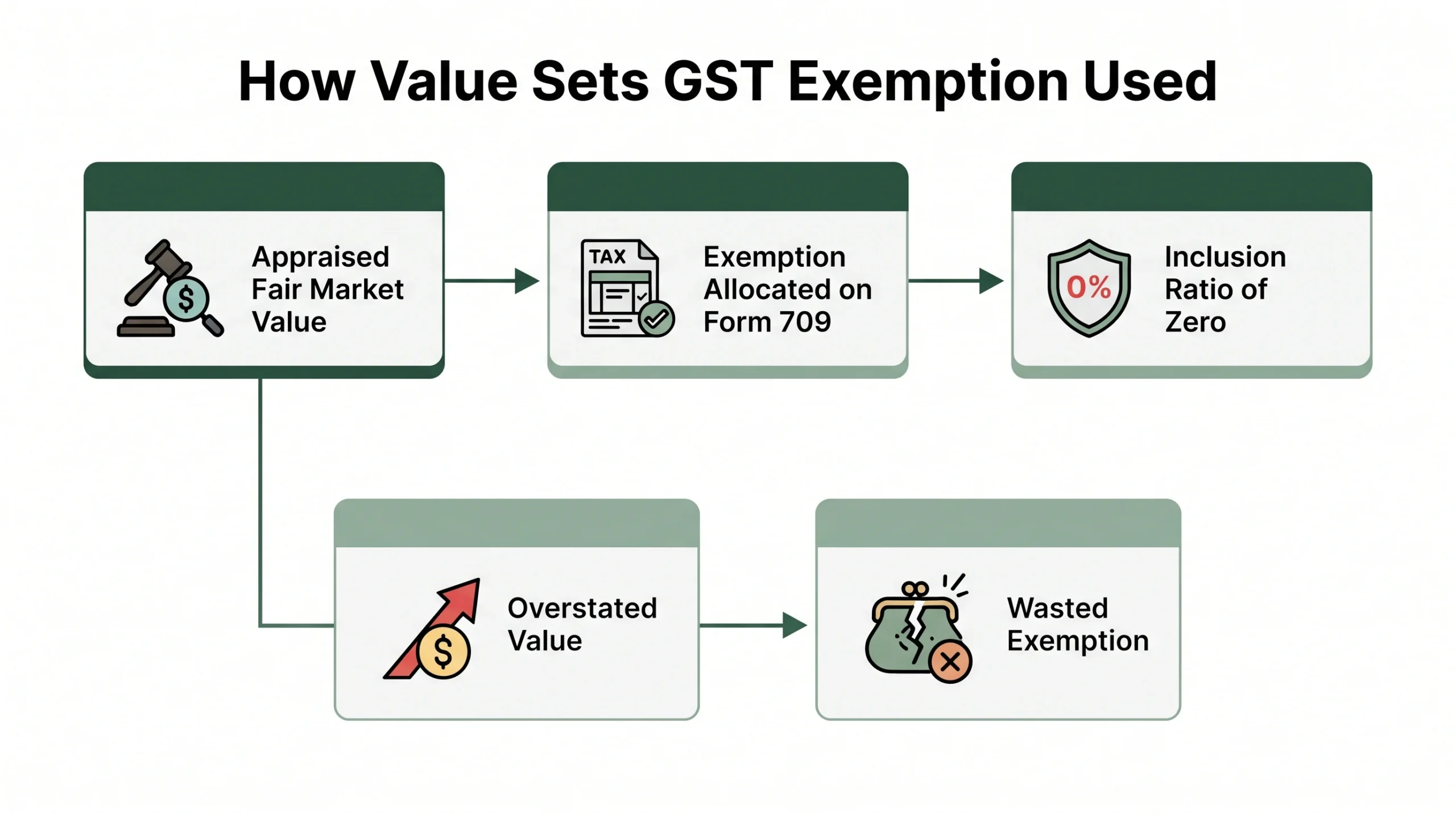
A GST exemption business interest valuation sets the fair market value of a private company stake before an owner gives it to a trust or a skip person. That value decides how much generation-skipping transfer (GST) tax exemption the gift uses. In 2026, each person holds a permanent $15 million GST exemption. So the number on the appraisal directly shapes how much of that shield the transfer consumes.
Sofer Advisors prepares these valuations for owners and their estate planning teams across the United States. The firm brings dual ABV and ASA credentials and 11+ expert witness cases to this tax work. That court-tested background matters when the IRS reviews how a family reported a large transfer.
For an owner, the accuracy of this number is not a formality. A defensible value protects future growth from the 40% GST tax. It also keeps the owner from wasting exemption on an inflated figure. The sections below explain how the value is set, how discounts apply, and when to allocate the exemption.
Key Takeaways
- Value sets the exemption used: the appraised fair market value decides how much GST exemption a transfer consumes, so accuracy protects your remaining shield.
- Allocation drives a zero inclusion ratio: allocating exemption on a timely Form 709 can bring the trust’s inclusion ratio to zero, which frees tax-free growth for later generations.
- Discounts lower the value: a discount for lack of control and a discount for lack of marketability often reduce the worth of a minority or illiquid interest.
- Timing changes the date used: a timely allocation uses the gift-date value, while a late one uses the value on the filing date, which can cost more exemption.
- The exemption is now permanent: under the 2025 tax law, the GST exemption sits at $15 million per person, is indexed for inflation, and has no scheduled sunset.
These points frame the tax rules and the technical choices behind a wealth transfer. The sections below show how business traits and valuation adjustments shape your tax position when you move an interest.
Why does valuation matter for GST planning?
Valuation matters because it fixes the exact amount of exemption a transfer needs. A precise appraisal lets an owner shield future growth for skip persons while avoiding costly reporting errors. GST planning rests on the correct use of the federal exemption. An error in the value of a business interest often wastes exemption or creates a needless tax bill later.
Undervaluing a business puts too little exemption on an asset that may still grow. That gap can pull the trust into GST tax on a later distribution. Overvaluing invites IRS scrutiny and can trigger an audit. A supported value keeps the report in line with the fair market value standard and ready for review.
What is GST exemption allocation?
GST exemption allocation is the act of assigning part of your lifetime exemption to a specific transfer. The goal is an inclusion ratio of zero, which means the trust holds fully exempt assets. When the ratio is zero, all future growth and every distribution to a grandchild or other skip person avoids the 40% GST tax. IRC Section 2642 sets the inclusion ratio formula that ties the value to the exemption used.
The math is direct. If a business interest is valued at $2 million and you allocate $2 million of exemption, the inclusion ratio is zero. If the value is set too high, you spend more exemption than the transfer required. If it is set too low and the IRS raises it later, part of the trust may lose its exempt status. A defensible appraised value is what keeps the ratio where you intended.
How are business interests valued for GST?
Business interests are valued with the income approach, the market approach, or the asset approach to reach fair market value. The appraiser picks the method that fits the entity and its facts. IRS Revenue Ruling 59-60 sets the framework, which weighs earnings, the economic outlook, and both tangible and intangible assets. By using a Heart of a Teacher approach, Sofer Advisors helps owners see how each factor shapes the final number.
The income approach turns expected future cash flow into a present value. It suits stable firms with steady earnings. The market approach compares the business to similar companies and past deals. The asset approach restates the balance sheet at current values, which fits holding companies. A qualified report explains why one method leads and how the others support it.
How do valuation discounts affect GST exemption?
Valuation discounts lower the reported value, so a transfer uses less exemption to reach a zero inclusion ratio. Two adjustments do most of the work. A discount for lack of control (DLOC) reflects that a minority owner cannot force dividends or set strategy. A discount for lack of marketability (DLOM) reflects that a private interest cannot be sold quickly. Both often become the main point of dispute with the IRS.
These discounts need real support, not round numbers. A defensible report ties each percentage to market data, court rulings, and the facts of the interest. Our guide to valuation discounts on estate and gift tax returns covers how these are built. The Sofer Difference process, which moves through Discovery, Diligence, Analysis, and Delivery, keeps that support consistent from data gathering to the final report.
Setting the right value for your interest takes a close look at your holdings and your tax goals. To review your options, discuss a tax and estate valuation with a member of the team.
When should you allocate GST exemption?
You should allocate on a timely filed Form 709 so the gift-date value sets the inclusion ratio. When the return is filed by its due date, the IRS accepts the value as of the gift date. That lets an owner lock in the exemption based on today’s number, even if the company grows sharply later. This timing is the simplest way to protect future appreciation from the GST tax.
A late allocation carries real risk. It generally uses the fair market value on the date the return is filed, not the gift date. If the interest has grown, the owner must allocate against that higher value. This step consumes more of the lifetime exemption than a timely filing would. A qualified report should match the value to the date the rules require.
How much GST exemption can you use in 2026?
Each person can shield $15 million in transfers with the GST exemption in 2026, and a married couple can shield $30 million. The 2025 tax law made this level permanent and indexed it for inflation, so there is no scheduled sunset. That stability lets families plan on a known number rather than racing a deadline. The IRS Instructions for Form 709 explain how to report and allocate the exemption.
A larger exemption does not remove the need for a careful valuation. The exemption is a finite resource across a lifetime. Spending it on an inflated business value leaves less room for future gifts. A supported appraisal helps a family use only what the transfer truly requires.
Which valuation provider should you choose?
Choose an independent firm whose credentials and standards fit high-stakes tax work. Owners weigh national valuation firms, law firms, and general CPA practices, and each plays a different role. Large firms such as Alvarez & Marsal, Stout, and Kroll serve the biggest enterprise deals. A specialized firm provides the empirical data and benchmarking that support discount claims under the American Society of Appraisers standards. The table below compares the options.
| Provider type | Core focus | Fit for GST work |
| Sofer Advisors | Independent, defensible valuation for tax reporting | Strong; dual ABV and ASA credentials with court-tested reports |
| Estate law firm | Legal structuring of trusts and transfers | Needed for the plan, but does not issue the appraisal |
| General CPA firm | Tax filing and general accounting | Limited; may lack database access to support discounts |
The right pick depends on the size of the transfer and the complexity of the interest. A dedicated valuation professional gives the objective number that a tax return must defend, while counsel handles the legal structure. Reports that follow USPAP standards carry more weight if the IRS asks questions. A full W2 team with subscriptions to the major valuation databases can back each figure with current market evidence. That support is what turns an opinion into a defensible record.
Frequently Asked Questions
What are the rules for valuation of a business interest?
The IRS requires a business interest to be valued at fair market value as of the transfer date under Revenue Ruling 59-60. That standard is the price a willing buyer and seller would agree on, with neither under pressure and both fully informed. When the value is not readily known, the rules call for a qualified appraisal by a qualified appraiser using the income, market, or asset approach.
Who qualifies for GST exemption?
Any U.S. citizen or resident who transfers property to a skip person can apply their lifetime GST exemption. A skip person is usually a grandchild, a more remote descendant, or a trust for their benefit. The exemption shields those transfers from the generation-skipping transfer tax. An accurate valuation of any business interest shows exactly how much exemption a given transfer will use.
What is the maximum GST exemption for individuals in 2026?
The GST exemption is $15 million per individual in 2026 and $30 million for a married couple. The 2025 tax law set this level permanently and indexes it for inflation, so no sunset is scheduled. The figure is separate from the annual gift exclusion. A supported business valuation helps an owner see how much of that lifetime amount a specific transfer consumes.
How is GST exemption allocated to a trust?
Allocation happens on Form 709, which names the trust and the amount of exemption applied to the transfer. The aim is an inclusion ratio of zero, which makes the trust assets fully exempt from future GST tax. The reported value of the interest determines how much exemption the allocation requires. A detailed appraisal supports that value and the tax-free status the family intended.
How much does a tax and estate valuation cost?
A tax and estate business valuation from Sofer Advisors typically runs $7,500 to $25,000. The range depends on the complexity of the entity, the number of business units, and the requested timeline. These engagements deliver defensible data that aligns with IRS requirements for wealth transfer. For a quote tied to your situation, contact the team with your entity details.
What happens if the IRS challenges my GST business valuation?
If the IRS challenges the value, the taxpayer must support the figure originally reported. That often means defending the discounts for lack of control and marketability against the agency’s questions. Independent, documented reports that use current market data and industry standards carry the most weight. A poorly supported number can raise the inclusion ratio and pull part of the trust back into GST tax.
What is the difference between a timely and a late GST allocation?
A timely allocation uses the fair market value of the interest on the gift date. A late allocation instead uses the value on the date the Form 709 is filed. If the business grew between those dates, a late filing forces the use of a higher value. That higher value consumes more lifetime exemption, so the timing of the filing carries real cost.
Do valuation discounts apply when allocating GST exemption?
Yes. A minority or illiquid business interest usually qualifies for a discount for lack of control and a discount for lack of marketability. These adjustments lower the fair market value, so the transfer uses less exemption to reach a zero inclusion ratio. Each discount needs support from market data and case law. Arbitrary percentages invite an audit and can be reduced by the IRS.
What credentials should a GST valuation expert have?
A qualified expert should hold the Accredited Senior Appraiser (ASA) or the Accredited in Business Valuation (ABV) designation. Both are recognized for federal tax work and signal training in defensible methods. Experience with estate and gift matters and expert witness work adds further weight. These credentials help confirm that a report meets the standards an IRS reviewer expects for a transfer of this size.
Related Case Studies
- Valuation Discounts (DLOC and DLOM) on Estate and Gift Tax Returns
- How Family Limited Partnerships Are Valued for Gift and Estate Tax
- Estate Freeze Strategies: How Valuations Lock In Today’s Value
Executive Summary
A GST exemption business interest valuation sets the fair market value that decides how much exemption a transfer uses. In 2026, each person holds a permanent $15 million exemption, indexed for inflation, with no sunset. The aim is an inclusion ratio of zero, which shields future growth and distributions to skip persons from the 40% GST tax. Discounts for lack of control and marketability lower the value and stretch the exemption when they are supported. A timely Form 709 locks in the gift-date value, while a late filing can cost more. A defensible, standards-based appraisal keeps the plan intact under IRS review.
What Should You Do Next?
Review your business interests and confirm which transfers you plan to make to a trust or a skip person. Gather your financial statements, ownership agreements, and prior gift tax returns, since these anchor the valuation. Then decide on a timeline with your advisors so a timely Form 709 can lock in the gift-date value before the interest appreciates further.
David Hern CPA ABV ASA, founder of Sofer Advisors, provides neutral, defensible valuations for estate and gift tax planning. Schedule a consultation to discuss your situation.
People Also Read
- Revenue Ruling 59-60: The IRS Foundation of Business Valuation
- Fair Market Value for Estate Tax: What Executors Need
About the Author
This guide was prepared by David Hern, CPA ABV ASA, founder of Sofer Advisors, a business valuation firm headquartered in Atlanta, GA, serving clients across the United States. David holds dual accreditations as an Accredited Senior Appraiser (ASA) and is Accredited in Business Valuation (ABV), credentials recognized by the IRS, SEC, and FINRA. He also holds the Certified Exit Planning Advisor (CEPA) designation. With 15+ years of valuation experience, David has served as an expert witness in 11+ cases across multiple jurisdictions and built Sofer Advisors into an Inc. 5000-recognized firm with 180+ five-star Google reviews. Its full W2 employee team maintains subscriptions to all major valuation databases and operates under a next-business-day response policy.
For professional business valuation services, visit soferadvisors.com/about-us/ or contact Sofer Advisors at soferadvisors.com/contact-us/.
Disclaimer: This content is for informational purposes only and does not constitute professional valuation advice. Business valuation conclusions depend on specific facts and circumstances. Contact Sofer Advisors for guidance regarding your specific situation.









