


Last Updated: September 2026
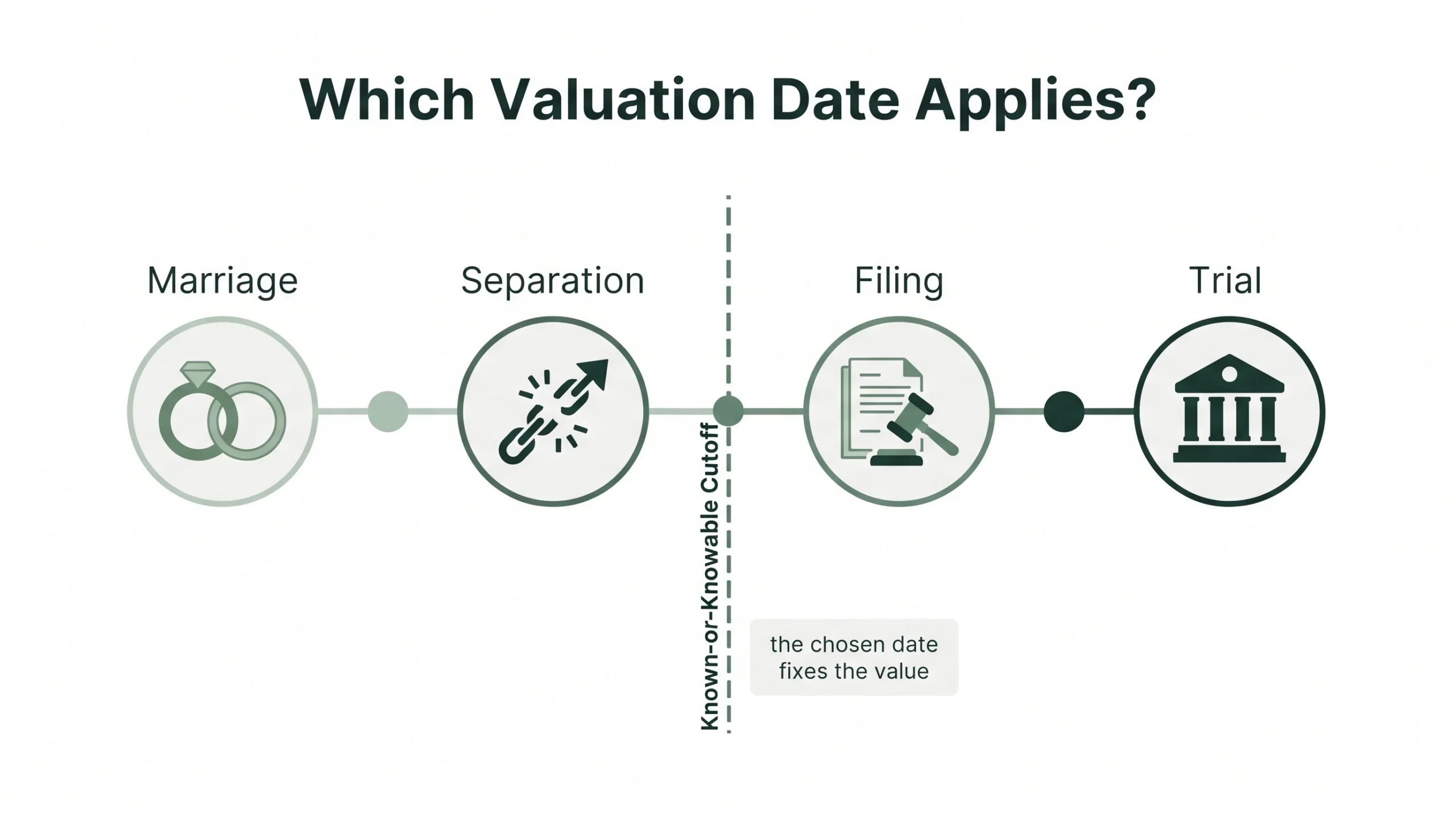
A valuation date is the exact “as of” date on which a business is valued in a legal dispute. In divorce and other litigation, that date often controls the number more than the valuation method does. Divorce cases usually turn on one of four candidate dates: marriage, separation, filing, or trial. Because a business can change sharply between those points, the date the court picks can swing the final value widely.
The date matters because value is a moving target. A company that had a strong year before separation may look very different by the time a case reaches trial. The applicable date is set by state statute or by the judge, and it varies by jurisdiction. Arguing the right date early can protect a client’s position more than a later fight over discount rates.
Sofer Advisors prepares neutral, court-defensible valuations for divorce, shareholder, and commercial disputes. Its senior team has given expert witness testimony in 11+ cases across Georgia, Florida, California, and New Mexico. The firm treats the valuation date as a threshold decision, because the date frames every number that follows.
Key Takeaways
- The date sets the value: the valuation date fixes the facts and figures the appraiser may use, so it shapes the answer before any method is chosen.
- Divorce dates vary by state: courts may use the date of marriage, separation, filing, or trial, and the choice is set by statute or the judge.
- Known or knowable controls the evidence: the appraiser generally uses only facts known or reasonably knowable on the valuation date.
- The date can beat the method: a shift of one or two years between candidate dates can move value more than a change in the discount rate.
- Lock the date early: settle or brief the date at the start, then hold the whole analysis strictly as of that date.
These points explain why litigators treat date selection as a first-order question. The sections below cover each candidate date, the known-or-knowable rule, and how to keep an analysis defensible.
What is the valuation date and why does it control the number?
The valuation date is the specific “as of” date on which a business is valued, and it controls the number because it fixes the facts and market conditions the appraiser may use. Two appraisers using the same method can reach very different values if they work from different dates. A strong quarter or a lost client can fall on either side of the date. The date sets the boundary of the whole analysis.
Think of the valuation date as a photograph that freezes the business at one moment. Everything the appraiser measures, from revenue and backlog to cash and risk, is read as of that day, and later events usually sit outside the frame. Two credible experts can defend different numbers in the same case simply because they picked different days. Firms credentialed through the American Society of Appraisers build their reports around this fixed point.
Which valuation date applies in a divorce?
The date that applies in a divorce depends on the state and sometimes on the judge. Some states value marital property as of the date of separation. Others use the date the complaint is filed. Several use the date of trial, and many leave it to the court’s discretion. Because the rule varies by jurisdiction, the applicable date is a legal question for counsel, not a fixed national standard.
| Candidate date | What it captures | Common rationale |
| Date of marriage | The company’s value at the start of the marriage | Separates premarital value from marital growth |
| Date of separation | Value when the spouses stopped acting as one economic unit | Used where courts freeze the estate at separation |
| Date of filing | Value when the divorce complaint is filed | A clear, documented cutoff used in several states |
| Date of trial | Value closest to the final ruling | Used where courts want the most current picture |
No single date is correct across the country. The right date is the one the governing statute or court assigns, and the value can differ at each. A business owner who built value after separation may prefer an earlier date, while a spouse may argue for a later one. The date of marriage also feeds the question of how appreciation and personal goodwill are split between the spouses.
What is the known-or-knowable rule?
The known-or-knowable rule says the appraiser may generally use only facts that were known, or reasonably knowable, as of the valuation date. Information that surfaced later is usually excluded, because a buyer on that date could not have acted on it. The rule keeps hindsight out of the number. Some courts do admit later events when they clarify a condition that already existed on the date, so the treatment of subsequent events varies by jurisdiction.
A simple example shows the point. Suppose a company loses its largest customer two months after the valuation date. If no one saw that loss coming, the appraiser usually leaves it out, because it was not knowable on the date. If the customer had already sent a termination notice before the date, the risk was knowable, and it belongs in the analysis. Professional standards such as USPAP guide how the expert documents that judgment, but how far a court looks past the date is a legal question for counsel.
How does the valuation date work in a shareholder dispute?
In a shareholder dispute, the valuation date is often set by statute or by the event that triggered the case. Many states fix the date in an oppression or buyout matter as the day before the disputed action, such as a freeze-out. Others use the date the suit was filed. As in divorce, the date decides which facts count, and a company that grew or shrank after the trigger can be valued very differently depending on the date chosen.
Shareholder cases add a twist: the conduct that started the fight can itself change the value. If a controlling owner strips assets or diverts customers, a later date would capture that damage and understate the squeezed-out owner’s stake. Courts often choose an earlier date to avoid rewarding that conduct. The expert measures the business as of the chosen date and treats later harm as a separate damages question, keeping the two analyses distinct.
Can the valuation date change the conclusion more than the method?
Yes. The valuation date can move the conclusion more than the choice of method, and litigants often underestimate this. Analysts sometimes spend weeks arguing over discount rates while the date does the heavier lifting. A business valued at the top of a good year can be worth far more than the same business valued after a downturn, no matter which method is used.
Method choice still matters, but it usually adjusts a value within a range, while the date can shift the entire range. A company that added a major contract, or lost a key employee, between two candidate dates can carry a very different value on each. So an experienced expert settles the date first, then selects methods that fit the facts as of that date.
How do you choose a valuation firm for a litigation engagement?
Choose a firm that is independent, credentialed, and ready to defend its work under cross-examination. Large national firms such as Alvarez & Marsal, Stout, and Kroll handle the biggest matters, while focused firms serve middle-market owners with senior attention on every file. The right choice fixes the valuation date early and produces a report that holds up in court. For divorce and dispute work, review the conflict resolution practice.
Sofer Advisors runs every litigation engagement through a repeatable process it calls The Sofer Difference: Discovery, Diligence, Analysis, and Delivery. Discovery sets the assignment and the valuation date, Diligence gathers the facts known or knowable on that date, Analysis applies the methods that fit those facts, and Delivery produces a clear report and, when needed, testimony. The firm works with a Heart of a Teacher, explaining each judgment so counsel and clients understand the number. Look for experts credentialed through bodies like the National Association of Certified Valuators and Analysts.
Frequently Asked Questions
What does “valuation date” mean?
A valuation date is the specific “as of” date on which a business is valued. Every figure in the report, from cash flow to risk, is measured as of that day. The date defines the facts the appraiser may use and the market conditions that apply. In litigation, it is set by statute or the court, and it often shapes the value more than the method that follows.
Which valuation date is used in a divorce?
It depends on the state. Some courts value a business as of the date of separation, some as of the date the complaint is filed, and some as of the date of trial. Many judges have discretion to pick the fairest date. Because the rule varies by jurisdiction, the applicable date is a legal question for counsel, and it can change the value a spouse receives.
What is the known-or-knowable rule?
The known-or-knowable rule limits the appraiser to facts that were known, or reasonably knowable, on the valuation date. Anything that could not have been foreseen on that day is usually left out, because a buyer could not have acted on it. The rule keeps hindsight out of the number, and it is a core reason two experts can value the same business at different figures.
Can events after the valuation date be considered?
Usually not, though it varies by court. Events after the date are generally excluded because they were not knowable when the business was valued. Some courts do admit a later event when it confirms a condition that already existed on the date, such as a contract loss already in motion. How far a court looks past the date is a legal question for counsel.
Does the valuation date matter more than the method?
Often, yes. Method choice adjusts a value within a range, while the date can move the entire range. A company valued after a strong year can be worth far more than the same company valued after a slump. When two litigation experts reach very different numbers, the difference in dates is frequently the larger driver. That is why the date should be settled before the analysis begins.
What valuation date applies in a shareholder dispute?
In many states, the date in an oppression or buyout case is set by statute, often the day before the disputed action. Other states use the date the lawsuit is filed. Courts may pick an earlier date so that harm caused by the disputed conduct does not lower the value owed to the squeezed-out owner. As in divorce, the applicable date is a legal question that varies by jurisdiction.
What is the biggest valuation mistake in a divorce?
A common mistake is arguing over methods and discounts while ignoring the valuation date. Parties can spend heavily on a report built to the wrong date, then watch its value collapse in court. Another error is letting later events slip into a number that should reflect only what was knowable on the date. Fixing the date first, with guidance from counsel, avoids both problems.
How long does a litigation business valuation take?
A typical litigation or divorce valuation runs four to eight weeks from the start of fieldwork. Complex companies, multiple valuation dates, or tight discovery deadlines can extend that window. Testimony and rebuttal work add time and are scheduled around the court’s calendar. Starting early gives the expert room to gather the facts that were knowable on the chosen date.
How much does a litigation or divorce business valuation cost?
A litigation or divorce business valuation from Sofer Advisors falls in the Standard Business Valuation range of $7,500 to $25,000, with a typical timeline of four to eight weeks. Expert witness services, including deposition and trial testimony, are billed at an hourly rate and quoted separately from the report. Final cost depends on the company’s complexity and the number of valuation dates required. For a quote tied to your case, contact our team.
Related Case Studies
- Divorce Business Valuation Georgia: What Business Owners Need to Know
- Business Divorce in Georgia: Fair Distribution and Valuation
- Shareholder Dispute Valuation Atlanta: Resolving Georgia Business Partner Conflicts
Executive Summary
The valuation date is the exact “as of” date a business is valued, and in litigation it often controls the number more than the method. Divorce cases can turn on the date of marriage, separation, filing, or trial, set by state law or the judge. The known-or-knowable rule limits the appraiser to facts known or reasonably knowable on that date, and treatment of later events varies by court. A company can swing widely in value between two candidate dates, so a two-year gap can matter more than any discount rate. Fix the date early and hold the analysis as of that day.
What Should You Do Next?
Ask counsel which valuation date your court is likely to apply, then gather the financials and records available as of that date. If more than one date is in play, have the business valued at each so you can see the range before you negotiate or testify. Keep any later events separate, and note whether they were knowable on the date.
David Hern CPA ABV ASA, founder of Sofer Advisors, provides neutral, defensible valuations for divorce and dispute matters. Schedule a consultation to discuss your case.
People Also Read
- Expert Witness Business Valuation Georgia: What Attorneys Need to Know
- USPAP Compliance: What Makes a Valuation Court Defensible
About the Author
This guide was prepared by David Hern CPA ABV ASA, founder of Sofer Advisors, a business valuation firm headquartered in Atlanta, GA serving clients across the United States. David holds dual accreditations as an Accredited Senior Appraiser (ASA) and is Accredited in Business Valuation (ABV), credentials recognized by the IRS, SEC, and FINRA. He also holds the Certified Exit Planning Advisor (CEPA) designation. With 15+ years of valuation experience, David has served as an expert witness in 11+ cases across multiple jurisdictions and built Sofer Advisors into an Inc. 5000-recognized firm with 180+ five-star Google reviews. Its full W2 employee team maintains subscriptions to all major valuation databases and operates under a next business day response policy.
For professional business valuation services, visit soferadvisors.com/about-us/ or contact Sofer Advisors at soferadvisors.com/contact-us/.
Disclaimer: This content is for informational purposes only and does not constitute professional valuation advice. Business valuation conclusions depend on specific facts and circumstances. Contact Sofer Advisors for guidance regarding your specific situation.