


Last Updated: October 2026
A business succession plan is a written roadmap for passing a company to its next owners and leaders. It sets who takes over, how the ownership changes hands, and what the business is worth on that date. At the center sits a current business valuation. Without a documented plan, an owner’s exit falls to chance. Only about 30% of family businesses survive into the second generation, and a missing or stale value is often part of the reason.
The team at Sofer Advisors values closely held companies for owners, CPAs, and attorneys who are planning an exit, backed by Inc. 5000 recognition in both 2024 and 2025. A plan built on a guess tends to break when it is tested. A plan built on a defensible valuation holds.
This guide explains why the valuation comes first, what a full plan contains, and how owners move a company to family, outside buyers, or employees. It also covers the buy-sell agreement that funds the transfer and the taxes that shape every path.
Key Takeaways
- Valuation comes first: a current, defensible business valuation sets the price every other part of the plan depends on.
- Plan the 5 D’s: a full plan prepares for death, disability, divorce, departure, and disagreement, not just a planned retirement.
- Pick the path: family, a third-party sale, or a management or ESOP buyout each carry a different price and tax result.
- Fund the buy-sell: a buy-sell agreement sets the transfer price and the funding, usually life insurance, so a trigger does not force a fire sale.
- Start early: starting 5 to 10 years out gives time to raise value, train successors, and cut the tax bill.
The sections below take these one at a time, starting with the number everything else leans on.
Why Does a Succession Plan Need a Valuation?
A succession plan needs a valuation because every decision in it turns on one number: what the business is worth today. That figure sets the buyout price in a buy-sell agreement, the gift and estate tax on transferred shares, and the funding the plan has to carry. A guess invites disputes among heirs and partners, and it invites a challenge from the IRS. A defensible number prevents both.
The standard that applies is fair market value, the benchmark the IRS set in Revenue Ruling 59-60. It is the price a willing buyer and a willing seller would agree on, with neither under pressure and both informed. A professional appraiser applies that standard with the income, market, and asset approaches, then documents the work. That record is what lets the number hold up in a tax filing, a court, or a negotiation. It is also what turns a vague plan into a clear one.
What Goes Into a Business Succession Plan?
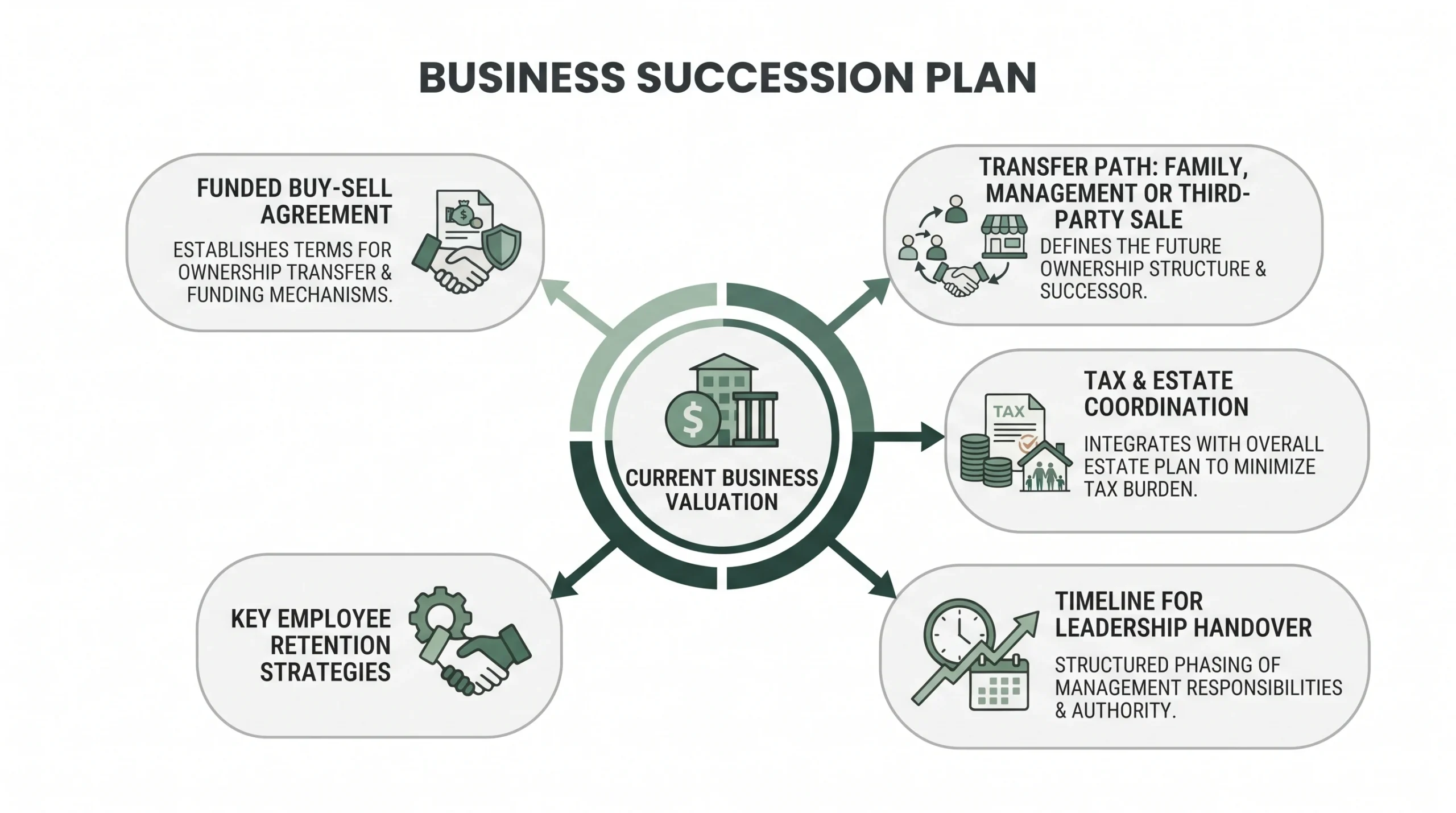
A business succession plan has four core parts. It names the successors and the timeline for handing over control. It sets the path for moving ownership, whether to family, a buyer, or employees. It funds a buy-sell agreement so shares can change hands on fair terms. And it plans for the 5 D’s, the sudden events that can force a transfer before anyone is ready.
The 5 D’s are death, disability, divorce, departure, and disagreement. Any one of them can put a stake in play overnight. A written plan says who may buy, at what price, and with what money, long before the event. It also protects the people left behind. Clear terms keep a grieving family or a split partnership out of court. Good planning pairs the ownership transfer with an exit planning timeline, so the owner’s retirement income and the company’s future are solved together.
How Do You Move a Business to Family, a Buyer, or Employees?
There are three main paths, and each sets its own price and tax result. A family transfer uses gifts and trusts to move shares to the next generation at the lowest tax cost. A third-party sale aims for the highest price by opening the company to outside buyers. A management buyout or an ESOP sells the business to the people who already run it, often with tax breaks for the seller.
Families often use a GRAT, a grantor retained annuity trust. The owner keeps an annuity for a set term, and growth above the IRS Section 7520 rate passes to heirs with little or no gift tax. An ESOP sells stock to an employee trust, and a C corporation owner who meets the rules can defer the gain under IRC Section 1042. Every path needs its own valuation, because the standard of value and the discounts change with the buyer.
How Does a Buy-Sell Agreement Fund the Transfer?
A buy-sell agreement is the contract that carries out the plan. It names who can buy an owner’s shares, what triggers a sale, and how the price is set. The trigger is usually one of the 5 D’s. The price comes from a set formula or a fresh appraisal. The funding is usually life or disability insurance, so cash is ready the day it is needed.
Funding is the part owners skip, and it is the part that fails. A promise to buy a dead partner’s shares means nothing without the money to pay. Life insurance on each owner fills that gap. When a trigger hits, the policy pays, and the company or the surviving owners buy the shares at the agreed price. A plan that pegs the price to a current valuation and funds it with life insurance turns a crisis into a routine transaction.
What Taxes Does a Succession Plan Plan For?
A succession plan works around three taxes: estate tax, gift tax, and capital gains tax. Moving shares during life can trigger gift tax, while shares left at death face estate tax. Selling the business triggers capital gains. The structure of the deal, an asset sale or a stock sale, decides who pays what. A current valuation sets the taxable value for every one of these.
Timing and structure do the heavy lifting. Gifting shares early, while the company is worth less, moves future growth out of the estate. Valuation discounts for a minority stake or for lack of marketability can lower the taxable value further, as long as an appraiser can support them. An asset sale often favors the buyer, while a stock sale often favors the seller. Owners weigh those trade-offs with their CPA and appraiser, because a wrong structure can cost far more than the planning did.
A defensible number is the thread that ties all of this together. You can see the full range of Sofer Advisors business valuation services for succession, tax, and transfer work.
Who Should Value a Business for Succession?
Owners choose a valuation partner based on the size of the business, the audit risk, and the budget. Large national firms such as Alvarez & Marsal, Stout, and Kroll serve big public companies with broad advisory teams. Specialized valuation firms focus on closely held and middle-market companies. Business brokers and online tools offer a quick estimate, but not a report that holds up for tax or in court. The table below lays out the common options.
| Provider | Typical role | Best for |
|---|---|---|
| Specialized valuation firm (e.g. Sofer Advisors) | Sets a defensible value and documents it for the buy-sell, the tax filing, and the transfer | Closely held and family businesses that need audit-ready, court-ready support |
| Large national firm | Broad advisory plus valuation at enterprise scale | Large public companies with complex, multi-entity plans |
| Business broker or online tool | Gives a quick price estimate to market a sale | A fast, rough gauge, not a defensible number for tax or litigation |
Sofer Advisors runs each engagement through a four-phase process it calls The Sofer Difference, moving from Discovery to Diligence to Analysis to Delivery. That path keeps every number tied to the facts behind it. It reflects the Heart of a Teacher approach, which means explaining the reasoning so an owner can defend the figure in any room. With 180+ five-star Google reviews and expert witness testimony in 11+ cases, the work is built to hold up for the IRS, a buyer, or a judge.
Frequently Asked Questions
How do I write a succession plan for my business?
Start by setting your exit goals and a target date. Name the people who could take over, and write down the roles they will fill. Gather financial statements and get a formal business valuation, since that number anchors every transfer. Then draft a buy-sell agreement that states the price and the funding. Sofer Advisors supplies the valuation that makes each of these steps defensible for tax and transfer purposes.
What are the 5 D’s of succession planning?
The 5 D’s are the sudden events that can force an ownership change: death, disability, divorce, departure, and disagreement. Any one of them can put a share of the business in play before an owner is ready. A good plan sets the price and the funding for each case in advance. Sofer Advisors builds the valuation behind those terms, so a buy-sell can pay out fairly when a D actually happens.
What is a succession plan for a business?
A succession plan is a written framework for who will own and run a company after the current owner steps back. It covers the transfer of control, the transfer of equity, and the taxes that come with both. It is not a single document but a set of linked decisions. Sofer Advisors supports the plan with the valuation that keeps the ownership transfer compliant and the price fair to everyone involved.
What are the downsides of succession planning?
The main downsides are the time it takes and the hard conversations it can start. Naming a successor may surface disagreements among family members or partners about who leads next. The process also costs money up front. Still, the cost of no plan is almost always higher, since a forced sale destroys value. Sofer Advisors gives owners a neutral, third-party number, which takes much of the emotion out of those talks.
How much does a business succession plan valuation cost?
A business valuation for succession planning usually runs from $7,500 to $25,000. The price depends on the size of the company, how many owners are involved, and the deadline. Most reports take four to eight weeks. A flat fee is quoted up front, so there are no surprises. Sofer Advisors scopes the work first, then sets a fixed price. Request a free estimate for your situation.
How long does a succession valuation take?
Most succession valuations take four to eight weeks from the day the records arrive. A simple company with one owner moves faster. A business with several owners, multiple entities, or messy books takes longer. A rush engagement can be done in two to three weeks for a higher fee. Sofer Advisors gives each client a timeline at the start, so the owner knows every milestone before the work begins.
When should you start succession planning?
Owners should start five to ten years before the planned exit. That window gives time to raise the value, train a successor, and gift shares while the company is worth less. It also leaves room to fix problems a buyer would punish. Waiting until a sale is close almost always means a lower price and a bigger tax bill. Sofer Advisors suggests a baseline valuation early, so owners can measure progress against a real number.
What happens if you have no succession plan?
Without a plan, the fate of the company falls to chance and to the courts. If an owner dies or is disabled, heirs and partners can end up fighting over control and price with no rules to follow. Value leaks fast during that fight, and a forced sale rarely fetches full price. Sofer Advisors recommends a current valuation and a funded buy-sell early, so a sudden event becomes a plan, not a crisis.
Related Case Studies
- Business Succession Planning Tips for Smooth Ownership Transfers
- How to Transfer Business Ownership: Options and Tax Impact
- Management Buyout Process: Steps, Financing, and Valuation
Executive Summary
A business succession plan decides who takes over a company and on what terms, and a current valuation sits at its center. That number sets the buyout price, the gift and estate tax on transferred shares, and the funding the plan has to carry. Owners move a business to family, an outside buyer, or employees, and each path has its own price and tax result. A buy-sell agreement, funded with insurance, turns a sudden event into a clean transfer. The best plans start five to ten years out and rest on a defensible fair market value. The first step is a current valuation of the business.
What Should You Do Next?
List your likely successors, pull your last three years of financials, and check whether your buy-sell names a real valuation method. If your last valuation is more than two years old, treat it as out of date for any transfer or tax filing. This guide was prepared by David Hern CPA ABV ASA, founder of Sofer Advisors, whose team provides neutral business valuation services for succession and tax planning. Schedule a free consultation through our contact page to discuss your specific situation.
People Also Read
- When to Start Succession Planning: Your Strategic Timeline Guide
- Buy-Sell Agreement vs Shareholder Agreement: Key Differences
About the Author
This guide was prepared by David Hern CPA ABV ASA, founder of Sofer Advisors, a business valuation firm headquartered in Atlanta, GA serving clients across the United States. David holds dual accreditations as an Accredited Senior Appraiser (ASA) and is Accredited in Business Valuation (ABV), credentials recognized by the IRS, SEC, and FINRA. He also holds the Certified Exit Planning Advisor (CEPA) designation. With 15+ years of valuation experience, David has served as an expert witness in 11+ cases across multiple jurisdictions and built Sofer Advisors into an Inc. 5,000-recognized firm with 180+ five-star Google reviews. Its full W2 employee team maintains subscriptions to all major valuation databases and operates under a next business day response policy.
For professional business valuation services, visit soferadvisors.com/about-us/ or contact Sofer Advisors at soferadvisors.com/contact-us/.
This content is for informational purposes only and does not constitute professional valuation advice. Business valuation conclusions depend on specific facts and circumstances. Contact Sofer Advisors for guidance regarding your specific situation.









