


Last Updated: June 2026
This article is written for Suwanee business owners, their CPAs, and their attorneys who need to understand how a business valuation works, what it costs, and what factors most affect the outcome. After reading, you will know what to expect from the process, how to choose the right appraiser, and when to order a valuation.
A business valuation Suwanee GA is a certified, professional process that determines what a privately held company is worth in dollar terms on a specific date. It matters because that number drives decisions in sales, estate transfers, buy-sell agreements, and legal disputes. A credentialed appraiser examines your financial records, industry data, and risk profile to produce a conclusion of value that buyers, courts, lenders, and the IRS will accept.
When Suwanee and Gwinnett County business owners need that number, many do not realize how much the appraiser’s credentials and process affect the final result. Sofer Advisors, headquartered in Atlanta, GA, serves business owners throughout the greater metro area – including Suwanee, Duluth, Lawrenceville, and Johns Creek – with certified appraisals built for real-world use. The firm holds 180+ five-star Google reviews and maintains a next business day response policy for new inquiries.
Key Takeaways
- Three Valuation Approaches – Appraisers use income, market, and asset approaches, weighting each based on the subject business’s industry and the purpose of the engagement.
- Cost Range Is $7,500 to $25,000 – A standard certified business valuation in Georgia costs $7,500 to $25,000 depending on complexity, company size, and the purpose of the appraisal.
- Revenue Is Not Value – A business with $500,000 in revenue might be worth $200,000 or $600,000 depending on profit margin, risk profile, and owner dependency level.
- ABV or ASA Is Required for IRS and Legal Use – Appraisers must hold an ABV or ASA credential for valuations used in tax filings, litigation, or SBA financing.
- Timeline Is 4 to 8 Weeks – Most standard Suwanee area engagements complete within four to eight weeks from the date documents are received.
- Local Market Data Changes Conclusions – Gwinnett County’s strong growth shifts buyer demand and market multiples, potentially affecting concluded value by 10% to 20% versus national averages.
The sections below examine each in detail.
What Is a Business Valuation in Suwanee?
A business valuation in Suwanee follows the same professional standards as any certified appraisal in the United States. Local market data plays a meaningful role in the final number. The appraiser uses financial records, comparable transaction data, and industry benchmarks to calculate fair market value or another standard appropriate to the engagement’s purpose.
Fair market value is the price at which property would change hands between a willing buyer and a willing seller. Neither party is under compulsion. That standard comes from Rev. Rul. 59-60.
Appraisers credentialed by the American Society of Appraisers or the AICPA follow USPAP. USPAP sets minimum standards for independence, documentation, and reporting. A valuation that does not meet USPAP will not hold up with the IRS or in a Georgia courtroom.
Gwinnett County’s economy spans manufacturing, healthcare, technology, and professional services. Appraisers need current local data, which can shift value conclusions by 10% to 20%.
Why Do Suwanee Owners Need a Valuation?
The purpose of a valuation drives the standard used and the methods the appraiser selects. Common reasons include:
- Selling the business to a third party or private equity group
- Funding a buy-sell agreement with life insurance or disability coverage
- Estate planning or gifting ownership interests to family members
- Responding to a shareholder dispute or divorce proceeding
- Qualifying for an SBA 7(a) or SBA 504 loan
- Setting up an employee stock ownership plan (ESOP)
Each purpose calls for a different standard. A third-party sale uses fair market value. An ESOP uses an adequate consideration standard under ERISA. A Georgia divorce proceeding applies the state’s marital property definition, which can differ from the IRS standard.
Business owners who use a firm offering valuation as a side service often get conclusions that fail when challenged.
How Do Appraisers Value a Business?
Appraisers use three recognized approaches: income, market, and asset. Most credentialed appraisers consider all three, then weight the most relevant for the subject company.
The income approach uses discounted cash flow (DCF) or capitalization of earnings. Higher-risk businesses carry higher capitalization rates and produce lower values.
The market approach compares the business to sales of similar companies. EBITDA multiples from comparable deals check the income approach result.
The asset approach values assets and liabilities at fair market value. It is most useful for holding companies or asset-heavy businesses.
| Business Type | Primary Approach | Secondary Approach | Typical Multiple |
|---|---|---|---|
| Professional Services | Income (Cap of Earnings) | Market | 2.5x – 4.5x SDE |
| Healthcare/Medical Practice | Income (DCF) | Market | 4x – 7x EBITDA |
| Manufacturing / Distribution | Market | Income | 4x – 6x EBITDA |
| Restaurant / Food Service | Market | Asset | 1.5x – 3x SDE |
| Technology / SaaS | Income (DCF) | Market | 5x – 12x ARR |
| Construction | Market | Income | 3x – 5x EBITDA |
These ranges reflect national data. Suwanee-area data may shift them based on local buyer demand and Gwinnett County’s growth.
What Factors Affect Value the Most?
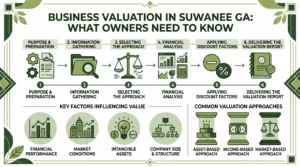
Several factors drive outsized impact on concluded value.
Normalized EBITDA is the biggest single driver. Addbacks for above-market owner pay and non-recurring expenses increase it. At a 4x multiple, a $50,000 addback adds $200,000 to value.
Customer concentration is the second major driver. If 30% or more of revenue traces to one customer, appraisers apply a discount of 10% to 25%.
Owner dependency is the third factor. When you hold the key relationships and run core operations, buyers discount the price. That adjustment can reduce value by 15% to 35%.
A business growing at 15% per year commands a higher multiple than a flat business at the same earnings.
How Much Is a Business Worth With $500K in Sales?
Revenue does not equal value – profit does. A business with $500,000 in revenue at a 25% SDE margin has $125,000 in seller’s discretionary earnings. At a 3x multiple, value is $375,000. At a 4x multiple, it is $500,000. Risk adjustments can move the final number by 15% to 35%.
At $100,000 in revenue, a 25% margin yields $25,000 in earnings. At a 3x to 4x multiple, value is $75,000 to $100,000. Most owners at this level use a broker’s opinion rather than a full USPAP report.
| Annual Revenue | SDE Margin | SDE | Value at 3.5x | Recommended Report Type |
|---|---|---|---|---|
| $100,000 | 20% | $20,000 | $70,000 | Calculation of value or broker opinion |
| $500,000 | 25% | $125,000 | $437,500 | Certified USPAP appraisal |
| $1,000,000 | 30% | $300,000 | $1,050,000 | Full certified engagement |
| $2,000,000 | 35% | $700,000 | $2,450,000 | Full DCF and market approach |
These figures show how earnings and multiples interact. Actual valuations also layer in company-specific risk.
What Is The Sofer Difference for Suwanee Owners?
This four-phase process – Discovery, Diligence, Analysis, and Delivery – gives Suwanee owners a clear picture of what their company is worth and why.
Discovery identifies the purpose, standard of value, and the owner’s timeline. Diligence reviews financial records and benchmarks against industry data. Analysis produces a supported value conclusion. Delivery presents that conclusion in a USPAP-compliant written report in plain language.
David Hern CPA ABV ASA brings a Heart of a Teacher approach to every engagement. The report explains how each conclusion was reached in terms you and your attorney can follow. That clarity matters when a buyer pushes back or the IRS requests documentation.
When Should You Order a Valuation?
Most Suwanee owners who call after negotiations begin are already at a disadvantage. Ordering a valuation before the event puts you in a stronger position.
For owners planning a sale in the next few years, a baseline valuation now creates a benchmark. For estate planning, valuations must be done before the transfer to meet IRS requirements.
For buy-sell agreements, most advisors recommend reviewing the valuation every two to three years. A policy set four years ago may no longer cover current value. If a partner dies and insurance falls short, a conflict follows.
Owners who wait for a triggering event consistently find themselves behind.
The questions below address what Suwanee owners ask most often.
Frequently Asked Questions
What is the average cost of a business valuation?
A certified business valuation in Georgia typically costs between $7,500 and $25,000. The range reflects differences in business size, industry complexity, and the purpose of the engagement. A straightforward third-party sale falls toward the lower end. An ESOP transaction, litigation support, or multi-entity healthcare practice falls toward the higher end. Rush engagements carry a 25% to 50% premium for completion in two to three weeks.
How much does a business valuation from Sofer Advisors cost?
Engagements typically range from $7,500 to $25,000. The exact cost depends on complexity, purpose, and the business’s size and industry. Most standard engagements complete within four to eight weeks. Rush turnaround is available at a 25% to 50% premium. Schedule a free consultation to receive a scoped estimate based on your specific situation, purpose of value, and timeline. No engagement fee is required to have that initial conversation.
How much is a business worth with $500,000 in sales?
A business with $500,000 in revenue is worth between $150,000 and $750,000 or more. The range depends on profit margin, industry multiple, and risk profile. At a 25% SDE margin and a 3.5x multiple, that is about $437,500 before adjustments. Owner dependency, customer concentration, and growth trend each shift that number up or down. A high-dependency business with concentrated revenue can fall well below that midpoint.
How much is a business worth with $100,000 in sales?
A business with $100,000 in annual revenue typically generates $15,000 to $25,000 in seller’s discretionary earnings after operating costs and owner pay. At a 3x to 4x multiple, value falls in the $45,000 to $100,000 range. At that size, a full certified appraisal often costs as much as the concluded value. Most owners at this revenue level use a broker’s opinion or a formal calculation of value instead.
What credentials should a business appraiser hold?
An appraiser working for IRS, legal, or lender purposes should hold an ABV (Accredited in Business Valuation, issued by the AICPA) or an ASA (Accredited Senior Appraiser, issued by the American Society of Appraisers). Both require demonstrated valuation experience, a written exam, and continuing education. The IRS and FINRA recognize both under IRC Section 170. A CPA credential alone does not satisfy the qualified appraiser standard.
How long does a business valuation take in Suwanee?
A standard engagement takes four to eight weeks from the date the appraiser receives complete financial documents. Complex engagements – multi-entity businesses, healthcare practices, or litigation support – can take eight to twelve weeks. Rush engagements are available at a premium. The clock starts when documents arrive, not when the engagement letter is signed. Preparing three to five years of financial statements before you call shortens the overall timeline.
Will my valuation hold up with the IRS?
A valuation by an ABV or ASA appraiser following USPAP holds up in most IRS contexts. Those include estate and gift tax filings, charitable deductions, and entity conversions. The IRS requires a qualified appraisal by a qualified appraiser under IRC Section 170. Appraisals from individuals without ABV or ASA credentials are regularly rejected. Rejection often triggers accuracy-related penalties that exceed the cost of a properly credentialed appraisal.
How does Suwanee’s market affect my business valuation?
Suwanee and Gwinnett County have grown consistently over the past decade. Buyers active in this market often pay higher multiples for established local businesses. Acquiring a going concern here is faster than starting from scratch. Local wage rates, lease costs, and competitive dynamics also affect the normalized earnings figure the appraiser uses as the value base. An appraiser working Gwinnett County regularly will have more accurate local data.
Related Case Studies
- How To Get A Business Valuation Complete Hiring Guide
- Personal Goodwill Vs Enterprise Goodwill Tax Divorce Guide
- Estate Planning Business Valuation Georgia Gift Tax Compliance Guide
Executive Summary
Business valuation in Suwanee GA follows certified professional standards, but Gwinnett County’s growth dynamics and local market data affect conclusions meaningfully. Appraisers apply income, market, and asset approaches weighted by industry and purpose. Certified valuations typically cost $7,500 to $25,000 and complete in four to eight weeks. Revenue alone does not determine value: profit margin, owner dependency, and concentration each drive the final number. ABV and ASA credentials are required for IRS, litigation, and SBA contexts.
What Should You Do Next?
If you own a business in Suwanee or Gwinnett County and need a certified valuation for a sale, estate plan, buy-sell agreement, or legal proceeding, start with a conversation about your situation and timeline. A baseline now gives you time to act on what you learn.
David Hern CPA ABV ASA, founder of Sofer Advisors works with business owners, CPAs, and attorneys across Georgia to produce credentialed, defensible valuations. Schedule a consultation to discuss your situation and receive a scoped estimate within one business day.
People Also Read
- Why You Must Start Planning Your Business Exit Now With The Right Valuation Expert
- What To Expect During A Business Valuation Step By Step Process
About the Author
This guide was prepared by David Hern CPA ABV ASA, founder of Sofer Advisors – a business valuation firm headquartered in Atlanta, GA serving clients across the United States. David holds dual accreditations as an Accredited Senior Appraiser (ASA) and is Accredited in Business Valuation (ABV), credentials recognized by the IRS, SEC, and FINRA. He also holds the Certified Exit Planning Advisor (CEPA) designation. With 15+ years of valuation experience, David has served as an expert witness in 11+ cases across multiple jurisdictions and built Sofer Advisors into an Inc. 5000-recognized firm with 180+ five-star Google reviews. The firm’s full W2 employee team maintains subscriptions to all major valuation databases and operates under a next business day response policy.
For professional business valuation services, visit soferadvisors.com or schedule a consultation.
This content is for informational purposes only and does not constitute professional valuation advice. Business valuation conclusions depend on specific facts and circumstances. Contact Sofer Advisors for guidance regarding your specific situation.