


Last Updated: September 2026
In an ESOP transaction, the plan does not speak for itself. An independent trustee stands in for the employees as the ERISA fiduciary. That trustee must make sure the plan pays a fair price for the stock, and no more. The legal test is adequate consideration, which means fair market value set in good faith.
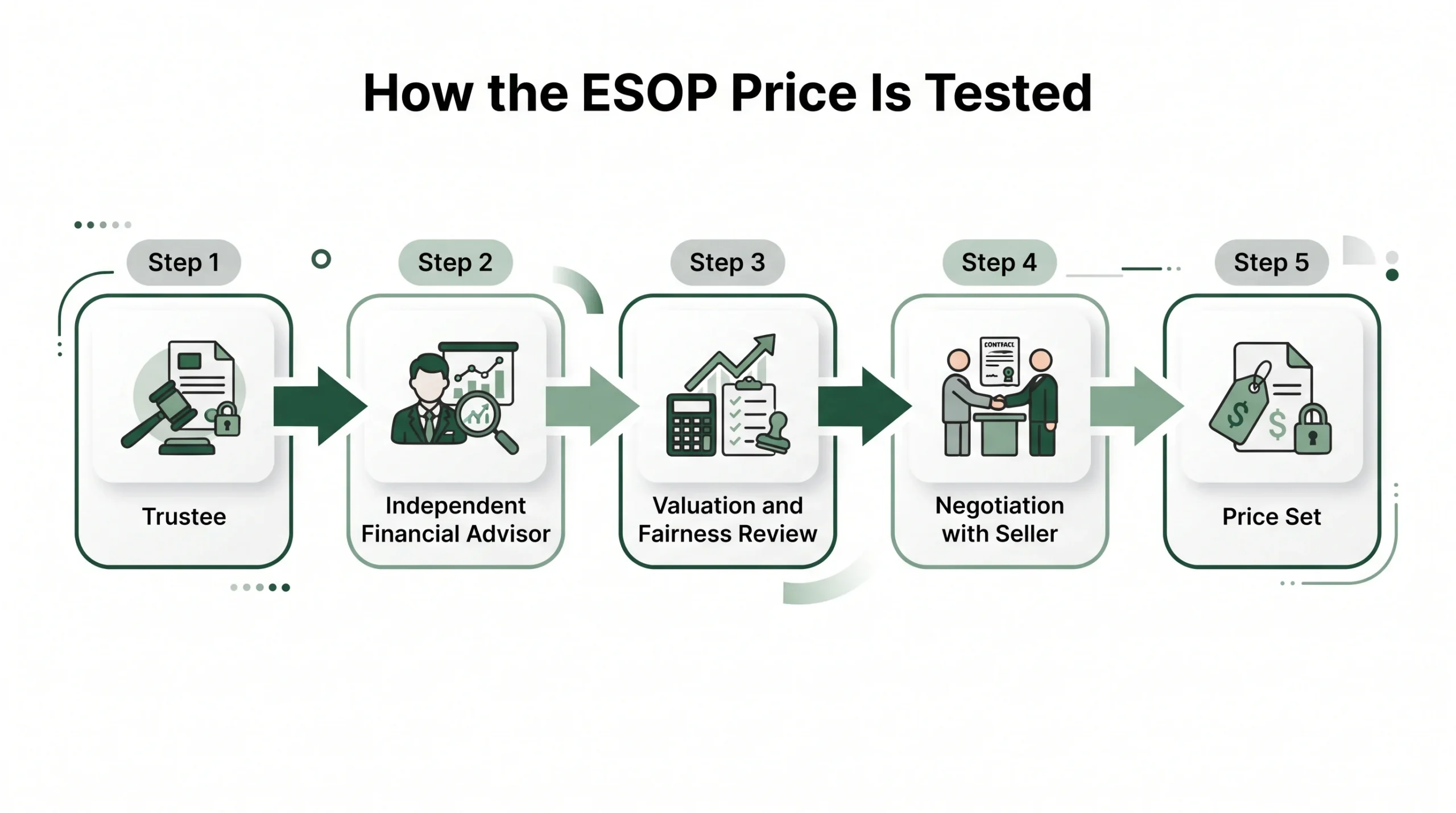
The trustee does not set that value alone. It hires its own independent financial advisor, a valuation firm separate from the seller and the seller’s advisors. The advisor determines fair market value, then opines that the price is fair to the plan. The trustee then negotiates with the selling shareholder as a buyer would, and signs only if satisfied. This guide walks through who does what, how the price is tested, and how Department of Labor enforcement changed the process.
Sofer Advisors provides independent, defensible valuations for privately held and family-owned businesses nationwide. The firm applies recognized professional standards to complex ownership deals. Its record includes 180+ five-star Google reviews and 11+ expert witness cases. Its senior team holds dual credentials, ABV and ASA, recognized by the IRS, SEC, and FINRA.
Key Takeaways
- The trustee represents the plan: an independent trustee is the ERISA fiduciary who acts for employees in the deal.
- The advisor is separate: the trustee hires its own financial advisor, apart from the seller, to set fair market value.
- Adequate consideration is the cap: the plan must pay no more than fair market value, set in good faith.
- The trustee negotiates: it bargains over price and terms as the buyer, protecting the plan, and signs only when it is not overpaying.
- DOL enforcement raised the bar: settlements set clear expectations for independence, projections, the discount rate, and records.
These points shape a defensible deal. The sections below explain each step in turn.
Who represents the ESOP in a stock transaction?
An independent trustee represents the ESOP in a stock transaction. The plan holds the shares in trust for the employees, and the trustee acts for those participants under ERISA. In most deals, the company appoints an outside institutional trustee, not an inside officer. That choice keeps the buyer side of the table free of conflict.
The trustee carries a fiduciary duty to the plan, not to the seller or management. It must act with care and loyalty and put the participants first. Because a founder or majority owner is often the one selling shares, the deal has a built-in tension. The independent trustee is the check that keeps the price fair. Our guide to the ESOP transaction process covers the owner side of the same deal.
What does the trustee’s independent financial advisor do?
The trustee’s independent financial advisor sets fair market value and opines on the fairness of the price. This advisor is a valuation firm the trustee hires directly. It works for the trustee, stays separate from the seller’s advisors, and has no stake in whether the deal closes. That separation is what makes the opinion credible.
The advisor runs its own due diligence on the business. It reviews the financials, tests management’s projections, and builds a value using the income, market, and asset approaches. It then delivers two things: an opinion of fair market value and a fairness opinion on the price. Sofer Advisors often serves as that independent financial advisor, giving the trustee a report it can stand behind.
How does the fairness and adequate consideration review work?
The fairness and adequate consideration review confirms the plan pays no more than fair market value, reached in good faith. Adequate consideration is the ERISA standard the trustee must meet, and the advisor’s work is how the trustee proves it. When the ESOP buys shares, the review caps the price. When the plan sells shares, it sets a floor. Either way, the plan should never overpay or be underpaid. Our overview of the fair market value standard explains the willing-buyer test behind it.
Good faith is the part that trips up many deals. The standard asks for both a fair number and a sound process behind it. So the advisor documents each judgment, and the trustee questions what drives value most. A fairness opinion caps that work. The table below shows what they test.
| Review area | What is tested | Why it matters |
| Advisor independence | No stake in the deal; hired and overseen by the trustee | A conflicted advisor taints the whole opinion |
| Management projections | Are forecasts supportable and tied to real history | Rosy forecasts inflate value and risk overpayment |
| Discount rate | Does the rate match the risk of the business | A low rate lifts the price; a high rate cuts it |
| Control and marketability | Discounts fit what the plan actually buys | Wrong treatment skews the price up or down |
| Process and records | Documented, arm’s-length steps and clear support | Good faith is proven by the paper trail |
Each row builds toward one question: would a careful, unconflicted buyer pay this price? Independence keeps the number neutral. Grounded projections keep it honest, and a clean record shows good faith.
How is the price negotiated with the selling shareholder?
The price is negotiated by the trustee, acting as the buyer for the plan. This is a real negotiation, not a rubber stamp. The seller wants the highest defensible price. The trustee wants to protect the plan and pay no more than fair market value. The advisor’s value gives the trustee a firm ceiling.
The talks cover more than the number. The trustee weighs the deal terms, any seller note, and how a debt-financed purchase affects the company. If the price sits above the supported value, the trustee pushes back or walks. It signs only when the terms fit adequate consideration. Owners weighing this path can compare options through our transaction advisory work.
How did DOL enforcement reshape the trustee’s process?
Department of Labor enforcement reshaped the process by setting clear expectations for how trustees work. The Department of Labor’s Employee Benefits Security Administration brought cases where it argued the plan overpaid for stock. Many resolved through consent judgments and settlements. A well-known process agreement became a playbook that many trustees now follow.
Those terms raised the bar on trustee independence, on how the advisor is chosen and overseen, and on the scrutiny of projections and the discount rate. They stressed documentation and an arm’s-length negotiation. One point matters for owners: the Department of Labor’s adequate consideration regulation remains proposed and is not final as of 2026. Because these are legal duties, owners and trustees should consult ERISA counsel rather than treat any article as advice. Groups like The ESOP Association and the National Center for Employee Ownership track how the standards develop.
Which financial advisor fits an ESOP trustee engagement?
An ESOP trustee usually chooses among independent valuation firms, large advisory practices, and generalist accountants. All can produce a number, but trustee-side work rewards independence and a defensible process. Large firms such as Alvarez & Marsal, Stout, and Kroll serve the biggest plans. Middle-market deals often want senior attention and a report tuned to DOL review. The table compares the options.
| Provider type | Service focus | Fit for a trustee engagement |
| Sofer Advisors | Independent value and fairness opinion | Strong; senior-level work sized for the middle market |
| Large advisory firm | Enterprise plans and complex deals | Good for the largest plans; higher cost and layers |
| Generalist accountant | Tax and compliance filings | Limited; rarely built for DOL-grade valuation |
Independence is the deciding factor. The trustee hires the advisor, and that advisor must have no stake in the price. This follows The Sofer Difference, a four-phase method of Discovery, Diligence, Analysis, and Delivery, with a Heart of a Teacher approach that keeps the trustee informed. Sofer Advisors keeps the valuation function separate from any deal role and applies USPAP and AICPA valuation standards. That gives the trustee a report it can defend and employees a price they can trust.
The questions below cover what trustees and owners ask most.
Frequently Asked Questions
Who is typically the trustee of an ESOP?
The trustee is often an independent institutional trustee appointed for the transaction, rather than a company officer. This outside trustee is the ERISA fiduciary that represents the plan and its participants. For a one-time sale of stock to the plan, companies commonly name a professional trustee to keep the buyer side free of conflict. A conflicted insider on both sides of the deal is exactly what the standard tries to prevent.
What does the ESOP trustee do in a valuation?
The trustee hires and oversees the independent financial advisor, then reviews and accepts the value the plan will use. It questions the advisor on the parts that drive value most, such as the projections and the discount rate. The trustee does not perform the appraisal itself. Instead, it makes sure the work is independent, supportable, and reached in good faith, then relies on it to meet its fiduciary duty to the plan.
What is a trustee’s independent financial advisor?
A trustee’s independent financial advisor is a valuation firm the trustee hires to set fair market value and opine on fairness. It works only for the trustee, stays separate from the seller and the seller’s advisors, and has no stake in whether the deal closes. The advisor runs due diligence, builds the value, and delivers a fairness opinion. That independence is what lets the trustee show the price was tested at arm’s length.
What is adequate consideration in an ESOP transaction?
Adequate consideration is fair market value determined in good faith, the price the plan must respect when it buys or sells company stock. ERISA section 3(18) sets the standard, and the Department of Labor enforces it. In practice, it means both a fair number and a sound process behind that number. When the ESOP buys shares, the plan should never pay more than they are worth, and a documented, arm’s-length process supports that conclusion.
How is the price negotiated in an ESOP sale?
The trustee negotiates the price as the buyer for the plan, using the advisor’s value as a ceiling. The seller seeks the highest defensible price, while the trustee protects the plan and holds the line at fair market value. The talks also cover deal terms, any seller note, and how a debt-financed purchase affects the company. If the seller’s price sits above supported value, the trustee pushes back or declines to sign.
What DOL enforcement changed the trustee’s process?
The Department of Labor brought cases arguing that plans overpaid for stock, and many resolved through consent judgments and settlements. A widely followed process agreement set expectations for trustee independence, advisor selection and oversight, scrutiny of projections and the discount rate, documentation, and arm’s-length negotiation. Many trustees now treat those terms as a practical standard. The Department’s adequate consideration regulation remains proposed and is not final as of 2026, so ERISA counsel should guide any deal.
Is a valuation report required for an ESOP?
Yes, an independent valuation is required for an ESOP that holds stock with no public market. ERISA calls for an independent appraisal for each transaction and at least once a year for an ongoing plan. In a transaction, the trustee’s financial advisor prepares the report that supports the price. Without a current, independent value, the trustee could not show the plan paid adequate consideration or credit employee accounts fairly.
What is the ESOP 25% rule?
The ESOP 25% rule refers to the IRS limit on how much a company can deduct for contributions to the plan, generally up to 25% of eligible participant payroll each year under Internal Revenue Code section 404. Debt-financed ESOPs have added rules for deducting loan payments. The limit shapes how quickly a plan is funded, but it is a tax matter. It is separate from the fair market value the trustee’s advisor sets.
How much does an ESOP trustee’s financial advisor cost?
An ESOP valuation and fairness engagement from Sofer Advisors runs $15,000 to $35,000, with a typical timeline of six to ten weeks. The fee depends on company size, deal complexity, and the scope of the fairness review. A transaction with layered terms or a debt-financed structure takes more work than a simple deal. For a quote tied to your plan, request an ESOP valuation estimate with your financials.
Related Case Studies
- ESOP Transaction Process Steps: Complete Guide for Business Owners
- ESOP Feasibility Study: Is Your Business a Good Candidate?
- ESOP Tax Benefits: What Owners and Employees Gain
Executive Summary
In an ESOP transaction, an independent trustee represents the plan as the ERISA fiduciary for employees. The trustee hires its own financial advisor, separate from the seller, to set fair market value and opine that the price is fair. The core test is adequate consideration: the plan must pay no more than fair market value, reached in good faith. The trustee then negotiates with the seller and signs only if the plan is not overpaying. Department of Labor enforcement raised the bar on independence, projections, the discount rate, and documentation, while the regulation stays proposed. This trustee-side review, priced at $15,000 to $35,000, is what makes the price defensible. Sofer Advisors delivers valuations and fairness reviews built for that scrutiny.
What Should You Do Next?
Appoint an independent trustee for the transaction and let it hire its own financial advisor, separate from your deal team. Keep management’s projections supportable, and save the records that show an arm’s-length process. Because these are fiduciary and legal duties, work with ERISA counsel on the trustee’s obligations before you sign anything.
David Hern CPA ABV ASA, founder of Sofer Advisors, provides independent, defensible valuations and fairness reviews built for DOL scrutiny. Schedule a consultation to discuss your plan.
People Also Read
- Management Buyout Process: Steps, Financing and Valuation
- How to Transfer Business Ownership: Options and Tax Impact
About the Author
This guide was prepared by David Hern CPA ABV ASA, founder of Sofer Advisors, a business valuation firm headquartered in Atlanta, GA serving clients across the United States. David holds dual accreditations as an Accredited Senior Appraiser (ASA) and is Accredited in Business Valuation (ABV), credentials recognized by the IRS, SEC, and FINRA. He also holds the Certified Exit Planning Advisor (CEPA) designation. With 15+ years of valuation experience, David has served as an expert witness in 11+ cases across multiple jurisdictions and built Sofer Advisors into an Inc. 5000-recognized firm with 180+ five-star Google reviews. Its full W2 employee team maintains subscriptions to all major valuation databases and operates under a next business day response policy.
For professional business valuation services, visit soferadvisors.com/about-us/ or contact Sofer Advisors at soferadvisors.com/contact-us/.
Disclaimer: This content is for informational purposes only and does not constitute professional valuation advice. Business valuation conclusions depend on specific facts and circumstances. Contact Sofer Advisors for guidance regarding your specific situation.









