


Last Updated: September 2026
The double dip in a divorce business valuation is the practice of counting the same business earnings two times. First, the business is valued as a marital asset by capitalizing its earnings. Then those same earnings are counted again as income available to pay spousal or child support. The owner-spouse can end up giving up value for the same dollar twice, once in the property split and once in the support order.
This matters most for owner-run companies where value comes from the owner’s future work, not from buildings or equipment. In those cases, the line between a fair salary and a return on the business is easy to blur, and one spouse can be paid twice. How courts treat this varies by state, so the way an appraiser builds the numbers can shape the outcome.
Sofer Advisors provides neutral, third-party valuations for family law matters and other disputes. Its senior team applies recognized appraisal standards and has given expert witness testimony in 11+ cases across multiple jurisdictions, backed by 180+ five-star Google reviews.
Key Takeaways
- One dollar, two claims: the double dip counts the same earnings as a divisible asset and again as income for support.
- Owner-run risk: the problem is sharpest when value rests on the owner’s future labor rather than hard assets.
- The fix is a clean split: separate a market salary for the owner’s work from the return on the business.
- Goodwill type matters: some states keep personal goodwill out of the marital estate, which changes the math.
- Treatment varies: some jurisdictions limit the double dip and others permit it, so counsel guides the local rule.
These points frame a single question: is the same money being used in two places? The sections below show how the double dip forms and how an appraiser stops it.
What is the double dip in a divorce business valuation?
The double dip is counting the same business earnings twice in one divorce case. An appraiser values the business as a marital asset, often by capitalizing its earnings into a present value. That value goes into the property split. Later, a court looks at the owner’s cash flow to set spousal or child support, and it uses the same earnings again. The non-owner spouse effectively receives the value of those earnings two times.
Think of a consulting firm worth most of its value because of what the owner earns each year. If the appraiser turns those earnings into an asset for the split, the earnings have already been paid out once. The same dollar cannot fairly do both jobs. This is why the double dip draws attention in owner-run businesses, where future earnings drive the number.
How does the same income get counted twice?
The income gets counted twice because the asset value and the support figure both come from earnings. The income approach capitalizes the owner’s excess earnings to set the business value. Those excess earnings are the profit left after a fair salary. When a court then treats the owner’s full earnings as income for support, the same excess earnings appear in both the asset and the support streams.
The overlap is easy to miss. In the property split, earnings are frozen into a lump-sum asset value. In the support order, earnings are treated as an ongoing paycheck. On paper these look like two different things, but they draw from one source of cash. A careful appraiser flags where the two streams touch so the court can decide how to handle it.
How does an appraiser separate compensation from business return?
An appraiser prevents the double dip by splitting one dollar of earnings into two parts. The first part is a reasonable salary for the owner’s labor, which belongs in the support and income analysis. The second part is the return on the business enterprise and its goodwill, which belongs in the asset value. When these two parts are kept apart, the same dollar is not counted in both places.
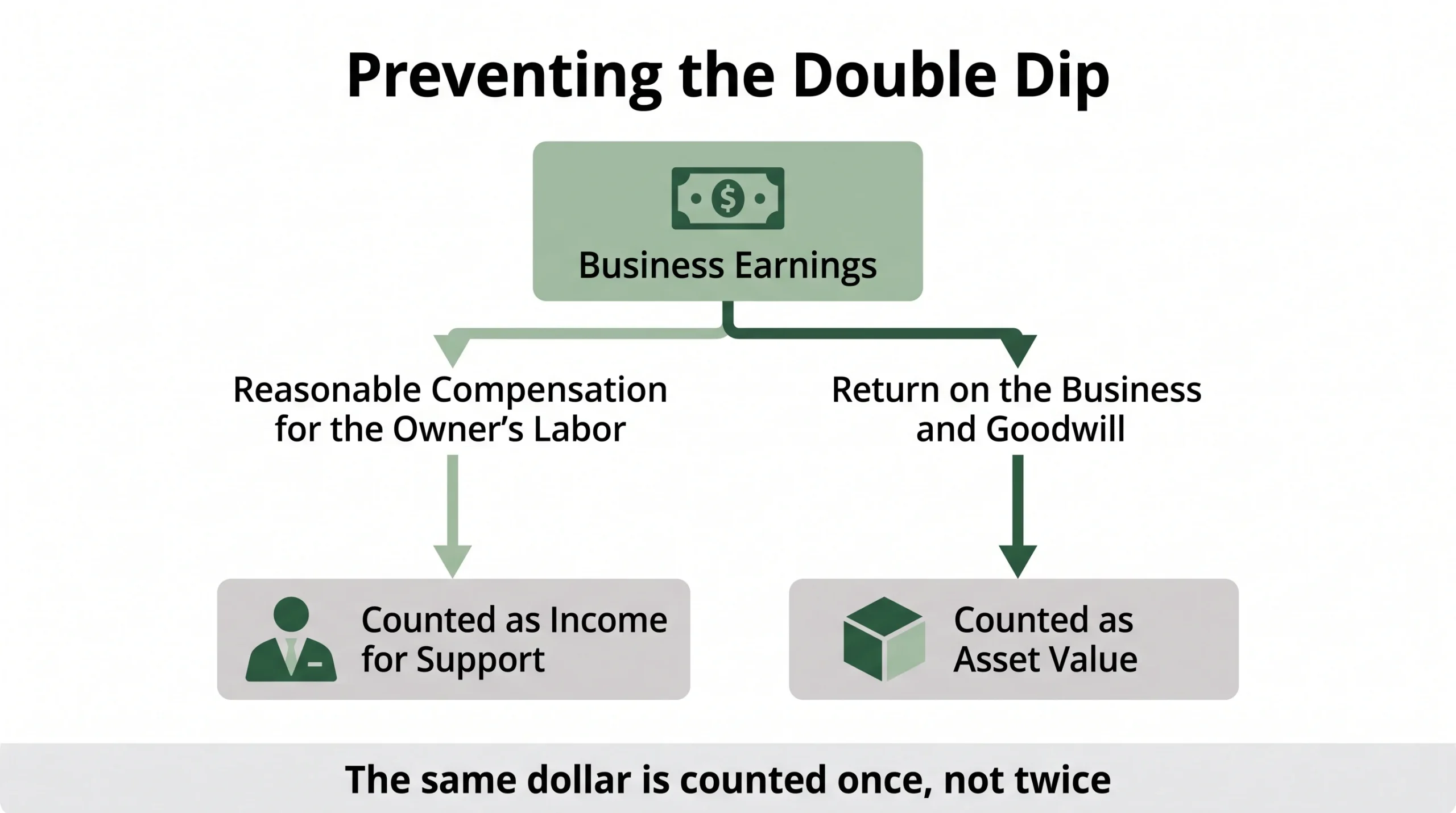
The tools for this split are reasonable compensation analysis and careful normalization. Reasonable compensation is the market pay a replacement would earn to do the owner’s job. The IRS publishes a reasonable compensation job aid on its valuation of assets page. Normalization then adjusts earnings for owner perks and one-time items so the profit is clean. The table shows how the pieces land.
| Earnings component | Where it belongs | Why |
| Reasonable salary for the owner’s work | Support and income analysis | It pays for labor going forward, not the business itself |
| Return on the enterprise and its goodwill | Marital asset value | It is the value of the business, already split as property |
| The same dollar placed in both | Neither; it must be removed | Counting it twice creates the double dip |
The split is a matter of judgment backed by data, not a fixed formula. An appraiser tests the salary against wage surveys and market rates for the role, and the remaining profit funds the asset value. Sofer Advisors builds this separation into every family law engagement so the support number and the asset number rest on the same clean set of earnings, without overlap.
Do all states bar the double dip?
No, states do not all treat the double dip the same way. Some jurisdictions restrict or bar counting the same earnings as both an asset and support income, while others permit it. The rule can also differ by the type of business and the facts of the case. Because the law varies and changes, the local rule is a question for a family law attorney, not a fixed national standard.
What an appraiser can do is stay neutral and transparent. A strong report shows the earnings, the reasonable salary, and the return on the business as separate figures. That way the court and both attorneys can apply the state’s rule to clear numbers. Court opinions and standards from groups like NACVA guide how experts present this issue. This article does not give legal advice, and the treatment of the double dip should always be confirmed with counsel in the relevant state.
How does personal goodwill change the picture?
Personal goodwill can change the picture because some states leave it out of the marital estate. Goodwill splits into two kinds. Enterprise goodwill is transferable value that stays with the business, such as its name, systems, and location. Personal goodwill is tied to the owner alone, such as personal skill and client relationships that would leave if the owner left.
Where a state excludes personal goodwill from the marital estate, keeping it in the asset value overstates the divisible property. It can also feed the double dip, because personal goodwill often reflects the very future earnings that support draws from. Separating personal goodwill from enterprise goodwill helps the court apply the right rule and avoid paying the owner-spouse twice for the same talent.
Which valuation provider should you choose for a divorce case?
The best choice for a divorce case is an independent valuation firm with courtroom experience and no stake in the outcome. Owners and attorneys can pick among independent firms, large advisory shops, and solo appraisers. Large firms like Alvarez & Marsal, Stout, and Kroll serve the biggest matters. The gap between the options is neutrality, cost, and courtroom experience. The table compares the common paths.
| Provider type | Service focus | Fit for divorce work |
| Independent valuation firm | Neutral, defensible opinion of value | Strong; built for court and testimony |
| Large advisory firm | Enterprise deals and consulting | Capable but often priced for big cases |
| Solo appraiser | Small local engagements | Varies; may lack a full team and databases |
The Sofer Difference is a set method of Discovery, Diligence, Analysis, and Delivery that keeps each engagement consistent and reviewable under standards like USPAP. That structure, paired with a Heart of a Teacher approach that explains the numbers in plain terms, helps a judge and both attorneys follow the logic. For contested matters, Sofer Advisors handles the work through its conflict resolution service, so the same clean earnings drive both the asset and the income analysis.
The double dip is a numbers problem with a legal frame. The questions below cover what owners and attorneys ask.
Frequently Asked Questions
What is the double dip in a divorce?
The double dip is counting the same business earnings twice in a divorce. The business is valued as a marital asset using its earnings, and then those same earnings are counted again as income to set spousal or child support. The owner-spouse can pay for the same dollar in both the property split and the support order, which is why appraisers separate the two streams.
How do you value a business for a divorce?
Valuing a business for a divorce usually starts with the income approach, which turns normalized earnings into a present value. An appraiser first sets a reasonable salary for the owner’s work, then measures the return on the business. Market and asset methods can support the result. The aim is a neutral, defensible number that both attorneys and the court can rely on.
Is my spouse entitled to half of my business in a divorce?
It depends on your state and the facts of your case. Community property states and equitable distribution states divide marital property in different ways, and how a business is classified matters. A half share is not automatic. Because the rules vary and turn on specific facts, this is a question for a family law attorney in your state, not a fixed national answer.
How much is a business worth with $500,000 in sales?
Sales alone do not set value; earnings and risk do. A business with $500,000 in sales could be worth very little or a large multiple of profit, depending on margins, growth, and how much value depends on the owner. An appraiser normalizes the earnings and applies a supported multiple or discount rate to reach a defensible figure for the specific business.
Is a business worth 3 times profit?
Three times profit is a rough rule of thumb, not a reliable value. Real multiples move with industry, size, growth, and risk, and they depend on which profit measure is used. Two firms with the same profit can be worth very different amounts. A supported valuation studies comparable data and the company’s own facts instead of relying on a single multiple.
Which states bar double dipping?
Treatment varies, so there is no single national list. Some jurisdictions restrict counting the same earnings as both an asset and support income, and others permit it. The outcome can also depend on the business type and the case facts. Confirm the current rule in your state with a family law attorney, since court decisions and statutes change over time.
What is the difference between enterprise and personal goodwill?
Enterprise goodwill is transferable value that stays with the business, such as its name, systems, and location. Personal goodwill is tied to the owner alone, such as personal skill and client loyalty that would leave if the owner left. The split matters in divorce because some states exclude personal goodwill from the marital estate, which changes what is divided.
How does an appraiser prevent the double dip?
An appraiser prevents the double dip by separating a reasonable salary for the owner’s labor from the return on the business. The salary belongs in the support and income analysis, and the return belongs in the asset value. Careful normalization and reasonable compensation analysis keep the same dollar from landing in both places, giving the court clean, separate figures to apply.
How much does a divorce business valuation cost?
A divorce business valuation from Sofer Advisors runs $7,500 to $25,000 for a standard engagement, with most matters completed in four to eight weeks. Expert witness testimony, if the case needs it, is billed separately at an hourly rate. Cost depends on the size of the business and the depth of the analysis. To get a quote for your matter, request a consultation with your details.
Related Case Studies
- Divorce Business Valuation Georgia: What Business Owners Need to Know
- Business Divorce in Georgia: Fair Distribution and Valuation
- Expert Witness Business Valuation Georgia: What Attorneys Need to Know
Executive Summary
The double dip in a divorce business valuation counts the same earnings twice, once as a marital asset and again as income for spousal or child support. The risk is highest for owner-run companies whose value rests on future labor. The fix is a clean split: set a reasonable salary for the owner’s work, which belongs in the support analysis, and measure the return on the business, which belongs in the asset value. Personal goodwill may fall outside the marital estate in some states, and treatment of the double dip varies by jurisdiction. Reasonable compensation analysis and careful normalization keep one dollar from being counted in both streams.
What Should You Do Next?
Gather three years of financial statements and tax returns, owner compensation records, and any wage data for the owner’s role, then ask your appraiser to show the reasonable salary and the business return as separate figures. Confirm your state’s rule on the double dip and on personal goodwill with your family law attorney before you negotiate. Getting a neutral valuation early gives both sides clean numbers and narrows the fight to the facts that matter.
David Hern CPA ABV ASA, founder of Sofer Advisors, provides neutral, defensible valuations for family law and dispute matters. Schedule a consultation to discuss your situation.
People Also Read
- Personal Goodwill vs Enterprise Goodwill: Tax & Divorce Guide
- Forensic Accounting in Business Valuation: When You Need Both
About the Author
This guide was prepared by David Hern CPA ABV ASA, founder of Sofer Advisors, a business valuation firm headquartered in Atlanta, GA serving clients across the United States. David holds dual accreditations as an Accredited Senior Appraiser (ASA) and is Accredited in Business Valuation (ABV), credentials recognized by the IRS, SEC, and FINRA. He also holds the Certified Exit Planning Advisor (CEPA) designation. With 15+ years of valuation experience, David has served as an expert witness in 11+ cases across multiple jurisdictions and built Sofer Advisors into an Inc. 5000-recognized firm with 180+ five-star Google reviews. Its full W2 employee team maintains subscriptions to all major valuation databases and operates under a next business day response policy.
For professional business valuation services, visit soferadvisors.com/about-us/ or contact Sofer Advisors at soferadvisors.com/contact-us/.
Disclaimer: This content is for informational purposes only and does not constitute professional valuation advice. Business valuation conclusions depend on specific facts and circumstances. Contact Sofer Advisors for guidance regarding your specific situation.









