


Last Updated: October 2026
Self storage trades on rate per square foot and the lease-up curve, not on building value. Two facilities can share the same slab, roof, and door count and still be worth very different sums. The one that charges more per foot and keeps its units full earns more income. Income is what a buyer pays for.
The team at Sofer Advisors values storage facilities for owners, lenders, and buyers, backed by Inc. 5000 recognition in both 2024 and 2025. The job is to turn a rent roll into a defensible number. That means reading occupancy and street rates the way the market reads them, then pricing the income they produce.
This guide explains the value drivers that matter, how occupancy and rates build net operating income, and why the income approach leads. It also covers ancillary revenue, depreciation and cost segregation, and where to find reliable market data.
Key Takeaways
- Income sets the price: value equals net operating income, or NOI, divided by a market cap rate, so rents and occupancy matter far more than the cost of the steel.
- Two kinds of occupancy: physical occupancy counts rented units, while economic occupancy counts the rent actually collected after discounts and delinquencies.
- Rate per square foot is the lever: a small lift in street rate flows almost straight to NOI, because operating costs barely move.
- Lease-up matters for new builds: a facility still filling up earns less, so its value must discount the ramp to stabilized occupancy.
- Ancillary income counts: tenant insurance, truck rental, and fees add revenue that lifts value when it repeats.
Each driver ties back to one number, the NOI.
Why Is Self Storage Facility Valuation Important to Understand?
A self storage valuation decides what the asset is worth for a sale, a loan, a partner buyout, or an estate. Get it wrong and the cost is real. Price it too high and a lender cuts the loan. Price it too low and the owner leaves money on the table. The value also drives property tax appeals and insurance limits. Because storage income shifts fast with local supply, the number has to rest on current rents and real occupancy, not on what the building cost to put up.
What Drives the Value of a Self Storage Facility?
The value factors fall into two groups. Physical factors are the site, the unit mix, climate control, security, and visibility from the road. Economic factors are the ones a buyer pays for: occupancy, street rates, expense ratios, and the trend in each.
Occupancy comes in two forms. Physical occupancy is the share of units rented. Economic occupancy is the share of potential rent actually collected. The gap between them tells a buyer how much the current owner leans on discounts and free months to keep the sign full. A facility at 95 percent physical occupancy but 78 percent economic occupancy is not as strong as it looks.
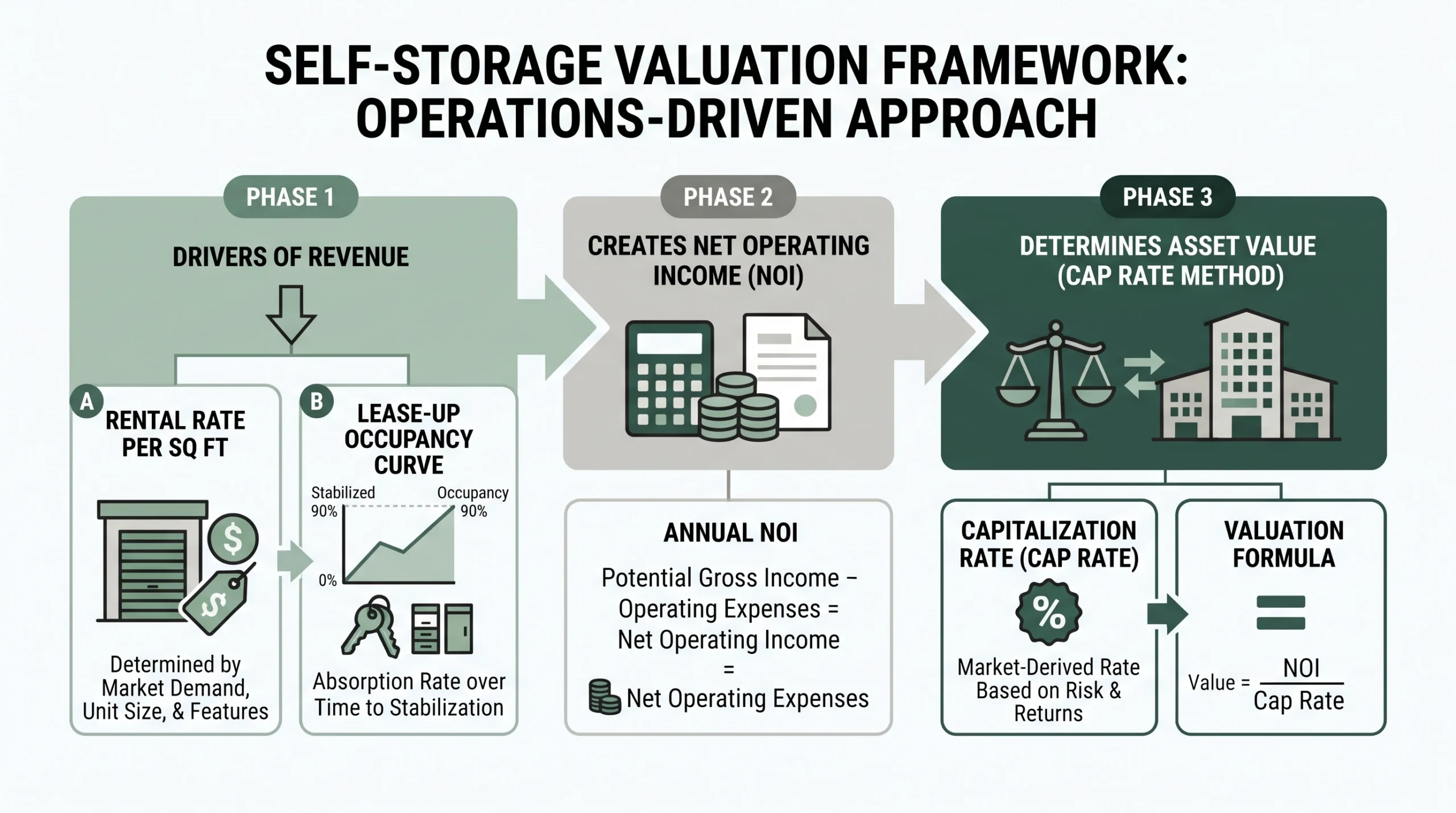
Rate per square foot is the pricing gauge. It equals the monthly street rent divided by the unit size. For a new build, the lease-up curve is its own factor. A facility fills from zero to stabilized occupancy over three to four years, and value during that ramp sits below a stabilized number.
How Do Occupancy and Street Rates Drive Net Operating Income?
Net operating income is annual revenue minus operating expenses, before debt service and income tax. On the revenue side, occupancy and street rates do almost all the work. Multiply rented square feet by the rate per foot, add ancillary income, and subtract the rent lost to discounts and bad debt. That is economic revenue.
Expenses in storage are light. Property taxes, insurance, payroll, marketing, and repairs usually run 30 to 40 percent of revenue. Because that base barely moves when rents rise, extra rate drops almost straight to NOI. A ten cent lift per square foot across 60,000 rented feet adds about $72,000 of income a year, and nearly all of it survives to the bottom line. Small rate changes swing value hard.
Why Is the Income Approach the Primary Method?
The income approach leads because storage is an income asset. You take the stabilized NOI and divide it by a market cap rate drawn from recent sales of similar facilities. A site with $600,000 of NOI at a 6.5 percent cap rate is worth about $9.2 million. Cap rates for stabilized storage usually run between 5.5 and 7.5 percent, with the best metro facilities at the low end.
The other two approaches play a supporting role. The cost approach estimates what it would take to build the facility today, less depreciation, and sets a floor for a newer site. The sales comparison approach checks the income result against actual price per square foot in closed deals nearby. When all three point the same way, the conclusion holds up under review. To see how this fits a deal, review Sofer Advisors’ transactional advisory valuation services.
How Do Management and Ancillary Revenue Affect Value?
Management quality shows up in the numbers. A facility run with dynamic pricing, online rentals, and firm collections posts higher economic occupancy and fewer write-offs. A buyer pays for that income, so a well-run site earns a lower cap rate and a higher price. Weak management is often an opportunity, since a new operator can raise rates and tighten expenses.
Ancillary revenue adds up. Tenant insurance or protection plans, administrative and late fees, retail sales of locks and boxes, and truck rental can add 5 to 15 percent to revenue. The costs attached are small, so most of it reaches NOI. The key is to separate recurring ancillary income from one-time items, because only the repeatable part gets capitalized into value.
How Do Depreciation and Cost Segregation Fit In?
Depreciation does not change NOI, but it shapes the after-tax return a buyer models. A cost segregation study breaks a facility into parts that depreciate faster than the 39-year building life, such as fencing, paving, security systems, and signage. That pulls deductions forward and improves early cash flow. Owners claim the deductions on IRS Form 4562.
When a facility sells as an asset deal, buyer and seller must allocate the price across asset classes, which sets the buyer’s depreciation basis and the seller’s gain. That allocation follows the rules in IRC Section 1060. A clean valuation supports the allocation, so the tax side of the deal matches the price both parties agreed to.
Where Does Reliable Market Data Come From?
A credible value rests on current, local evidence. For cap rates and sale prices, transaction databases such as DealStats record closed deals with their terms. Rent and occupancy trends come from storage sector research and public REIT filings, which report same-store rate and occupancy each quarter.
Large national advisory firms such as Alvarez & Marsal, Stout, and Kroll serve big institutional portfolios with broad teams. Sofer Advisors focuses on defensible, partner-led valuations for single facilities and smaller portfolios, with 180+ five-star Google reviews and expert witness testimony in 11+ cases behind its reports. The point of any source is the same: tie the cap rate and rents to the market the facility competes in.
Who Values a Self Storage Facility, and How Do the Options Compare?
Owners pick a partner based on the size of the asset, the audit or lender exposure, and the budget. The table below sets out the common options.
| Provider | Typical role | Best for |
|---|---|---|
| Specialized valuation firm (e.g. Sofer Advisors) | Builds NOI from the rent roll and sets the cap rate from comparable sales | Single facilities and smaller portfolios needing a defensible report |
| Large national advisory firm | Portfolio valuation and advisory at institutional scale | Large owners and funds with many sites across markets |
| Commercial real estate broker | Offers a price opinion to list and market the asset | Owners ready to sell who want a quick market read, not a signed opinion |
Sofer Advisors runs each engagement through a four-phase process it calls The Sofer Difference, moving from Discovery to Diligence to Analysis to Delivery. That structure keeps every number tied to the rent roll and the comparable sales behind it. It reflects the Heart of a Teacher approach, which means explaining the reasoning behind a value rather than just handing over a figure. For a facility that stands up to a lender or a court, an independent valuation supplies both the number and the trail of evidence behind it.
Frequently Asked Questions
How do you calculate the value of a self storage facility?
The main method is the income approach. You take the facility’s net operating income, or NOI, and divide it by a market cap rate. NOI is annual rental and ancillary revenue minus operating costs, before debt and taxes. A facility with $600,000 of NOI at a 6.5 percent cap rate is worth about $9.2 million. Sofer Advisors builds the NOI from the rent roll and checks it against sold comparable facilities nearby.
How profitable is a self storage facility?
Self storage runs high margins because staffing and upkeep are light. A stabilized facility often posts a net operating income margin between 60 and 70 percent of revenue, well above most retail or hospitality assets. Profit depends on occupancy, street rates, and tight expense control. New builds earn little until lease-up fills the units. Sofer Advisors normalizes the income statement so owners see the true, repeatable margin behind the headline revenue.
What is a good cap rate for a self storage facility?
Cap rates for stabilized self storage generally fall between 5.5 and 7.5 percent, depending on location, size, and tenant quality. A lower cap rate means a higher price for each dollar of income. Class A facilities in dense metros trade at the low end, while rural single-story sites sit higher. Sofer Advisors selects the cap rate from recent sales of similar facilities, not a national average, so the value reflects the local market.
What do self storage facilities sell for?
Price equals net operating income divided by the cap rate, so the sale figure tracks income, not square feet. A site with $400,000 of NOI at a 6 percent cap rate sells for roughly $6.7 million. Small single-facility deals often range from $1 million to $10 million, while portfolios run far higher. Sofer Advisors ties each conclusion to the rent roll and comparable sales, so buyers and sellers price from the same evidence.
What is the difference between physical and economic occupancy?
Physical occupancy is the share of units that are rented. Economic occupancy is the share of potential rent the facility actually collects. The two split apart when discounts, promotions, free months, and delinquencies pull cash below the asking rate. A site can show 92 percent physical occupancy but only 80 percent economic occupancy. Sofer Advisors measures both, because economic occupancy is the figure that drives net operating income and the final value.
How does rate per square foot affect value?
Rate per square foot is the street rent divided by unit size, and it is the clearest gauge of pricing power. Raising the average rate flows almost straight to net operating income, since costs barely move. A ten cent lift per square foot across 60,000 rented feet adds about $72,000 of annual income. Sofer Advisors compares a facility’s rates to nearby competitors to judge whether rents can rise or already sit at the ceiling.
What is the lease-up curve for a new self storage facility?
The lease-up curve is the path a new facility follows from empty to stabilized occupancy, usually over three to four years. Income is thin at the start, then climbs as units fill and concessions fade. A valuation of a new build must discount that ramp, not assume a full facility on day one. Sofer Advisors models the curve month by month, so the value reflects real lease-up risk rather than a stabilized guess.
Does ancillary revenue like insurance and truck rental add value?
Yes. Tenant insurance, administrative fees, late charges, retail sales, and truck rental can add 5 to 15 percent to revenue, and because the costs are small, most of it reaches net operating income. Since value is NOI divided by a cap rate, that extra income lifts the price directly. Sofer Advisors separates recurring ancillary income from one-time items, so the figure a buyer capitalizes is the part that actually repeats each year.
How much does a self storage facility valuation cost?
Most self storage valuations run from $5,000 to $15,000 and take about two to four weeks, depending on facility size, portfolio count, and the deadline. The fee covers the rent roll analysis, cap rate study, and comparable sales research behind the conclusion. A flat price is quoted before the work starts, so there are no surprises. Sofer Advisors scopes each engagement first, then quotes a fixed fee. Request a free estimate for your facility.
Related Case Studies
- How to Value a Self-Storage Facility: Cap Rates and Operations
- How to Value an Assisted Living Facility: Census, Cap Rates
- Cost Approach vs Income Approach: Complete Guide
Executive Summary
A self storage facility is worth its net operating income divided by a market cap rate, so rents and occupancy drive the price, not the cost of the building. Read occupancy two ways: physical occupancy counts rented units, and economic occupancy counts the rent actually collected. Rate per square foot is the main lever, since extra rent flows almost straight to NOI. New builds need a lease-up discount until they stabilize. Ancillary revenue from insurance, fees, and truck rental lifts value when it repeats. The income approach leads, with cost and sales comparison in support. The first step is a clean NOI built from the rent roll and a cap rate drawn from real comparable sales.
What Should You Do Next?
Gather the rent roll, the trailing twelve months of income and expenses, the unit mix, and current street rates, since a clean file supports a defensible value. Separate recurring ancillary income from one-time items before you start. This guide was prepared by David Hern CPA ABV ASA, founder of Sofer Advisors, an Inc. 5000 firm specializing in neutral third-party valuations for sales, lending, and estate reporting. Schedule a free consultation to discuss your specific facility.
People Also Read
- What Multiple Do Businesses Sell For? By Industry in 2026
- Boutique Hotel Valuation: How to Value Your Property with ADR, RevPAR, and Key Multiples
About the Author
This guide was prepared by David Hern CPA ABV ASA, founder of Sofer Advisors, a business valuation firm headquartered in Atlanta, GA serving clients across the United States. David holds dual accreditations as an Accredited Senior Appraiser (ASA) and is Accredited in Business Valuation (ABV), credentials recognized by the IRS, SEC, and FINRA. He also holds the Certified Exit Planning Advisor (CEPA) designation. With 15+ years of valuation experience, David has served as an expert witness in 11+ cases across multiple jurisdictions and built Sofer Advisors into an Inc. 5,000-recognized firm with 180+ five-star Google reviews. Its full W2 employee team maintains subscriptions to all major valuation databases and operates under a next business day response policy.
For professional business valuation services, visit soferadvisors.com/about-us/ or contact Sofer Advisors at soferadvisors.com/contact-us/.
This content is for informational purposes only and does not constitute professional valuation advice. Business valuation conclusions depend on specific facts and circumstances. Contact Sofer Advisors for guidance regarding your specific situation.









