


Last Updated: July 2026
An assisted living facility valuation finds the worth of the facility’s business, intangible assets, and real estate. It leans on a review of special revenue streams, the rules the facility must meet, and local demographics. Market data shows the U.S. assisted living sector earns over $98 billion in revenue a year, per IBISWorld.
Setting an accurate value takes a firm grasp of both operational performance and asset quality. Sofer Advisors approaches each engagement with technical precision and transparency. Its analysts bring diverse experience to this sector, supporting 11+ expert-witness cases with court testimony across Georgia, Florida, California, and New Mexico. Beyond court work, it holds a high standard of client service, backed by 180+ five-star Google reviews.
Owners, attorneys, and financial professionals seek these valuations for tax planning, deals, or estate needs. Knowing where operating income meets the rules helps owners decide well during high-stakes events. With a clear, teaching-first process, Sofer Advisors helps clients handle the technical demands of a valuation with confidence.
Key Takeaways
- Separate OpCo and PropCo: value the operating company and the real estate on their own, since each has distinct value drivers.
- Track key metrics: occupancy and revenue per occupied unit signal health, and the private-pay versus Medicaid mix shapes cash flow.
- Apply the right multiples: EBITDA multiples of 4.0x to 6.0x value the business; a cap rate values the property.
- Lead with the income approach: future cash flow projections drive the business value.
- Weigh regulatory risk: licensure and staff-to-resident ratios create real valuation volatility.
These foundations give a baseline for evaluating a specific facility. The sections below cover the operational and financial factors that shape value.
What are the key valuation drivers for ALFs?
The primary drivers are the resident census (occupancy rate), Revenue Per Occupied Unit (REVPOU), and the EBITDA margin. These reflect the cash flow the facility can produce and form the base for the income approach. High occupancy signals strong local demand and good care, while healthy margins show the facility runs well. Analysts also weigh the private-pay versus Medicaid mix, since that split changes how steady the revenue is. Our home health agency guide shows how payer mix moves a multiple.
Beyond core figures, analysts weigh staff retention and property conditions for future risk. A property that needs heavy capital spending to keep compliance or appeal often faces downward pressure. Location quality stays a constant factor in attracting residents. Sofer Advisors examines these variables to see how they affect the cost of capital and future cash flow.
How are valuation multiples determined for facilities?
Multiples reflect steady cash flow and risk, with larger entities valued on EBITDA multiples and smaller, owner-run facilities on Seller’s Discretionary Earnings (SDE). These earnings give a standard base to compare against similar operations in the Business Valuation Resources (BVR / DealStats) database. Owners often see higher multiples when the facility shows strong private-pay demand rather than reliance on government payers.
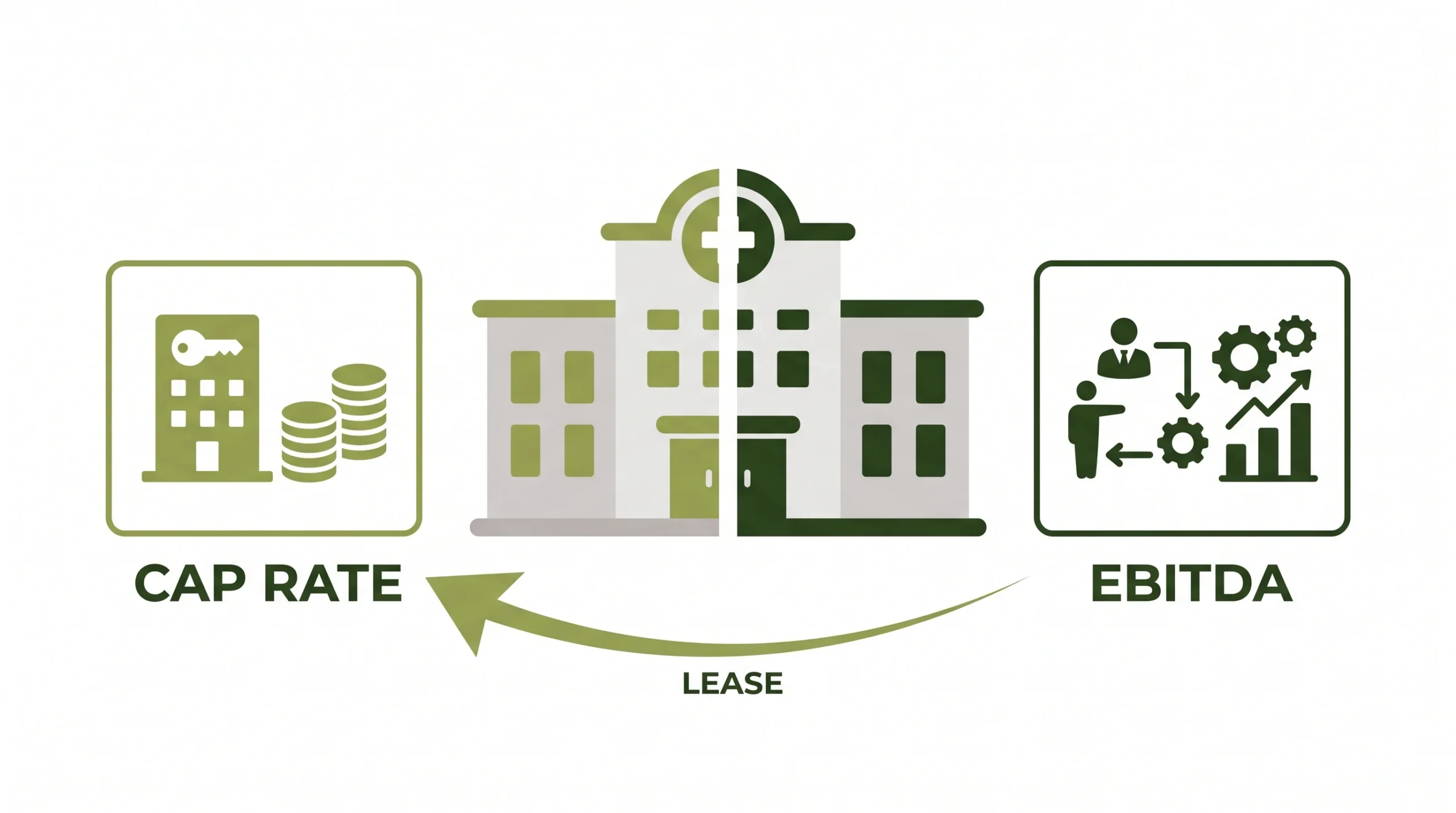
The underlying real estate often needs a separate assessment using a capitalization rate (cap rate), which measures the expected annual return on the property. A high-quality facility presents a detailed quality of earnings report to prove its recurring revenue to buyers. Adjusting for one-time costs or non-operational items is a core step during the analysis. Our healthcare valuation methods guide covers how these fit together.
Which valuation methods are most common?
Analysts primarily use three methods: the income approach, the market approach, and the asset approach. These follow professional standards from bodies like the American Society of Appraisers. Using them together makes sure the final value reflects both past performance and future potential.
The income approach is often weighted most heavily, because it projects future earning power. Within it, the discounted cash flow (DCF) method is the most common choice. It finds the present value of future cash flows, showing what the business might generate over time. Though other models exist, the DCF remains a staple.
The market approach is a real-world check. By analyzing recent sales of similar companies in databases like Business Valuation Resources, appraisers compare the subject firm to actual deals. That keeps the value grounded in current conditions. The asset approach sets a value floor by summing the fair market value of all tangible and intangible assets. It is critical when the business holds significant real estate or liquid capital.
How does real estate impact facility valuation?
Real estate shapes the valuation by requiring a clear split between the property company (PropCo) and the operating company (OpCo). This keeps the risks and returns of the real estate from clouding the value of the business. By splitting the two, an appraiser can better weigh the cash flow against the physical value of the site.
The split works by setting a fair market rent for the facility. That rent becomes a normalized expense on the OpCo income statement, reflecting the real cost of occupancy as if the owner were a third-party landlord. This gives clarity for owners who sell the business and real estate as a package, or who keep the property under a triple net (NNN) lease. Detailed records on property condition and usage help support these figures during a Sofer Advisors analysis.
What regulatory factors influence value?
Rules strongly shape value, since state licensure, Certificate of Need (CON) hurdles, and compliance history decide long-term health. A facility that runs without proper permits loses all worth, so licensure is the base layer of protection. In many states, the Certificate of Need acts as a barrier that limits new rivals and guards the market share of set facilities. Buyers pay a premium for these protected markets, since the barrier guards against a sudden glut of new beds. The key rule-based factors are:
- State licensure and proper permits, the base layer of value
- Certificate of Need hurdles that limit new competition
- Staff-to-resident ratios that govern capacity and labor cost
- A clean compliance history free of health department deficiencies
Staffing ratios drive financial health by setting how many residents a facility can support per shift. If a state raises its minimum staff rule, labor costs rise and margins can shrink overnight. A clean compliance history lowers risk during due diligence. Any gaps found in health department surveys point to future costs, such as more monitoring or lost revenue from an admissions ban.
Sofer Advisors evaluates these risks so the final value reflects both current operations and future liability, following Appraisal Foundation standards throughout. Talk to a Sofer Advisors specialist about how current regulatory trends affect your asset.
What is the due diligence process?
Due diligence is a thorough review of a facility’s financial, operational, and regulatory records to verify seller claims and surface risks. This work lets a buyer decide on accurate data, not estimates. During it, professionals run a rigorous financial statement analysis to find hidden liabilities or revenue quality issues.
The Sofer Difference guides this through its Diligence and Analysis phases. For a healthcare facility, that means a deep review of occupancy and payer mix trends, which often dictate long-term margins. Reviewing staff turnover data shows the stability of the workforce and future recruiting costs. Examiners check compliance with state and local rules to avoid a legal burden after closing. This review reduces surprises by confirming the operational health of the target before the deal closes.
Which valuation provider is best for an ALF?
The right provider matches your entity’s size and the scrutiny the report will face. National firms like Alvarez & Marsal, Stout, and Kroll handle the largest, most complex deals, while a solo practitioner suits simple, low-complexity work. A specialist middle-market firm fits owners who need a defensible report for tax, litigation, or reporting. The table below compares the options.
| Provider type | Typical engagement | Best for |
| Sofer Advisors | $1M to $100M+ revenue; tax, deals, litigation, reporting | Middle-market ALFs needing a defensible, compliant report |
| Large national firm | $100M to $1B+ revenue; complex transactions | Public companies and multibillion-dollar structures |
| Solo practitioner | Under $5M revenue; SDE-based calculations | SBA loans, divorce, or simple estate planning |
These tiers reflect clear differences in scope and technical depth. When comparing options, owners should weigh the scrutiny the report will face from the IRS or auditors. A firm with specialized expertise gives a defensible, detailed report that aligns with strict reporting standards, such as those overseen by AICPA valuation standards. A solo practitioner may meet a simple need, while a larger or more complex entity needs the deeper resources of a firm like Sofer Advisors. Matching the level of service to the actual requirement gives the clarity you need without excess cost.
Assisted living valuation rewards clean census data and the OpCo/PropCo split. The questions below cover what owners ask most.
Frequently Asked Questions
How do you evaluate an assisted living facility?
Start by assessing quality of care, staffing ratios, and compliance history to gauge operational stability. Review occupancy trends and the private-pay versus government-reimbursed mix to understand revenue reliability. Physical asset condition and local market saturation also drive long-term viability. Sofer Advisors runs a comprehensive financial and operational analysis to identify performance risks.
How much do assisted living facility owners make?
Owner earnings vary with facility size, occupancy, and service level, often running 15 to 30 percent of gross revenue. Private-pay markets typically see higher margins than government-reliant ones, reflecting the value of premium care. Sofer Advisors weighs these margins against industry benchmarks to help owners see whether their performance matches market expectations.
What is a good cap rate for an assisted living facility?
A good cap rate reflects the risk and growth potential of the underlying real estate, often falling between 7 and 10 percent in established markets. A lower cap rate suggests high demand and lower risk, while a higher rate signals a need for greater returns to justify the risk. Sofer Advisors applies property-specific assumptions to set a justifiable cap rate for your real estate.
How does census data impact the value of an assisted living facility?
Census, or occupancy, directly sets the revenue base and the facility’s ability to cover fixed costs. A stable, high census signals strong demand, which supports a higher value by showing lower volatility to buyers. Sofer Advisors builds historical and projected occupancy into its models so the final value reflects the true income capacity of the site.
What is the difference between OpCo and PropCo in a facility valuation?
The OpCo, or operating company, holds the business license and runs daily care, while the PropCo owns the real estate. Separating them matters for tax and liability, since each needs its own approach based on its risk profile and asset type. Sofer Advisors values both the operations and the real estate to give an accurate, compliant, and defensible appraisal.
Are EBITDA multiples a reliable way to value an assisted living business?
EBITDA multiples are highly reliable for larger assisted living businesses, because they give a standard way to compare profitability across the industry. The metric normalizes performance by removing non-cash expenses, which helps buyers and lenders. Sofer Advisors selects the right multiple by reviewing current transaction data from databases like Business Valuation Resources to match recent market sales.
What regulatory factors can decrease an assisted living facility’s value?
Value often drops from poor compliance records, higher state-mandated staffing ratios, and the threat of admissions bans. These raise labor costs or limit the ability to generate revenue, which depresses cash flow. Sofer Advisors identifies these risks during diligence, giving clients a clear picture of how rule changes and compliance history affect the price.
What is the typical due diligence process when buying an assisted living facility?
It begins by verifying financial performance through audited statements and reviewing operational logs, including occupancy and staff turnover. Buyers also review all licensure documents and health department survey reports to confirm no legal liabilities. Sofer Advisors supports this phase by normalizing the financials and assessing risks so the final price reflects the true state of the asset.
How much does an assisted living facility valuation from Sofer Advisors cost?
An assisted living valuation from Sofer Advisors runs $10,000 to $30,000, based on its published engagement data, with complex OpCo/PropCo structures reaching the higher end. Cost depends on the scope, the entity structure, and the timeline. For a quote tied to your facility, request a valuation estimate with your financials and census data.
Related Case Studies
- Behavioral Health Practice Valuation: Multiples and Demand
- Medical Spa Valuation: Multiples, Add-Backs, and Buyer Demand
- How to Value an Insurance Agency: Multiples and Methods
Executive Summary
An assisted living valuation splits the operating company from the real estate, because each has distinct value drivers. The OpCo is valued on occupancy, revenue per occupied unit, and EBITDA margin, usually at 4.0x to 6.0x EBITDA, with the income approach weighted most heavily. The PropCo is valued on a cap rate, often 7 to 10%, with a fair market rent normalized onto the OpCo. A strong private-pay mix lifts the multiple above a Medicaid-reliant facility. Licensure, Certificate of Need, staffing ratios, and compliance history drive real regulatory risk. To prepare, gather census and payer-mix trends, three years of financials, licensure records, and health department survey reports.
What Should You Do Next?
Gather census and payer-mix trends, three years of financials, licensure records, and recent health department survey reports, then confirm whether you will sell the property with the business or keep it under a lease. An independent valuation can then split the OpCo and PropCo into a defensible whole. Preparing early shortens the timeline and surfaces any regulatory risk before a buyer does.
David Hern CPA ABV ASA, founder of Sofer Advisors, provides neutral, defensible valuations for senior care and healthcare facilities. Schedule a free consultation to discuss your situation.
People Also Read
- Atlanta Retail Company Valuation Multiples: A 2026 Guide
- How to Value an HVAC or Home Services Business: A Multiples Guide
About the Author
This guide was prepared by David Hern CPA ABV ASA, founder of Sofer Advisors, a business valuation firm headquartered in Atlanta, GA serving clients across the United States. David holds dual accreditations as an Accredited Senior Appraiser (ASA) and is Accredited in Business Valuation (ABV), credentials recognized by the IRS, SEC, and FINRA. He also holds the Certified Exit Planning Advisor (CEPA) designation. With 15+ years of valuation experience, David has served as an expert witness in 11+ cases across multiple jurisdictions and built Sofer Advisors into an Inc. 5000-recognized firm with 180+ five-star Google reviews. Its full W2 employee team maintains subscriptions to all major valuation databases and operates under a next business day response policy.
For professional business valuation services, visit soferadvisors.com/about-us/ or contact Sofer Advisors at soferadvisors.com/contact-us/.
Disclaimer: This content is for informational purposes only and does not constitute professional valuation advice. Business valuation conclusions depend on specific facts and circumstances. Contact Sofer Advisors for guidance regarding your specific situation.









