


Last Updated: September 2026
A Section 754 election is a partnership tax choice that adjusts the inside basis of its assets after a triggering event. It matches the tax basis of partnership property to the price a new partner paid. The change prevents a buyer from paying tax on gains already priced into the interest. It applies when a partner dies or sells an interest. The IRS governs the process under IRC Section 743(b). Once filed with Form 1065, the election binds the partnership for all future years.
Sofer Advisors provides the independent valuation these tax adjustments require. The firm holds 180+ five-star Google reviews and has completed 11+ expert witness cases. Its team pairs deep tax knowledge with disciplined appraisal work. That focus helps each allocation stand up to IRS review.
Owners and their advisors face this election after a partner dies, a sale closes, or property changes hands. The mechanics decide how much tax the new partner saves over time. This guide covers the triggers, the appraisal, and the rules that shape each basis adjustment.
Key Takeaways
- Basis alignment: A 754 election adjusts inside asset basis to match what a new partner paid, under IRC Section 743(b).
- Triggering events: The adjustment applies when a partner dies or sells an interest, not from routine operations.
- Appraisal required: A formal valuation sets the fair market value of each asset so the basis change is allocated correctly.
- Tax benefit: A step-up can raise a partner’s depreciation and amortization deductions when assets have gained value.
- Binding choice: Once made, the election stays for all future years and can force a step-down when an interest sells at a loss.
Each point above ties to a specific tax reporting duty under the Internal Revenue Code. The sections below explain the triggers, the appraisal, and the allocation rules.
What triggers a Section 754 basis adjustment?
A sale or exchange of a partnership interest triggers the adjustment. So does the death of a partner. The election then lets the partnership align its inside asset basis with the buyer’s outside basis under IRC Section 743(b). Without it, the new partner could owe tax on gains already priced into the interest. The event must meet the Internal Revenue Code rules to qualify. The common triggers are:
- A sale or exchange of a partnership interest
- The death of a partner and transfer to an estate or heir
- A distribution of cash or property that shifts basis under Section 734(b)
Outside basis is what a partner paid for a share of the partnership. Inside basis is the partnership’s adjusted tax cost for its assets. A gap opens between the two when a partner buys in at a premium. The election closes that gap for the incoming partner only. The partnership then spreads the difference across specific assets. This keeps the tax records aligned with the real economics of the deal.
Why does a 754 election need a valuation?
A 754 election needs a valuation because the 743(b) adjustment rests on the fair market value of the transferred interest. That value fixes the size of the basis change. The partnership must then spread the change across its assets under IRC Section 755. A third-party appraisal gives that split a defensible, supportable base. IRS guidance in Publication 541 covers the partnership rules that frame this work.
Without a professional opinion of value, partners risk wrong tax reporting and audit trouble. A clear appraisal records why each asset carries the value assigned to it. That record shows the basis change tracks the true economic interest each partner holds. Sofer Advisors builds this file so the numbers hold up. The firm follows fair market value standards and USPAP throughout the engagement.
How is the inside basis step-up calculated?
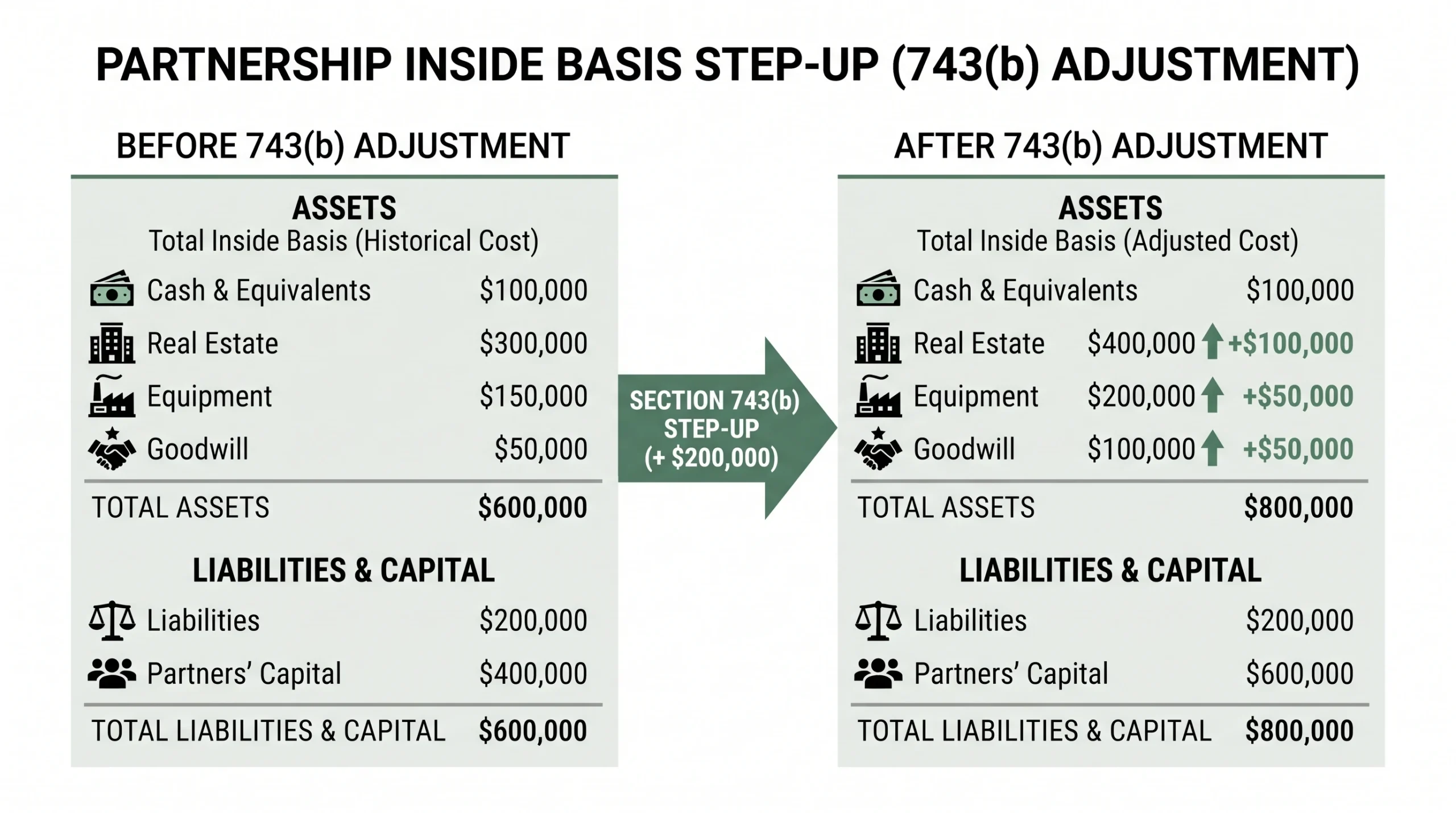
The step-up equals the gap between the new partner’s outside basis and their share of inside basis. That figure is the net gain or loss the partner inherits at purchase. The partnership then splits the amount across specific assets so inside basis matches the cost of the interest. The valuation sets the fair market value of each asset first. Only then can the total be assigned in a fair way.
The math mirrors a hypothetical sale. Picture the partnership selling every asset at fair market value, then buying each one back. The basis of assets that gained value goes up. The basis of assets that lost value goes down. A qualified appraiser uses the appraisal data to run this split. Clean allocation keeps the new partner from a tax distortion in year one.
What valuation methods apply to 754 assets?
Appraisers set the fair market value of 754 assets with three methods. They apply the asset approach, the market approach, and the income approach across the partnership’s holdings. The right method depends on the asset. Specialists often blend them for a neutral, defensible result. The American Society of Appraisers standards guide that choice, as its business valuation program shows.
Each approach fits a different asset type:
- Asset approach: best for equipment and machinery, based on current replacement cost
- Market approach: best for real estate, based on sales of similar property
- Income approach: best for the business as a whole, including goodwill and other intangible assets
Tangible assets and intangible assets need different care. A single method rarely captures a full partnership. That is why appraisers pair techniques and cross-check the results. The blend gives a clear view of total value and each asset within it. A qualified appraiser applies this multi-method work so every figure has support. The result feeds a clean 755 allocation.
How does Section 755 allocate the adjustment?
IRC Section 755 splits the total adjustment between two asset classes. One class holds capital assets. The other holds ordinary income assets. The partnership first finds the gain or loss it would book if it sold all assets at fair market value. It then assigns the change to each class by its net gain or loss. A basis increase in one class cannot pair with a decrease in the other, except in narrow cases.
The partnership then pushes each class amount down to single assets. Within a class, the change narrows the gap between fair market value and tax basis for each item. Goodwill is handled last through the residual method. That method assigns value to goodwill only after every other asset is valued. This order keeps the tax records compliant. A disciplined appraiser documents each step so the allocation reads clearly for the IRS.
When is a 754 election not worth it?
A 754 election may not be worth it when an interest transfers at a loss. That case forces a mandatory step-down. A step-down lowers the basis of partnership property and cuts future deductions. It reduces the depreciation and amortization a partner can claim for years. The election also adds real paperwork. The partnership must track a separate basis schedule for each affected partner. It binds all future years unless the IRS grants consent to revoke.
Choosing how to value the assets is its own decision. The table below compares common paths for a partnership asset allocation.
| Approach | Provider | Key benefit | Primary risk |
| Full appraisal | Sofer Advisors | Defensible value for all assets, including goodwill | Higher upfront cost than an estimate |
| Enterprise valuation team | Alvarez & Marsal, Stout, Big 4 | Scale for very large deals | Higher fees; junior-staff review layers |
| Informal estimate | General CPA or solo practitioner | Low cost and fast | High audit risk; may misallocate basis |
| Book value only | Software-driven | Simple and automated | Misses fair value of gained assets and goodwill |
The choice weighs tax impact against upfront cost. A full appraisal supports the tax position and lowers the odds of an audit change. Large firms like Alvarez & Marsal and the Big 4 serve enterprise clients through layered review. Solo practitioners and software tools cost less but carry real risk. Sofer Advisors follows The Sofer Difference, its Discovery, Diligence, Analysis, and Delivery process. That method, paired with a Heart of a Teacher approach, keeps the report clear and defensible. AICPA valuation standards guide the whole engagement.
A 754 election rewards careful valuation and clean records. The questions below cover what partners and their advisors ask most.
Frequently Asked Questions
What are common mistakes with a Section 754 election?
The most common mistake is a poor allocation of the basis change across single assets. That error breaks the rules under IRC Section 755 and can draw an audit. Partners also forget to file the election statement on time. Some skip the appraisal and lean on book value. A qualified appraiser avoids these traps with a multi-method valuation. The appraiser values each asset and records why, so the tax filing stands up to review.
What are the IRS rules for a 754 inside basis step-up?
The IRS requires the election on a timely filed partnership return for the year of the triggering event. The partnership attaches a written statement to Form 1065. It then computes the 743(b) adjustment as the gap between the partner’s outside basis and their share of inside basis. The change is spread across assets under Section 755. A qualified appraiser ties each calculation to the Internal Revenue Code so the reporting is clean and supportable.
Is making a Section 754 election worth it?
A 754 election is often worth it when a partner buys in at a premium. The step-up can raise that partner’s depreciation and amortization deductions. Those savings add up when assets have gained value. The trade-off is a binding choice and more paperwork each year. A qualified appraiser runs the numbers both ways. The analysis weighs the tax benefit against the ongoing compliance load so partners can decide with clear facts.
Which partnership assets do not get an inside basis step-up under Section 754?
Assets the partnership does not hold at the transfer date get no step-up. Items with no tax basis also fall outside the change. Section 755 blocks a basis increase that would push an asset above its fair market value. Cash is not stepped up. A qualified appraiser flags these limits during the valuation. That review keeps the allocation accurate and the tax reporting compliant for every partner involved.
How is the 743(b) basis adjustment allocated across partnership assets?
The adjustment first splits into two classes: capital assets and ordinary income assets. The partnership then spreads each class amount to single assets. It uses the gap between fair market value and tax basis for each item. Goodwill comes last through the residual method. A qualified appraiser applies standard appraisal techniques for tangible assets and the residual method for intangibles. The result is a defensible split that meets the rules under IRC Section 755.
How long does a Section 754 election last?
A Section 754 election is permanent once made. It applies to the year of the election and every year after. Partners cannot switch it off for a single event or a future deal. Because it binds the life of the partnership, the choice deserves a careful look first. A qualified appraiser reviews the long-term tax effect and the added compliance load. That review helps partners weigh the full cost before they file with the IRS.
Can a Section 754 election be revoked?
An election can be revoked only with IRS permission. The partnership must show a real business reason for the request. Valid reasons include a major change in the business or a large jump in compliance cost. The IRS will not approve a revocation aimed at dodging tax. A qualified appraiser helps partners gather the records that support such a request. The analysis also models the effect of keeping the election in place.
What is the difference between a 754 election and a 734(b) adjustment?
The 754 election is the choice that turns on basis adjustments. The 734(b) adjustment is one result of that choice. It changes asset basis when the partnership distributes cash or property to a partner. A 743(b) adjustment is the other result. It applies when an interest is sold or transferred. A qualified appraiser explains these distinctions so partners apply the right rule to each transaction type without confusion.
How much does a Section 754 valuation cost?
A Section 754 basis allocation typically ranges from $7,500 to $25,000 depending on complexity. Cost depends on the number of assets, the mix of property, and the timeline. A partnership with real estate and goodwill sits at the higher end. For a quote tied to your facts, schedule a consultation with your asset schedule and partnership return ready.
Related Case Studies
- Partnership Dissociation: How a Departing Partner’s Stake Is Valued
- How S Corp Owner Basis Is Tracked and Why It Matters at Sale
- How Family Limited Partnerships Are Valued for Gift and Estate Tax
Executive Summary
A Section 754 election lets a partnership step up its inside asset basis after a partner dies or sells an interest. The 743(b) adjustment equals the gap between the new partner’s outside basis and their share of inside basis. An appraisal sets the fair market value of each asset first. The partnership then spreads the change across capital assets and ordinary income assets under Section 755, with goodwill valued last. A step-up can raise future deductions, while a transfer at a loss can force a step-down. To prepare, gather your partnership return, asset schedule, and current tax basis, then get an independent valuation. An independent appraiser delivers that opinion.
What Should You Do Next?
Start by reviewing your partnership agreement and recent tax returns to confirm a triggering event. List every partnership asset with its current tax basis and note any real estate or goodwill. Then engage an independent appraiser before you file, so the 755 allocation rests on supportable fair market value. That preparation keeps the tax reporting clean and audit-ready.
David Hern CPA ABV ASA, founder of Sofer Advisors, provides neutral, defensible valuations for partnership tax and tax reporting engagements. Schedule a consultation to discuss your situation.
People Also Read
- Purchase Price Allocation ASC 805 and IFRS 3: Complete Guide for Business Leaders
- Cost Basis vs Fair Market Value: Key Differences Explained
About the Author
This guide was prepared by David Hern CPA ABV ASA, founder of Sofer Advisors, a business valuation firm headquartered in Atlanta, GA serving clients across the United States. David holds dual accreditations as an Accredited Senior Appraiser (ASA) and is Accredited in Business Valuation (ABV), credentials recognized by the IRS, SEC, and FINRA. He also holds the Certified Exit Planning Advisor (CEPA) designation. With 15+ years of valuation experience, David has served as an expert witness in 11+ cases across multiple jurisdictions and built Sofer Advisors into an Inc. 5000-recognized firm with 180+ five-star Google reviews. Its full W2 employee team maintains subscriptions to all major valuation databases and operates under a next business day response policy.
For professional business valuation services, visit soferadvisors.com/about-us/ or contact Sofer Advisors at soferadvisors.com/contact-us/.
Disclaimer: This content is for informational purposes only and does not constitute professional valuation advice. Business valuation conclusions depend on specific facts and circumstances. Contact Sofer Advisors for guidance regarding your specific situation.









