


Last Updated: September 2026
A Section 6166 valuation is a business appraisal that proves a closely held company makes up more than 35 percent of an estate. Clearing that 35 percent test lets the estate pay federal estate tax in installments for up to 14 years, instead of all at once. The appraisal sets the business value used in the ratio. It must be defensible, because the IRS reviews these elections with care.
This matters most for families whose wealth sits inside one business. The federal estate tax exemption is now permanent at $15 million per person and $30 million per couple under the 2025 law, so Section 6166 applies to estates above that level. Without the election, heirs may be forced to sell the company fast just to raise cash for the tax bill.
Sofer Advisors prepares the appraisals that support this election, with a focus on clear, defensible reports that hold up under IRS review. The sections below explain how the 35 percent test works and how the valuation drives the result.
Key Takeaways
- Longer payment terms: Section 6166 lets an estate pay estate tax on a closely held business over as long as 14 years when the business tops 35 percent of the adjusted gross estate.
- Ownership rules: A business is closely held if it has 45 or fewer owners, or if the estate holds at least 20 percent of the company.
- Active assets only: Only the value of active business operations counts toward the 35 percent test. Passive assets like cash and marketable securities are left out.
- Valuation drives it: The appraisal sets the business value in the ratio and shapes the total estate, so it is the single most important input.
- Built to defend: A qualified, defensible appraisal is what lets the election survive an IRS audit.
Each rule ties back to the Internal Revenue Code. The sections below show how asset type, ownership, and valuation method decide whether an estate qualifies.
What is the purpose of the 35 percent test?
The 35 percent test gives tax relief to estates that are rich in assets but short on cash. Many families hold most of their wealth in one private business. To qualify, the business interest must be worth more than 35 percent of the adjusted gross estate. When it clears that bar, the estate can pay the tax in installments rather than a lump sum, which protects heirs from a forced quick sale.
The payment plan can run up to 14 years. For the first few years, the estate can pay interest only. After that, it pays the tax in yearly installments, which keeps the business running while the tax gets paid over time. Congress built the rule to protect operating companies, not passive investment holdings.
How is the adjusted gross estate calculated?
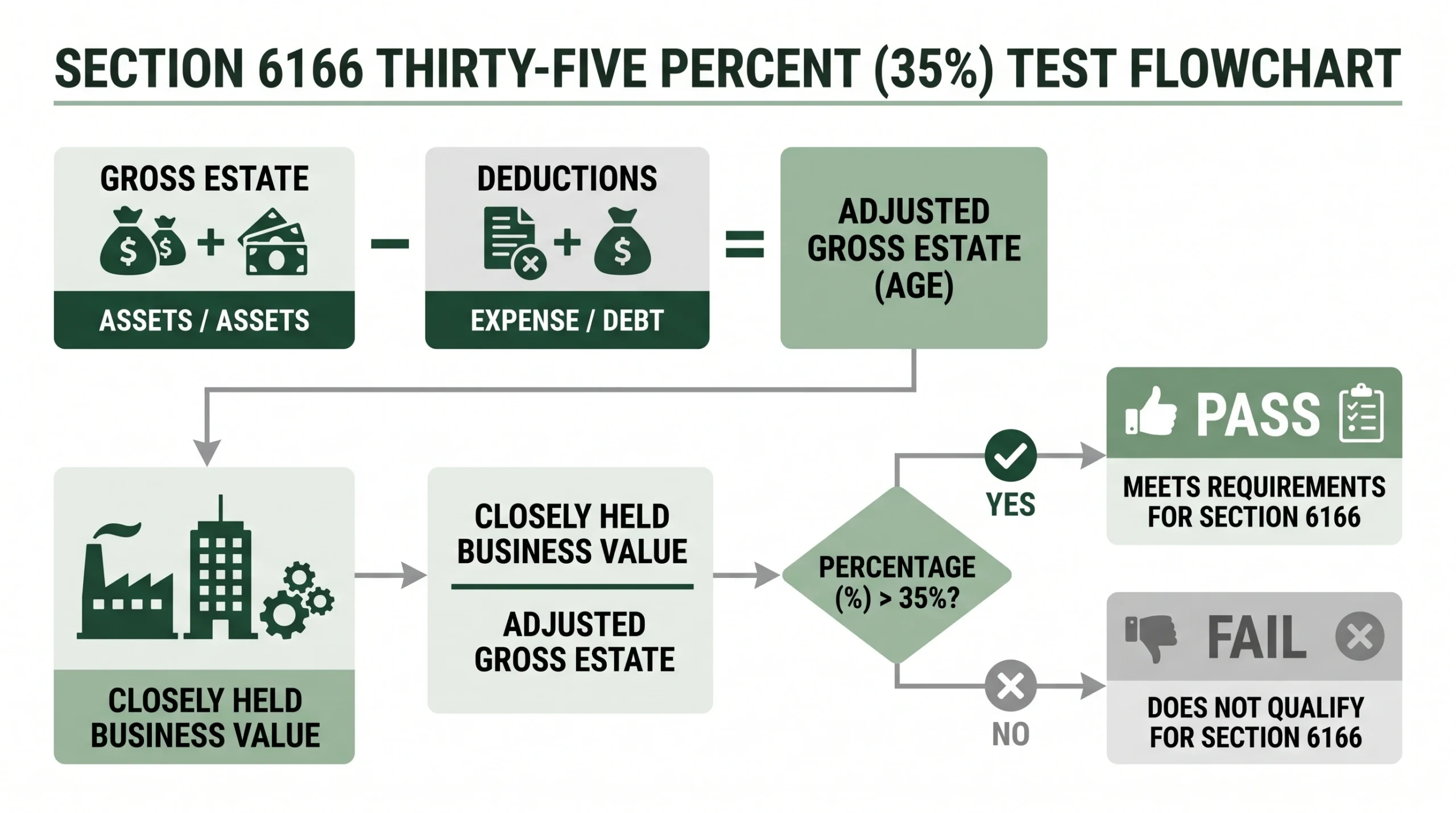
The adjusted gross estate is the gross estate minus allowed deductions. You start with everything the person owned at death: cash, real estate, securities, and business interests. Then you subtract funeral costs, administration expenses, debts, and unpaid mortgages. What remains is the adjusted gross estate. This figure is the bottom of the 35 percent ratio, so it sets how large the business must be to qualify.
A common mistake is to measure the business against the full gross estate. The test uses the adjusted gross estate instead, which is smaller. IRS rules under sections 2053 and 2054 spell out which expenses count. For date-of-death values on each asset, executors rely on fair market value for estate tax standards.
What defines a closely held business?
A closely held business under Section 6166 is an active trade or business owned by a small group. It can be a sole proprietorship. It can be a partnership with 45 or fewer partners. It can be a corporation with 45 or fewer shareholders. The point is that ownership sits with a few people, not the public market.
There is also an ownership-size path to qualify. An interest can count when the estate holds a large enough stake:
- A partnership qualifies if the estate includes at least 20 percent of its total capital interest.
- A corporation qualifies if the estate includes at least 20 percent of its voting stock.
- The entity must run an active business, not hold passive investments.
This structure keeps the benefit aimed at real operating companies. A pure investment or holding company does not qualify, because the law targets the cash squeeze that comes from owning an active business. Families that hold interests in several entities can sometimes combine them, which the pitfalls section covers below. Getting the entity type right early prevents a failed election later.
How does valuation impact the 35 percent threshold?
The valuation sets both sides of the ratio, so it drives the outcome. The business value is the top number. That same value also feeds the total estate, the bottom number. The appraiser must split active business assets from passive ones. Passive items like extra cash or marketable securities are not operating value. If those get misclassified, the estate can fail the 35 percent test.
A defensible appraisal shows why each asset is active or passive. Owners use that report to protect the election if the IRS asks questions. The Sofer Difference is a four-step process of Discovery, Diligence, Analysis, and Delivery, so each conclusion stands on its own.
A clear read on whether your business clears 35 percent needs an advisor who knows the tax rules. Dual ABV and ASA credentials bring that depth to every estate engagement. Get a defensible valuation for your estate plan.
What are common pitfalls in these valuations?
The most common pitfall is counting passive assets as part of the business. That inflates the top of the ratio and can void the election on review. The IRS has firm rules on what counts as an active trade or business. Assets held for investment do not qualify. When the appraisal blurs that line, the estate risks failing the test.
Other frequent errors include:
- Using stale financial data that does not match the value at the date of death.
- Applying a discount for lack of marketability (DLOM) or lack of control (DLOC) without sound support.
- Forgetting to combine qualifying interests across several entities the estate owns.
Each of these can push the ratio below 35 percent or trigger an IRS challenge. Discounts draw the most scrutiny, so they need clear reasoning. Aggregation can help an estate that holds several smaller stakes, but only when each interest meets the 20 percent rule. This point often surfaces with family limited partnerships. A qualified appraiser applies USPAP standards to keep every figure defensible.
Why is a qualified appraisal critical?
A qualified appraisal is the main proof that the business tops 35 percent of the estate. The IRS reviews these elections for inflated values or misclassified assets. A report from a credentialed analyst, such as a CPA with the ABV credential or an ASA, carries weight. It explains the methods used and the fair market value reached. That record is what defends the number if the return is examined.
Following USPAP and IRS Revenue Ruling 59-60 raises the bar further. A weak appraisal can lead to a denied election, plus penalties and interest. A strong one lowers that risk. Guided by a Heart of a Teacher approach, a qualified appraiser explains each conclusion in plain terms, so executors and their attorneys see why every figure holds.
Choosing a provider means knowing the gap between a quick estimate and a defensible report. The table below compares three common options for a complex estate.
| Provider | Approach to Section 6166 | Key strength |
| Sofer Advisors | Focused on splitting active from passive assets and defending the 35 percent result, with deep IRS experience | Expert-led, defensible reports for high-stakes tax work |
| National firms like Alvarez & Marsal, Stout, or Kroll | Valuation sits inside a broad advisory and restructuring menu; may be less focused on Section 6166 asset rules | Deep bench for large, cross-border engagements |
| Automated online calculator | Formula-based estimate; cannot split assets or defend a report to the IRS | Fast, low-cost figures for informal use only |
The right choice depends on the estate’s risk and the type of business held. Automated tools give a fast snapshot, but they cannot exclude passive assets under federal rules. National firms like Alvarez & Marsal, Stout, and Kroll bring broad resources, yet they may lack a sharp focus on the Section 6166 asset split. A specialized appraiser runs the whole process to keep the value defensible in an audit. That focus helps the final tax position rest on solid ground.
Frequently Asked Questions
Is a business appraisal required to elect Section 6166 estate tax deferral?
Yes. A formal appraisal is essential because the IRS needs proof that the business interest tops 35 percent of the adjusted gross estate. The value must be defensible and based on recognized methods, since the election can be audited. A qualified appraiser includes full documentation in the report to meet these standards and support the estate’s tax position during the process.
What counts toward the 35 percent closely held business threshold?
Only the value of an active trade or business counts toward the 35 percent test. Assets used in daily operations are included. Passive assets, such as cash, marketable securities, or investment real estate, are usually left out. A qualified appraiser performs a detailed asset split, so only qualifying active business value goes into the final 35 percent calculation.
What are common mistakes when qualifying a business for the election?
Common errors include counting passive assets as business value, miscalculating ownership percentages, and using stale valuation data. Each one can lead to a wrong reading of the 35 percent test and a disallowed election. A thorough discovery phase verifies every asset and entity before the valuation is finished, which helps prevent a failure from classification errors.
How do you calculate whether a business exceeds 35 percent of the estate?
You divide the value of the closely held business interest by the adjusted gross estate. The result must be more than 35 percent to qualify for Section 6166. Because the math rests on both the business value and the total estate, a defensible valuation handles both sides with care.
Can passive assets be excluded from the 35 percent test?
Yes. Passive assets must be excluded from the business value when you run the 35 percent test. The rules allow only assets used in the active conduct of a trade or business to count. A qualified appraiser applies rigorous standards to separate active operating assets from investments, so the value used for the election is accurate and matches IRS rules.
What is the interest rate on estate taxes deferred under Section 6166?
Section 6166 sets a low 2 percent interest rate on the tax tied to a set portion of the business value. That portion is a dollar figure the IRS indexes for inflation each year. Tax above the portion carries interest at 45 percent of the normal underpayment rate. Rates and thresholds change, so confirm the current figures with your tax advisor and the IRS before you file.
What happens if the closely held business is sold during the deferral period?
Selling or liquidating a large part of the business can accelerate the remaining tax. If the estate disposes of 50 percent or more of the business interest, the entire unpaid deferred tax can become due at once. Clean records help executors track these triggers across the full payment period, so a sale does not create a surprise bill.
Can multiple business interests be combined to meet the 35 percent test?
Yes, in some cases. Interests can be combined when the estate owns at least 20 percent of the total value of each business. This aggregation rule helps estates that hold stakes in several smaller entities. The appraiser reviews each entity on its own, then runs an aggregation analysis to see whether the combined interests reach the required 35 percent.
How much does a tax and estate valuation cost?
Pricing depends on the number of business interests, the entity’s complexity, and the timeline. Most tax and estate valuations run $7,500 to $25,000. Engagements usually take four to eight weeks, and a rush timeline adds to the fee. For a quote tied to your estate, contact a qualified appraiser with your entity details and a summary of the assets.
Related Case Studies
- Valuation of Closely Held Business for Estate Tax Purposes
- Valuation Discounts (DLOC and DLOM) on Estate and Gift Tax Returns
- Estate Freeze Strategies: How Valuations Lock In Today’s Value
Executive Summary
Section 6166 lets an estate pay federal estate tax on a closely held business over as long as 14 years, but only when the business tops 35 percent of the adjusted gross estate. The appraisal decides the result: it sets the business value and must split active operating assets from passive investments, since only active value counts. Errors like counting passive assets or applying weak discounts can push the ratio below 35 percent and void the election. Gather your financials and asset schedule, then get a defensible valuation before you file.
What Should You Do Next?
Start by gathering recent business balance sheets, personal financial statements, and a full schedule of assets. Compare the business value against the adjusted gross estate to see if it clears 35 percent. Then review your ownership percentages to confirm the active trade or business test, since these steps decide eligibility before the filing deadline.
David Hern CPA ABV ASA, founder of Sofer Advisors, supports executors and legal professionals with independent valuations for complex tax matters. Schedule a consultation to discuss your specific situation.
People Also Read
- Stepped-Up Basis at Death: What Business Owners Must Know
- Cost Basis vs Fair Market Value: Key Differences Explained
About the Author
This guide was prepared by David Hern CPA ABV ASA, founder of Sofer Advisors, a business valuation firm headquartered in Atlanta, GA serving clients across the United States. David holds dual accreditations as an Accredited Senior Appraiser (ASA) and is Accredited in Business Valuation (ABV), credentials recognized by the IRS, SEC, and FINRA. He also holds the Certified Exit Planning Advisor (CEPA) designation. With 15+ years of valuation experience, David has served as an expert witness in 11+ cases across multiple jurisdictions and built Sofer Advisors into an Inc. 5000-recognized firm with 180+ five-star Google reviews. Its full W2 employee team maintains subscriptions to all major valuation databases and operates under a next-business-day response policy.
For professional business valuation services, visit soferadvisors.com/about-us/ or contact Sofer Advisors at soferadvisors.com/contact-us/.
Disclaimer: This content is for informational purposes only and does not constitute professional valuation advice. Business valuation conclusions depend on specific facts and circumstances. Contact Sofer Advisors for guidance regarding your specific situation.









