


Last Updated: October 2026
Construction company valuation multiples are ratios used to estimate what a company is worth. They compare a business to similar companies that have recently sold. The most common are multiples of earnings, such as SDE or EBITDA, and sometimes revenue. Based on market data such as DealStats, they often fall in the range of 2.5 to 5.0 times earnings for a given trade, which gives an analyst a grounded, market-based starting point.
Sofer Advisors values construction and specialty trade companies for owners, lenders, and buyers, backed by Inc. 5000 recognition in both 2024 and 2025. No two construction companies are the same, so project backlog, equipment age, and regional demand all shift the result, and a raw multiple is only a benchmark, never the final answer.
This guide explains which multiples apply, how they differ by trade, and the factors that move the final number up or down.
Key Takeaways
- Trade matters: specialty contractors often earn higher multiples than general contractors, because of niche skills and barriers to entry.
- Metric by size: SDE suits smaller owner-run firms; EBITDA suits larger firms with a management team.
- Working capital: weak net working capital, including heavy retainage, can reduce the price dollar for dollar at closing.
- Backlog is a driver: a profitable, long-term backlog with recurring maintenance work can justify a premium.
- Asset floor: for equipment-heavy firms, the value of tangible assets often sets a floor for the whole business.
Each driver has to be measured, not assumed. The sections below examine each one in detail.
Why Is Construction Company Valuation Important to Understand?
Understanding construction multiples matters because a credible valuation must rest on recognized standards, not a rule of thumb alone. The Uniform Standards of Professional Appraisal Practice, known as USPAP, govern how the appraisal is developed and reported. For a closely held contractor, the IRS fair market value standard and the eight factors of Revenue Ruling 59-60 shape how earnings, assets, and risk are weighed. Market multiples from sources such as DealStats and Business Valuation Resources (BVR) are benchmarks the analyst adjusts within that framework, so the final number is defensible to a buyer, a lender, or an auditor.
What Are the Key Construction Valuation Multiples?
Construction valuations rely mainly on three metrics. The first is Seller’s Discretionary Earnings, or SDE. It suits smaller, owner-operated firms where the business income supports the owner’s lifestyle. The second is EBITDA, which fits larger firms with a formal management team. The third is revenue, used as a quick secondary check.
Which metric applies depends on size and purpose. Smaller firms need an adjustment to remove owner-specific costs and show true cash flow. Larger, equipment-heavy firms must account for depreciation and capital spending. Revenue multiples are fast but blunt, since they rarely capture the margins or overhead that define a specific business. A careful analysis makes sure each multiple reflects real risk, so a buyer, a lender, and an auditor would all find it reasonable.
How Do Different Trades Affect Multiples?
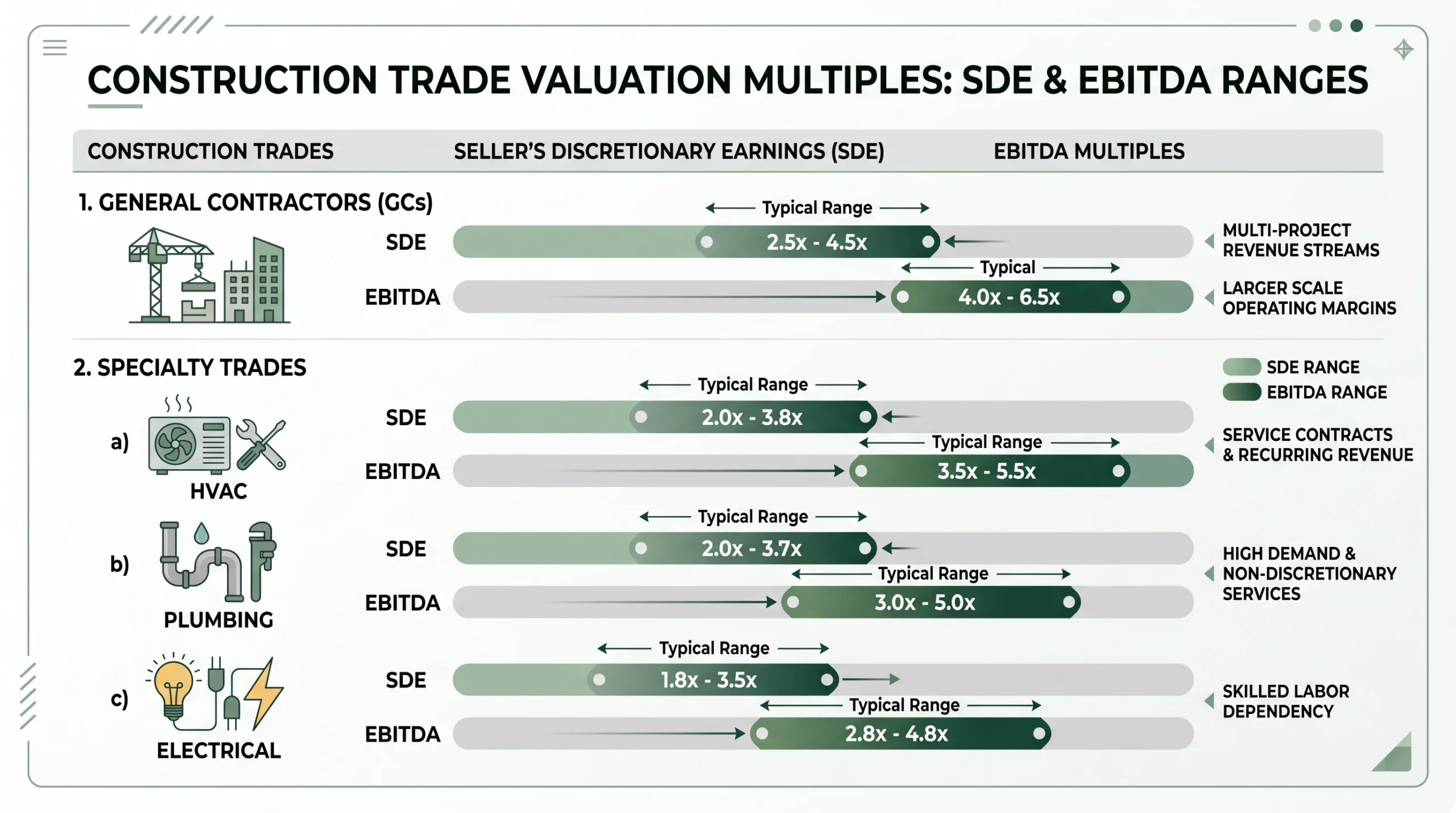
Specialty trade contractors often command higher multiples than general contractors. The reason is defensibility. A business focused on electrical, HVAC, or plumbing work has niche skills and faces less competition. Property owners must maintain these systems, so the work is essential, and that technical position is what buyers pay a premium for.
Recurring maintenance agreements add to the case. Steady service revenue is more predictable than one-off project work. A strong backlog signals future stability, and a healthy bonding capacity shows the company can win larger jobs. Based on market transaction data such as DealStats, general contractors often trade around 2.5 to 4.0 times SDE, while specialty trades can reach 3.5 to 5.0 times. These are broad rules of thumb, not fixed or guaranteed rates.
What Non-Financial Factors Adjust the Value?
Several non-financial factors move the final value. Customer concentration is a big one. If one or two clients drive most of the revenue, the earnings are fragile, so analysts apply a higher risk premium, which lowers the multiple. A broad client base does the opposite.
Management depth also matters. A company that runs without the founder is worth more, because the buyer inherits a stable team. Equipment condition is the third factor. Deferred capital spending can make a company look profitable today, but it hides a bill the buyer must pay soon. Labor structure, such as union versus non-union, affects margins too. Each factor shifts the value in a specific, measurable direction.
Why Is Working Capital So Critical in Construction?
Construction runs on a tough cash cycle. Companies pay for labor and materials up front, then bill as the job progresses. So working capital is central to any valuation. The analyst sets a net working capital target that makes sure the company has enough liquidity to finish its jobs after the sale.
Retainage makes this harder. Project owners often hold back a share of each progress billing until the job is done, and that cash can sit locked up for months or years. A valuation must account for it. If working capital falls short of the target at closing, the buyer usually cuts the price to match, often dollar for dollar. Tangible equipment also sets a floor: the business should be worth at least the orderly liquidation value of its equipment, which is why lenders and buyers both watch net asset value.
Setting a sound net working capital target is easier with a valuation expert who knows the construction cash cycle. Talk to a Sofer Advisors valuation specialist about your company.
Which Earnings Metric Should You Use?
The choice between SDE and EBITDA comes down to size and structure. The table below shows where each metric fits, and picking the right one is the difference between a credible value and a misleading one.
| Metric | Best for | What it captures |
|---|---|---|
| SDE | Smaller, owner-operated contractors | Total benefit to a single owner, including salary |
| EBITDA | Larger firms with a management team | Earnings power independent of owner pay |
| Revenue | Quick industry benchmark | Scale, but not profitability or risk |
| Net asset value | Equipment-heavy firms | Floor value of tangible assets |
Most engagements use more than one metric: an earnings multiple sets the core value, an asset check confirms the floor, and a revenue multiple provides a sanity check against the market. Large national firms such as Alvarez & Marsal, Stout, and Kroll handle valuations for large contractors and public filers with broad advisory teams. Sofer Advisors focuses on partner-led valuations for closely held and middle-market contractors, backed by expert witness testimony in 11+ cases, and works through a four-phase process it calls The Sofer Difference, moving from Discovery to Diligence to Analysis to Delivery.
How Does Earnings Normalization Work?
Reported earnings rarely show the true profit a buyer will inherit, so the analyst normalizes them. The process adds back owner-specific and one-time costs. For a small contractor, that means the owner’s above-market salary, personal vehicles, and discretionary expenses. The result is SDE, the full benefit available to one owner-operator.
For a larger firm, the analyst normalizes to EBITDA instead. Add-backs there include non-recurring legal costs, one-time project losses, and related-party rent set above market. Each add-back must be documented, because an unsupported add-back inflates the value and draws a challenge. Sofer Advisors brings a Heart of a Teacher approach to normalization, showing owners and reviewers the support behind every add-back rather than asserting a number, an approach reflected in its 180+ five-star Google reviews.
Frequently Asked Questions
How much is a business worth with $1,000,000 in sales?
Revenue alone does not fix a value. Profit margins and risk drive the price, so buyers apply a multiple to earnings, not to gross sales. A business with strong, stable earnings is worth far more than one with thin margins on the same revenue. The right figure depends on the trade, the backlog, and the equipment base. Sofer Advisors builds the value from normalized earnings and comparable transaction data, not a single revenue rule.
What are the best multiples to use for valuation?
It depends on size and maturity. SDE multiples suit smaller, owner-run contractors, while EBITDA multiples suit larger firms with professional management. The right choice comes from comparable transaction data for the specific trade, such as DealStats, not a single industry average. Sofer Advisors selects the metric that matches the company’s structure and supports it with recent, trade-specific sales so the multiple reflects real market evidence.
How do you value a construction company?
The analyst reviews backlog, bonding capacity, and the fair market value of equipment, then reconciles those with the company’s ability to generate future cash flow from active contracts. The result combines an earnings approach with an asset check to reflect both profit and security. Market multiples provide a third view. Sofer Advisors weighs all three approaches and explains the weighting, so the conclusion is defensible in a sale or an audit.
How much is a business worth with $500,000 in sales?
At this size, owner compensation and the replacement cost of tools and vehicles drive the value, and the company often runs as a small trade practice. Discretionary cash flow, measured through SDE, is the key input for a credible estimate. Revenue by itself says little about the price. Sofer Advisors normalizes the owner’s pay and perks to find true cash flow before applying a trade-specific multiple to reach a supported value.
Is SDE or EBITDA better for a construction business?
SDE is usually better for a small, owner-managed trade firm, because it captures the full benefit to a single owner, including salary. EBITDA is better for a larger firm with a management team, since it measures earnings power independent of owner pay. The right metric depends on the company’s structure and the complexity of its finances. Sofer Advisors matches the metric to the business so the multiple applied is the right one.
How does project backlog impact value?
A profitable, high-quality backlog is a strong value driver. It gives the buyer predictable future revenue and lowers risk, and signed, permitted projects show a solid reputation and a clear path to near-term earnings. That stability supports a higher multiple. Sofer Advisors reviews the backlog alongside the work-in-progress report to confirm the margins are real and the revenue is likely to convert, which keeps the valuation grounded.
How important is bonding capacity?
Bonding capacity is a key sign of financial health, because it controls which contracts a company can bid. A low bonding limit caps growth and value, while a strong limit lets the company pursue larger jobs, which supports a higher multiple against industry benchmarks. Buyers read it as a measure of stability. Sofer Advisors factors bonding capacity into both the risk assessment and the earnings outlook when setting the value.
How much does a construction company valuation cost?
A standard construction valuation ranges from $7,500 to $25,000. The fee depends on the project’s complexity, the size of the equipment fleet, and the reporting requirements, since more assets and tighter deadlines add work. A flat scope is quoted up front, so the cost is clear before work starts. Sofer Advisors sets the scope first, then holds that price. Request a free estimate for your company.
Related Case Studies
- How to Value Construction Company: Expert business valuation Guide
- Atlanta Retail Company Valuation Multiples: 2026 Guide
- Construction Company Valuation Georgia: Complete Industry Guide
Executive Summary
Construction company value rests on earnings multiples, adjusted for trade, risk, and assets. SDE fits smaller owner-run contractors; EBITDA fits larger firms with a management team. Based on market data such as DealStats, general contractors often trade around 2.5 to 4.0 times SDE, while specialty trades can reach 3.5 to 5.0 times, as broad rules of thumb rather than fixed rates. Working capital, including retainage, can cut the price dollar for dollar at closing, and tangible equipment sets a floor through net asset value. A standard valuation runs $7,500 to $25,000. The first step is to gather three to five years of statements, tax returns, the backlog, and an equipment list.
What Should You Do Next?
Define the purpose of your valuation first, since it sets the scope and the standard of value. Gather your financial statements, tax returns, backlog, and an equipment list before the engagement begins, because clean inputs lead to a tighter, more defensible range. Decide early which earnings metric fits your size and structure. This guide was prepared by David Hern CPA ABV ASA, founder of Sofer Advisors, an Inc. 5000 firm specializing in construction and closely held business valuations. Schedule a free consultation to discuss your specific situation.
People Also Read
About the Author
This guide was prepared by David Hern CPA ABV ASA, founder of Sofer Advisors, a business valuation firm headquartered in Atlanta, GA serving clients across the United States. David holds dual accreditations as an Accredited Senior Appraiser (ASA) and is Accredited in Business Valuation (ABV), credentials recognized by the IRS, SEC, and FINRA. He also holds the Certified Exit Planning Advisor (CEPA) designation. With 15+ years of valuation experience, David has served as an expert witness in 11+ cases across multiple jurisdictions and built Sofer Advisors into an Inc. 5,000-recognized firm with 180+ five-star Google reviews. Its full W2 employee team maintains subscriptions to all major valuation databases and operates under a next business day response policy.
For professional business valuation services, visit soferadvisors.com/about-us/ or contact Sofer Advisors at soferadvisors.com/contact-us/.
This content is for informational purposes only and does not constitute professional valuation advice. Business valuation conclusions depend on specific facts and circumstances. Contact Sofer Advisors for guidance regarding your specific situation.









