


Last Updated: November 2026
A marina is valued mainly by its income, using the income approach. You take one year of net operating income and divide it by a market cap rate, and the result is the indicated value. Because a marina is part real estate and part operating business, a sound valuation measures both sides together. The land, docks, and buildings count, and so do slip rentals, fuel sales, and service income.
Sofer Advisors prepares these valuations for owners, lenders, and attorneys across the country.
This guide explains how the income approach works, what drives a marina’s value, and why seasonal income must be normalized.
Key Takeaways
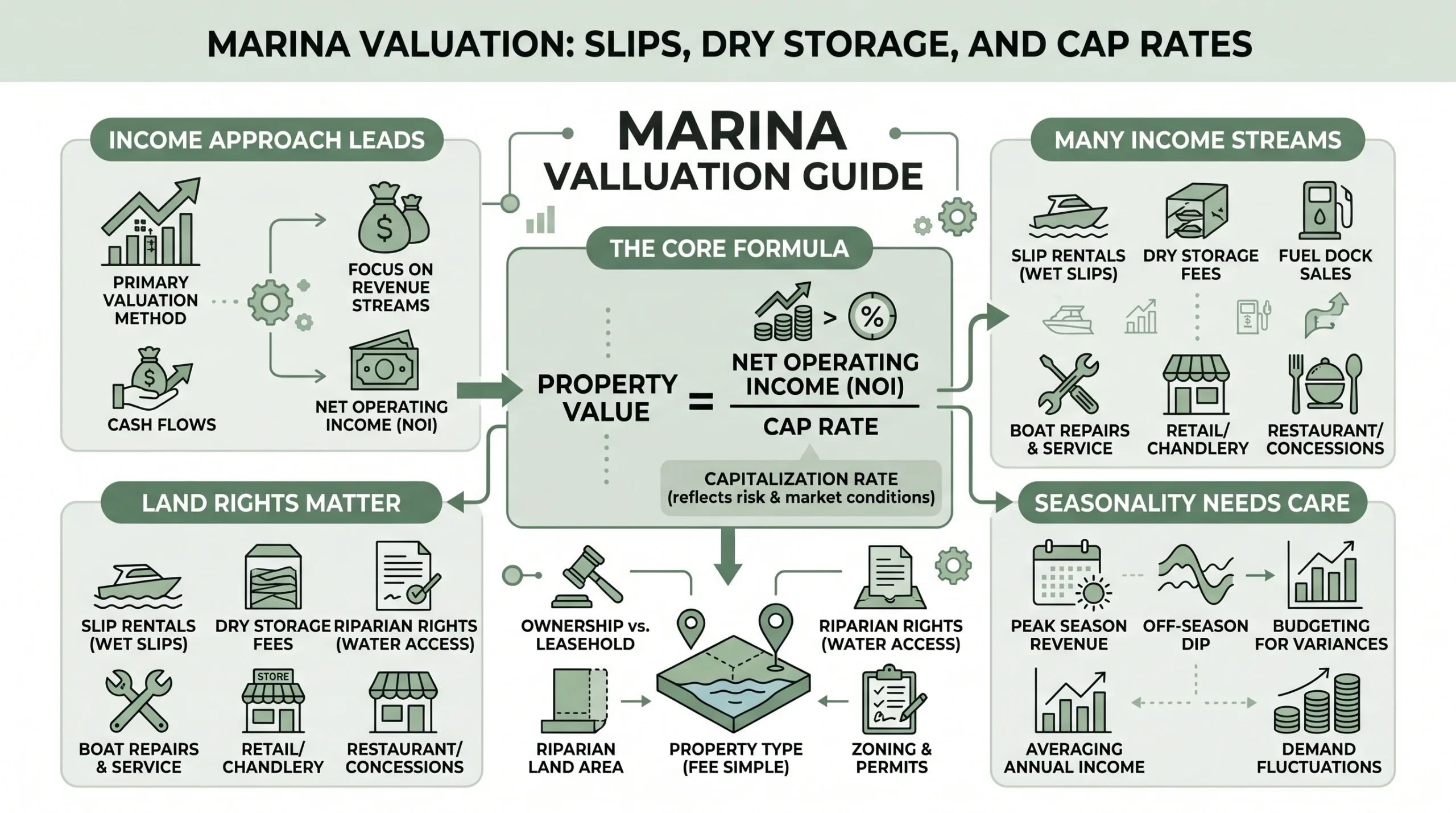
- Income approach leads: Most marinas are valued by capitalizing net operating income at a market cap rate.
- The core formula: Value equals net operating income divided by the cap rate.
- Many income streams: Slips, dry storage, fuel, service, and retail all feed the total.
- Land rights matter: Owned sites, lease terms, location, and occupancy shift the value.
- Seasonality needs care: Many marinas earn most of their income in a few months, so income must be normalized.
Why is a marina hard to value?
A marina is a hybrid asset. It is real estate and a business at the same time. The land, docks, and buildings sit on one side. The slip rentals, fuel sales, and repair work sit on the other. You cannot value one side and ignore the other. Both parts drive the final number. That is what makes the task harder than a standard appraisal.
The physical site brings its own puzzles. Many marinas sit on leased submerged land. A city or state owns the water bottom and rents it out. These tidelands leases carry set terms, rents, and renewal dates. A short lease can cap the value of the whole site. Environmental rules and permits add more limits. A fuel dock, for example, must meet strict standards. All of this shapes what the marina can earn and for how long.
How does the income approach work?
The income approach is the main tool for most marinas. It values the asset by the cash it produces. The method is direct capitalization. You take one year of net operating income. Then you divide it by a market cap rate. The result is the indicated value.
Here is the formula in plain terms. Value equals net operating income divided by the cap rate. A lower cap rate points to a higher value. A higher cap rate points to a lower value. The cap rate reflects risk. Investors accept a lower rate for a safe, stable marina. They demand a higher rate for a risky one.
A short example shows the flow. Suppose a marina earns $500,000 in net operating income for the year. Say the market cap rate is 8 percent. The math is $500,000 divided by 0.08. That equals $6.25 million. These numbers are illustrative only. Real income and cap rates differ by site, region, and market.
What is net operating income for a marina?
Net operating income, or NOI, is the heart of the method. It is the cash the marina keeps after normal operating costs. You start with all the revenue. Then you subtract the costs of running the place. You do not subtract the mortgage, income tax, or depreciation. NOI measures the asset, not the owner’s loan or tax position.
Revenue comes from many streams at a marina. Expenses include staff, utilities, insurance, dredging, and repairs. Dock upkeep and dredging can be large costs. The analyst reviews several years of records. The goal is a clean, normal figure. One-time items are stripped out. What remains is the NOI that feeds the formula.
What revenue streams does a marina have?
A marina earns money in many ways. Wet slip rentals are usually the base. Owners pay by the slip, often by length. Dry storage and dry-stack racks add more. Boats are stacked indoors and launched by forklift. Together these form the core rental income.
Other streams fill out the total. Fuel sales, service and repair, and haul-outs bring in cash. A ship store, restaurant, or hotel can add still more. Transient dockage and moorings serve visiting boats. Each stream carries its own margin and its own risk. The table below lists the common ones.
| Revenue stream | What it is |
|---|---|
| Wet slip rentals | In-water berths rented by slip size or length |
| Dry storage and dry-stack | Indoor or rack storage, launched as needed |
| Fuel sales | Gas and diesel sold at the fuel dock |
| Service and haul-out | Repair, maintenance, and lift-out work |
| Transient and moorings | Short stays for visiting boats |
| Retail and dining | Ship store, restaurant, or other on-site sales |
What drives a marina’s value?
A few factors move a marina’s value the most. The number and size mix of slips come first. More slips and larger berths mean more income. Occupancy matters just as much. A full marina earns more than a half-empty one. Location is key too. Protected water and easy access draw boaters and keep slips full.
Land rights carry real weight. An owned site is usually worth more than a leased one. A long, stable submerged-land lease beats a short one. Permits and environmental limits also count. So does the mix of income. A marina with fuel, service, and retail is less exposed to any single stream. That spread of income can support a higher value.
How do the cost and sales approaches help?
The income approach leads, but it does not work alone. The sales comparison approach looks at recent marina sales. The analyst finds similar properties that have sold. Then adjustments are made for size, location, and condition. Good comparable sales are hard to find. Marinas rarely trade, so the data is thin.
The cost approach is the third method. It estimates the cost to rebuild the marina today. Then it subtracts for wear and age. This approach fits new or special-use sites. It is weaker for an older, profitable marina. It often misses the value of a strong income stream. Most reports lean on the income approach and use the other two as a check.
Why does seasonality matter?
Many marinas are seasonal. In colder regions, boats come out of the water for winter. Income may arrive in just a few months. A single year can look odd on its own. A hard winter or a storm can distort the numbers. The analyst has to look past one season.
This is why NOI is normalized. The analyst reviews several years of records. Seasonal swings are smoothed into a steady figure. One-time events are removed. The goal is income the marina can repeat year after year. A normalized NOI gives a fairer base for the cap rate.
How does an analyst normalize marina income?
Normalization turns a messy history into a steady figure. The analyst gathers several years of profit and loss records. Then unusual items are removed from the picture. A one-time legal cost or a storm repair does not belong in a normal year. Owner perks and above-market pay are adjusted too. The result reflects how the marina should run under normal management.
Revenue is reviewed the same way. The analyst checks slip occupancy against the local market. A year with a deep rate cut or a one-off event is adjusted. Fuel margins and service income are tested against prior years. The aim is a figure the marina can repeat each year. That normalized income is what the cap rate is applied to.
What risks can lower a marina’s value?
Several risks can pull a marina’s value down. Deferred maintenance is a common one. Worn docks, old power pedestals, and aging fuel lines all need capital. A buyer will discount the price to cover those repairs. Environmental problems are a larger worry. Contaminated sediment or a past fuel spill can trigger costly cleanup. Permits and zoning rules can also limit what the site is allowed to do.
Access and water depth matter as well. A marina needs enough depth for the boats it serves. Shoaling can force regular dredging, which is expensive and ongoing. Limited road access or weak local boating demand can hold income back. A short or uncertain submerged-land lease adds risk on top of that. Each of these factors raises the cap rate an investor would use. A higher cap rate means a lower value.
When do owners need a marina valuation?
Owners seek a marina valuation for several reasons. A sale or purchase is the most common. A buyer wants a fair price, and a seller wants proof of worth. Estate and gift planning is another reason. The IRS expects a defensible value for a transferred interest. A partner buyout or a divorce can call for one too. Lenders may also ask for a value before they finance a deal.
The purpose shapes the report. A valuation for tax follows fair market value standards. A sale may focus on what a likely buyer would pay. The standard of value and the effective date are set at the start. Those choices guide every step that follows.
Frequently Asked Questions
What approach is used to value a marina?
The income approach leads for most operating marinas. It values the marina by the cash it produces. Analysts capitalize net operating income at a market cap rate. The cost and sales comparison approaches can support the result.
How do you value a marina with a cap rate?
You use direct capitalization. Take one year of normalized net operating income. Divide it by a market cap rate. The result is the estimated value. A lower cap rate points to a higher value.
What is net operating income for a marina?
It is the cash left after normal operating costs. You start with all revenue, then subtract running expenses. You do not subtract the mortgage, income tax, or depreciation. NOI measures the asset itself.
What revenue streams add to a marina’s value?
Wet slip rentals are the base. Dry storage and dry-stack racks add more. Fuel sales, service, haul-outs, moorings, and transient dockage help too. A ship store, restaurant, or hotel can round out the income.
Why does seasonality matter in a marina valuation?
Many marinas earn most of their income in a few months. A single year can look uneven. Analysts normalize income over several years. This smooths seasonal swings and gives a fairer base for the cap rate.
Does it matter if the marina land is owned or leased?
Yes, it matters a great deal. An owned site usually supports a higher value. Many marinas lease submerged land from a city or state. The lease term, rent, and renewal rights all affect value.
What makes one marina worth more than another?
Slip count and size mix come first. Occupancy, location, and protected water follow. Owned land and a stable lease help. A mix of fuel, service, and retail income lowers risk and lifts value.
Do ancillary services raise a marina’s value?
They can. Fuel, repair, and retail spread income across more streams. That lowers reliance on slip rentals alone. More stable income can support a higher value.
How do the cost and sales comparison approaches fit in?
They support the income approach. The sales approach compares recent marina sales. The cost approach estimates rebuild cost minus wear. Both serve as a check on the income result.
Related Case Studies
- Self Storage Facility Valuation: Occupancy and Rates
- How to Value a Self-Storage Facility: Cap Rates and Operations
- How to Value an Assisted Living Facility: Census, Cap Rates
Executive Summary
Most marinas are valued by capitalizing net operating income at a market cap rate. Value equals net operating income divided by the cap rate. Slips, dry storage, fuel, service, and retail all feed the total. Owned sites, lease terms, location, and occupancy shift the value. Many marinas earn most of their income in a few months, so income must be normalized.
What Should You Do Next?
Start by gathering three years of financial records. Add your slip list, lease and permit documents, and income broken out by service type. These let an analyst build a clean, normalized view of value. Sofer Advisors provides independent marina valuations, led by David Hern CPA ABV ASA CVA. Schedule a consultation to discuss your situation.
People Also Read
About the Author
This guide was prepared by David Hern CPA ABV ASA CVA, founder of Sofer Advisors, a business valuation firm headquartered in Atlanta, GA serving clients across the United States. David holds accreditations as an Accredited Senior Appraiser (ASA) and is Accredited in Business Valuation (ABV), credentials recognized by the IRS, SEC, and FINRA, and is also a Certified Valuation Analyst (CVA). David has served as an expert witness in dozens of cases across multiple jurisdictions, and Sofer Advisors is an Inc. 5000 honoree in 2024 and 2025 with 240+ five-star Google reviews.
For professional business valuation services, visit soferadvisors.com/about-us/ or contact Sofer Advisors at soferadvisors.com/contact-us/.
Disclaimer: This content is for informational purposes only and does not constitute professional valuation advice. Business valuation conclusions depend on specific facts and circumstances. Contact Sofer Advisors for guidance regarding your specific situation.