


Last Updated: November 2026
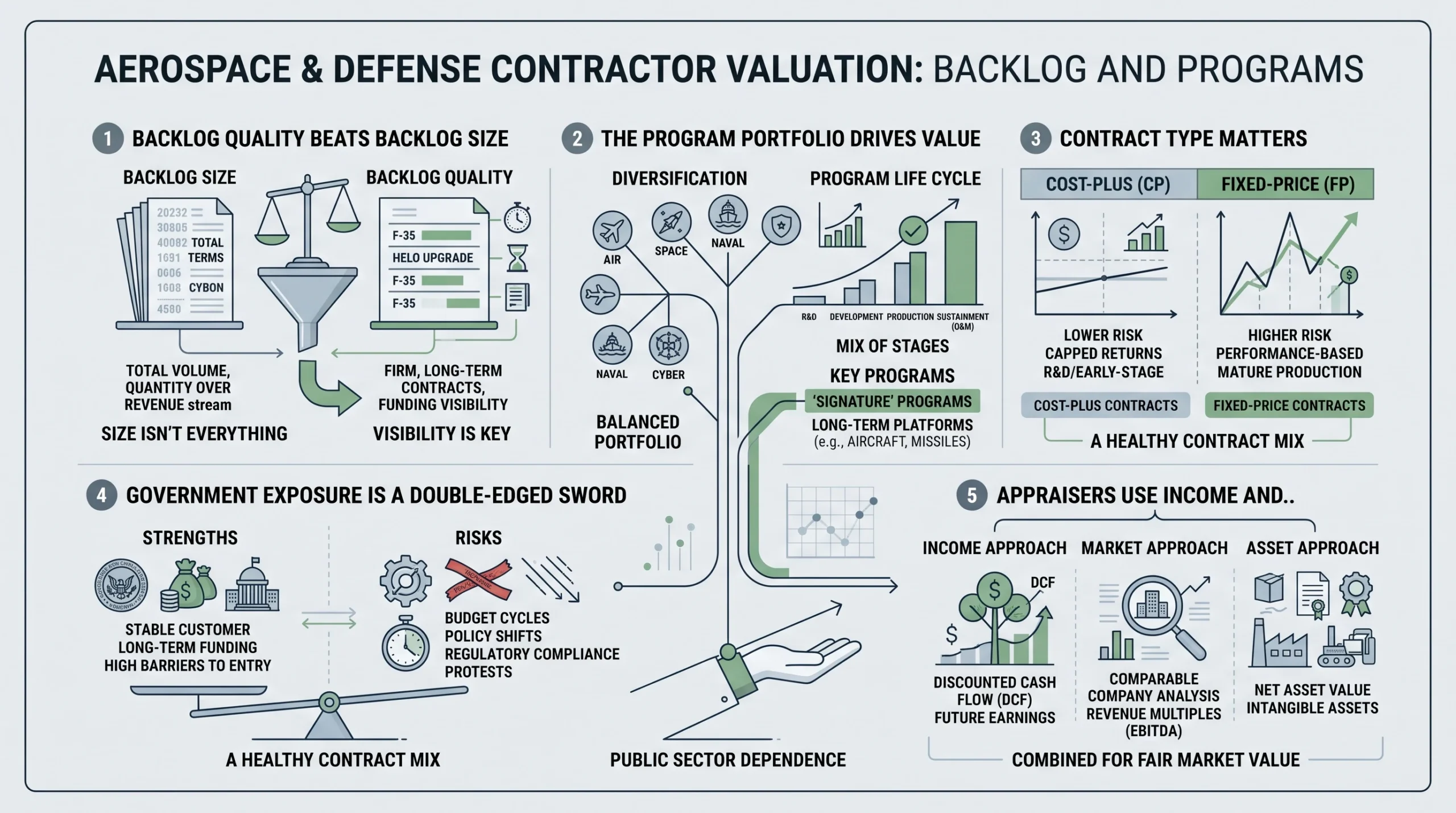
An aerospace and defense contractor is valued on its long contracts, its pipeline of future work, and its ability to hold sensitive government clearances. The key is the backlog, the work already won but not yet delivered. Funded backlog is worth far more than unfunded work that still needs an appropriation, so an appraiser sorts the two apart. Appraisers then use the income and market approaches together to reach a defensible number.
The team at Sofer Advisors builds these valuations for owners, buyers, and attorneys who need a number they can defend.
This guide explains backlog quality, the program portfolio, contract types, the risks that move the discount rate, and the methods appraisers use.
Key Takeaways
- Backlog quality beats backlog size: funded work is worth far more than unfunded work that still needs an appropriation.
- The program portfolio drives value: where each program sits in its lifecycle shapes margin and risk.
- Contract type matters: fixed-price, cost-reimbursable, and time-and-materials deals each carry different risk.
- Government exposure is a double-edged sword: it steadies revenue but ties the company to budget and policy swings.
- Appraisers use income and market approaches together: a DCF plus guideline public companies and M&A deals.
Why is A&D contractor valuation different?
A&D contractors live on government money. Much of their revenue flows from federal programs, not open-market demand. That link steadies sales in good years. It also exposes the contractor to budget fights, delays, and program cuts. An appraiser weighs both sides.
These firms also carry heavy compliance costs. They face export rules, audits, and cybersecurity standards that most companies never see. Clearances and facility security act as a wall against new rivals. That wall protects margins, but it also raises the cost of doing business. Value depends on how well the contractor manages both.
Because of this, standard shortcuts do not work. You cannot value a defense contractor on a simple revenue multiple. The mix of funded and unfunded backlog, program maturity, and contract type all change the answer. Each factor feeds the discount rate and the multiple a buyer is willing to pay.
How do you value a contract backlog?
Start by splitting the backlog into two buckets. Funded backlog is work with money already obligated. Unfunded backlog is work under contract but still waiting on future appropriations. The two are not equal. Funded work is close to cash in hand. Unfunded work may never arrive.
The gap matters for the valuation. An appraiser leans on funded backlog for the near-term forecast. Unfunded backlog gets a discount to reflect the risk of delay or cancellation. The deeper the uncertainty, the larger the haircut.
Total contract value can mislead a buyer. A headline figure may cover many years and many option periods. Only a slice of it is obligated today. A careful appraiser models the funded piece first, then adds unfunded work at a lower weight. This keeps the forecast honest.
Backlog visibility is just as important as size. A buyer wants to know when the work will convert to revenue. Clear delivery schedules and firm order dates raise confidence. Vague timelines lower it. The appraiser maps the backlog to a year-by-year forecast rather than a single lump sum.
Why does the program portfolio matter?
Every program sits somewhere in its lifecycle. Development programs design and test new systems. Production programs build them at scale. Sustainment programs maintain and upgrade fielded systems for years. Each stage carries its own margin and risk.
Development work can be lumpy and uncertain. Production work brings volume but often thinner margins. Sustainment and aftermarket work tends to be stickier and higher-margin. Spare parts, repairs, and upgrades can run long after the original sale. A portfolio weighted toward aftermarket revenue usually earns a stronger valuation.
Concentration is the other half of the story. A firm tied to one platform or one program faces real danger. If that program is cut, revenue can fall fast. An appraiser looks for a spread of programs across customers and lifecycle stages. A balanced book lowers risk and supports a higher multiple.
Position in the supply chain counts too. A prime contractor holds the direct relationship with the government. A subcontractor sits one or more steps removed. Primes often enjoy more control and visibility. Subcontractors can still hold strong value when they supply sole-source or hard-to-replace content.
Program age also shapes the forecast. A new program may grow for years as it ramps up. A mature program may be stable but near the end of its run. An appraiser asks what comes next. A firm with follow-on work in the pipeline looks safer than one facing a cliff. The strength of customer relationships helps predict that future work.
How do contract types affect value?
Contract type shapes both margin and risk. Firm-fixed-price contracts set a price up front. The contractor keeps any savings but absorbs any overruns. These deals reward efficient operators and punish sloppy ones.
Cost-reimbursable contracts work the other way. The government covers allowable costs and pays a fee on top. Risk to the contractor is lower, but so is the upside. Margins are capped by the fee. Time-and-materials contracts bill for hours and materials, which suits work that is hard to scope in advance.
An appraiser reads the whole contract mix. A book heavy in fixed-price work on mature programs can be stable and profitable. A book heavy in cost-plus development work may be safer but lower-margin. Sole-source awards usually beat competitively bid work, because they face no price pressure at renewal. The blend of these features drives the earnings forecast.
What risks shape the discount rate?
The US defense budget sits at the center of the risk picture. Appropriations move with politics and priorities. A continuing resolution or a program cut can stall revenue. An appraiser studies how exposed each program is to the next budget cycle.
Export controls add another layer. The International Traffic in Arms Regulations (ITAR) and the Export Administration Regulations (EAR) govern what a firm can sell and to whom. These rules limit foreign sales but also protect a specialized niche. International and commercial aerospace exposure can diversify revenue, though it brings its own cycles.
Compliance risk is constant. A Defense Contract Audit Agency (DCAA) review can question costs and delay payment. Cost Accounting Standards (CAS) govern how large contractors track and allocate cost. The Cybersecurity Maturity Model Certification (CMMC) sets security requirements for handling defense data. A firm that fails these tests can lose eligibility to bid.
Security clearances and facility security round out the list. Cleared facilities and cleared staff can pursue work that others cannot touch. That access is hard to replicate and slow to build. It raises the barrier to entry and, with it, the value of a qualified contractor. Together these risks set the discount rate the appraiser applies to future cash flow.
Which valuation methods apply?
Appraisers rely on two main approaches. The income approach uses a discounted cash flow, or DCF. The market approach uses comparable companies and deals. Most engagements use both and check whether the answers agree.
A DCF for an A&D contractor ties the forecast to the contract base. Funded backlog anchors the early years. Program lifecycle and win rates inform the later years. The discount rate reflects the risks above: budget exposure, concentration, and compliance. Heavier risk means a higher rate and a lower value.
The market approach looks outward. The guideline public company method applies trading multiples from listed defense firms, adjusted for size and risk. The guideline transaction method uses prices paid in real M&A deals for similar businesses. Appraisers adjust these multiples down for concentration or up for a strong, diversified backlog.
The two approaches work as a pair. The income approach captures the company’s own contracts and risks. The market approach grounds the result in what buyers actually pay. When the two land close together, the conclusion is stronger. When they diverge, the appraiser digs into why. Any sample multiple or figure used in a report should be labeled illustrative unless it comes from a named, verified source. The table below shows how A&D value drivers differ from a typical manufacturer.
| Factor | A&D Contractor | Commercial Manufacturer |
|---|---|---|
| Main revenue driver | Multi-year government programs | Open-market sales cycles |
| Key asset | Funded backlog and clearances | Inventory and throughput |
| Top risk | Budget and program cuts | Shifting customer demand |
| Backlog signal | Funded vs unfunded split | Order book and lead times |
Frequently Asked Questions
What is the difference between funded and unfunded backlog?
Funded backlog is work with money already obligated by the government. It is close to certain. Unfunded backlog is work under contract that still needs a future appropriation. It carries more risk. Appraisers weight funded backlog more heavily in the forecast.
Why does sole-source work command a premium?
Sole-source work faces no competing bidder. The contractor supplies content that is hard to replace. That position protects pricing and margin over time. Competitively awarded work, by contrast, can face price pressure at each renewal.
How do export controls like ITAR affect value?
ITAR and EAR limit what a contractor can sell and to whom. They restrict some foreign sales. They also protect a specialized niche that few firms can enter. An appraiser treats compliance as both a cost and a barrier that shields margin.
Do security clearances add value?
Yes. Cleared facilities and cleared staff can bid on work that others cannot access. Building that access takes time and money. The exclusivity raises the barrier to entry. It often supports a higher value for a qualified contractor.
What is a DCAA audit and why does it matter?
The Defense Contract Audit Agency reviews a contractor’s costs and accounting. A poor result can trigger questioned costs, delayed payments, or penalties. A clean audit history signals lower risk. That record can support both revenue stability and the valuation.
How does CMMC affect a defense contractor’s value?
The Cybersecurity Maturity Model Certification sets security rules for handling defense data. A firm that meets the standard stays eligible for awards. A firm that falls short can be shut out. Appraisers view strong compliance as a factor that protects future revenue.
Is a prime contractor worth more than a subcontractor?
Not always. Primes hold the direct government relationship and more visibility. That often helps. But a subcontractor with sole-source or mission-critical content can hold strong value too. Position in the supply chain is one factor among many.
Why is program concentration a risk?
A firm tied to one program or platform is exposed. If that program is cut or delayed, revenue can drop sharply. A spread of programs across customers and lifecycle stages lowers that risk. Appraisers reward a diversified book with a higher multiple.
Which valuation approaches do appraisers use for A&D firms?
They use the income approach and the market approach together. The income approach is a discounted cash flow tied to the contract base. The market approach draws on public company multiples and comparable M&A deals. Using both gives a cross-check on value.
Related Case Studies
- Electrical Contractor Valuation Multiples: What Drives the Number
- Customer Backlog Valuation: Pricing Signed Orders
- HVAC Contractor Valuation: Multiples and Service Contracts
Executive Summary
Funded work is worth far more than unfunded work that still needs an appropriation. Where each program sits in its lifecycle shapes margin and risk. Fixed-price, cost-reimbursable, and time-and-materials deals each carry different risk. Government exposure is a double-edged sword: it steadies revenue but ties the company to budget and policy swings. Appraisers use income and market approaches together: a DCF plus guideline public companies and M&A deals.
What Should You Do Next?
Gather your contract data before anything else. Sort your backlog into funded and unfunded work, list your programs by lifecycle stage, and note your clearances and compliance record. For a valuation built on that foundation, contact Sofer Advisors and David Hern CPA ABV ASA CVA for a consultation.
People Also Read
About the Author
This guide was prepared by David Hern CPA ABV ASA CVA, founder of Sofer Advisors, a business valuation firm headquartered in Atlanta, GA serving clients across the United States. David holds accreditations as an Accredited Senior Appraiser (ASA) and is Accredited in Business Valuation (ABV), credentials recognized by the IRS, SEC, and FINRA, and is also a Certified Valuation Analyst (CVA). David has served as an expert witness in dozens of cases across multiple jurisdictions, and Sofer Advisors is an Inc. 5000 honoree in 2024 and 2025 with 240+ five-star Google reviews.
For professional business valuation services, visit soferadvisors.com/about-us/ or contact Sofer Advisors at soferadvisors.com/contact-us/.
Disclaimer: This content is for informational purposes only and does not constitute professional valuation advice. Business valuation conclusions depend on specific facts and circumstances. Contact Sofer Advisors for guidance regarding your specific situation.