


Last Updated: September 2026
A redemption versus cross-purchase buy-sell is a choice about who buys a departing owner’s shares. In a redemption, the company buys the shares back. In a cross-purchase, the remaining owners buy them one by one. Both fix a price and a funding source, and that source is often life insurance. The choice looks small on paper. It changes basis, estate tax, and how death benefits are taxed. A 2024 Supreme Court ruling, Connelly v. United States, made the choice more urgent for owners who fund with company-owned policies.
The price formula matters, but so does the structure behind it. The same shares can carry a different tax bill based on who signs the check. A cross-purchase can hand survivors a higher cost basis. A redemption can lift the estate tax on a deceased owner’s stock. Owners who skip a valuation review often learn the cost too late.
Sofer Advisors provides independent business valuations that support buy-sell agreements and the tax planning around them. The firm brings a Heart of a Teacher approach, with 180+ five-star Google reviews and expert witness testimony in 11+ cases. This guide is educational, not legal or tax advice, and the rules below need your own counsel.
Key Takeaways
- Who buys differs: a redemption has the company buy the shares; a cross-purchase has the remaining owners buy them.
- Basis step-up splits the two: cross-purchase buyers get a cost basis in the new shares, but redemption survivors get no basis increase.
- Connelly changed the math: insurance a company must use to redeem a deceased owner’s shares can be counted in the company’s value for estate tax.
- Transfer-for-value is a trap: shuffling policies among owners can make part of a death benefit taxable unless an exception applies.
- Valuation comes first: a sound price formula and an independent review belong under either structure before signing.
Each lever below shows how the two structures treat the same event differently. The goal is to match the structure to your tax picture, not to pick a default. A buy-sell agreement and a shareholder agreement serve different roles, so weigh both.
How does a redemption buy-sell work?
A redemption buy-sell is an agreement where the company buys back the shares of a departing or deceased owner. The company is the buyer and usually owns the funding life insurance. When an owner dies, it collects the death benefit and buys the shares from the estate. The surviving owners hold the same number of shares, but their percentage of the company rises because fewer shares are outstanding.
The appeal is simple structure. One agreement and one set of policies cover every owner, which is why many small companies start here. But the trade-off shows up later. Survivors gain a bigger slice without paying for it, yet their basis does not move. The value the insurance adds also sits on the books when the shares are valued, a point the Connelly section covers.
How does a cross-purchase buy-sell work?
A cross-purchase buy-sell is an agreement where the remaining owners, not the company, buy the departing owner’s shares. Each owner typically holds a policy on the life of every other owner. When one owner dies, the others collect their death benefits and buy the estate’s shares directly. The buyers add those shares to their holdings, and the company is not a party.
The structure gives each buyer a clean cost basis in the new shares, which lowers a future tax bill. The proceeds also stay outside the company, so they do not inflate its value at death. The cost is complexity. A company with four owners needs many policies for full coverage. Moving policies later to fix an imbalance is where the transfer-for-value rule can bite.
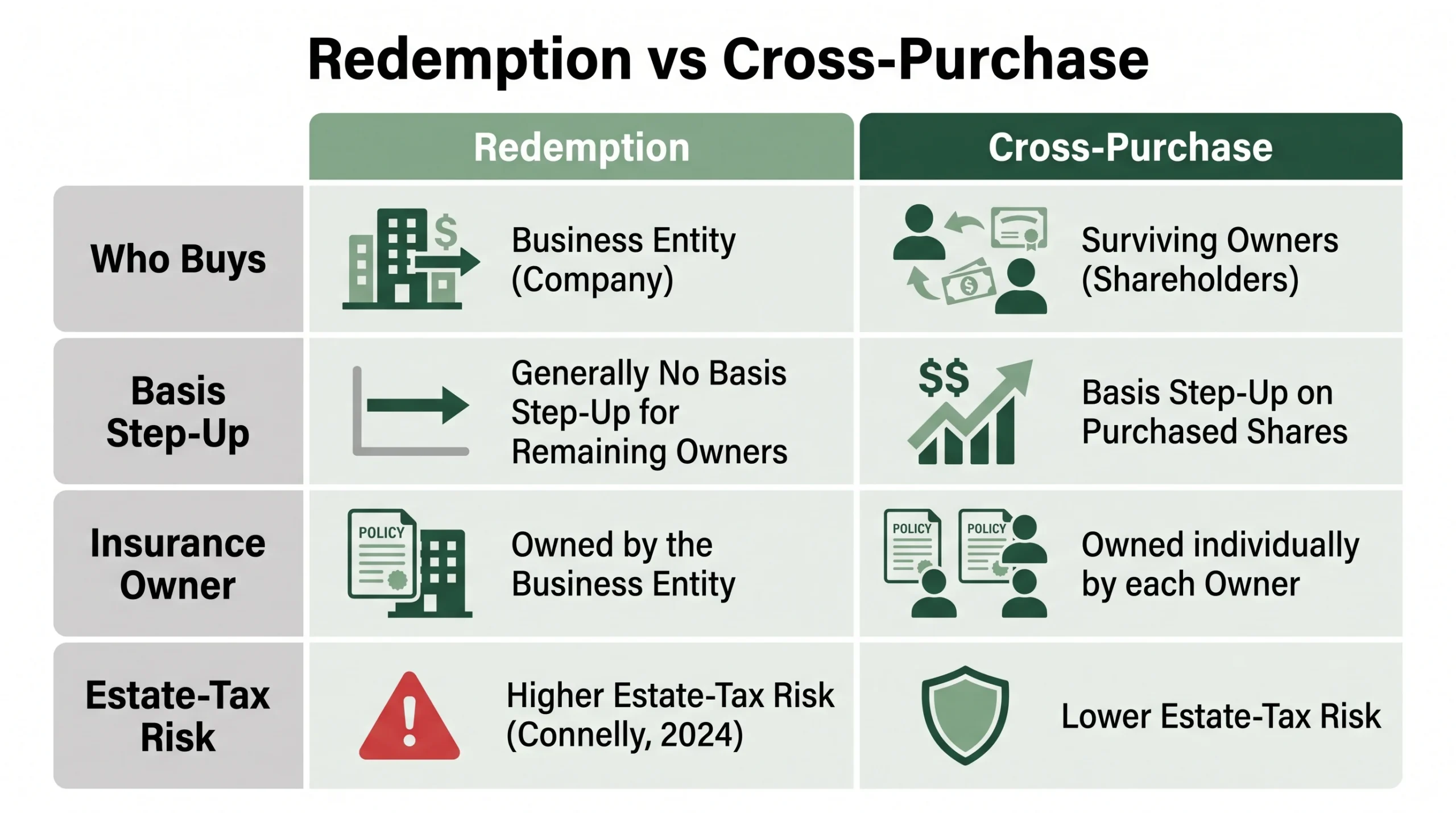
Does a cross-purchase give owners a basis step-up?
Yes, a cross-purchase gives buying owners a cost basis in the shares they buy, and a redemption does not. In a cross-purchase, each buyer pays cash and takes a basis equal to what they paid. If they sell those shares later, the higher basis reduces the taxable gain, a saving that grows as the company grows.
In a redemption, the surviving owners get no basis increase in their existing shares. Their percentage climbs, but the tax cost in each share stays the same. Selling later, the low basis means a bigger capital gain. The difference is not about how much the company is worth. It is about who buys the shares and what basis the buyer takes. For more, see how S corporation owner basis moves over time.
| Feature | Redemption (entity purchase) | Cross-purchase |
| Who buys the shares | The company | The remaining owners |
| Who owns the insurance | Usually the company | Usually each owner |
| Basis step-up for buyers | No increase in existing shares | Cost basis in new shares |
| Estate-tax / Connelly risk | Higher; proceeds can lift value | Lower; proceeds stay outside |
| Number of policies | Fewer; one set for all owners | More; grows with each owner |
The table shows why advisers do not treat the two as equal. Basis, insurance ownership, and estate exposure all move together for each structure. A cross-purchase trades simpler paperwork for a better tax result. A redemption trades that result for easier funding. Neither is right for every company; the answer turns on the owners’ ages, their number, and the tax picture.
How does Connelly change insurance-funded redemptions?
The Connelly decision changed how a company-owned redemption is valued for estate tax. In Connelly v. United States, decided in 2024, the U.S. Supreme Court held that life-insurance proceeds a company receives to redeem a deceased shareholder’s stock are included in the company’s fair market value for estate-tax purposes. The Court also held that the duty to redeem the shares does not offset that value. So the insurance money counts as a company asset when the shares are valued.
The effect can be large. Say two owners each hold half of a company worth $3 million, and it holds a $3 million policy on each. When one dies, the company collects $3 million, so under Connelly it is now worth $6 million. The deceased owner’s half is valued at $3 million, not $1.5 million, and the estate tax rises. That is why many advisers now favor a cross-purchase, or a separate insurance limited liability company, so the proceeds never sit inside the company. Our guide to ILIT cross-purchase buy-sells covers one way to keep policies out of the estate. Because Connelly is recent, run any redemption plan past your tax and legal counsel.
What is the transfer-for-value trap in a cross-purchase?
The transfer-for-value rule can make part of a death benefit taxable when a policy is sold or transferred for value. Death benefits are normally income-tax free. But Internal Revenue Code Section 101 pulls that shield away if a policy changes hands for value. In a cross-purchase, the risk appears when owners move policies among themselves, often after one owner leaves and the others swap policies to keep coverage in balance.
Exceptions exist. A transfer to the insured, to a partner of the insured, or to a partnership in which the insured is a partner does not trigger the rule. So owners often place the policies in an insurance limited liability company or partnership to stay safe. The number-of-policies problem drives this too. A cross-purchase among many owners needs many policies, and every later change is a chance to trip the rule. None of this removes the need for a sound price, so valuation and tax planning belong together, with counsel.
Which structure is right for your company?
The right structure depends on your tax goals, your number of owners, and your funding plan. A cross-purchase tends to win when a basis step-up matters and estate-tax exposure is real. A redemption can fit when there are many owners and separate policies would be hard to manage, as long as the Connelly result is planned around. Redemptions also raise questions under Internal Revenue Code Section 302, which decides whether a buyback is taxed as a sale or a dividend.
Whatever structure you choose, the price mechanism has to hold up. A fixed formula can drift from real value over years, so a regular independent appraisal keeps the number defensible. During transaction advisory work, an appraiser tests the formula, the funding, and the discounts on a minority stake. The Sofer Difference runs through four phases: Discovery, Diligence, Analysis, and Delivery. Large firms like Alvarez & Marsal, Stout, and Kroll serve the biggest deals, while Sofer Advisors focuses on middle-market owners.
Frequently Asked Questions
What is the difference between a redemption and a cross-purchase buy-sell?
The difference is who buys the departing owner’s shares. In a redemption, the company buys them back and usually owns the funding insurance. In a cross-purchase, the remaining owners buy the shares directly and each owner holds policies on the others. The choice drives basis, estate tax, and how death benefits are treated, so weigh a valuation and tax counsel first.
What are the four types of buy-sell agreements?
The common forms are the redemption or entity purchase, the cross-purchase, the hybrid or wait-and-see agreement, and the one-way buy-sell. A redemption uses the company as buyer, and a cross-purchase uses the other owners. A hybrid lets the parties decide at the event which applies. A one-way agreement fits a single owner selling to one successor.
Is a redemption considered a sale?
A redemption is a sale of shares, but the tax result is not always capital gain. Under Internal Revenue Code Section 302, a buyback is taxed at capital-gain rates only if it meets certain tests, such as ending or greatly reducing the owner’s stake. If it fails those tests, the payment can be taxed as a dividend instead. The facts decide the outcome, so ask tax counsel.
What are the disadvantages of redeeming shares?
A redemption gives surviving owners no basis increase in their existing shares, which can mean a larger capital gain on a later sale. It can also raise estate tax after the Connelly ruling, since company-owned insurance proceeds can lift the value of the deceased owner’s stock. The company must also have the cash or coverage to fund the buyback. Weigh each drawback against the simpler funding.
What is a redemption purchase?
A redemption purchase is when a company buys back its own shares from an owner or an owner’s estate. The company is the buyer, and it retires or holds the shares. In a buy-sell, the company often funds the purchase with a life-insurance policy it owns on each owner. The remaining owners then hold a larger percentage without paying for the shares.
Does the surviving owner get a basis step-up in a redemption?
No, a surviving owner does not get a basis step-up in a redemption. Their percentage rises because fewer shares remain, but the basis in their existing shares does not change. That low basis can create a larger capital gain when they sell later. A cross-purchase avoids this, since buyers take a cost basis in what they paid.
How does the Connelly decision affect insurance-funded buy-sells?
The Connelly decision means life-insurance proceeds a company holds to redeem a deceased owner’s shares are counted in the company’s value for estate tax, and the duty to redeem does not offset that value. So a company-owned redemption can inflate the estate-tax value of the deceased owner’s stock. Many owners now use a cross-purchase or a separate insurance entity to keep the proceeds outside the company, with guidance from counsel.
What is the transfer-for-value rule?
The transfer-for-value rule can make part of a death benefit taxable when a life-insurance policy is transferred for value. Under Internal Revenue Code Section 101, death benefits are usually income-tax free, but that shield can fall away after such a transfer. Exceptions cover a transfer to the insured, to a partner of the insured, or to a partnership in which the insured is a partner. Owners often use an insurance partnership to stay inside those.
How much does a buy-sell valuation from Sofer Advisors cost?
A buy-sell valuation from Sofer Advisors falls in the Standard Business Valuation range of $7,500 to $25,000, based on its published service pricing, and most engagements run four to eight weeks. Cost depends on the number of owners, the entity type, and the depth of the review. For a quote, request a consultation with your ownership details and current buy-sell terms.
Related Case Studies
- Buy-Sell Agreement Valuation: A Complete Guide for Business Partners
- Business Valuation for a Partner Buyout: A Complete Transition Guide
- Partnership Dissociation: How a Departing Partner’s Stake Is Valued
Executive Summary
A redemption has the company buy a departing owner’s shares; a cross-purchase has the remaining owners buy them. The structures split on three tax levers. A cross-purchase gives buyers a cost basis in the new shares, while a redemption gives survivors no basis increase and a larger gain later. The 2024 Connelly ruling means company-owned insurance used to fund a redemption can raise the estate-tax value of the deceased owner’s stock. A cross-purchase funded by many policies can trip the transfer-for-value rule unless an exception applies. Under either path, the price formula needs a regular independent review, and the tax questions need qualified counsel.
What Should You Do Next?
Start by pulling your current buy-sell agreement and checking who is named as the buyer and who owns each policy. Compare the basis and estate-tax result against the alternative, and ask whether Connelly changes your funding plan. Then schedule an independent valuation so the price formula does not drift.
David Hern CPA ABV ASA, founder of Sofer Advisors, provides independent, defensible valuations for buy-sell agreements and owner transitions. Schedule a consultation to discuss your structure with your tax and legal team.
People Also Read
- How Is a Buy-Sell Agreement Funded With Life Insurance?
- Stepped-Up Basis at Death: What Business Owners Must Know
About the Author
This guide was prepared by David Hern CPA ABV ASA, founder of Sofer Advisors, a business valuation firm headquartered in Atlanta, GA serving clients across the United States. David holds dual accreditations as an Accredited Senior Appraiser (ASA) and is Accredited in Business Valuation (ABV), credentials recognized by the IRS, SEC, and FINRA. He also holds the Certified Exit Planning Advisor (CEPA) designation. With 15+ years of valuation experience, David has served as an expert witness in 11+ cases across multiple jurisdictions and built Sofer Advisors into an Inc. 5000-recognized firm with 180+ five-star Google reviews. Its full W2 employee team maintains subscriptions to all major valuation databases and operates under a next business day response policy.
For professional business valuation services, visit soferadvisors.com/about-us/ or contact Sofer Advisors at soferadvisors.com/contact-us/.
Disclaimer: This content is for informational purposes only and does not constitute professional valuation advice. Business valuation conclusions depend on specific facts and circumstances. Contact Sofer Advisors for guidance regarding your specific situation.









