


Last Updated: October 2026
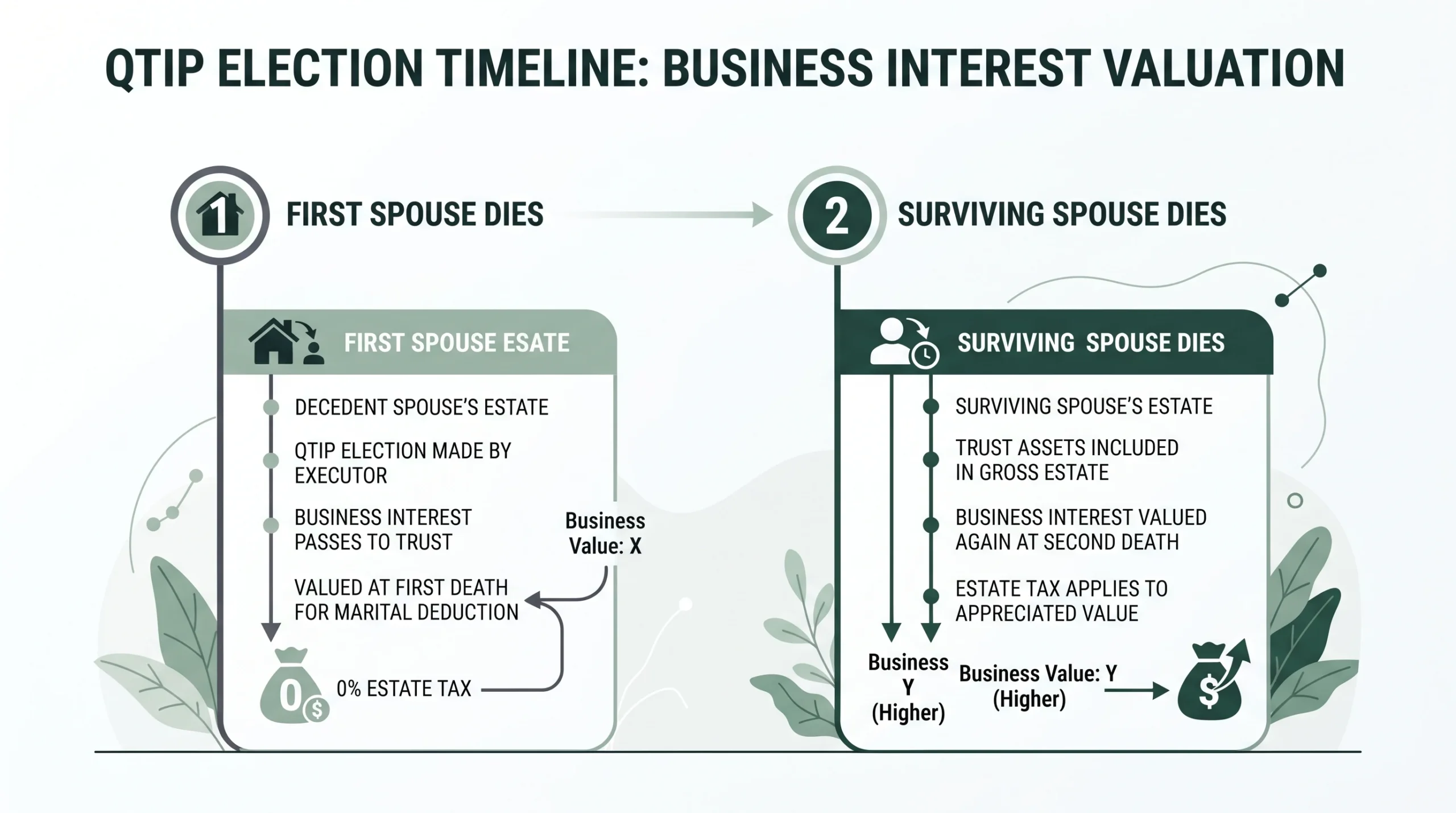
A QTIP election fixes the value of a business interest twice. The first time is at the death of the first spouse. The second is at the death of the survivor. QTIP stands for qualified terminable interest property. The election lets a married couple defer estate tax on property left in trust for the surviving spouse, while still fixing who inherits it at the second death. The hard part is valuation. The same closely held interest has to carry a value for the marital deduction at the first death, then get pulled back in and valued again when the survivor dies.
The team at Sofer Advisors values closely held business interests held in QTIP trusts for estate attorneys, CPAs, and executors, backed by Inc. 5000 recognition in both 2024 and 2025. Both valuations have to agree in method and stand up under review. A number that drifts between the two filings is the kind of gap an IRS examiner looks for first.
This guide explains what a QTIP election is, what the estate must prove to claim it, and which form and schedule report it. It also covers how the business interest is valued at each death, the reverse QTIP election for the generation skipping tax, the court cases, and the deadline.
Key Takeaways
- The election defers tax, not the valuation: QTIP property qualifies for the marital deduction at the first death, so no estate tax is due then, but the interest still has to be valued and reported.
- Section 2056(b)(7) sets the rules: the surviving spouse must receive all income for life, and the executor must make the election on a timely filed return.
- Schedule M carries it: the QTIP election is made on Form 706, Schedule M, by listing the property and electing it as qualified terminable interest property.
- Section 2044 brings it back: at the survivor’s death, the same property is included in that estate and valued again at current fair market value.
- A reverse QTIP election preserves GST exemption: it treats the first spouse as the transferor for generation skipping tax, which matters when the trust benefits grandchildren.
Each of these pieces ties into the wider estate plan. The sections below take them one at a time.
Why Is QTIP Election Valuation Important to Understand?
A QTIP election valuation decides how much tax a family pays across two deaths instead of one. At the first death, the value sets the marital deduction and the basis the trust carries forward. At the second death, a fresh value sets the estate tax the survivor’s estate owes. Price the interest too low at the first death and the IRS may argue the deduction was overstated. Let the two valuations contradict each other and the duty of consistency can bind the survivor’s estate to the earlier number. The valuation is what keeps both returns defensible.
What Is a QTIP Election?
A QTIP election is a choice the executor makes to claim the marital deduction for property that does not pass outright to the surviving spouse. Normally the deduction requires the spouse to receive the property free of strings. Qualified terminable interest property is the exception. The first spouse can leave the asset in trust, give the survivor income for life, and still name who takes the remainder, often children from an earlier marriage. The election is the price of that control. By electing, the executor agrees the property will be taxed in the survivor’s estate later rather than the first spouse’s estate now.
What Must the Estate Prove to Claim the Election?
The estate must prove the trust meets three tests under IRC Section 2056(b)(7). First, the surviving spouse must be entitled to all the income from the property, payable at least annually, for life. Second, no person can hold a power to appoint the property to anyone other than the spouse during the spouse’s life. Third, the executor must affirmatively elect QTIP treatment on the estate tax return. If the trust pays income to anyone else, or lets a trustee divert principal away from the spouse, the property fails the test and the deduction is lost. The valuation report supports the numbers, but the trust terms carry the qualification.
Which Form and Schedule Report the Election?
The QTIP election is made on Form 706, the federal estate tax return, using Schedule M. Schedule M is where the executor lists property passing to the surviving spouse and claims the marital deduction. The executor identifies the trust property, states its value, and elects it as qualified terminable interest property. See the IRS overview of Form 706 for the filing itself. The listed value is the appraised fair market value of the business interest as of the date of death, or the alternate valuation date if the estate elects it. This is why a defensible appraisal matters at the first death even though no tax is due. The value flows into the deduction and sets the record the IRS reads later.
How Is a Closely Held Business Interest Valued at Each Death?
At the first death, the business interest is valued at fair market value and reported on Schedule M. Because the interest usually lacks control and a market, the appraiser applies a discount for lack of control and a discount for lack of marketability. Those discounts lower the value that enters the marital deduction. At the survivor’s death, Section 2044 includes the same property in the survivor’s gross estate and requires a fresh valuation at that later date. The business may have grown, shrunk, or changed hands. The discounts are tested again against the facts then. Sofer Advisors documents the company you can read more about in its tax and estate reporting valuations, tying each discount to the interest and the date so the two reports read as one consistent record.
What About the Reverse QTIP Election, Court Cases, and the Deadline?
A reverse QTIP election, under Section 2652(a)(3), lets the first spouse’s estate stay the transferor of the property for generation skipping tax, even though the QTIP election shifts the estate tax to the survivor. Families use it to apply the first spouse’s GST exemption to a trust meant for grandchildren. Two cases frame the valuation risk. Estate of Letts v. Commissioner applied the duty of consistency, holding that a survivor’s estate must include QTIP property when the first estate claimed the deduction, even if that election was flawed. Estate of Clack addressed the income rules that qualify a trust in the first place. On timing, the election must be made on a timely filed Form 706, including extensions, so the deadline is the return deadline itself. Miss it and the deduction, and the planning behind it, can be lost.
Who Values a QTIP Interest, and How Do the Options Compare?
Executors pick a valuation partner based on the size of the interest, the audit exposure, and the budget. Large national firms such as Alvarez & Marsal, Stout, and Kroll serve big public companies with broad advisory teams. Sofer Advisors focuses on defensible, partner led valuations for closely held and middle market businesses, with expert witness testimony in 11+ cases behind its reports and 180+ five-star Google reviews. The table below sets out the common options.
| Provider | Typical role | Best for |
|---|---|---|
| Specialized valuation firm (e.g. Sofer Advisors) | Values the interest at each death and documents consistent discounts | Family and closely held trusts needing audit-ready support |
| Large national firm | Broad advisory plus valuation at enterprise scale | Large public companies with complex, multi-entity estates |
| Estate attorney | Drafts the trust and makes the election; does not value | Families needing the legal structure built and reviewed |
Sofer Advisors runs each engagement through a four-phase process it calls The Sofer Difference, moving from Discovery to Diligence to Analysis to Delivery. That structure keeps the first-death value and the Section 2044 value tied to the same method and facts. It reflects the Heart of a Teacher approach, which means explaining the reasoning behind a number rather than just handing over a figure. For a QTIP trust that will be reviewed twice, an independent valuation supplies both the value and the trail of evidence behind it.
Frequently Asked Questions
What is a QTIP election?
A QTIP election is a choice the executor makes on the estate tax return to claim the marital deduction for property left in trust for the surviving spouse. It lets the first spouse control who inherits the remainder while still deferring estate tax. In exchange, the property is taxed in the survivor’s estate later. Sofer Advisors values the business interest that funds the trust so the deduction rests on a defensible number.
What must the estate prove to claim the election?
The estate must prove the trust gives the surviving spouse all income for life, payable at least annually, and that no one can appoint the property away from the spouse during life. The executor must also elect QTIP treatment on a timely filed return under Section 2056(b)(7). Fail any test and the deduction is lost. Sofer Advisors supports the reported value so the qualification is not undone by a weak appraisal.
Which form and schedule report a QTIP election?
The election is made on Form 706, the federal estate tax return, using Schedule M. The executor lists the trust property, states its fair market value, and elects it as qualified terminable interest property. The listed value is the appraised value as of the date of death or the alternate valuation date. Sofer Advisors prepares the date-of-death valuation that Schedule M reports, with support an examiner can follow line by line.
How is a closely held business interest in a QTIP trust valued at the first death?
It is valued at fair market value as of the date of death and reported on Schedule M. Because the interest usually lacks control and a ready market, the appraiser applies a discount for lack of control and a discount for lack of marketability. Those discounts lower the value entering the marital deduction. Sofer Advisors ties each discount to the specific interest and date, so the first-death report stands on its own.
How is QTIP property revalued in the surviving spouse’s estate?
Under Section 2044, the same property is included in the surviving spouse’s gross estate and valued again at fair market value as of that later death. The business may have grown or changed, so the discounts are tested fresh against the facts then. The two valuations must stay consistent in method. Sofer Advisors prepares the second valuation so it reconciles cleanly with the number first reported years earlier.
What is a reverse QTIP election?
A reverse QTIP election, under Section 2652(a)(3), keeps the first spouse as the transferor of the property for generation skipping tax, even though the regular QTIP election shifts the estate tax to the survivor. It lets the first spouse’s GST exemption apply to a trust meant for grandchildren. The two elections work together. Sofer Advisors values the interest so both the GST exemption allocation and the marital deduction rest on the same figure.
What court cases shaped QTIP valuation?
Estate of Letts v. Commissioner applied the duty of consistency, holding that a survivor’s estate must include QTIP property when the first estate claimed the deduction, even if the election was flawed. Estate of Clack addressed the income rules that let a trust qualify at all. Together they show the first return binds the second. Sofer Advisors keeps the two valuations consistent so these precedents work for the family, not against it.
What is the deadline for a QTIP election?
The election must be made on a timely filed Form 706, including any extensions, so the deadline is the estate tax return deadline itself, generally nine months after death plus a six-month extension. Once the return is filed, the election is largely irrevocable. Missing it can forfeit the marital deduction. Sofer Advisors delivers the valuation on a schedule that fits the return deadline, so the election is never held up waiting on a number.
How much does a QTIP election valuation cost?
Most QTIP interest valuations run from $7,500 to $25,000 and take about two to six weeks, depending on the business interest and the deadline. The range covers the discount analysis needed to support the value on Schedule M. A flat fee is quoted up front, so the cost is clear before the work starts. Sofer Advisors scopes the engagement first, then quotes a fixed price. Request a free estimate for your situation.
Related Case Studies
- Valuing a Closely Held Business Interest for Form 706
- Valuing a Business Interest for GST Exemption Allocation
- Valuing a Business Interest to Fund a SLAT
Executive Summary
A QTIP election claims the marital deduction for property left in trust for a surviving spouse, so no estate tax is due at the first death while the first spouse still controls the remainder. The trade is that the same property is taxed in the survivor’s estate later under Section 2044. The election is made on Form 706, Schedule M, and requires that the spouse get all income for life under Section 2056(b)(7). The business interest is valued at fair market value at the first death, with discounts for lack of control and marketability, then valued again at the second death. A reverse QTIP election preserves the first spouse’s GST exemption. The two valuations must stay consistent, because the duty of consistency can bind the survivor’s estate to the earlier number. The first step is a defensible appraisal at the first death.
What Should You Do Next?
Gather the trust document, the business financials, and the date of death, since a clean file supports a defensible value on Schedule M. Confirm whether a reverse QTIP election is needed before the return is filed. This guide was prepared by David Hern CPA ABV ASA, founder of Sofer Advisors, an Inc. 5000 firm specializing in neutral third-party valuations for tax and estate reporting. Schedule a free consultation to discuss your specific situation.
People Also Read
- Valuation of Closely Held Business for Estate Tax Purposes
- Fair Market Value for Estate Tax: What Executors Need
About the Author
This guide was prepared by David Hern CPA ABV ASA, founder of Sofer Advisors, a business valuation firm headquartered in Atlanta, GA serving clients across the United States. David holds dual accreditations as an Accredited Senior Appraiser (ASA) and is Accredited in Business Valuation (ABV), credentials recognized by the IRS, SEC, and FINRA. He also holds the Certified Exit Planning Advisor (CEPA) designation. With 15+ years of valuation experience, David has served as an expert witness in 11+ cases across multiple jurisdictions and built Sofer Advisors into an Inc. 5,000-recognized firm with 180+ five-star Google reviews. Its full W2 employee team maintains subscriptions to all major valuation databases and operates under a next business day response policy.
For professional business valuation services, visit soferadvisors.com/about-us/ or contact Sofer Advisors at soferadvisors.com/contact-us/.
This content is for informational purposes only and does not constitute professional valuation advice. Business valuation conclusions depend on specific facts and circumstances. Contact Sofer Advisors for guidance regarding your specific situation.









