


Last Updated: November 2026
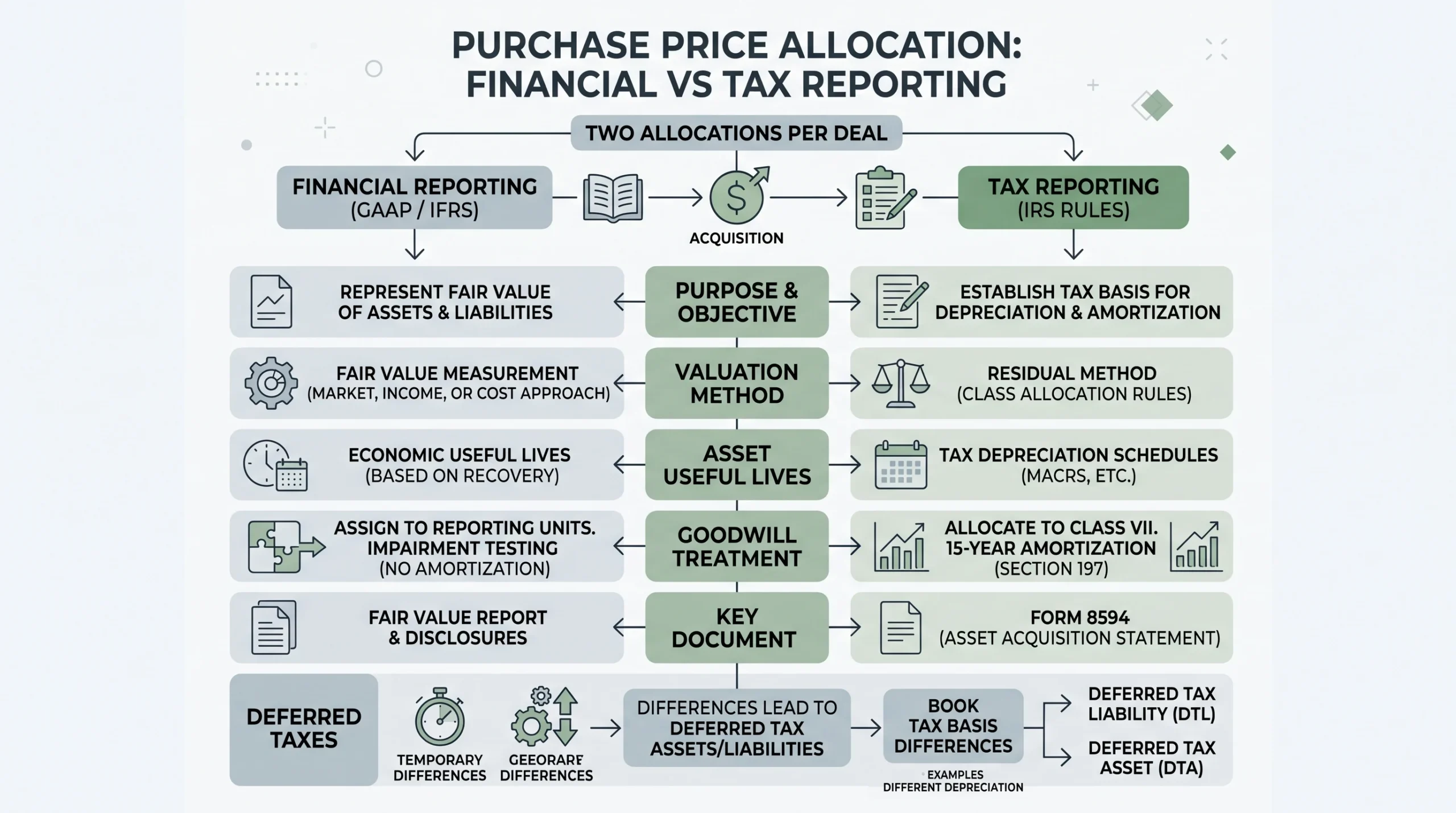
Every acquisition needs two purchase price allocations, not one. A financial reporting allocation follows ASC 805 and records each asset at fair value. A tax allocation follows IRC Section 1060 and uses a residual method across seven asset classes. Because the two use different methods, they usually land on different numbers for the same deal, and those gaps create deferred taxes.
The team at Sofer Advisors prepares both allocations for business owners, CPAs, and deal teams across the country.
This guide explains how each allocation works, where they differ, and why those differences drive deferred taxes.
Key Takeaways
- Two allocations per deal: Every acquisition needs a financial reporting PPA under ASC 805 and a tax PPA under IRC Section 1060.
- Different methods: The book PPA records assets at fair value. The tax PPA uses a residual method across seven asset classes.
- Goodwill splits: Book goodwill is not amortized and is tested for impairment under ASC 350. Tax goodwill amortizes over 15 years under Section 197.
- Form 8594: The buyer and seller report the tax allocation to the IRS on Form 8594.
- Deferred taxes: The gap between book values and tax bases creates temporary differences, which drive deferred taxes.
What is a purchase price allocation?
A purchase price allocation, or PPA, breaks a purchase price into parts. A buyer pays one total price for a business. That price buys many things. It buys equipment, inventory, contracts, brand names, and more. A PPA assigns a value to each one.
Why split the price at all? Because the parts get treated differently later. Equipment depreciates. Many intangibles amortize. Goodwill sits on the books. Each line drives future expenses, deductions, and taxes. So the allocation shapes the numbers for years.
There are two allocations because two rulebooks apply. Financial reporting follows US GAAP, mainly ASC 805. Tax follows the Internal Revenue Code, mainly Section 1060. They ask different questions. They get different answers.
How does financial-reporting PPA work under ASC 805?
ASC 805 covers business combinations under US GAAP. It tells the buyer to record what it acquired at fair value. Fair value is the price an asset would fetch in an orderly sale.
The buyer identifies each asset and liability. Tangible items come first. These include cash, receivables, inventory, and equipment. Then come the identifiable intangibles. These include customer relationships, technology, trademarks, and non-competes. Each one gets its own fair value.
Goodwill is the leftover. The buyer adds up the fair value of all identified assets. It then subtracts the liabilities. Whatever price remains above that net total becomes goodwill. Goodwill is not a specific asset. It reflects the premium paid for the business as a whole.
Fair value is not a guess. ASC 805 points to the market, income, and cost approaches. A customer list might be valued on the income it brings in. Equipment might be valued on what it would cost to replace. The method depends on the asset. The work takes real judgment. For this reason, a buyer often brings in an outside appraiser.
How does tax PPA work under IRC Section 1060?
Tax PPA follows IRC Section 1060. It uses the residual method. This is not a free fair-value exercise. The buyer and seller sort every asset into one of seven classes. The price then fills those classes in order.
The classes run from most liquid to least. Class I is cash and cash equivalents. Class II covers actively traded items, such as securities. Class III is accounts receivable and similar assets. Class IV is inventory. Class V is most tangible property, such as equipment. Class VI is Section 197 intangibles other than goodwill. Class VII is goodwill and going-concern value.
The price fills each class up to its fair value, in that order. Whatever is left lands in Class VII as goodwill. That remainder is the residual. This is why tax goodwill is a plug, not a direct estimate.
Both sides report the allocation to the IRS on Form 8594. The buyer and seller are expected to agree. Their numbers should match. The allocation sets the buyer’s tax basis in each asset. That basis then drives future depreciation and amortization deductions.
Timing matters here. The allocation is set at closing. It is reported for the tax year of the sale. A later change can force an amended Form 8594. So buyers lock the numbers early. They often write the allocation into the purchase agreement.
How does goodwill treatment differ between book and tax?
Goodwill is where book and tax split most clearly. The two rules treat it in opposite ways.
For financial reporting, book goodwill is not amortized. The buyer holds it on the balance sheet. Each year, under ASC 350, the company tests it for impairment. If the value has dropped, the company writes it down. That write-down hits earnings as a non-cash charge. If the value holds, nothing changes.
For tax, goodwill works the other way. Acquired goodwill is a Section 197 intangible. The buyer amortizes it straight-line over 15 years. That creates a steady deduction every year. The deduction applies whether or not the business thrives.
So one deal can show no book expense for goodwill in a given year. Yet it can still claim a tax deduction for that same goodwill. The gap is normal. It is built into the rules.
How do the two allocations treat other intangibles?
Identifiable intangibles also differ between the two systems. The groupings and the useful lives are not the same.
For book purposes, each intangible stands on its own. A customer list, a trademark, and a patent each get a fair value. The company then amortizes most of them over their useful lives. A customer relationship might run ten years. A technology asset might run five. Some intangibles, such as certain trademarks, have no set life. Those are not amortized. They are tested for impairment instead.
For tax purposes, the picture is simpler. Most acquired intangibles are Section 197 assets. That group includes goodwill, customer lists, trademarks, and non-competes. Nearly all of them amortize over the same 15 years. The real useful life does not matter for tax. The 15-year rule applies across the whole group.
So a trademark might amortize over 15 years for tax. The same trademark might never amortize for book. One asset, two very different schedules.
These differences add up fast in a larger deal. A single acquisition can carry a dozen separate intangibles. Each one may have its own book life. Each one still folds into the 15-year tax group. That is why careful tracking matters from day one.
Which allocation should you prioritize?
You do not pick one allocation over the other. Both are required. A company that files financial statements needs the book PPA. The buyer that files a tax return needs the tax PPA. Skipping either one creates a compliance problem.
The table below lines up the main differences.
| Feature | Book PPA (ASC 805) | Tax PPA (IRC Section 1060) |
|---|---|---|
| Purpose | Fair value for financial statements | Tax basis for the buyer |
| Method | Fair value of each asset | Residual method across seven classes |
| Where it is reported | Audited financial statements | IRS Form 8594 |
| Goodwill | Not amortized; impairment tested under ASC 350 | Amortized over 15 years under Section 197 |
| Intangibles | Amortized over useful life | Amortized over 15 years |
The goal is to run both allocations well and keep them reconciled. The values will differ. That is expected. What matters is that you can explain each number and track the gap between the two.
Why do book and tax differences create deferred taxes?
The two allocations rarely match. That mismatch creates temporary differences. Temporary differences are the root of deferred taxes.
The logic is simple. Book value and tax basis start at different numbers. They also change at different speeds. Book goodwill may stay flat while tax goodwill shrinks each year. So the two figures drift apart over time.
When the book value of an asset sits above its tax basis, the company records a deferred tax liability. The reverse creates a deferred tax asset. These entries live on the balance sheet. They reconcile the two worlds.
Picture a simple case. The numbers here are illustrative. A buyer pays for a business and books $3 million of goodwill. For tax, goodwill is also $3 million. In year one, book goodwill stays at $3 million. Tax goodwill drops by $200,000 through amortization. That $200,000 gap feeds the deferred tax math. Multiply the gap by the tax rate, and you have the deferred entry for the year.
Accountants track these differences on a schedule. Each acquired asset gets a book value and a tax basis. The gap, times the tax rate, sets the deferred tax entry. Clean records make later filings and audits far easier.
Frequently Asked Questions
What is a purchase price allocation?
A purchase price allocation assigns the total price of an acquisition to the assets and liabilities acquired. It puts a value on each item, from equipment to intangibles to goodwill. Those values then drive future depreciation, amortization, and taxes.
Why are there two different PPAs for one deal?
One allocation meets financial reporting rules under US GAAP, mainly ASC 805. The other meets tax rules under IRC Section 1060. The two use different methods, so they usually produce different values for the same assets.
What is Form 8594?
Form 8594 is the Asset Acquisition Statement. The buyer and seller each file it with the IRS to report how they allocated the price under Section 1060. The two filings are expected to agree.
What is the residual method?
The residual method fills seven asset classes in order, each up to its fair value. Any price left over after the first six classes is assigned to goodwill in Class VII. So tax goodwill is the remainder, not a direct estimate.
How is book goodwill treated under ASC 350?
Book goodwill is not amortized. Instead, the company tests it for impairment, at least once a year under ASC 350. If the value has fallen, the company writes it down and records a non-cash charge to earnings.
How long is acquired goodwill amortized for tax?
Acquired goodwill is a Section 197 intangible. For tax, the buyer amortizes it straight-line over 15 years. This is true even though book goodwill is never amortized.
What are the seven asset classes under Section 1060?
The classes are cash, actively traded items, accounts receivable, inventory, other tangible property, Section 197 intangibles other than goodwill, and goodwill and going-concern value. The price fills them in that order.
Why does a PPA create deferred taxes?
The book value and tax basis of an asset often differ, and they change at different speeds. That gap is a temporary difference. A book value above tax basis creates a deferred tax liability, and the reverse creates a deferred tax asset.
Do the buyer and seller have to agree on the tax allocation?
Yes. Both parties report the same allocation to the IRS on Form 8594. Inconsistent filings can draw IRS scrutiny, so the buyer and seller usually set the allocation in the purchase agreement.
Related Case Studies
- Valuing Customer Relationships in a Purchase Price Allocation
- What is PPA in Accounting? Purchase Price Allocation Explained
- Purchase Price Allocation ASC 805 and IFRS 3: Complete Guide for Business Leaders
Executive Summary
Every acquisition needs a financial reporting PPA under ASC 805 and a tax PPA under IRC Section 1060. The book PPA records assets at fair value. The tax PPA uses a residual method across seven asset classes. Book goodwill is not amortized and is tested for impairment under ASC 350. Tax goodwill amortizes over 15 years under Section 197. The buyer and seller report the tax allocation to the IRS on Form 8594. The gap between book values and tax bases creates temporary differences, which drive deferred taxes.
What Should You Do Next?
Start by gathering your deal documents and the closing balance sheet. List the assets you acquired, both tangible and intangible. Then map each one to its book fair value and its tax class. If a deal just closed, do not wait, because the allocation affects your first post-close filing.
Sofer Advisors prepares both allocations and keeps them reconciled, with work led by David Hern CPA ABV ASA CVA. Schedule a free consultation to discuss your transaction.
People Also Read
- Is Goodwill Amortized or Impaired? Book vs Tax
- Goodwill Calculation Example: Purchase Price to Residual
About the Author
This guide was prepared by David Hern CPA ABV ASA CVA, founder of Sofer Advisors, a business valuation firm headquartered in Atlanta, GA serving clients across the United States. David holds accreditations as an Accredited Senior Appraiser (ASA) and is Accredited in Business Valuation (ABV), credentials recognized by the IRS, SEC, and FINRA, and is also a Certified Valuation Analyst (CVA). David has served as an expert witness in dozens of cases across multiple jurisdictions, and Sofer Advisors is an Inc. 5000 honoree in 2024 and 2025 with 240+ five-star Google reviews.
For professional business valuation services, visit soferadvisors.com/about-us/ or contact Sofer Advisors at soferadvisors.com/contact-us/.
Disclaimer: This content is for informational purposes only and does not constitute professional valuation advice. Business valuation conclusions depend on specific facts and circumstances. Contact Sofer Advisors for guidance regarding your specific situation.