


Last Updated: November 2026
AI companies are valued mostly on forecast revenue rather than current profit, because most are young and growing fast but not yet consistently profitable. Analysts start from expected revenue and the growth behind it, apply a forward revenue multiple, and usually set a discounted cash flow model beside it. Standard profit-based methods rarely work, because early AI firms have little past earnings to lean on.
The team at Sofer Advisors values technology and software companies for owners, investors, and the advisors who serve them.
This guide explains how a forward revenue multiple and a discounted cash flow model work, what drives the value, and where the risk hides.
Key Takeaways
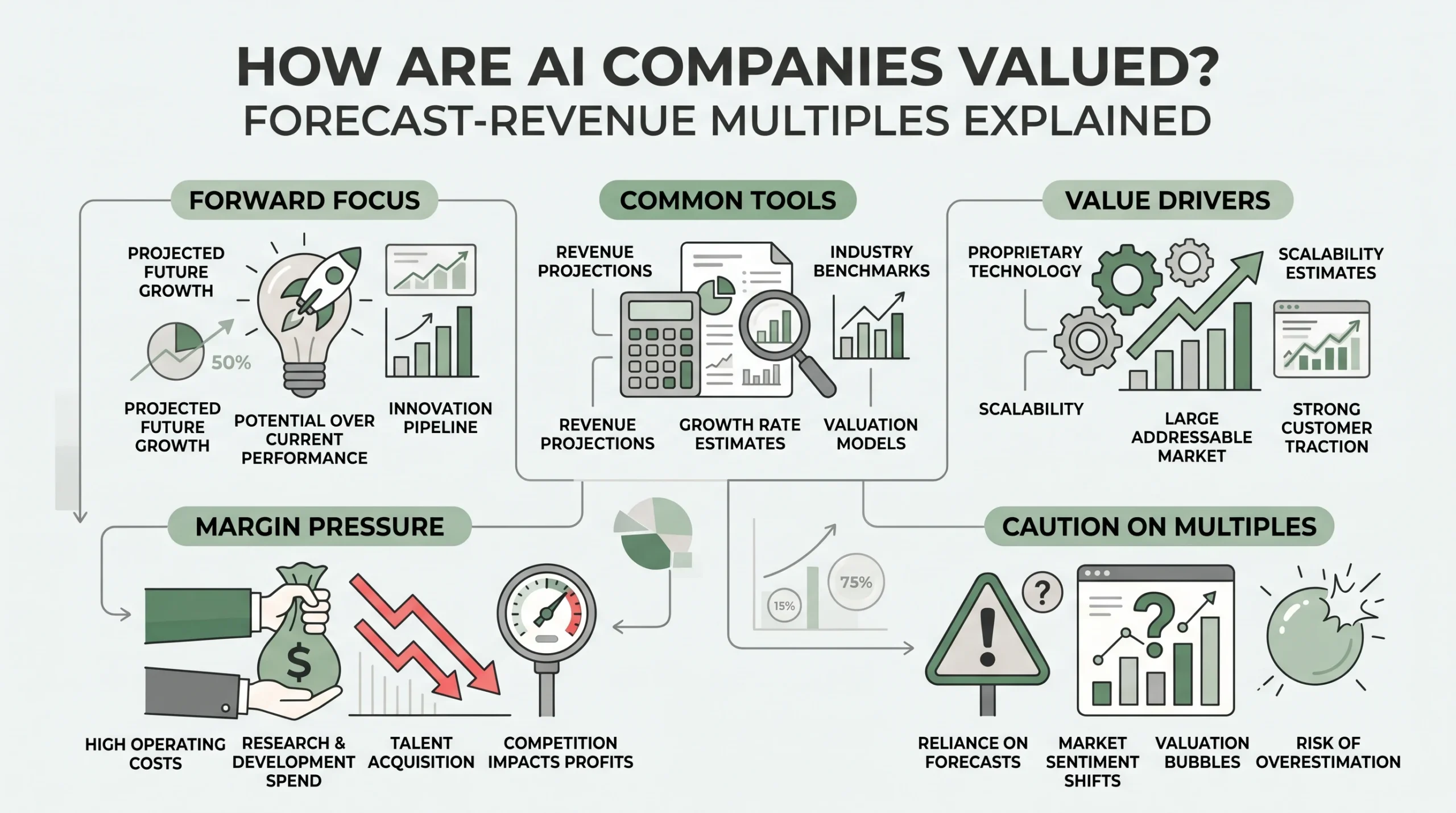
- Forward focus: AI firms are often valued on forecast revenue, not current profit.
- Common tools: Analysts pair a forward revenue multiple with a discounted cash flow model.
- Value drivers: Growth rate, gross margin, customer retention, data, and a real moat.
- Margin pressure: Compute and inference costs weigh on AI gross margins.
- Caution on multiples: Very high forecast multiples carry real downside if growth slows.
Why is profit-based valuation hard for AI companies?
Many AI companies reinvest almost everything they earn. They spend heavily on research, talent, and computing power. Earnings often run negative for years. That breaks the methods that rely on profit.
A price-to-earnings multiple needs earnings. An EBITDA multiple needs positive EBITDA. Early AI firms frequently show neither. So an analyst cannot anchor the value to a profit figure that does not yet exist.
Value here sits mostly in things you cannot touch. It lives in the software, the data, the models, and the people. It also lives in the revenue the business expects to earn later. A good valuation has to capture that future, not just the current loss.
What is a forward revenue multiple?
A forward revenue multiple values a company against revenue it has not booked yet. The common form divides enterprise value by expected revenue over the next twelve months. Analysts call that figure NTM revenue. A related version uses forward annual recurring revenue, or forward ARR.
Why look forward? Because a fast-growing firm can double its revenue in a year. A backward-looking multiple would miss most of that growth. The forward view tries to price the business the market is becoming, not the one it was.
Here is a simple, illustrative example. Suppose a firm expects 50 million dollars in revenue next year. Suppose similar firms trade near a given multiple of forward revenue. You would apply that multiple to the 50 million to get an enterprise value. The numbers here are illustrative only. Real multiples depend on growth, margin, and risk, and they move with the market.
How do analysts choose the right multiple?
A multiple does not come from thin air. Analysts build it from comparable companies. They look at firms of similar size, growth, and business model. Public companies give one set of reference points. Recent private deals give another.
No two companies match perfectly. So the analyst adjusts. A firm that grows faster than its peers may earn a higher multiple. A firm with thinner margins or heavy customer concentration may earn a lower one. The goal is a multiple that fits the specific company, not the sector average.
Judgment matters at every step. Market mood can push multiples up in a boom and down in a slump. A careful analyst notes that context. The final figure should rest on evidence a reviewer can follow, not on a hopeful guess.
Which revenue measures matter most?
Not all revenue is equal. For software and AI firms, recurring revenue carries the most weight. Annual recurring revenue shows the steady base a company can count on. Investors trust it more than one-time sales.
Net revenue retention matters just as much. It tracks how spending from existing customers changes over a year. A figure above 100 percent means current customers spend more over time. That signals a sticky product and healthy demand. A figure below 100 percent is a warning sign.
Growth rate ties it together. A high growth rate can support a higher multiple. But the market cares whether that growth can last. Durable growth is worth far more than a single fast year.
Gross margin rounds out the picture. Revenue only helps if the company keeps a healthy share of it. A dollar of revenue at a high margin is worth more than a dollar at a thin one. For AI firms, the cost of running models can eat into that margin. So analysts study the margin closely, not just the top line.
What drives the value of an AI company?
Several factors push the value up or down. Each one deserves its own look during a valuation.
Growth and its durability come first. A firm that can grow for years is worth more than one with a brief spike. Gross margin comes next. AI products carry real compute and inference costs. Those costs can hold margins below the level a pure software firm enjoys. A weak margin limits how much future revenue turns into cash.
Retention and concentration follow. Strong net revenue retention lifts value. Heavy reliance on one or two large customers lowers it, because losing one client would hurt. A broad customer base spreads that risk. Analysts check how much revenue the top few clients supply.
Then come the assets that are hard to copy. Proprietary data, trained models, and key engineers all build a moat. Talent weighs heavily here. A small team of skilled researchers can be a core part of the value. A durable moat lets a firm defend its prices and its market. The wider the moat, the steadier the forecast.
| Approach | What it measures | Best used when |
|---|---|---|
| Forward revenue multiple | Enterprise value against expected next-year revenue | The company grows fast and lacks steady profit |
| Forward ARR multiple | Value against recurring revenue run-rate | Revenue is mostly subscription based |
| Discounted cash flow | Present value of projected future cash | A credible long-range forecast exists |
How does a discounted cash flow model fit in?
A discounted cash flow model, or DCF, looks at future cash and brings it back to today. For an AI firm, the model has to stretch. The analyst builds explicit assumptions for high growth in the early years. The forecast then runs long enough to reach the point where the company turns profitable.
Two inputs do most of the heavy lifting. The first is the path to profit. The model must show when margins improve and losses end. The second is the discount rate. A young, unproven firm carries more risk, so it earns a higher rate. That higher rate pulls distant cash flows down in value.
A DCF is useful, but it is only as good as its inputs. Small changes in the growth rate or the discount rate can swing the answer by a wide margin. Careful analysts test a range of assumptions. They show how the value moves, rather than trusting a single number.
What risks justify a cautious valuation?
AI moves fast, and that speed is a risk. A new model can reset the field in months. A product that leads today can fall behind quickly. A valuation has to account for that pace of change.
Cost is a second risk. Training and running large models takes capital and computing power. Those costs can stay high even as revenue grows. Competition is a third. Large and well-funded rivals can enter a market and press on prices.
Rules can shift too. New laws on data and on AI could change how a product works. A change in the rules can raise costs or limit a market. Analysts weigh that uncertainty when they set the discount rate and the forecast. The point is to stay honest about what could go wrong.
The biggest risk is simple. The forecast may not come true. A forward multiple prices in revenue that has not arrived. If growth slows, the same multiple applied to lower revenue means a much lower value. That is why very high forecast multiples carry real downside. They reward a firm for a future it still has to earn. A sound valuation treats that gap as a risk to weigh, not a number to assume.
Frequently Asked Questions
What does “forward revenue” mean in a valuation?
Forward revenue is the revenue a company expects to earn in a future period. The common window is the next twelve months. Analysts use it instead of past revenue because fast-growing firms change quickly. The forward figure aims to reflect where the business is heading.
Why not value an AI company on profit?
Most early AI firms do not have steady profit. They reinvest to grow and often post losses. Profit-based methods need a positive earnings figure to work. Without one, analysts turn to revenue and cash flow forecasts instead.
What is forward ARR?
Forward annual recurring revenue is the expected run-rate of recurring revenue. It counts subscriptions and other repeating income, not one-time sales. Investors favor it because recurring revenue is more predictable. A multiple applied to forward ARR is common for subscription businesses.
Are very high revenue multiples safe?
No. A high forward multiple assumes strong revenue that has not been earned yet. If growth slows, the value can fall sharply. The multiple magnifies both the upside and the downside. Treat an extreme multiple as a signal of risk, not of certainty.
Does a discounted cash flow model work for AI firms?
It can, with care. The model needs explicit growth assumptions and a long forecast horizon. It also needs a higher discount rate to reflect the added risk. Because the inputs are uncertain, analysts test a range rather than one estimate.
Why do compute costs matter to AI valuations?
Compute and inference costs are part of the cost of serving customers. High costs hold down gross margin. A lower margin means less of each revenue dollar becomes cash. That weaker cash conversion lowers the value a firm can support.
Why does net revenue retention matter so much?
Net revenue retention shows whether existing customers spend more or less over time. A figure above 100 percent means the base is growing on its own. That points to a sticky product and durable demand. Both support a higher and more defensible value.
What makes an AI company’s moat durable?
A durable moat is hard for rivals to copy. Proprietary data, well-trained models, and key engineering talent all help. Switching costs for customers add to it. The wider and more lasting the moat, the more confident a forecast can be.
How is valuing an AI company different from a SaaS company?
Both often rely on recurring revenue, so the methods overlap. An AI valuation puts more weight on compute costs and model performance. It also leans harder on proprietary data and the strength of the moat. A pure SaaS valuation usually centers on growth and churn alone.
Related Case Studies
- How Vertical SaaS Companies Are Valued: ARR Multiples by Niche
- Consumer Brand Valuation: EBITDA vs Revenue Multiples
- Deferred Revenue Fair Value Acquisition: The Haircut Explained
Executive Summary
AI firms are often valued on forecast revenue, not current profit. Analysts pair a forward revenue multiple with a discounted cash flow model. Growth rate, gross margin, customer retention, data, and a real moat. Compute and inference costs weigh on AI gross margins. Very high forecast multiples carry real downside if growth slows.
What Should You Do Next?
Start by gathering the numbers that drive the value. Pull together your recurring revenue, your growth rate, and your retention data. Note your gross margin and the compute costs behind it. List the data, models, and people that set you apart. Those details turn a rough estimate into a defensible one. Sofer Advisors provides independent valuations for AI and technology companies, and this work is led by David Hern CPA ABV ASA CVA. Schedule a free consultation to discuss your situation.
People Also Read
- Construction and Contractor Multiples: 2026 by Trade
- Retail Company Valuation Multiples: Complete Guide 2026
About the Author
This guide was prepared by David Hern CPA ABV ASA CVA, founder of Sofer Advisors, a business valuation firm headquartered in Atlanta, GA serving clients across the United States. David holds accreditations as an Accredited Senior Appraiser (ASA) and is Accredited in Business Valuation (ABV), credentials recognized by the IRS, SEC, and FINRA, and is also a Certified Valuation Analyst (CVA). David has served as an expert witness in dozens of cases across multiple jurisdictions, and Sofer Advisors is an Inc. 5000 honoree in 2024 and 2025 with 240+ five-star Google reviews.
For professional business valuation services, visit soferadvisors.com/about-us/ or contact Sofer Advisors at soferadvisors.com/contact-us/.
Disclaimer: This content is for informational purposes only and does not constitute professional valuation advice. Business valuation conclusions depend on specific facts and circumstances. Contact Sofer Advisors for guidance regarding your specific situation.