


Last Updated: November 2026
A non-operating asset is something a company owns but does not use to run its core business, such as excess cash, marketable securities, or idle real estate. The standard approach values the operating business first, then adds the non-operating assets on top at their own fair value. You also strip out any income these assets earn, so the same value is not counted twice. Skip these steps and the final number can be wrong in either direction.
The team at Sofer Advisors helps owners, CPAs, and attorneys separate operating from non-operating assets in a valuation.
This guide explains what counts as non-operating, how to value the main cases, and how the pieces fit together.
Key Takeaways
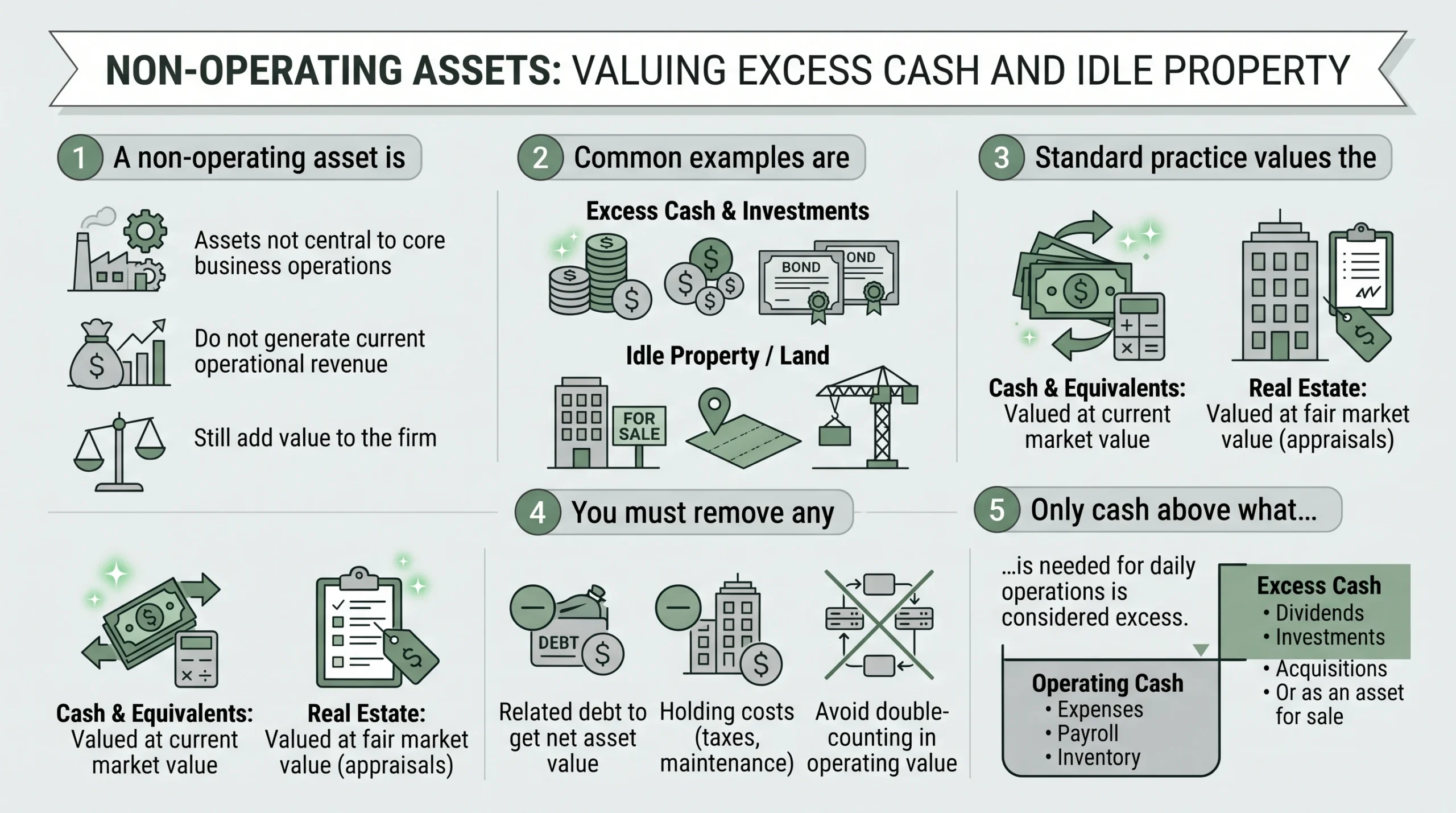
- A non-operating asset is owned by the company but is not used in core operations.
- Common examples are excess cash, marketable securities, idle property, and stakes in other firms.
- Standard practice values the operating business first, then adds non-operating assets separately.
- You must remove any income and expense from these assets so you do not count them twice.
- Only cash above what the business needs to operate counts as excess cash.
What is a non-operating asset?
A non-operating asset is any holding that the core business does not need to function. The company owns it, but it does not drive day-to-day revenue. It earns a return some other way, or it simply sits idle.
A few items show up again and again. Excess cash is the most common. Marketable securities, like stocks and bonds held for investment, are another. So are idle real estate and vacant land. The list also covers investments in other companies, non-operating subsidiaries, and company-owned life insurance.
These assets build up for ordinary reasons. A company may hold extra cash after a strong year. It may keep a building it has since outgrown. It may own a stake in a supplier or a joint venture. None of these are wrong to hold. They simply sit outside the daily work of the business.
Judgment matters here. The same asset can be operating in one business and non-operating in another. A delivery van is core to a courier. A van parked and unused is not. The test is use, not the label on the balance sheet. A careful analyst looks at how each asset actually supports the business.
Why value non-operating assets separately?
The income approach and the market approach both value a business from its earnings. They take the cash flow the operations produce and turn it into a value. Non-operating assets do not belong in that stream. Leave them in, and you value them twice or price them wrong.
So the work happens in two parts. First, strip the non-operating income and expense out of the earnings you use. Interest from a large cash balance comes out. Rent from an idle building comes out. This leaves a clean picture of what the operations earn. You value that stream on its own.
Second, add the fair value of the non-operating assets back at the end. The operating value plus the non-operating value gives the total. This keeps each part honest. The operations are judged on their own output. The extra assets are counted at what they are actually worth.
A short example helps. Say a company earns one million dollars a year from its operations. It also owns idle land that it rents to a neighbor. You value the operations on their earnings alone. You take the rent out of those earnings first. Then you add the appraised value of the land on top. The land is counted once, at its own worth. These figures are illustrative, but the order of steps holds in real work.
How do you calculate excess cash?
Excess cash is the cash a company holds above what it needs to operate. Every business needs some cash on hand. It covers payroll, suppliers, and the normal swings in working capital. That required amount stays with the operations. Anything beyond it is excess, and the excess is a non-operating asset.
The hard part is setting the required level. An analyst looks at how much cash the business normally keeps to run smoothly. Seasonal swings matter. A retailer may need a larger cushion before the holidays. Past cash balances and the working capital cycle both give clues. There is no single formula, so this takes judgment.
Once you set the required cash, the math is easy. Subtract required cash from total cash. What is left is excess cash. You add that amount to the operating value at the end, the same way you treat other non-operating assets. Only the excess counts. The cash the business truly needs stays inside the operating value.
Owners often miss this split. They see one cash balance and treat it as a single number. But a buyer does not pay an operating multiple for idle cash. Cash is worth its face value, no more. Folding it into the earnings stream would overstate the value of the operations. Pulling the excess out keeps the two apart.
How do you value idle real estate and property?
Idle real estate is property the business owns but does not use in operations. A vacant lot, an empty building, or land held for later all qualify. These items are valued on their own, usually by a qualified real estate appraiser.
An appraiser has three standard tools. The market approach compares the property to recent sales of similar ones. The income approach looks at the rent the property could earn. The cost approach estimates what it would cost to replace the asset, less depreciation. The right tool depends on the property and the data at hand.
A good appraisal looks at the property’s highest and best use. That is the most valuable legal use of the site, not just how it is used today. A vacant lot zoned for housing may be worth more than its current state suggests. The appraiser weighs that potential when setting the value.
The resulting value is then added to the operating business value. The property is kept separate for a reason. Its risk and return differ from the core business. Treating it as part of operations would blur both. A separate figure keeps the final conclusion clear and easier to defend.
How do non-operating assets affect M&A and tax valuations?
The purpose of the valuation shapes how these assets are handled. A sale and a tax filing do not treat them the same way.
In a deal, the buyer usually wants the operating business. Many sales are structured on a cash-free, debt-free basis. The seller keeps the excess cash. Non-operating assets are often excluded, or their value is added to the price on top of the operating figure. The aim is to price the profit engine first, then settle the extra assets.
For tax work, the rules are stricter. Estate and gift tax valuations follow Revenue Ruling 59-60, which asks for the fair market value of the whole interest. You cannot simply ignore the non-operating assets. They are identified, valued, and included. The method differs from a deal, but the core idea holds. Value the operations, then account for the rest.
Control also matters. An owner with control can reach the excess cash and sell the idle land. A minority owner often cannot. That difference can affect the discounts applied to a minority interest. Who holds the asset, and what they can actually do with it, is a real part of the analysis.
Which valuation approach fits each asset?
Each non-operating asset has a method that suits it best. The table below shows the common pairings. These are not fixed rules. They are the usual starting points an analyst will weigh.
| Asset type | Common approach | Basis of value |
|---|---|---|
| Excess cash | Face value | Cash above required operating cash |
| Marketable securities | Market approach | Quoted price on the valuation date |
| Idle real estate | Market, income, or cost | Independent appraisal |
| Stake in another company | Income or market | Earnings or comparable sales |
The pattern is clear. Liquid assets are easy. Cash is counted at face value, and traded securities use their quoted price. Harder cases, like property or a stake in another firm, need more work. The goal stays the same throughout. Each asset is measured at fair value and added to the operating business once.
Frequently Asked Questions
What is the difference between operating and non-operating assets?
Operating assets are used to run the core business, such as inventory, equipment, and the main building. Non-operating assets are owned but not used in operations, such as excess cash or idle land. The split matters because a valuation treats each group in a different way.
Is excess cash a non-operating asset?
Yes, but only the excess part. The cash a business needs to operate stays with the operations. Cash held above that level is treated as a non-operating asset. It is added separately at the end of the valuation.
What counts as excess cash?
Excess cash is any cash above the amount the business needs to run day to day. The required amount covers payroll, suppliers, and normal working capital swings. There is no fixed figure. An analyst sets it using the company’s history and cash cycle.
Are marketable securities a non-operating asset?
Usually, yes. Stocks and bonds held for investment are not part of the core business for most companies. They are valued at their quoted market price on the valuation date. That value is then added to the operating value separately.
Is a rental property a non-operating asset?
It depends on the business. If the company is not a real estate firm, a rental property it owns is often non-operating. The rent is passive income. Both the property value and the rent are pulled out of the operating analysis and handled on their own.
Is company-owned life insurance a non-operating asset?
Often, yes. A policy held on an owner or a key person is not used in daily operations. Its cash surrender value is usually treated as a non-operating asset and added separately. The exception is a policy that funds a specific operating obligation.
Do you remove non-operating income from the earnings you value?
Yes. This step prevents double counting. If you add a building’s value as a non-operating asset, you must also remove the rent it earns from the operating earnings. Otherwise the same value shows up twice.
Does a minority owner get full value for non-operating assets?
Not always. A controlling owner can access the excess cash or sell idle assets. A minority owner usually cannot force that. This limit can affect the discounts applied to a minority interest in the business.
Can a non-operating asset become an operating asset?
Yes. If the company starts using an idle asset in its core business, the asset moves into operations. For example, a vacant lot used for a new plant becomes an operating asset. The valuation then reflects its new role.
Related Case Studies
- Excess Earnings: Valuing Goodwill and Assets
- Community Property Double Step-Up Valuation Guide
- Valuing a Non-Compete Agreement in an Acquisition
Executive Summary
A non-operating asset is owned by the company but is not used in core operations. Common examples are excess cash, marketable securities, idle property, and stakes in other firms. Standard practice values the operating business first, then adds non-operating assets separately. You must remove any income and expense from these assets so you do not count them twice. Only cash above what the business needs to operate counts as excess cash.
What Should You Do Next?
Start by listing every asset the business owns and asking one simple question of each. Does the core business actually use it? Flag the excess cash, the idle property, and the passive investments. Then gather your support, such as recent appraisals, investment statements, and cash records. For a defensible result, Sofer Advisors provides independent business valuations led by David Hern CPA ABV ASA CVA. Schedule a consultation to discuss the facts of your own situation.
People Also Read
- Minority Discount Gift Tax: Valuing a Non-Control Stake
- Eminent Domain Business Valuation Georgia: Property and Business Owner Rights
About the Author
This guide was prepared by David Hern CPA ABV ASA CVA, founder of Sofer Advisors, a business valuation firm headquartered in Atlanta, GA serving clients across the United States. David holds accreditations as an Accredited Senior Appraiser (ASA) and is Accredited in Business Valuation (ABV), credentials recognized by the IRS, SEC, and FINRA, and is also a Certified Valuation Analyst (CVA). David has served as an expert witness in dozens of cases across multiple jurisdictions, and Sofer Advisors is an Inc. 5000 honoree in 2024 and 2025 with 240+ five-star Google reviews.
For professional business valuation services, visit soferadvisors.com/about-us/ or contact Sofer Advisors at soferadvisors.com/contact-us/.
Disclaimer: This content is for informational purposes only and does not constitute professional valuation advice. Business valuation conclusions depend on specific facts and circumstances. Contact Sofer Advisors for guidance regarding your specific situation.