


Last Updated: October 2026
Goodwill is whatever is left after every identifiable asset is valued. It is a residual, not a figure you measure on its own. When one company buys another, the buyer first assigns a fair value to each asset and liability it can name. Goodwill is the amount paid above that total. In plain terms, goodwill is an output of the purchase price allocation, or PPA.
The team at Sofer Advisors values these assets for business owners, CPAs, and deal attorneys, backed by Inc. 5000 recognition. The number matters because it sits on the balance sheet for years. Value the other assets well, and the goodwill figure holds up. Miss them, and the goodwill number is wrong from the first day.
This guide gives the goodwill formula, a worked example with real numbers, and the steps accountants follow. It also covers ASC 805, IFRS 3, IRS Form 8594, and where the fair-value inputs come from. The goal is a figure that stands up to an auditor.
Key Takeaways
- The formula is simple: goodwill equals the purchase price minus the fair value of net identifiable assets.
- Goodwill is a residual: it is what is left after each separable asset and liability has its own value.
- It is a PPA output: you cannot find goodwill until the rest of the purchase price allocation is done.
- Standards govern it: ASC 805 and IFRS 3 set the rules for how a buyer records goodwill after a deal.
- No amortization for GAAP: public companies do not amortize goodwill; they test it for impairment under ASC 350.
Each of these pieces ties into the wider financial report. The sections below take them one at a time.
Why Is Goodwill Calculation Important to Understand?
A goodwill calculation sets the opening value for an asset that can live on the books for decades. The buyer pays one price. The accountant then splits that price across everything the buyer received. Goodwill is the leftover. If the other assets are valued too low, goodwill is too high, and a later write-down can hit earnings hard. If they are valued too high, goodwill is too thin. Get the split right, and the balance sheet tells the true story of the deal.
What Is the Goodwill Calculation Formula?
The goodwill formula is the purchase price minus the fair value of net identifiable assets. Net identifiable assets are the fair value of the assets acquired, less the fair value of the liabilities assumed. Whatever the buyer paid above that net figure becomes goodwill. The result is always a single number on the balance sheet.
The purchase price is the total consideration the buyer gives up. That can be cash, stock, assumed debt, or an earnout tied to future results. Each piece is measured at fair value on the closing date. The net identifiable assets side covers both tangible items, such as equipment and inventory, and separable intangibles, such as patents and customer lists. Goodwill is simply the gap between the two.
How Do Accountants Calculate Goodwill Step by Step?
Accountants build the goodwill number through a purchase price allocation. The process runs in a fixed order, and goodwill is the last step. The sequence below is the one an appraiser and an auditor both expect to see.
- Step one: total the purchase price, including cash, stock, assumed debt, and any earnout.
- Step two: value each tangible asset at fair value, from cash and receivables to property.
- Step three: value each separable intangible asset, such as trademarks, technology, and customer relationships.
- Step four: subtract the fair value of the liabilities assumed to reach net identifiable assets.
- Step five: subtract net identifiable assets from the purchase price. The remainder is goodwill.
ASC 805, the US standard for business combinations, requires this order. IFRS 3 sets a close parallel rule for companies reporting under international standards. Both treat goodwill as a residual, not a stand-alone appraisal. That is why the accuracy of the goodwill figure depends on the work done in the earlier steps.
Can You Walk Through a Goodwill Calculation Example?
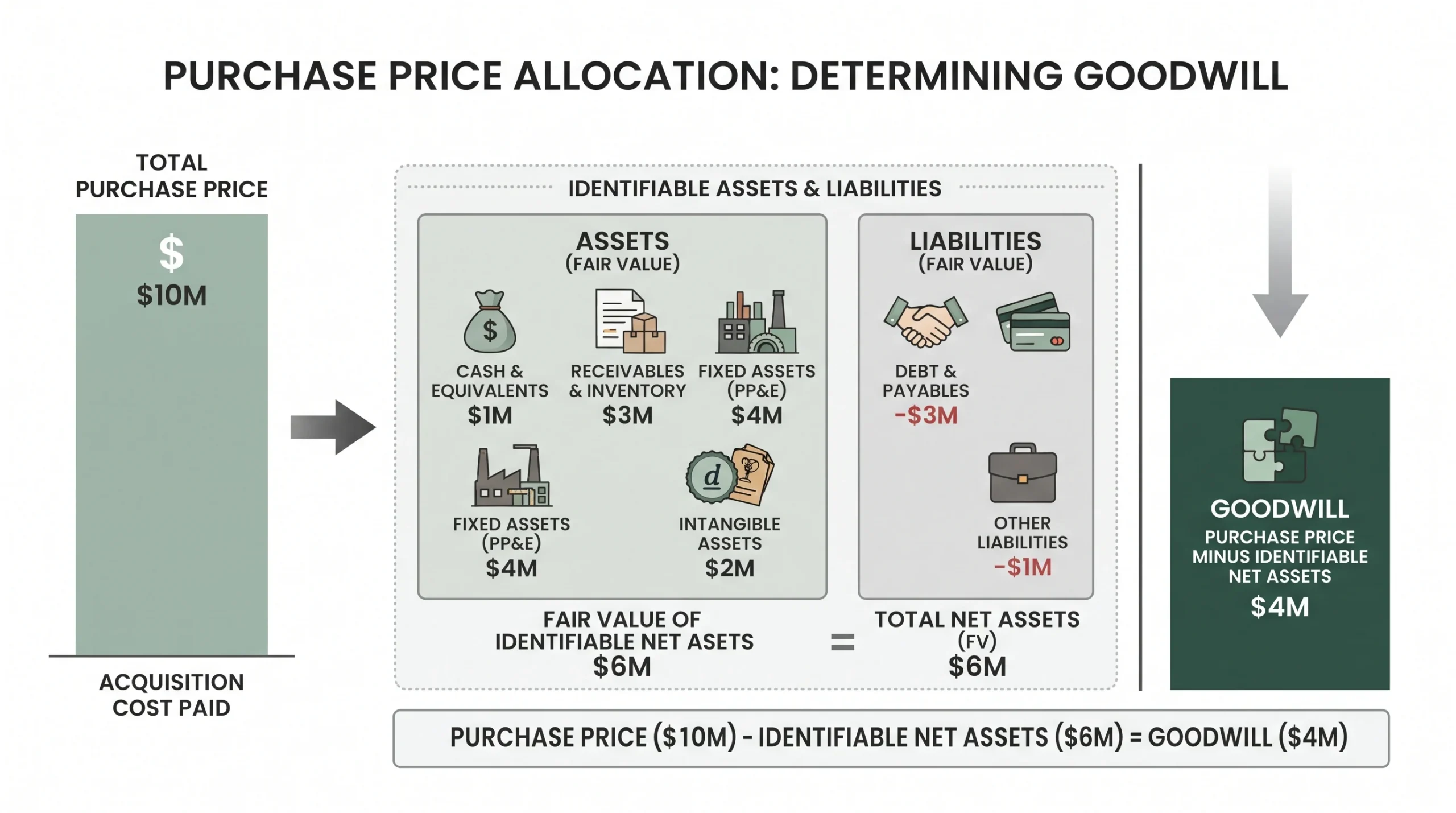
Here is a clean worked example. Assume Company A buys Company B for a purchase price of $10,000,000. Company B has identifiable assets with a fair value of $8,000,000 and liabilities with a fair value of $2,000,000. The math then follows the formula in two short moves.
- Net identifiable assets: $8,000,000 in assets minus $2,000,000 in liabilities equals $6,000,000.
- Goodwill: the $10,000,000 purchase price minus $6,000,000 in net assets equals $4,000,000.
So Company A records $4,000,000 of goodwill. That figure is the premium paid above the fair value of what could be named and valued. It stands in for brand strength, a loyal customer base, and a trained workforce. None of those can be sold on their own, so they land in goodwill. You can see how Sofer Advisors handles financial reporting valuations that support each figure in an allocation like this one.
What Are Identifiable Net Assets, and Where Does the Data Come From?
Identifiable net assets are the items a buyer can name, value, and in theory sell on their own. An asset is identifiable if it is separable or arises from a contract or legal right. Fair value is the exit price in an orderly sale between willing parties. Appraisers pull the inputs from market data, comparable deals, royalty rates, and the target company records.
Tangible assets, such as inventory and equipment, often have clear market prices. Intangibles need more care. A trademark may be valued with a relief-from-royalty method. Customer relationships often use a multi-period excess earnings method. For tax purposes, the buyer also allocates the price across seven asset classes on IRS Form 8594, under the rules of Internal Revenue Code Section 1060. Book goodwill and tax goodwill can differ, so both sets of numbers need a clear record.
How Is Goodwill Treated After the Deal Closes?
Goodwill does not get amortized for US public company reporting. It stays on the books at its recorded amount and is tested for impairment at least once a year under ASC 350. If a reporting unit falls in value, the company writes goodwill down and books a charge. Private companies may elect to amortize goodwill over ten years instead, which lowers the testing burden.
Tax treatment runs on its own track. For a taxable asset deal, acquired goodwill is amortized over fifteen years under Internal Revenue Code Section 197. That write-off is a real cash benefit the buyer values during a deal. Negative goodwill is a separate case. When the net assets are worth more than the price paid, the buyer records a bargain purchase gain rather than an asset.
Who Values Goodwill, and How Do the Options Compare?
Buyers pick a valuation partner based on the size of the deal, the audit exposure, and the budget. Large national firms such as Alvarez & Marsal, Stout, and Kroll serve big public companies with broad advisory teams. Sofer Advisors focuses on defensible, partner-led valuations for closely held and middle-market buyers, with expert witness testimony in 11+ cases behind its reports and 180+ five-star Google reviews. The table below sets out the common options.
| Provider | Typical role | Best for |
|---|---|---|
| Specialized valuation firm (e.g. Sofer Advisors) | Values each asset and documents goodwill as the audited residual | Middle-market buyers needing audit-ready PPA support |
| Large national firm | Broad advisory plus valuation at enterprise scale | Large public companies with complex, multi-entity deals |
| In-house accounting team | Books the entries once the fair values are set | Companies that still need an outside appraisal for the inputs |
Sofer Advisors runs each engagement through a four-phase process it calls The Sofer Difference, moving from Discovery to Diligence to Analysis to Delivery. That structure keeps every asset value tied to the data behind it. It reflects the Heart of a Teacher approach, which means explaining why a number came out as it did rather than just handing over a figure. For a goodwill number that survives review, an independent valuation supplies both the inputs and the trail of evidence.
Frequently Asked Questions
What is the formula for calculating goodwill?
The formula for goodwill is the total purchase price minus the fair value of net identifiable assets. Net identifiable assets are the acquired assets less the liabilities assumed, each measured at fair value. Whatever the buyer paid above that net figure becomes goodwill on the balance sheet. It is always a residual, not a direct appraisal. Sofer Advisors values every asset in the deal so the final goodwill figure is precise and defensible.
How do accountants calculate goodwill?
Accountants calculate goodwill through a purchase price allocation. They first value each tangible asset and each separable intangible asset at fair value. They then subtract the liabilities assumed to reach net identifiable assets. Finally, they subtract that net figure from the total purchase price, and the remainder is goodwill. The order is fixed, since goodwill is the last step. Sofer Advisors applies this process so each number ties to the evidence behind it.
How is goodwill calculated in accounting?
In accounting, goodwill is calculated by assigning fair value to every asset and liability a buyer acquires, then recording the leftover. The buyer pays one price, splits it across the identifiable items, and books the gap above net identifiable assets as goodwill. ASC 805 and IFRS 3 govern this treatment for US and international reporting. Sofer Advisors prepares the supporting workpapers so the recorded goodwill reads as a clean, audit-ready residual figure.
Can you give a goodwill calculation example?
Yes. Suppose a buyer pays $10,000,000 for a company. The acquired assets have a fair value of $8,000,000 and the liabilities a fair value of $2,000,000, so net identifiable assets are $6,000,000. The purchase price of $10,000,000 minus $6,000,000 leaves $4,000,000 of goodwill. That residual stands in for brand and customer value. Sofer Advisors verifies each input so the recorded goodwill in an example like this holds up under review.
What are identifiable net assets?
Identifiable net assets are the assets a buyer can name and value, less the liabilities it assumes, all at fair value. An asset is identifiable if it is separable or comes from a contract or legal right. Tangible items and separable intangibles both count, while goodwill does not, since goodwill cannot stand alone. Sofer Advisors isolates and values each identifiable item first, which is the only way to reach a correct goodwill number.
Is goodwill amortized or depreciated under US GAAP?
Under US GAAP, public companies neither amortize nor depreciate goodwill, because it is treated as an asset with an indefinite life. Instead, they test it for impairment at least once a year under ASC 350 and write it down if a reporting unit loses value. Private companies may elect ten-year amortization. Sofer Advisors supports both the impairment testing and the initial measurement so the carrying value stays accurate on the books.
Can goodwill be negative in an acquisition?
Goodwill can be negative in a bargain purchase, where the fair value of net identifiable assets is more than the price paid. Rather than record a negative asset, the buyer books a bargain purchase gain in earnings under ASC 805. This often signals a distressed sale or a pricing error worth a second look. Sofer Advisors reviews every asset and liability value to confirm whether a bargain purchase gain is truly warranted.
What is IRS Form 8594 used for?
IRS Form 8594 reports how a buyer and seller allocate the purchase price across seven asset classes in a taxable asset deal. Goodwill sits in the final residual class, Class VII. Both parties must file consistent figures under Internal Revenue Code Section 1060. Tax goodwill is then amortized over fifteen years under Section 197. Sofer Advisors prepares allocations that support both the book entries and the figures these tax forms carry.
How much does a purchase price allocation cost?
Most purchase price allocations run from $10,000 to $35,000 and take about four to eight weeks, depending on the deal size and the number of intangibles. The range covers the asset valuations needed to isolate goodwill as a defensible residual. A flat fee is quoted up front, so the cost is clear before work starts. Request a free estimate from Sofer Advisors for your situation.
Related Case Studies
- Calculating Goodwill in an Acquisition: Formula Explained
- Purchase Price Allocation ASC 805 and IFRS 3: Complete Guide for Business Leaders
- Valuing Customer Relationships in a Purchase Price Allocation
Executive Summary
Goodwill is the residual of a purchase price allocation. The buyer pays one price, values every identifiable asset and liability at fair value, and books the leftover as goodwill. The formula is the purchase price minus net identifiable assets. In the worked example, a $10,000,000 price over $6,000,000 of net assets produces $4,000,000 of goodwill. ASC 805 and IFRS 3 govern the recording, and ASC 350 governs the yearly impairment test for public companies. For tax, Form 8594 and Section 1060 drive the allocation, and Section 197 sets a fifteen-year write-off. The goodwill figure is only as sound as the asset values beneath it, so the first step is a careful valuation of everything that can be named.
What Should You Do Next?
Gather the signed purchase agreement, the target company financial statements, and a list of the intangibles in the deal, since a clean file supports a defensible allocation. Confirm whether you report under ASC 805 or IFRS 3 before the work begins. This guide was prepared by David Hern CPA ABV ASA, founder of Sofer Advisors, an Inc. 5000 firm specializing in neutral third-party valuations for financial reporting. Schedule a free consultation to discuss your specific situation.
People Also Read
- Goodwill Impairment Testing ASC 350: Complete Guide for 2025-2026
- Goodwill vs Intangible Assets: Key Differences Explained
About the Author
This guide was prepared by David Hern CPA ABV ASA, founder of Sofer Advisors, a business valuation firm headquartered in Atlanta, GA serving clients across the United States. David holds dual accreditations as an Accredited Senior Appraiser (ASA) and is Accredited in Business Valuation (ABV), credentials recognized by the IRS, SEC, and FINRA. He also holds the Certified Exit Planning Advisor (CEPA) designation. With 15+ years of valuation experience, David has served as an expert witness in 11+ cases across multiple jurisdictions and built Sofer Advisors into an Inc. 5,000-recognized firm with 180+ five-star Google reviews. Its full W2 employee team maintains subscriptions to all major valuation databases and operates under a next business day response policy.
For professional business valuation services, visit soferadvisors.com/about-us/ or contact Sofer Advisors at soferadvisors.com/contact-us/.
This content is for informational purposes only and does not constitute professional valuation advice. Business valuation conclusions depend on specific facts and circumstances. Contact Sofer Advisors for guidance regarding your specific situation.









